30 秒でわかる
Sparsh Jain describes his team’s approach to recurring agent mistakes: store useful experience at different levels of abstraction, update it as conditions change, and retrieve relevant context. He discusses evaluation and cleanup loops, while offering team-reported examples and predictions about autonomous collaboration.
- 1More context is not always betterJain says indiscriminate memory can increase latency and cost while reducing performance.
- 2Three levels of experienceCases, strategies and skills retain different levels of detail and generality.
- 3A memory lifecycleFormation, updating and retrieval keep lessons useful as conditions change.
- 4Retrieval determines relevanceA stored fact can still be unhelpful when the wrong context is selected.
- 5Cleanup and evaluation loopsRecurring maintenance updates priorities and tests proposed changes.
ポイント
- More stored context can increase cost and harm performance if relevant information is hard to retrieve.
- Experiential memory can represent cases, strategies and reusable skills.
- Memory requires formation, updates, selective forgetting and retrieval.
- Retaining the history of superseded judgments can support deeper investigation.
- Evaluation and safeguards are needed when updates are proposed automatically.
チャプターごとに整えた全文を読む
Why agents repeat mistakes
Jain describes repeated corrections and the limits of adding more context.
I am Sparsh Jain, head of AI at CentralAgent AI. Teams learn from working with an agent, but the agent may repeat the same mistakes in a new session or with another teammate. A senior executive described that recurring correction as a practical problem: there are too many mistakes to manually fix every time.
The initial response is often to supply all the available context and memory. In our experience, that becomes counterproductive at enterprise scale: more material can increase cost, effort and latency while making retrieval and performance worse. More context is not always better context.
We looked at how people improve through experience, mistakes and course corrections. Our question became how to preserve useful lessons from interactions rather than merely store a larger collection of facts. I describe the resulting architecture as experiential memory.
Experiential memory and its lifecycle
Cases, strategies and skills are formed and updated as the environment changes.
I distinguish short-term working memory from long-term memory. Long-term memory includes both facts and experience: lessons abstracted from what happened while the agent worked. My team claims a substantial improvement from its system, but the talk does not provide enough experimental detail to generalize the number.
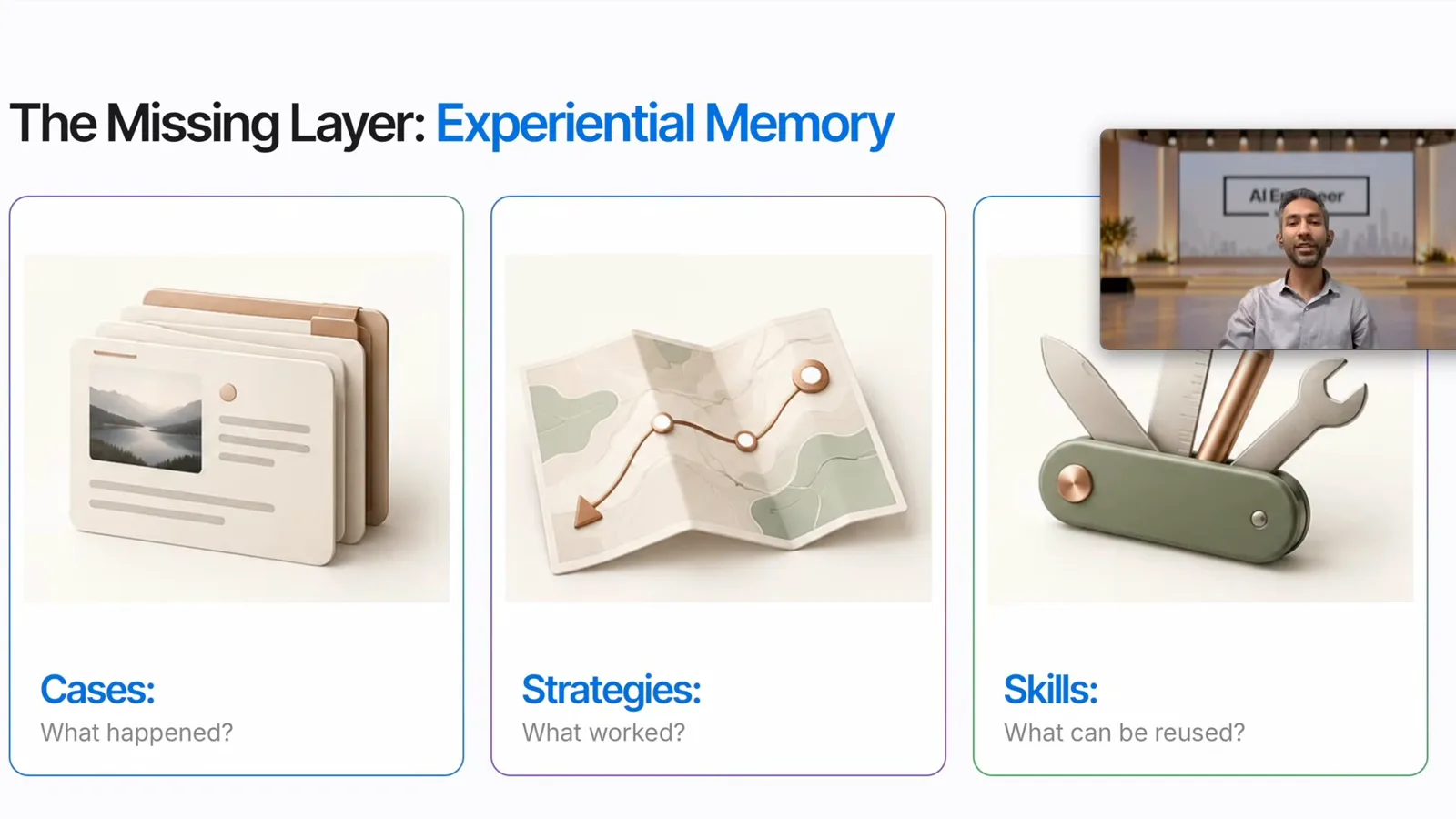
We divide experience into cases, strategies and skills. A case retains details of a particular situation; a strategy records an approach that worked in a situation; a skill is a more generalized procedure that an agent can reuse. These represent different levels of abstraction, not interchangeable storage.
Building the first memory layer exposed another challenge: data, systems and the environment change. A note that was useful today may become stale. Memory infrastructure therefore needs to evolve rather than be built once and left untouched.
I organize the memory lifecycle into formation, updating and retrieval. Formation extracts potential lessons. Updating adds new observations, revises existing notes, deactivates outdated ones and provides a way to forget material that no longer helps.
Keeping only the latest judgment is not always enough. We retain inactive notes as a record of how the judgment changed: a shallow lookup may use active notes, while deeper investigation can also inspect the earlier history. The distinction lets a system examine why a previous conclusion was replaced.
I use the story of a person with unusually strong recall to illustrate why forgetting can matter. The lesson for an agent system is narrower than the analogy: if every old item competes equally for attention, retaining everything can overwhelm the process rather than improve a decision.
Verification and retrieval
The proposal adds model-assisted verification and stresses context-sensitive retrieval.
After adding memory, much of the upkeep was still manual. I argue that models can help verify proposed updates and make the loop more autonomous. That is a design proposal, not proof that model verification is always correct or that human oversight is never needed.
Retrieval is as important as storage. Imagine asking an agent to navigate home when it knows about homes in two cities. A correct fact is not enough if the system retrieves the wrong one for the current location. Formation and updates cannot compensate for consistently irrelevant retrieval.
In one example, my team says reusing previously gathered context reduced a task from around 20 minutes to around two. We also observed savings in effort and tokens. This is a team-reported example, and the result depends on the task and evaluation conditions.
Cleanup loops and team learning
Jain describes recurring maintenance, evaluation and his predictions for agent collaboration.
We call the next part a dreaming cycle: a recurring cleanup and evaluation loop that removes or demotes stale information, updates priorities and reorganizes memory. The sleep analogy describes the role of the loop; the implementation is a process for maintaining stored information.
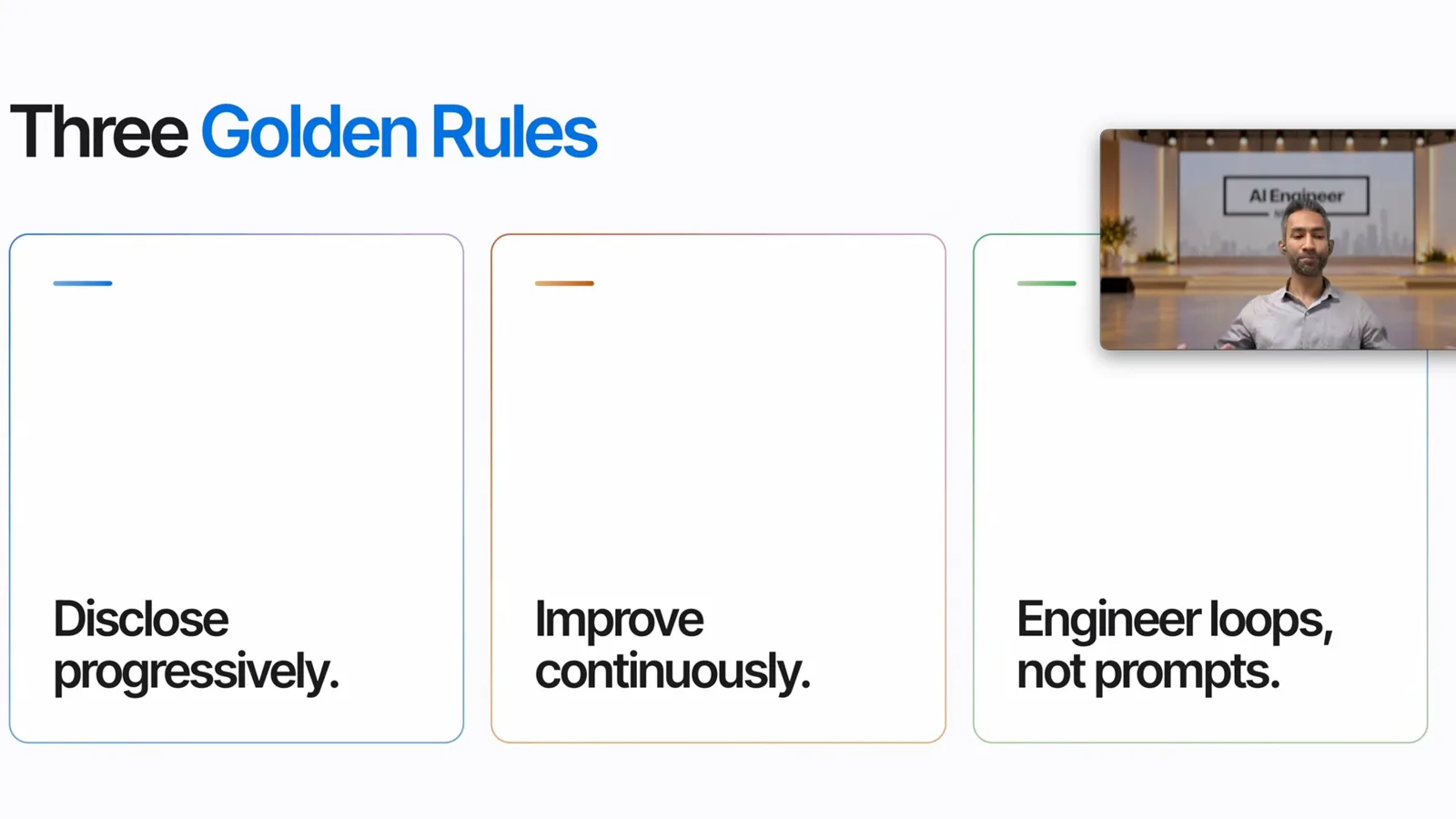
My three rules are to disclose context progressively rather than dump everything, keep improving the system as conditions change, and build feedback loops rather than relying only on a fixed prompt. Observability and evaluation surround the memory lifecycle so proposed changes can be tested before use.
I expect teams to benefit when lessons from different users become available to the same agent. I also predict much more autonomous human-agent collaboration. Claims of tenfold or hundredfold teams and exponential improvement are my projections, not demonstrated universal outcomes.
The takeaway is to build a way for agents to learn from corrections instead of repeating the same mistakes. That requires selective memory, updates, retrieval, evaluation and safeguards working together.
同じチャンネルの記事
 23:05ZH
 AI Engineer· 2026年11月6日Ryo Lu:当我们什么都能做,还知道自己想做什么吗?Ryo Lu从 AI 生成的日记工具到爵士乐团,Ryo Lu 讨论如何在更强大的工具旁保有判断、生活和与他人合作的空间。
 17:27ENAI Engineer· 2026年11月6日Philipp Schmid: Seven Things an AI Coworker NeedsPhilipp Schmid · Google DeepMindA walkthrough of managed agents, skills, credentials and controls, culminating in a scheduled portfolio-audit demo.
 18:13ENAI Engineer· 2026年11月6日Sid Pednekar: Judgment Is the Scarce Resource in AI AdoptionSid PednekarA framework for choosing valuable problems, building shared capabilities and turning experience into organizational learning.
 14:04ENAI Engineer· 2026年11月6日Frank Long on Building AI Investment Workflows Around QualityFrank Long · CoatueCoatue’s Frank Long breaks investing into information, analysis and decision steps, and argues for choosing the right combination of code, models and people.
 17:52ENAI Engineer· 2026年11月5日Cameron Wolfe on Evaluating AI When Answers Are SubjectiveCameron Wolfe · NetflixNetflix’s Cameron Wolfe outlines human review, calibrated model judges and production monitoring as a repeatable evaluation loop.
 20:45ENAI Engineer· 2026年11月5日John Stecher and Scott Worland on Building AI Systems That Can ChangeScott Worland, John Stecher · Norm AIThe Blackstone and Norm AI CTOs discuss data strategy, evaluations, production controls and when to wait for a better model.