30 秒でわかる
Matthew Berman walks through clips from OpenAI’s November 2023 DevDay, highlighting GPT-4 Turbo, new API capabilities, model customization, pricing and custom GPTs. He welcomes the releases but warns developers about relying on a platform that can add competing features. Prices, product availability and the planned GPT Store schedule reflect the 2023 announcement, not current offers. His comments on company ownership, a live demo and future revenue sharing are opinions or speculation.
- 1Longer contextGPT-4 Turbo was announced with a 128,000-token window; Berman welcomes it while noting that long-context recall still needs testing.
- 2More developer controlThe presentation introduces JSON mode, multiple function calls and a seed parameter intended to make outputs more consistent.
- 3New modalities and customizationVision, DALL·E 3 and text-to-speech APIs were announced alongside Whisper large-v3 and new fine-tuning options.
- 4Historical API pricingThe announced GPT-4 Turbo price was $0.01 per 1,000 input tokens and $0.03 per 1,000 output tokens, relative to 2023 GPT-4 pricing.
- 5Custom GPTsOpenAI demonstrated tailored ChatGPT experiences with instructions, knowledge and actions; Berman considers their competitive implications.
ポイント
- GPT-4 Turbo was announced in 2023 with a 128,000-token context window and an April 2023 knowledge cutoff.
- The developer announcement included JSON mode, improved function calling, retrieval, vision, image generation and text-to-speech.
- OpenAI announced lower historical API prices and more generous rate limits, plus a limited experimental GPT-4 fine-tuning program.
- Custom GPTs combined instructions, extra knowledge and actions, while Berman wanted better support for teams of agents.
- Berman sees both convenience and platform risk when a model provider builds features previously offered by independent developers.
チャプターごとに整えた全文を読む
GPT-4 Turbo and developer control
Berman reviews the longer context window, JSON mode, function calling and reproducible outputs. He also discusses retrieval and the updated knowledge cutoff.
OpenAI’s DevDay brought a long list of announcements. Matthew Berman starts with GPT-4 Turbo, which he describes as faster, cheaper and available with higher rate limits than the earlier GPT-4 offering. This article describes the November 2023 event; its product availability, terms and prices are historical.
OpenAI CEO Sam Altman says GPT-4 Turbo supports a 128,000-token context window, roughly 300 pages of text, and claims improved accuracy over long contexts. Berman welcomes the larger window, especially for coding, but notes that models can miss information in the middle of long inputs and plans to test the claim.
Altman introduces JSON mode for syntactically valid JSON and improved function calling, including multiple function calls in one message. Berman sees these as useful for applications and agents. A beta seed parameter was also announced to make responses consistent most of the time; it is not a guarantee of identical output, and OpenAI also planned log-probability support.
OpenAI introduces retrieval to bring external documents and knowledge into applications. Berman thinks this creates competitive pressure for startups that built retrieval-augmented generation products around the API. The [2023 developer announcement](https://openai.com/index/new-models-and-developer-products-announced-at-devday/) describes retrieval as an Assistants API tool; it does not mean retrieval or application design becomes unnecessary.
Altman says the model’s knowledge cutoff moves to April 2023, an improvement on the earlier cutoff. Berman compares that with the then-new Grok product and its access to information from X, and expects competition around up-to-date information.
Modalities, customization and pricing
The keynote covers vision, image generation, speech, fine-tuning, rate limits and Copyright Shield. Berman considers the price reductions and their impact on developers.
The keynote announces API access to GPT-4 Turbo with vision, DALL·E 3 image generation and text-to-speech. Berman is enthusiastic about image understanding and the release of the open-source Whisper large-v3 speech-recognition model, which turns speech into text. These were separate capabilities and interfaces, rather than a single model doing every task.
OpenAI expands GPT-3.5 fine-tuning to the 16K version and invites eligible users to apply for experimental GPT-4 fine-tuning. A separate Custom Models program pairs selected organizations with OpenAI researchers on domain-specific training and post-training. Altman says the program will initially be limited and expensive; Berman sees a potentially substantial enterprise business.
The company announces doubled tokens-per-minute limits for established paying GPT-4 customers and requests for increases through account settings. Berman welcomes this because he has encountered rate limits when using the API with AutoGen. Those limits describe the offer at the time, not necessarily current account limits.
OpenAI also announces Copyright Shield: it said it would defend eligible customers and pay costs for covered copyright claims involving generally available ChatGPT Enterprise and developer-platform features. Altman says API and Enterprise data are not used for model training. The protection has a defined scope and should not be interpreted as a guarantee covering every copyright issue.
For the 2023 launch, GPT-4 Turbo was priced at $0.01 per 1,000 input tokens and $0.03 per 1,000 output tokens: one-third and one-half of the comparable earlier GPT-4 rates, respectively. OpenAI also lowered the new GPT-3.5 Turbo’s rates. Berman suggests routing easier tasks to the cheaper model and using GPT-4 for more complex work.
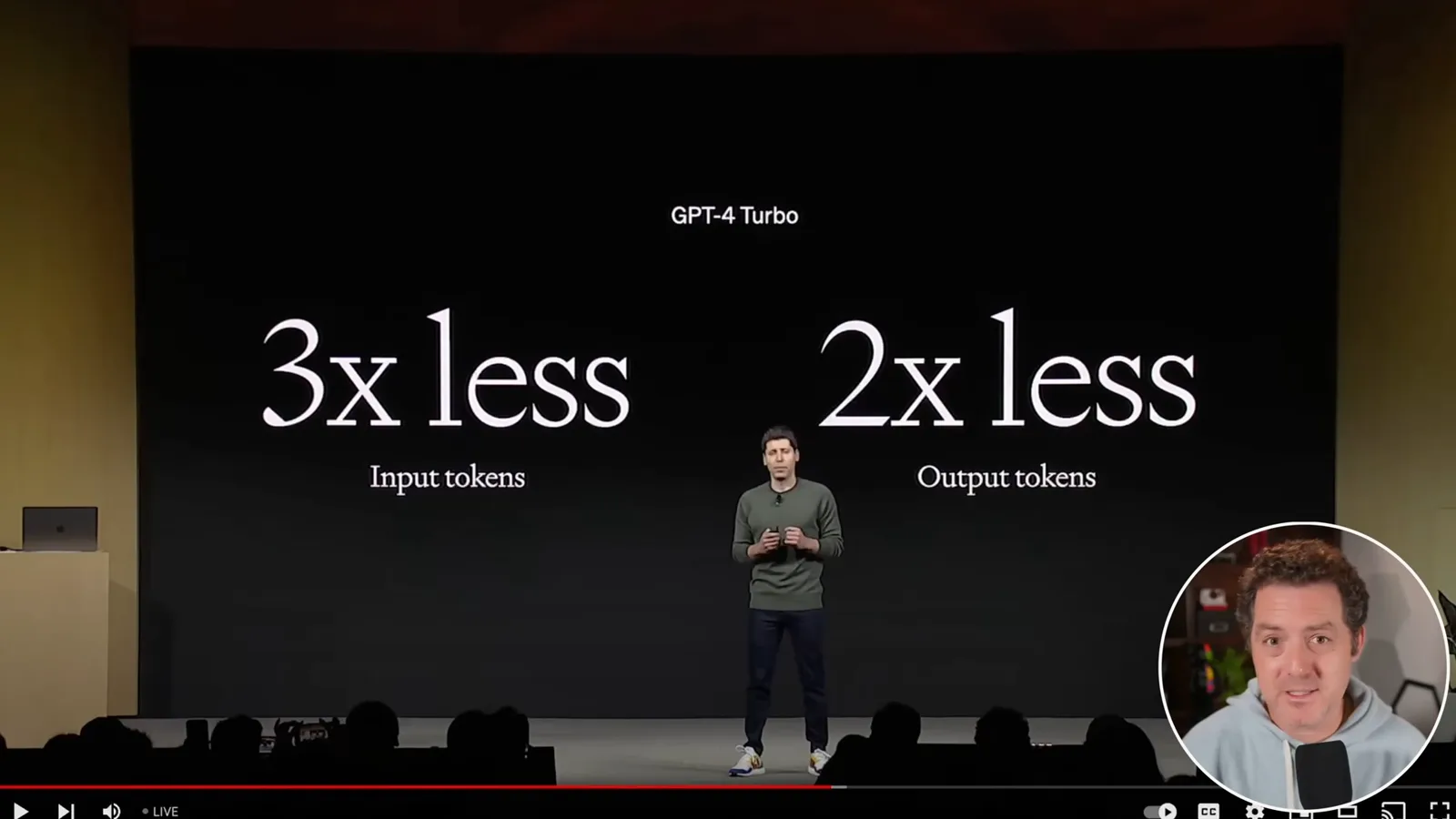
Microsoft CEO Satya Nadella briefly appears to discuss the partnership. Berman speculates about Microsoft’s ownership and contrasts the partnership with its other open-source relationships; his on-air estimate that Microsoft owned half of OpenAI is not substantiated here. He expects improving open models and orchestration tools to put pricing pressure on proprietary providers.
ChatGPT and custom GPTs
The presentation moves to integrated tools, custom GPTs and live demonstrations. Berman asks about multi-agent teams and developer platform risk.
The keynote says ChatGPT is incorporating newer GPT-4 capabilities and bringing browsing, code execution, data analysis and image tools into a more unified interface. Berman welcomes the removal of the need to choose a tool manually and hopes the system can select an appropriate capability as needed.
Altman frames GPTs as a first step toward assistants that can perform tasks: customized versions of ChatGPT with instructions, additional knowledge and actions. Berman sees a direct competitor to some third-party agent products. A custom GPT is a configured assistant, however, not necessarily a multi-agent team or a separately trained model.
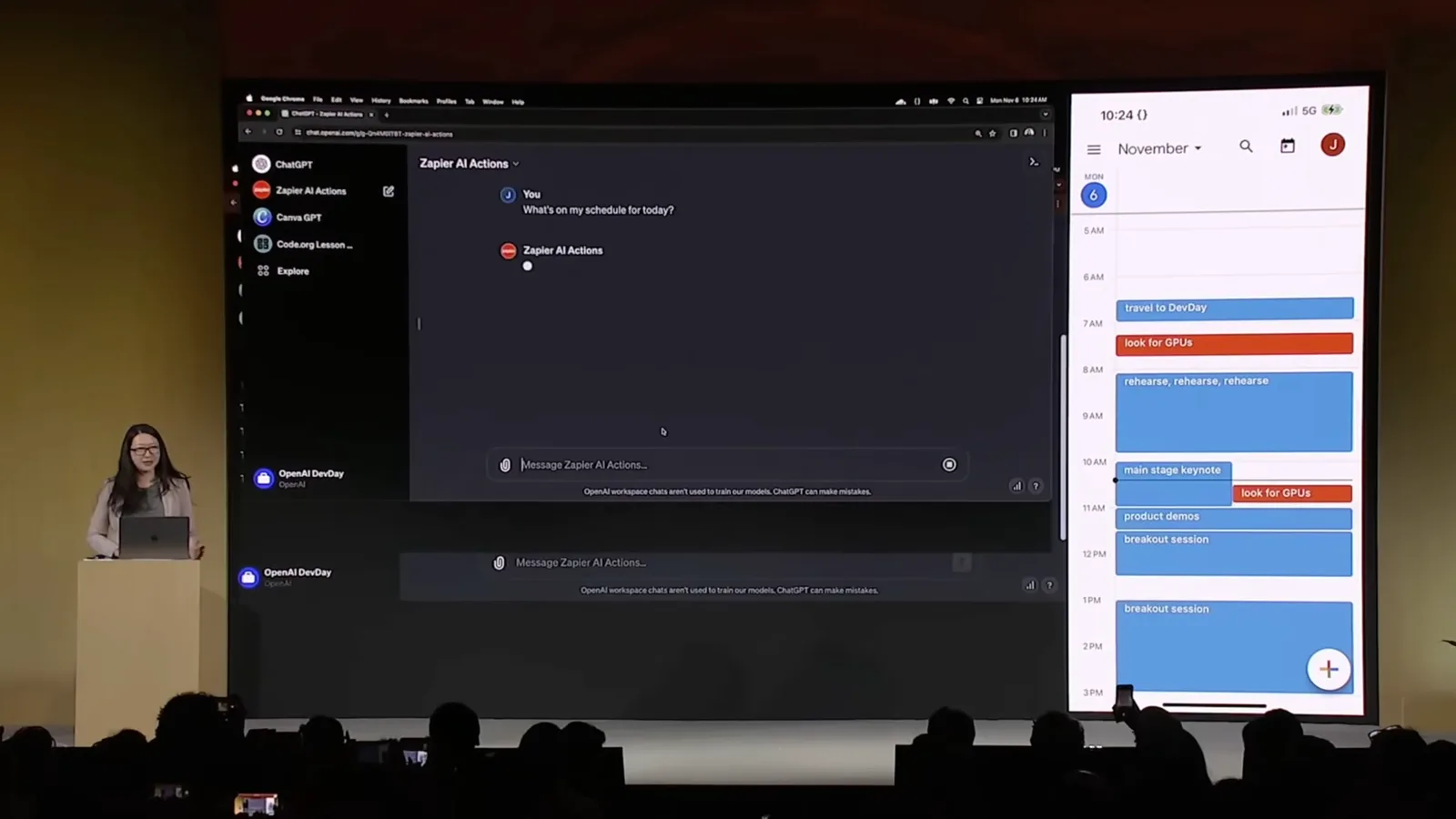
A presenter demonstrates a Zapier GPT connected to a calendar, asking it for the day’s schedule and conflicts. Berman notices another browser window visible behind the demo and wonders whether actions were being prepared in the background. The visible window does not by itself establish deception or explain how the demonstration was staged.
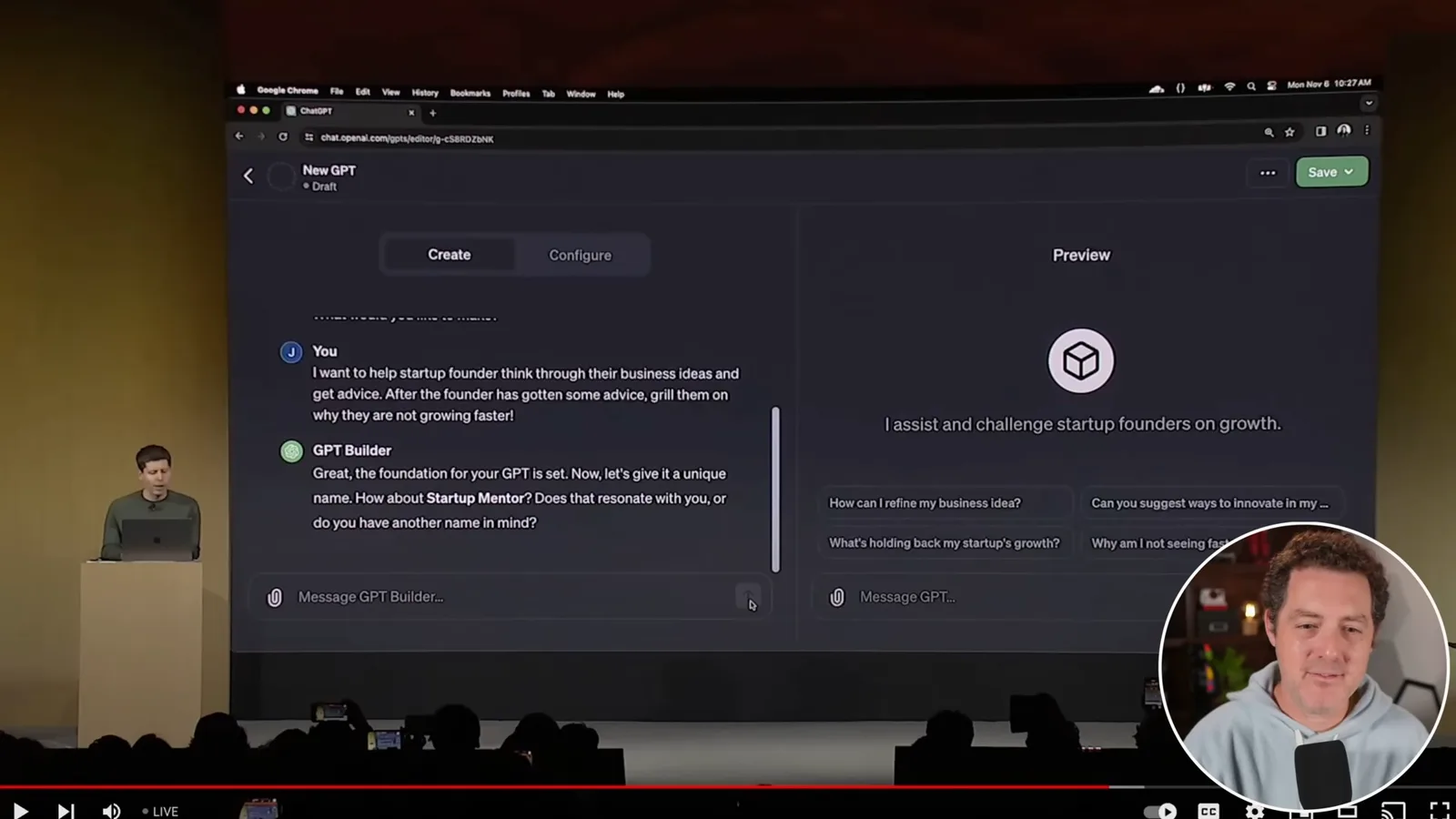
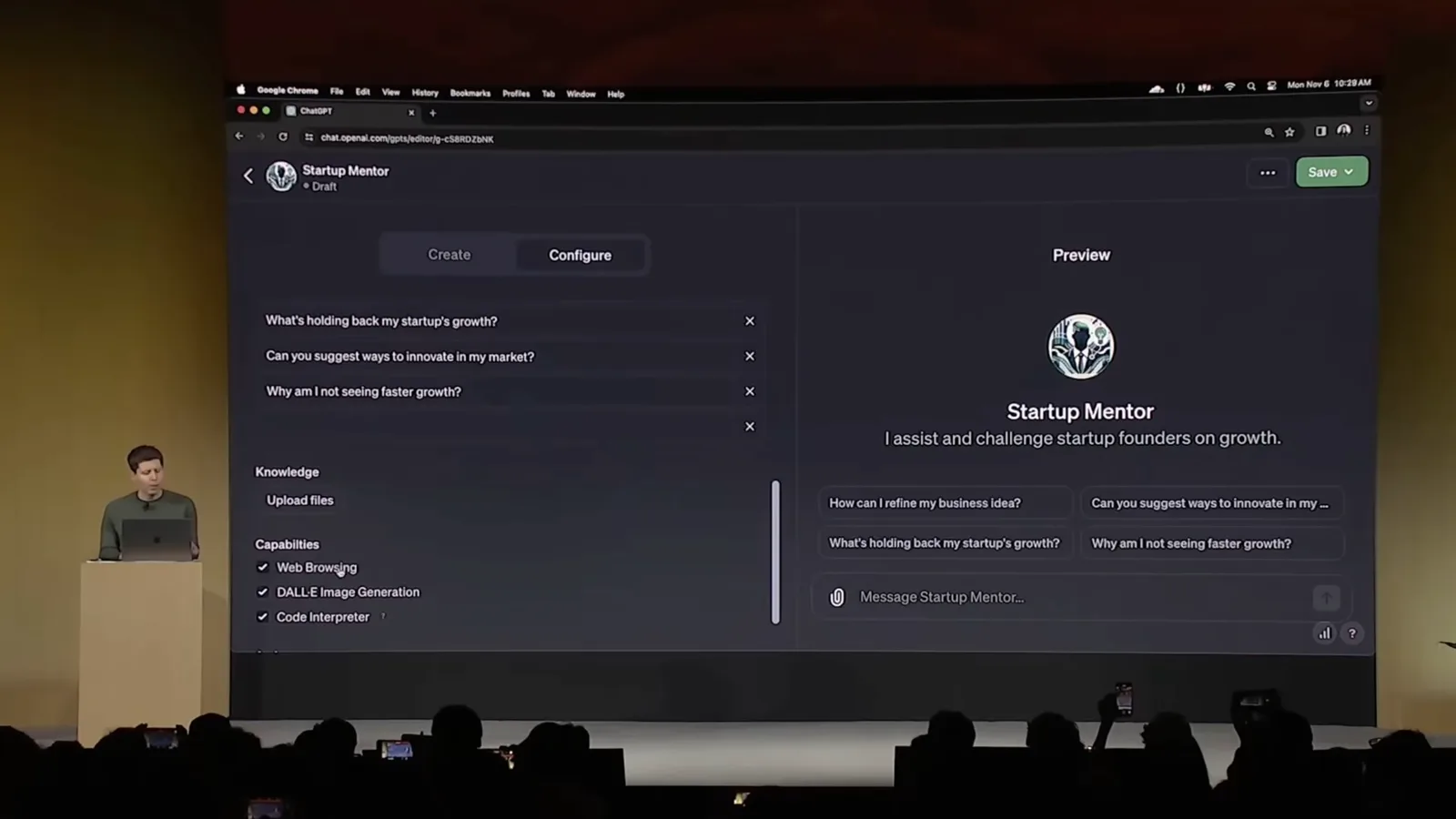
Altman demonstrates GPT Builder by describing a startup mentor in conversation. The interface generates instructions and a name, previews the result, creates an image with DALL·E and offers configuration options. A document can be uploaded as extra knowledge, illustrating a retrieval-based use case that Berman finds straightforward.
OpenAI says users can keep GPTs private, share them by link or make them available within an Enterprise workspace, and announces plans for a GPT Store. Berman compares the idea with an app store and predicts paid distribution and revenue sharing; those details are his expectations at the time, not established terms for every creator.
Berman’s main missing feature is cooperation among specialized agents. He sees systems such as AutoGen as useful for dividing complex tasks among agents and expects the area to develop. He closes by praising OpenAI’s pace of releases while cautioning developers that building entirely on one provider exposes them to platform risk; diversifying models is one way to manage it.
同じチャンネルの記事
 34:21EN
 Matthew Berman· 2026年10月27日Matthew Berman Examines Anthropic’s IPO Filing, AI Growth and GovernanceMatthew Berman, Sam Altman · Forward FutureThe presenter reviews the S-1’s financial metrics, compute strategy and voting structure while questioning the tension between rapid AI development and safety.
 0:36ENMatthew Berman· 2026年10月25日Kimi K3.1 and a Rubik’s Cube Solver DemonstrationMatthew Berman · Forward FutureMatthew Berman shows a scrambled virtual cube being solved and gives the Kimi K3.1 test a favorable assessment.
 25:50ENMatthew Berman· 2026年10月24日Kimi K3.1 Pro Tested: Strong 3D Demos, Uneven Results and Competitive PricingMatthew Berman · Forward FutureMatthew Berman tests the open-weight model on coding, 3D rendering and visual explanations, then compares benchmark results and prices.
 32:20ENMatthew Berman· 2026年10月23日Who Is Local AI For? The Costs, Trade-offs and a Hybrid FutureMatthew Berman · Forward FutureMatthew Berman weighs data control and independence against hardware cost, setup complexity and inference speed.
 1:03:37ENMatthew Berman· 2026年10月23日Matthew Berman’s Team Tests Kimi K3.1 on Animation, Games, and ChartsMatthew Berman, Alex, Brian · Forward FutureA live team AMA turns into an informal test of Kimi K3.1, from personal-agent workflows to motion graphics, a browser game, and a benchmark chart.
 0:53ENMatthew Berman· 2026年10月22日Sam Altman on AI and the Discovery of New KnowledgeSam Altman · OpenAIAltman expects progress in mathematical discovery to extend to biology, materials and energy.