30 秒でわかる
Origami theorists and artists Erik and Martin Demaine explain their collaborative process and the exchange between sculpture and mathematical research. Their work Solve Me, displayed at Jane Street in Hong Kong, combines intertwined curved-crease forms with mathematical puzzles and specially designed fonts.
- 1Art and mathematics feed each otherMaking a sculpture can lead to a new existence or generalization question; a mathematical result can become a physical artwork.
- 2Design, fold, improviseThe artists design and score sheets, then fold and assemble multiple pieces by hand without knowing the entire final form.
- 3A puzzle in paperSolve Me weaves its components into a form that makes them hard to count and invites viewers to investigate.
- 4Two mathematical fontsThe Tetris font uses seven pieces per letter, while each letter of the two-piece dissection font can be rearranged into a six-by-six square.
ポイント
- Origami sculpture can generate mathematical questions, and mathematical discoveries can inspire physical art.
- The Demaines design and score paper before folding and assembling pieces by hand, improvising as the three-dimensional form develops.
- Solve Me deliberately obscures how many pieces it contains and embeds mathematical problems, including unsolved ones.
- Its Tetris and two-piece dissection fonts turn letter design into geometric puzzles.
- Building the sculpture produced new questions that may guide future research.
チャプターごとに整えた全文を読む
Origami as art and research
Erik and Martin Demaine introduce their backgrounds and explain how mathematics and sculpture inspire one another.
Erik Demaine is an MIT computer science professor; his father Martin Demaine is an MIT researcher and artist in residence. Erik brings a background in mathematics and computing, Martin one in art and making. Together they describe themselves as both origami theorists and artists: they study how sheets fold and make intriguing sculptures from paper.
When the Demaines began studying origami mathematics, they were advised that it was a niche recreational subject and not a promising research area. They ignored the advice because the questions were too compelling. The mathematics of their curved-crease forms remains an active subject, with foundational existence questions still unproved.
Art and mathematics inspire each other in their work. Trying to build a sculpture can raise a mathematical question about whether a shape exists or how to generalize it. A mathematical result, in turn, can become a physical sculpture that people can appreciate beyond a screen.
Collaboration and making
Their process combines brainstorming, design and hand assembly with improvisation and a longstanding collaborative relationship.
Their process is often improvisational. One might add a few pieces and then the other adds more; the sculpture grows as they respond to each other and to the material. They may have several projects in progress at once, moving to another when stuck. Some remain unfinished, but still produce artistic or mathematical insights.
The Demaines credit their collaboration to communication that is honest and humorous, as well as deep trust. They have written hundreds of papers and made hundreds of sculptures together. Martin describes Erik as his best friend and their work as a shared undertaking.
They spend much of their time brainstorming what a piece should be. The process starts with a design on a sheet of paper, which is scored and folded; they repeat that to make multiple pieces and then assemble them into a three-dimensional sculpture. The assembly is improvised, and its outcome is not fully known in advance.
They use technology for much of the design, but insist on assembling the sculptures by hand. As with building blocks, they make adjustments while working and sometimes take a piece apart and start over.
The puzzles inside Solve Me
The sculpture hides mathematical problems and makes its pieces hard to distinguish. It incorporates Tetris and dissection fonts.
For a new piece, they discuss overlapping sheets and making dissection a theme, with mathematical problems incorporated into the design. They call the sculpture Solve Me, a reference to the 'eat me' and 'drink me' prompts in Alice in Wonderland. The finished work is displayed in Jane Street's Hong Kong office.
In many of their sculptures, a viewer can count the pieces. Solve Me is designed to make that difficult: the twisting and weaving patterns lead the eye through an intricate whole. The artists want viewers to wonder how it was made and whether it really is paper.
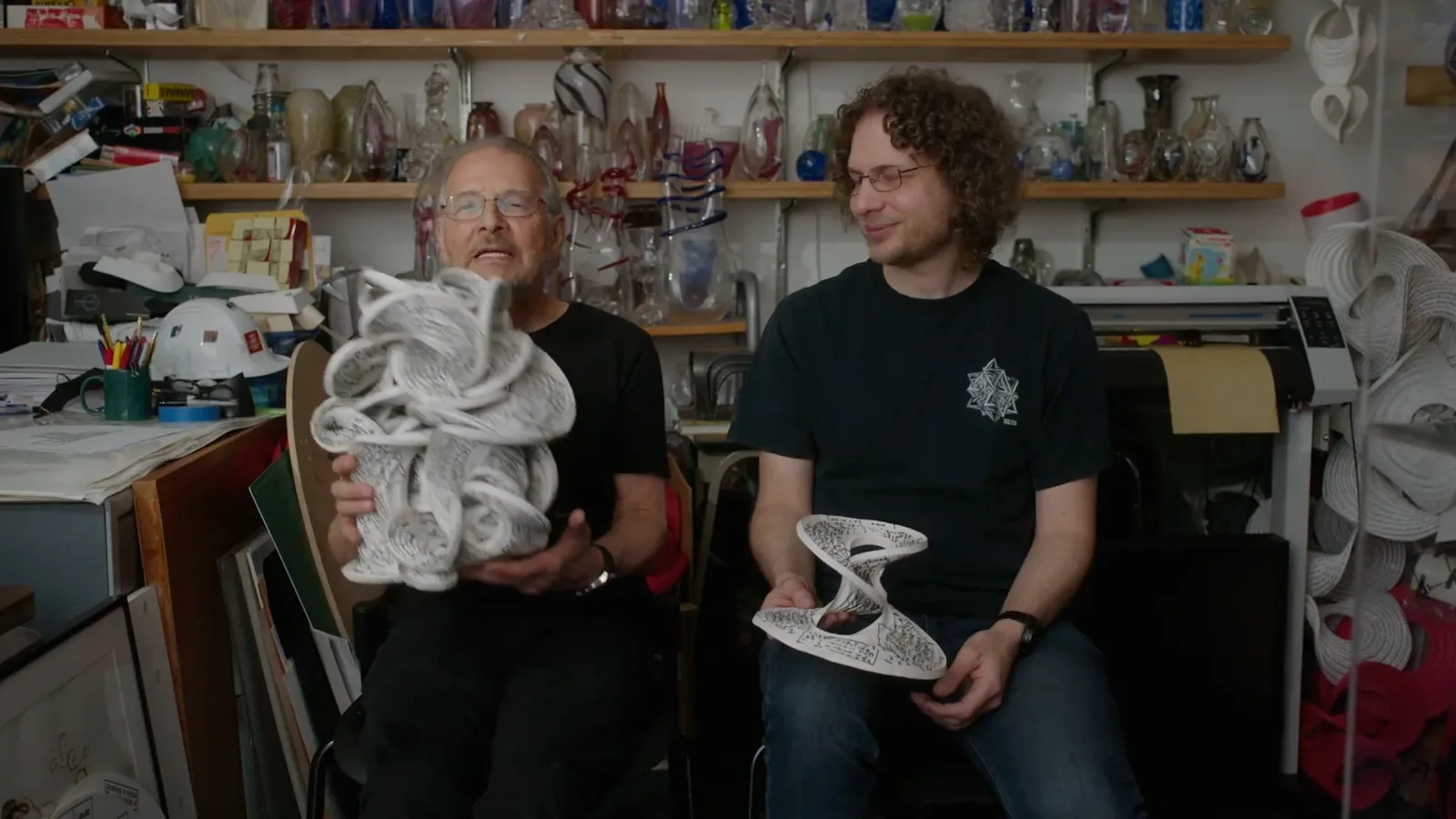
The printed text hides mathematical problems the artists think about, including a couple that remain unsolved. Such problems lie on the frontier between what mathematicians know how to solve and what they do not yet know.
The sculpture incorporates two mathematical fonts the Demaines designed. In the Tetris font, each letter is made from all seven Tetris pieces. In the two-piece dissection font, each letter can be divided into two sets and rearranged into a six-by-six square.
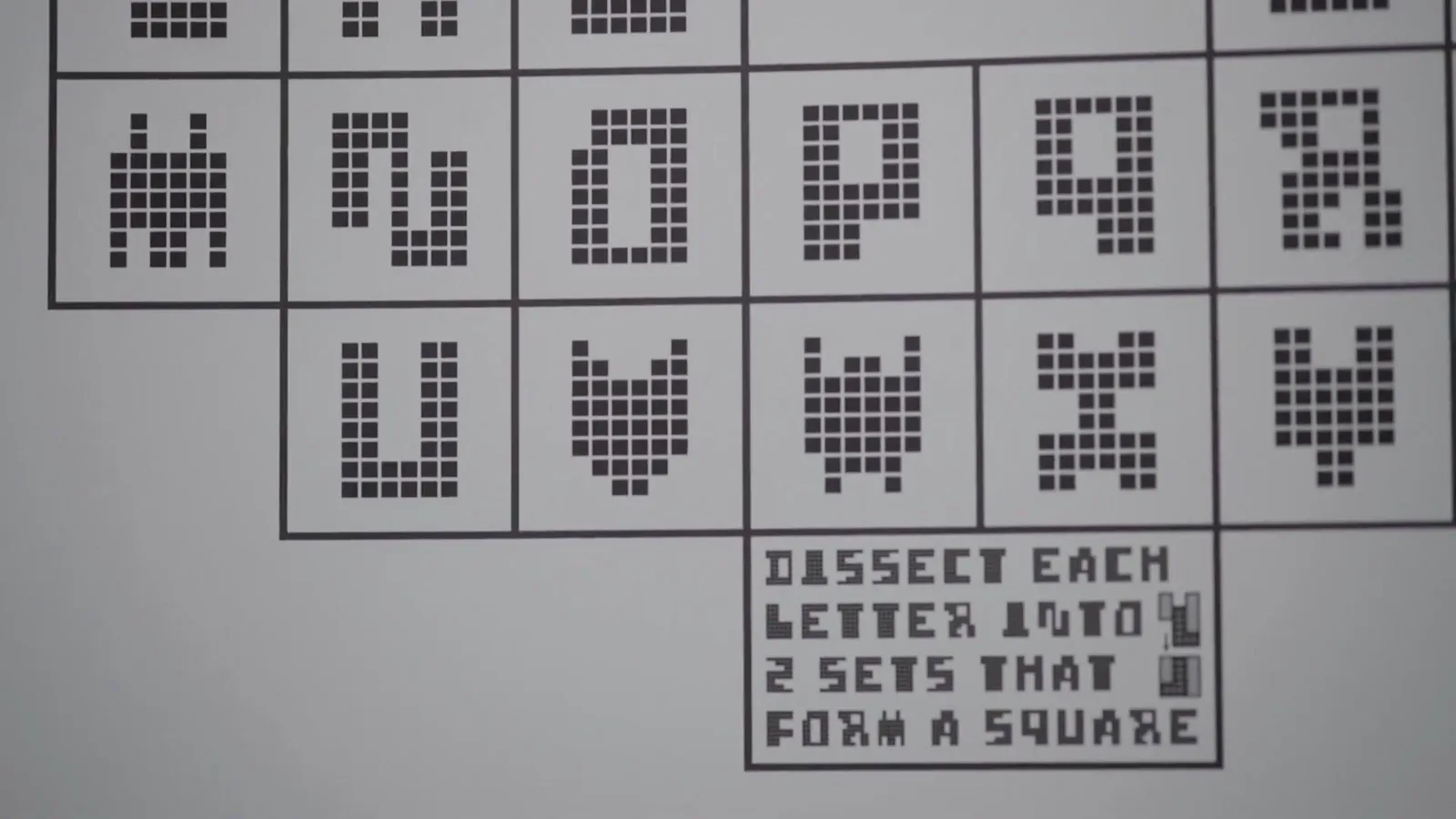
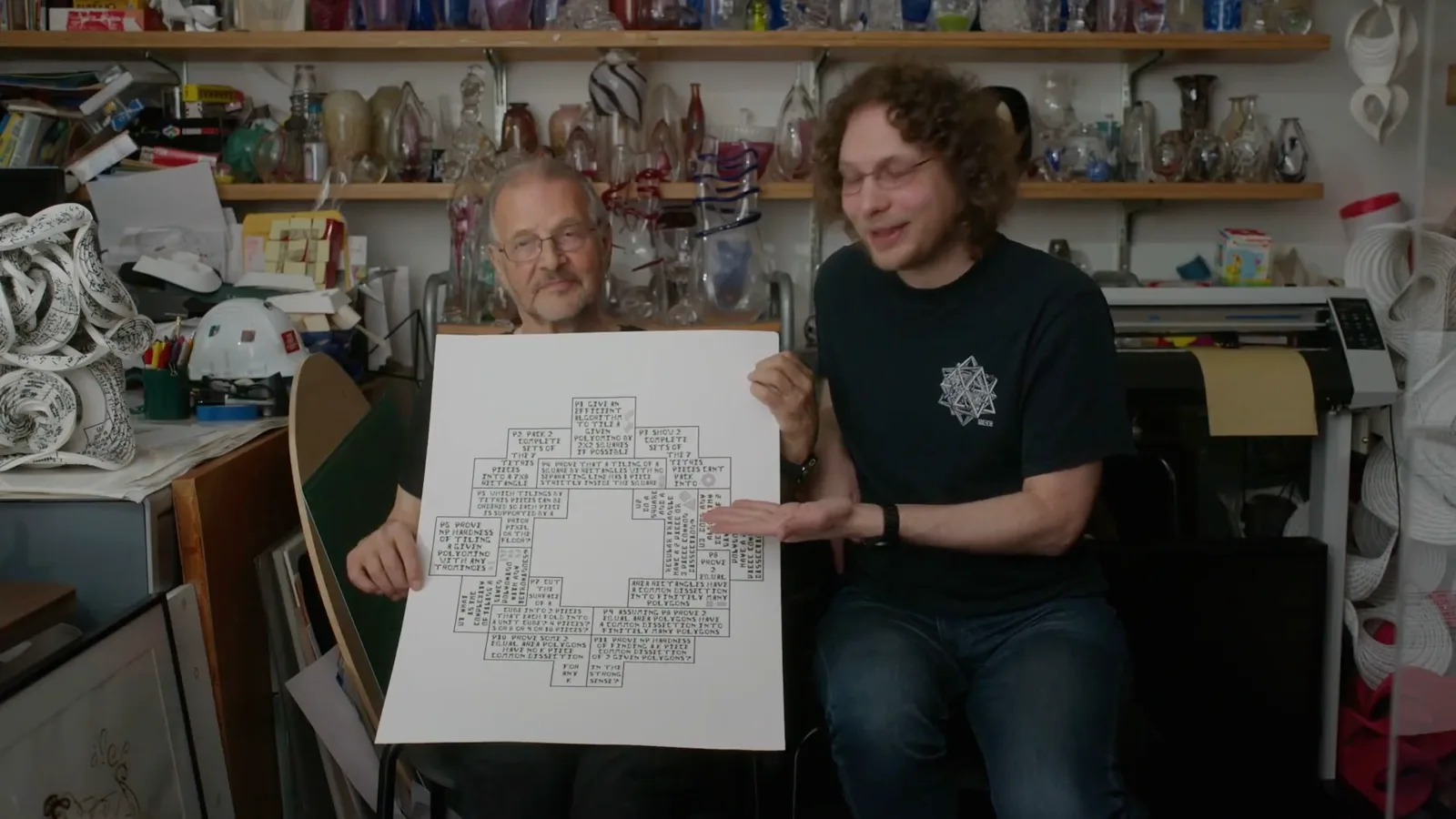
The layout of the problems also follows Tetris: bold outlines form the game pieces. One surprise for the artists was that the printing on the paper helped the piece shape itself, blending components into a complex form that makes them hard to distinguish.
New questions
The artists reflect on the unexpected geometry and new research problems that emerged from building the piece.
The Demaines say they could not have imagined these geometries when they first began folding paper. Building Solve Me generated new puzzles and mathematical problems that may guide future research. For them, the attraction of mathematics is how much remains unknown and open to discovery.
同じチャンネルの記事
 1:48:29EN
 1:36:37EN
 1:05:45EN
 1:25:00EN
 1:16:29EN
 27:39EN