30 秒でわかる
Matthew Berman reviews Axios journalist Ina Fried’s Davos interview with Sam Altman, recorded in January 2024. Altman forecasts more capable models and conversational workflows, while identifying autonomous scientific discovery as a longer-term goal. Fried presses him on training data, elections, military applications, differing cultural values and OpenAI’s recent board crisis. Berman adds both optimism and concerns; his predictions about jobs, model release timing and chip companies are his own.
- 1More capable modelsAltman predicts broad improvements in reasoning and complex tasks but does not announce a model release date.
- 2Training data and opt-outsAltman says OpenAI tries to respect opt-outs and prevent verbatim reproduction, while acknowledging the difficulty of identifying copied material.
- 3Election risksAltman says he is nervous about election misuse and calls for monitoring, quick changes and partnerships.
- 4Military gray areasFried asks how to distinguish benign from harmful uses. Altman says society and technology must co-evolve, while acknowledging unresolved middle cases.
- 5Customizing valuesAltman anticipates individual and cultural customization within global boundaries; Berman worries about reinforcing echo chambers.
- 6Chip projectAltman says the chip effort was an OpenAI strategic initiative approved by its board, not a personal project.
ポイント
- Altman expects broad gains in model capability but announces no name or release date for the next model.
- He expects better access to relevant data and more conversational work, while treating autonomous scientific discovery as a longer-term goal.
- Altman distinguishes current publisher content used at inference time from training data and says OpenAI seeks to honor opt-outs and limit regurgitation.
- He identifies elections as a major risk and proposes monitoring, rapid response and partnerships, without guaranteeing a safe outcome.
- Altman supports some military uses under restrictions and says difficult intermediate cases require further judgment.
- He expects customization within global limits, while acknowledging that OpenAI may decide not to operate in some countries.
チャプターごとに整えた全文を読む
A more capable next model
Altman reflects on ChatGPT adoption and expects model capability to keep improving. Berman distinguishes model research from the applications built on top.
Matthew Berman reviews a January 2024 Davos interview in which Axios journalist Ina Fried asks OpenAI CEO Sam Altman about the next generation of AI and the dilemmas facing his company. Altman says the team expected ChatGPT to do well but was surprised by how quickly people found the technology useful, despite its limitations.
Asked what AI might do in 2024 that it could not do the previous year, Altman emphasizes general capability rather than a single feature. He expects a future model, which he calls ‘GPT-5 or whatever we call it,’ to handle longer, more complex problems more accurately. He does not announce a name or release date.
Fried asks whether progress will come primarily from better models or from developers building on existing ones. Altman expects both to compound, with more capable models providing the largest step and productization making those capabilities useful. Berman agrees that both matter, but predicts that application builders will contribute significantly and that AGI will not arrive in 2024; his suggestion that a new model might arrive that year is speculation.
Data access and conversational computing
Altman anticipates better access to relevant data and faster voice interfaces. He and Berman imagine how AI might change knowledge work, though Berman makes a stronger prediction about programming.
On practical limitations, Altman expects better access to relevant company or task-specific data and improvements in voice speed. Berman explains that retrieving information at inference time can supply current context that a model's fixed training data cannot. He points to retrieval and web access as ways of connecting language models to newer information.
Altman imagines a future in which people use computers through conversation: instead of opening email and navigating a browser, a user could ask an assistant to identify important messages or perform a task. He does not expect the transition to be complete in 2024, but anticipates more work being done inside AI interfaces.
Berman connects that vision to the newly announced Rabbit device and predicts a move toward natural-language computing. He goes further than Altman, suggesting that programmers might no longer be needed in about ten years if models can write and execute the necessary code. That is Berman's prediction, not a claim established by the interview.
Fried asks whether people will spend hours a day with an AI assistant. Altman says some programmers already work that way and expects more people to incorporate such experiences into their workflows, although he does not know what the computer or AI operating system of the future will look like. Berman expects the shift to start gradually and deepen over several years.
Scientific discovery and copyright
Altman sees autonomous scientific discovery as a longer-term prospect. Fried presses him on publisher deals, opt-outs and the data used to train models.
Asked what remains more than a year away, Altman identifies autonomous scientific discovery as the most important eventual application: AI could help greatly accelerate research and make discoveries with increasing independence. He explicitly says he does not think that is a 2024 development. Berman imagines the potential for systems working continuously on diseases, while recognizing this is a future possibility rather than a demonstrated cure.
Fried turns to content licensing and the New York Times lawsuit. Altman says the focus of OpenAI's publisher deals is access to trusted, current, branded information when users ask questions, rather than simply obtaining training data. Berman interprets the answer as distinguishing current information at inference time from material used to train a model.
On whether all publicly accessible material is fair game for training, Altman declines a simple yes-or-no answer. He says OpenAI seeks to respect opt-outs, but that unattributed copies on other sites make them difficult to enforce perfectly. He also says the company wants to minimize verbatim reproduction of copyrighted material, whatever the training source.
Berman says he disagrees with Altman's assessment of whether training on copyrighted material is legal. Fried notes that courts will decide issues raised by lawsuits and asks whether OpenAI could build a model solely from clearly public-domain or licensed sources. Altman responds that no particular publisher's data is indispensable, and that better reasoning might make high-quality data more valuable.
Altman also says large amounts of data will remain important, even as models increasingly reason over smaller amounts of high-quality information. Berman sees a contradiction and predicts that synthetic data will play a larger role; the legal status of AI-generated training material cannot be assumed from that prediction. Asked whether such a restricted-data model exists in the lab, Altman declines to discuss unreleased work.
Elections and the military
Altman discusses monitoring election risks and permitted military uses. Fried asks about staffing and the difficult cases between obvious benign and harmful uses.
Fried asks about protecting elections in 2024 and whether OpenAI's technology could be used to influence campaigns. Before playing the answer, Berman displays OpenAI's Democratic Inputs to AI grant program and questions why outside teams were funded. That January 2024 program concerned methods for public participation in AI governance; OpenAI's separate election-security announcement addressed the election question.
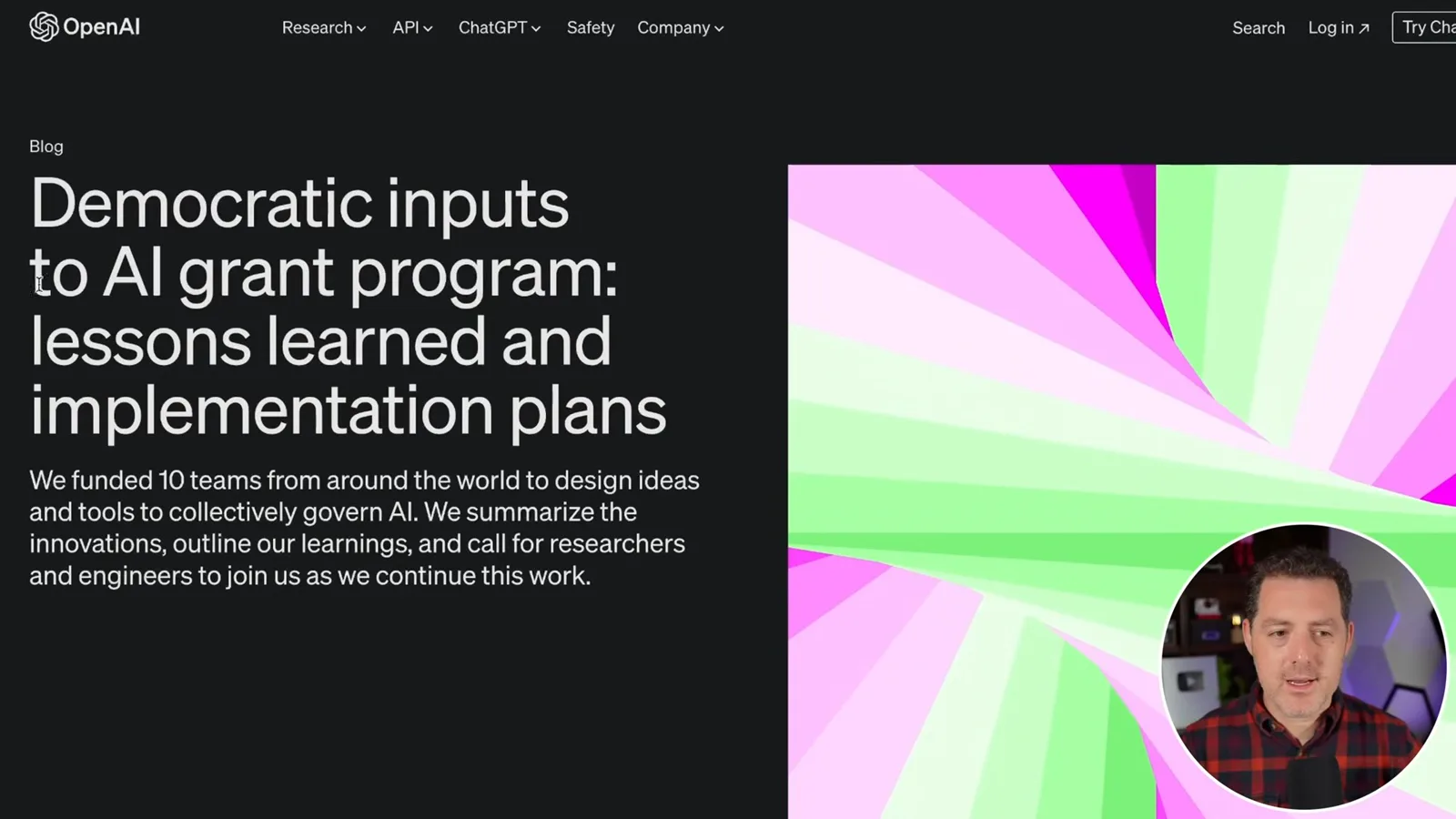
Altman says election misuse is among his top worries and expects new challenges that may not resemble those of previous elections. His proposed response is close monitoring, rapid changes when problems appear, and collaboration with outside partners. He says he is nervous, not that the measures will guarantee safety.
Fried challenges whether a relatively small company can dedicate enough people to elections compared with large social platforms. Altman says headcount alone does not measure effectiveness and argues that a small competent team can outperform a much larger one. Berman agrees, citing OpenAI's work with a comparatively small staff; neither offers evidence here that a particular staffing level is sufficient for election safety.
The interview turns to OpenAI's change in military-use policy. Altman says the company chose to specify prohibited uses rather than exclude an entire class of users, and sees legitimate uses within the US Department of Defense while opposing use for kill decisions. Berman supports allowing military access subject to limits.
Fried contrasts low-risk examples, such as translation or supporting veterans, with prohibited weapons-related uses, and asks how the company will handle ambiguous applications between those extremes. Altman argues that technology and society need to co-evolve through iterative deployment, allowing people to encounter the technology, adapt and develop rules.
Berman sees a trade-off: early deployment allows testing, but misuse, deepfakes or election interference could cause damage that cannot simply be undone. Altman acknowledges that he does not yet know the right answer for all middle cases and says some uses will require a slow, iterative approach. He also affirms his support for working with the US and other governments.
Whose values should AI follow?
Altman anticipates global bounds alongside individual customization. The conversation considers cultural differences, LGBTQ rights and countries where OpenAI might not operate.
Fried asks whether a single model can satisfy societies with different values. Altman expects some global boundaries, questions about defaults and permitted behavior, and substantial customization at cultural and individual levels. Berman worries that a model tailored to each user might reinforce existing beliefs and deepen online echo chambers.
Fried presses him on countries that do not respect LGBTQ rights. Altman says a demand for a system to endorse killing gay people would be beyond the bounds he envisions, while other views he personally disagrees with might still be permitted. Berman guesses that Altman would allow anything legal; Altman does not state that rule in the interview.
Altman suggests customization may matter even more at the individual level than the country level. Fried points out that some governments may not allow individuals to choose freely. Altman says there are countries where OpenAI may decide not to operate, while it may find enough common ground to work in others despite disagreements.
The board crisis, investments and infrastructure
Altman provides no update on Ilya Sutskever and describes the chip initiative as OpenAI work. Berman closes with observations on enterprise use and AI infrastructure.
In a lightning round, Fried asks about Ilya Sutskever's role after Altman's brief removal and return as OpenAI CEO in November 2023. Altman has no update on his exact status, but calls Sutskever an exceptional researcher and says he cares about him. Berman recounts Sutskever's involvement in the board crisis; the interview does not establish the reasons for the board's decision.
Fried asks whether Altman's work on outside projects or investments competes with his responsibilities at OpenAI. Altman says the chip initiative was an OpenAI project that its board had treated as strategically important, rather than a personal venture. He says he has largely stopped making new personal startup investments but continues to support some earlier commitments, and cites Humane as an investment that has grown too close to OpenAI's work for another round.
Berman summarizes the remainder of the interview: Altman encourages executives to use AI internally to improve productivity and says infrastructure investment is critical. Berman then offers his own bullish view of Nvidia's position in AI chips and Apple's potential for running AI on its devices. These are his forecasts as of January 2024, not established future investment outcomes.
同じチャンネルの記事
 34:21EN
 Matthew Berman· 2026年10月27日Matthew Berman Examines Anthropic’s IPO Filing, AI Growth and GovernanceMatthew Berman, Sam Altman · Forward FutureThe presenter reviews the S-1’s financial metrics, compute strategy and voting structure while questioning the tension between rapid AI development and safety.
 0:36ENMatthew Berman· 2026年10月25日Kimi K3.1 and a Rubik’s Cube Solver DemonstrationMatthew Berman · Forward FutureMatthew Berman shows a scrambled virtual cube being solved and gives the Kimi K3.1 test a favorable assessment.
 25:50ENMatthew Berman· 2026年10月24日Kimi K3.1 Pro Tested: Strong 3D Demos, Uneven Results and Competitive PricingMatthew Berman · Forward FutureMatthew Berman tests the open-weight model on coding, 3D rendering and visual explanations, then compares benchmark results and prices.
 32:20ENMatthew Berman· 2026年10月23日Who Is Local AI For? The Costs, Trade-offs and a Hybrid FutureMatthew Berman · Forward FutureMatthew Berman weighs data control and independence against hardware cost, setup complexity and inference speed.
 1:03:37ENMatthew Berman· 2026年10月23日Matthew Berman’s Team Tests Kimi K3.1 on Animation, Games, and ChartsMatthew Berman, Alex, Brian · Forward FutureA live team AMA turns into an informal test of Kimi K3.1, from personal-agent workflows to motion graphics, a browser game, and a benchmark chart.
 0:53ENMatthew Berman· 2026年10月22日Sam Altman on AI and the Discovery of New KnowledgeSam Altman · OpenAIAltman expects progress in mathematical discovery to extend to biology, materials and energy.