30 秒でわかる
In February 2026, Matthew Berman discusses GPT-5.3-Codex’s launch, selected coding and knowledge-work demos, and OpenAI’s benchmark results. He compares the release with Claude Opus 4.6 and highlights token efficiency, while OpenAI attributes its stated 25% speedup to infrastructure and inference-stack improvements.
- 1Reported speed increaseOpenAI attributed the 25% faster Codex experience to infrastructure and inference improvements.
- 2Assisted developmentOpenAI says early versions helped engineers debug training and evaluate deployment; Berman’s self-improvement interpretation is speculative.
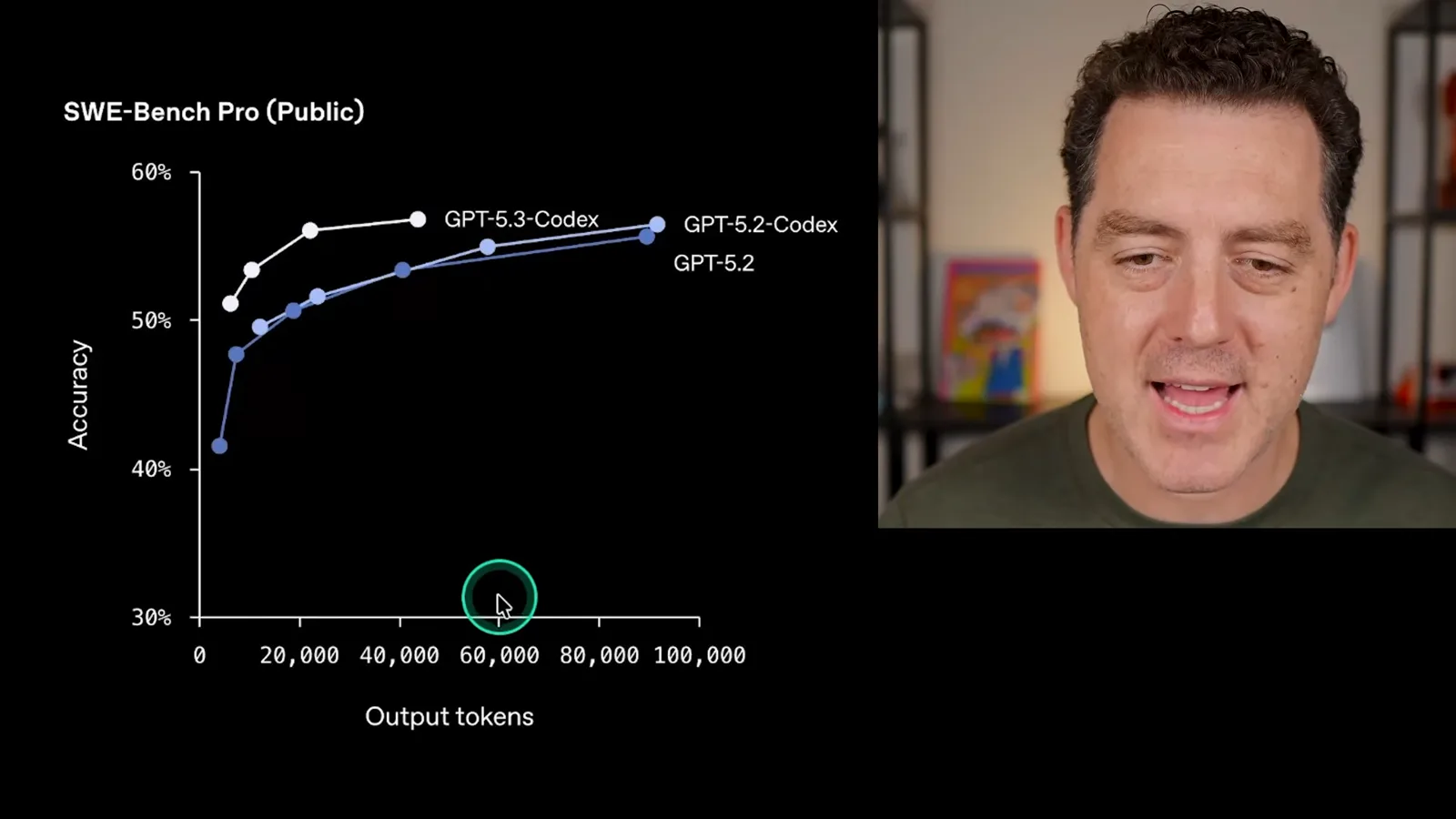
- 3Output-token comparisonThe displayed SWE-Bench Pro chart uses about 43,000 versus 91,000 output tokens at selected points.
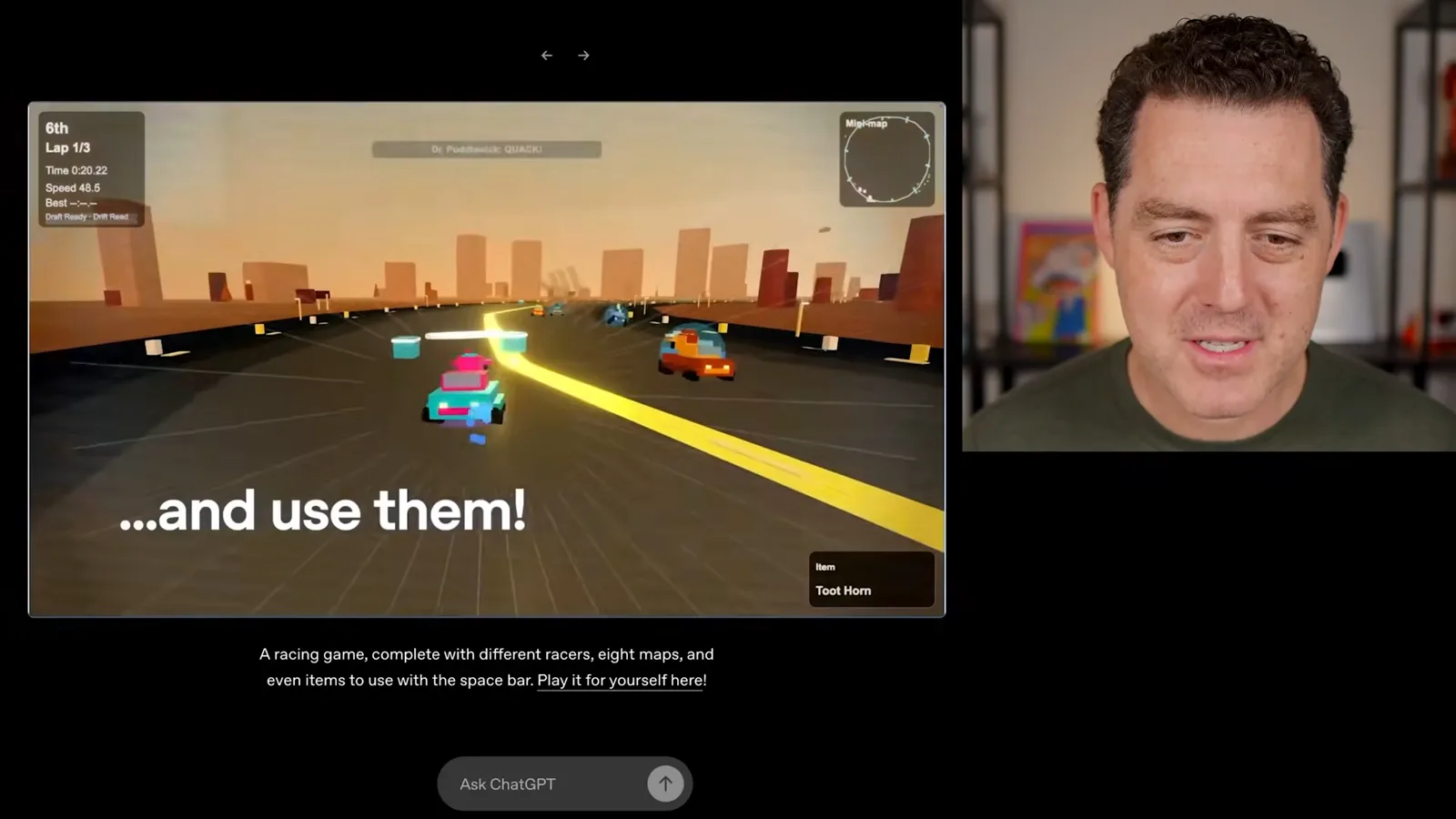
- 4Game demonstrationsOpenAI shows racing and diving games generated with periodic human prompts.
- 5Computer-use benchmarkOpenAI reports 64.7% on OSWorld-Verified, comparing with its earlier models rather than competitors.
ポイント
- OpenAI reported a 25% faster Codex experience from infrastructure and inference-stack improvements.
- A SWE-Bench Pro chart showed fewer output tokens at selected points; it does not alone prove the cause of the speedup.
- Early model versions assisted a human-led development process, rather than autonomously creating a successor.
- Game and landing-page examples are selected demonstrations, not comprehensive quality evaluations.
- The reported 64.7% OSWorld-Verified score is a vendor benchmark result under specific conditions.
- Model availability and competitive comparisons reflect February 2026.
チャプターごとに整えた全文を読む
Release and agent workflow
Berman introduces GPT-5.3-Codex and Claude Opus 4.6. He discusses speed, steering and OpenAI’s account of using earlier versions in development.
In this February 2026 video, Matthew Berman discusses OpenAI’s GPT-5.3-Codex release alongside Anthropic’s Claude Opus 4.6, announced the same day. He focuses on long-running coding agents, responsiveness and examples from OpenAI’s release materials. The comparisons reflect announcements and benchmarks available at the time.
OpenAI reports that GPT-5.3-Codex runs 25% faster for Codex users. Berman welcomes the change because many users had found coding agents slow. He also mentions Peter Steinberger’s preference for Codex over Claude on his own codebase, while noting that he does not necessarily agree; that is an individual assessment, not a controlled comparison.
OpenAI says users can steer the agent during a task without losing context. It also says early versions helped the team debug training, manage deployment and diagnose evaluations. Berman calls this nearly autonomous self-improvement, but the description is assistance to a human-led development process, not evidence that the model independently designed or trained its successor.
Benchmarks and generated games
The SWE-Bench Pro chart shows different output-token counts, while OpenAI attributes its 25% speed increase to infrastructure and inference improvements. Berman reviews selected game demonstrations.
Berman points to an OpenAI SWE-Bench Pro chart showing roughly 43,000 output tokens for GPT-5.3-Codex versus 91,000 for GPT-5.2-Codex at the displayed operating points. He interprets the reduction as the cause of the speedup. OpenAI’s release separately attributes the reported 25% faster Codex experience to infrastructure and inference-stack improvements; the token-count chart alone does not establish the cause of that figure.
OpenAI also reports improved Terminal-Bench results and presents two game examples: a racing game with different racers and a diving game with objectives, predators and an oxygen limit. Berman says the runs involved brief human prompts such as fixing bugs or improving the game over millions of tokens. These are selected demonstrations, not proof that arbitrary games can be built without supervision.
Design and knowledge work
OpenAI’s examples include landing pages, spreadsheets and presentations. Berman also discusses code review in a sponsored segment.
OpenAI says the model handles underspecified prompts by making more sensible defaults. Berman thinks that could help less experienced users who cannot specify every design detail. In the sponsored segment he describes Greptile’s code-review product; automated review and confidence scores may surface issues, but do not replace appropriate testing or human review.
A landing-page example compares GPT-5.2-Codex and GPT-5.3-Codex using the same Quiet KPI prompt. Berman prefers the newer page’s visual design, month-over-month figures and clearer pricing toggle with annual savings. The screenshots show one curated example, so his aesthetic preference should not be generalized into a comprehensive design benchmark.
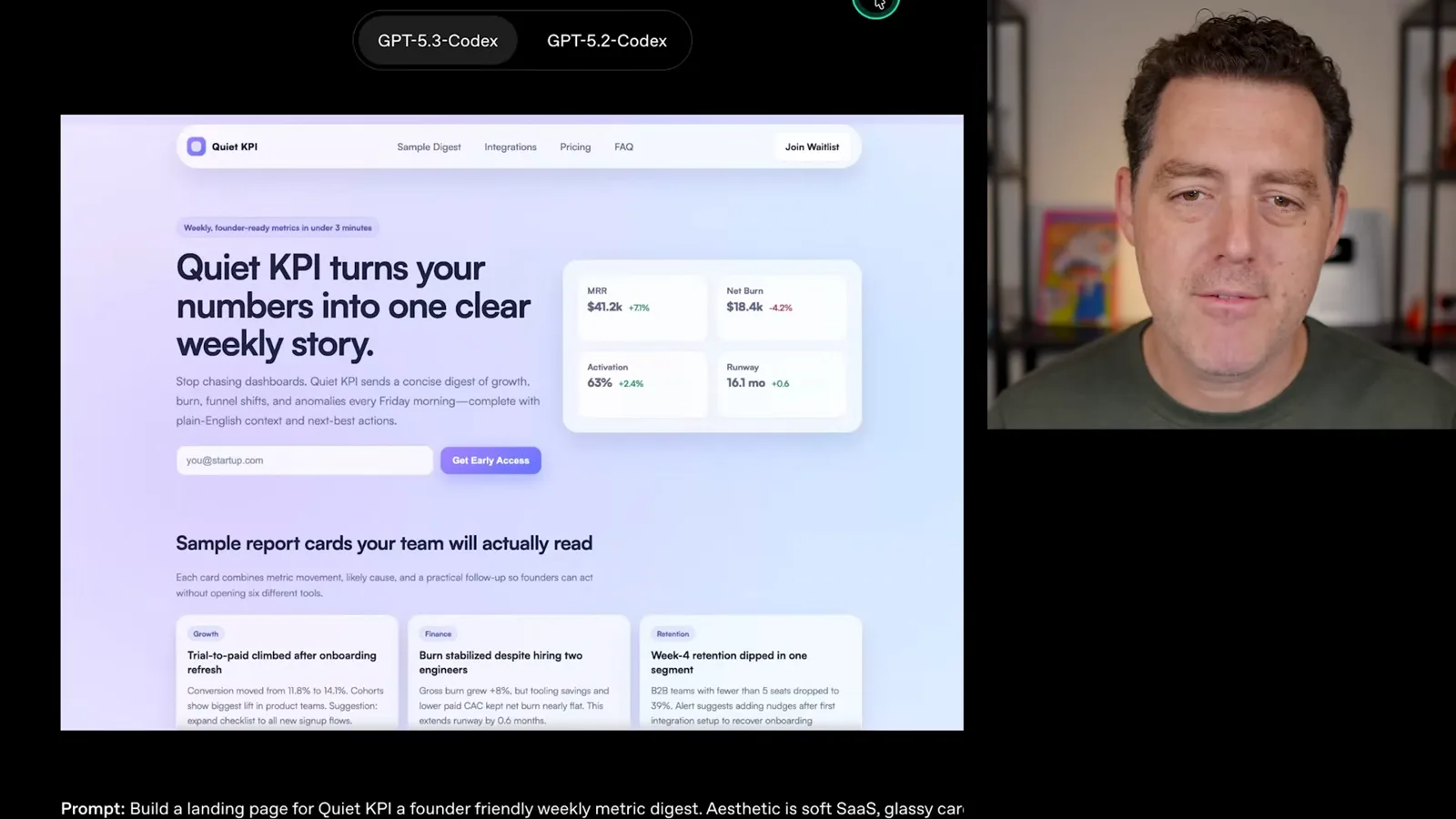
Berman compares the push into professional work with Anthropic’s Claude Cowork, citing examples such as documents, spreadsheets and presentations. OpenAI’s examples show outputs for financial, retail and fashion tasks. These examples illustrate the intended scope of the product, not independent validation that their contents are correct.
Computer use
OpenAI reports OSWorld-Verified scores against earlier GPT models. Berman notes that the chart does not include competing providers.
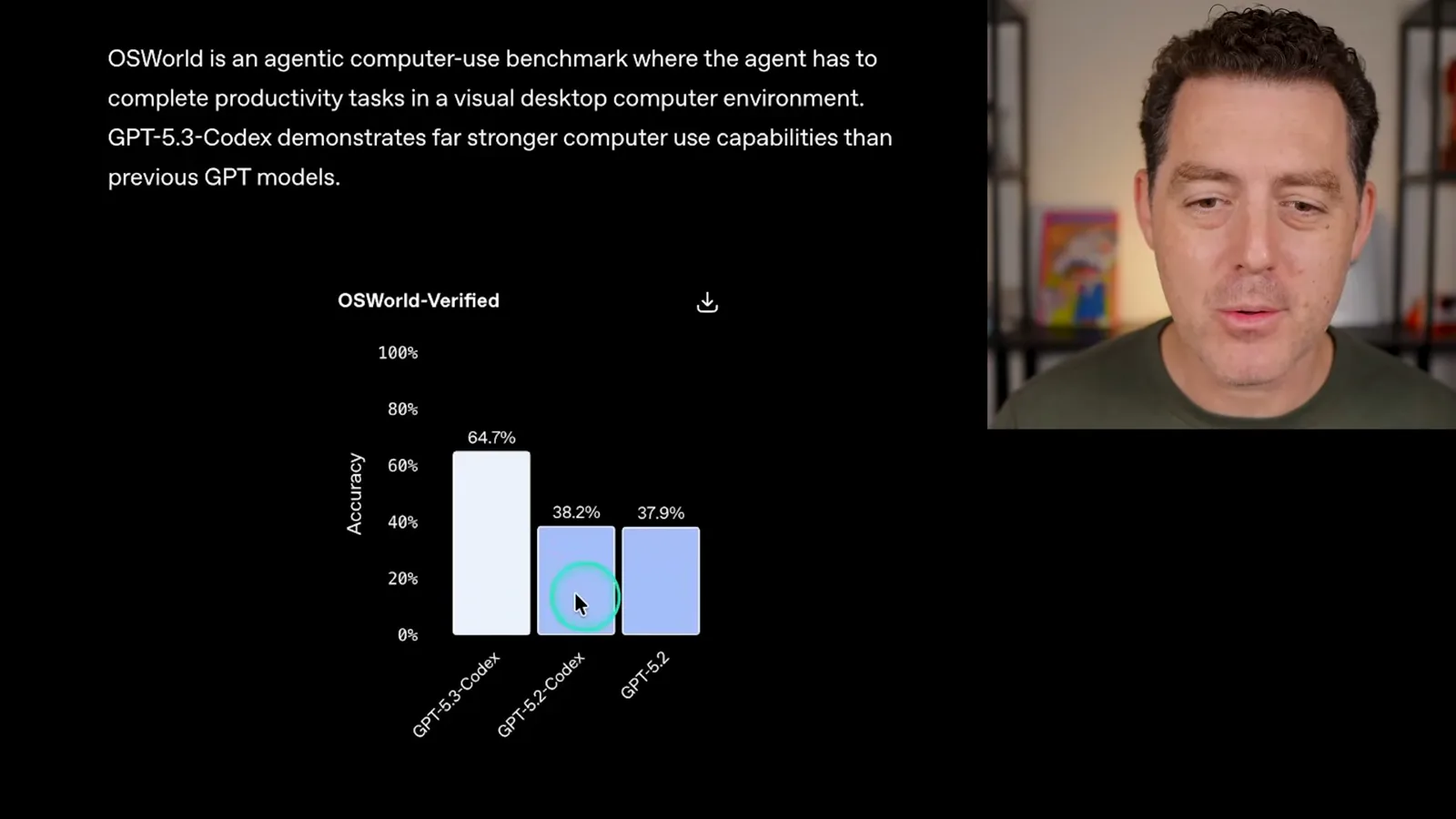
For computer use, OpenAI reports 64.7% on OSWorld-Verified for GPT-5.3-Codex, compared with 38.2% for GPT-5.2-Codex and 37.9% for GPT-5.2 in its displayed results. OSWorld evaluates tasks in a visual desktop environment. Berman criticizes OpenAI’s chart for omitting competitors; the figures do not establish a ranking against them or guaranteed reliability on every desktop task.
Berman says the model was available in the downloadable Codex app and invites viewers to compare it with Opus 4.6. Availability and model rankings change over time; the video is a release-day perspective, not a current purchase or deployment recommendation.
同じチャンネルの記事
 34:21EN
 Matthew Berman· 2026年10月27日Matthew Berman Examines Anthropic’s IPO Filing, AI Growth and GovernanceMatthew Berman, Sam Altman · Forward FutureThe presenter reviews the S-1’s financial metrics, compute strategy and voting structure while questioning the tension between rapid AI development and safety.
 0:36ENMatthew Berman· 2026年10月25日Kimi K3.1 and a Rubik’s Cube Solver DemonstrationMatthew Berman · Forward FutureMatthew Berman shows a scrambled virtual cube being solved and gives the Kimi K3.1 test a favorable assessment.
 25:50ENMatthew Berman· 2026年10月24日Kimi K3.1 Pro Tested: Strong 3D Demos, Uneven Results and Competitive PricingMatthew Berman · Forward FutureMatthew Berman tests the open-weight model on coding, 3D rendering and visual explanations, then compares benchmark results and prices.
 32:20ENMatthew Berman· 2026年10月23日Who Is Local AI For? The Costs, Trade-offs and a Hybrid FutureMatthew Berman · Forward FutureMatthew Berman weighs data control and independence against hardware cost, setup complexity and inference speed.
 1:03:37ENMatthew Berman· 2026年10月23日Matthew Berman’s Team Tests Kimi K3.1 on Animation, Games, and ChartsMatthew Berman, Alex, Brian · Forward FutureA live team AMA turns into an informal test of Kimi K3.1, from personal-agent workflows to motion graphics, a browser game, and a benchmark chart.
 0:53ENMatthew Berman· 2026年10月22日Sam Altman on AI and the Discovery of New KnowledgeSam Altman · OpenAIAltman expects progress in mathematical discovery to extend to biology, materials and energy.