30 秒でわかる
Sawyer poses an unanswered challenge about damage from one of three equally likely monster types and explains expected value using a die. He then solves the previous episode's window puzzle, finding a maximum segment length of (1 + √5)/2 meters and relating it to the power of a point theorem.
- 1Three indistinguishable monstersTimid, aggressive and deadly monsters are equally likely and deal uniformly distributed damage from 1–6, 1–12 and 1–20 respectively. The episode leaves the expected damage and conditional follow-up as challenges.
- 2A probability-weighted averageExpected value sums each possible outcome multiplied by its probability. A fair die has expected value 7/2, even though that value is not a possible roll.
- 3A window becomes a line-segment problemA one-meter square topped with a semicircle forms the window. Orienting the wider-than-tall painting perpendicular to its plane reduces the problem to finding the longest segment inside the shape.
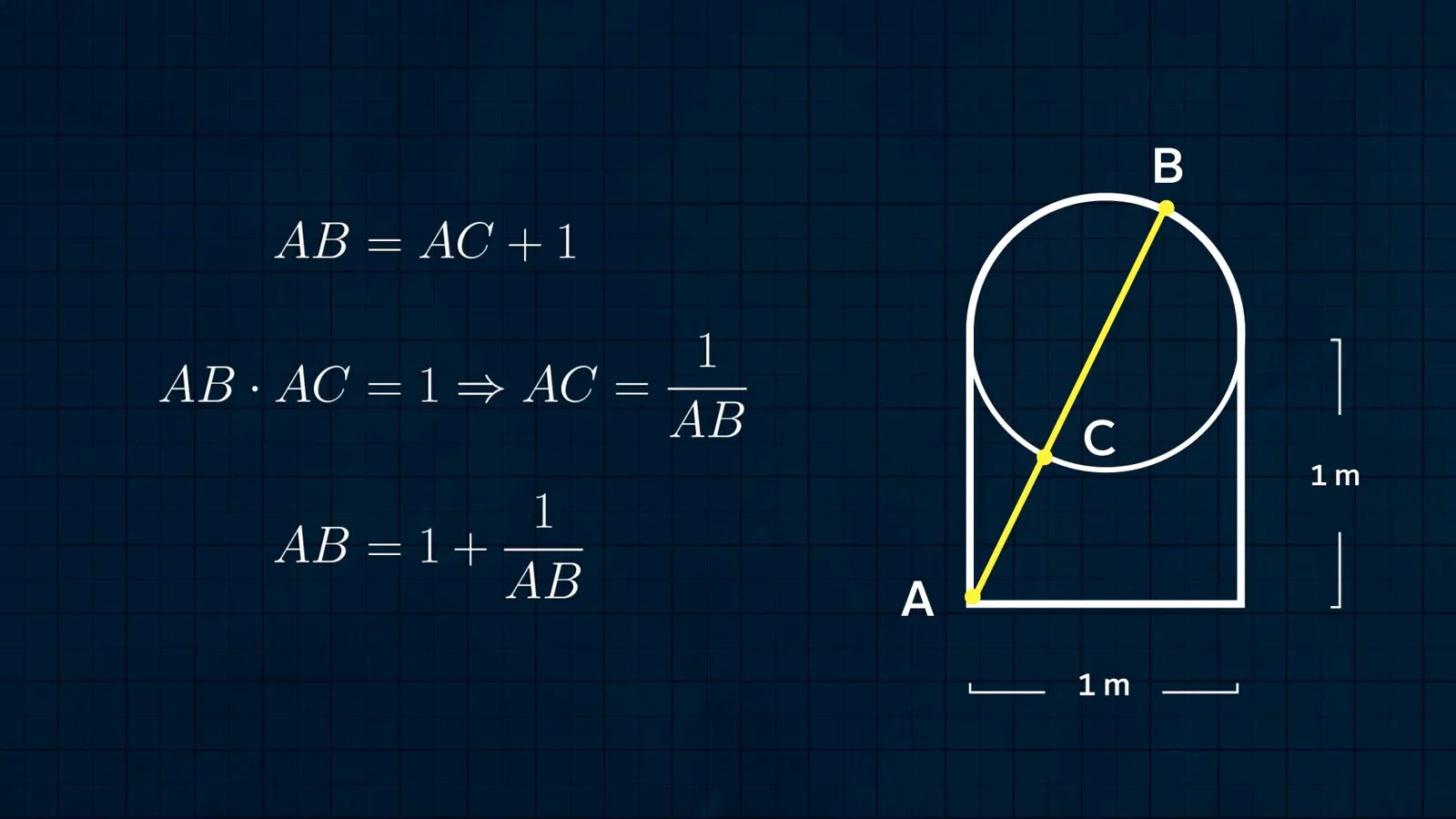
- 4The longest segment through the centerAt the optimum, the segment meets the semicircle perpendicular to its tangent and passes through the circle's center. Its length is (1 + √5)/2 meters.
- 5Why the golden ratio appearsThe power of a point gives AB·AC = 1, while the optimal chord BC is a diameter of length 1. Together these imply AB = 1 + 1/AB.
ポイント
- Expected value is the probability-weighted sum of a random variable's possible outcomes.
- The expected value of a fair six-sided die is 3.5, even though no roll can equal 3.5.
- The monster challenge asks about both an unconditional expected attack and a second attack after observing four damage.
- A painting-window problem reduces to finding the longest line segment inside a square topped by a semicircle.
- That segment has length (1 + √5)/2 meters, the golden ratio, and a power-of-a-point argument explains its appearance.
チャプターごとに整えた全文を読む
A monster and expected damage
Sawyer poses a new challenge involving three equally likely monster types. The bonus asks about a second attack after observing four damage from the first.
I'm Sawyer, and this is Real Numbers. Usually we solve mathematics problems motivated by real-world situations; this time our problem comes from a video game. You're exploring a haunted forest and encounter a monster whose difficulty class you cannot tell by looking at it.
There are three equally likely classes: timid, aggressive, and deadly. A timid monster deals an integer amount of damage uniformly from 1 to 6, an aggressive one from 1 to 12, and a deadly one from 1 to 20. All three look identical. On average, how much damage does the first attack from an unknown monster deal?
For a bonus, suppose that very monster deals four damage on its first attack. What is the average damage from a second attack by the same monster? To solve these questions, we need the mathematical idea behind the words ‘on average’: expected value.
What expected value means
Expected value weights each outcome by its probability. A fair six-sided die has expected value 3.5, even though 3.5 is not a possible roll.
The ordinary average of n values is their sum divided by n. For example, the rolls 1, 5, and 5 average 11/3. We can write this as (1/3)·1 + (1/3)·5 + (1/3)·5: a weighted sum whose equal weights add up to one.
For a probabilistic process, expected value is the average of all possible outcomes, each weighted by its probability. In other words, multiply each value a random variable can take by the probability of that value and add the results. The weights still sum to one, but need not be equal.
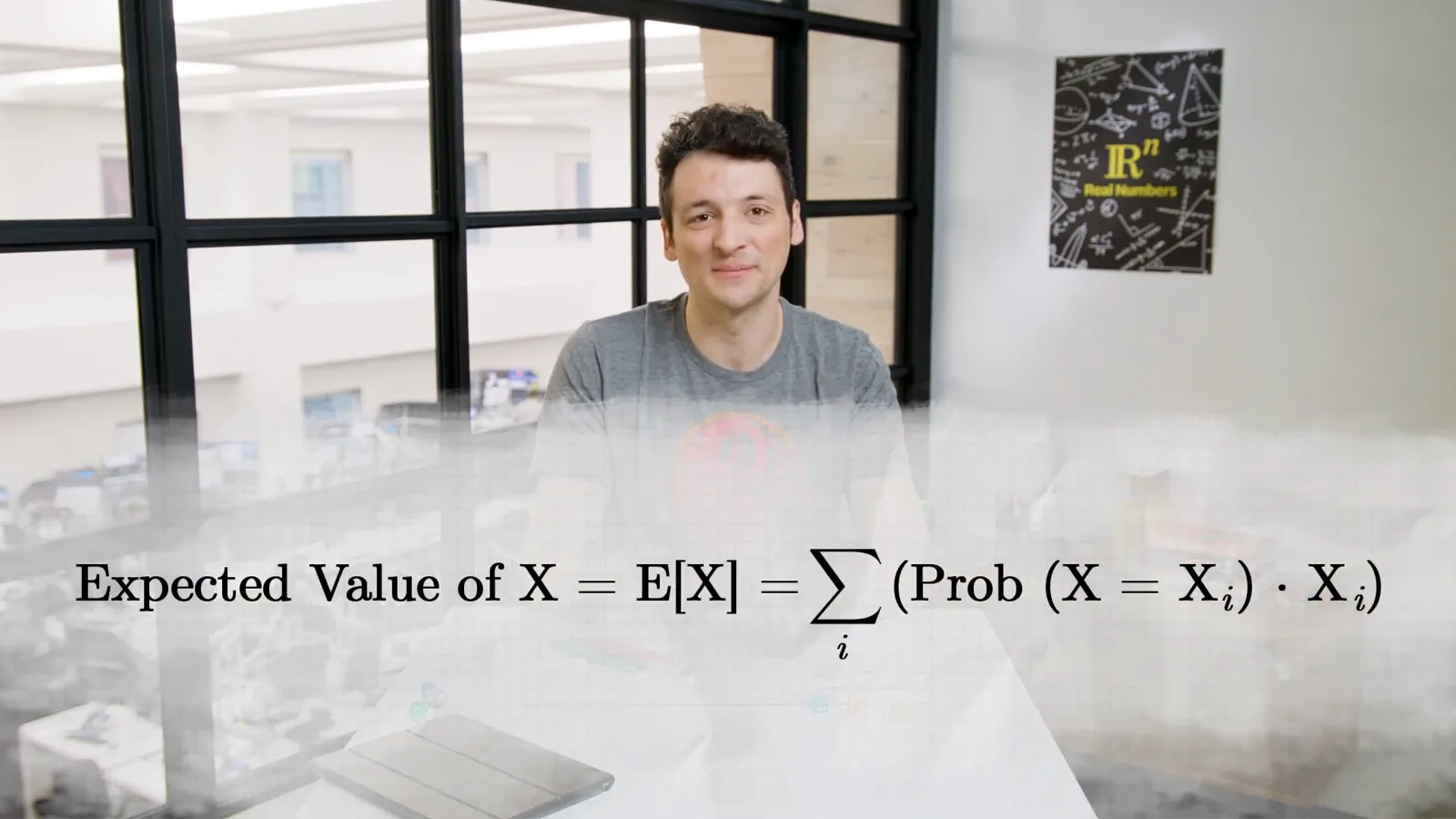
For a fair six-sided die, each outcome from 1 through 6 has probability 1/6. The expected roll is (1 + 2 + 3 + 4 + 5 + 6)/6 = 21/6 = 7/2. A roll can never actually be 3.5, but that number summarizes the distribution of outcomes. We'll return to ways of making that idea precise in later episodes.
Solving the window puzzle
The previous problem reduces to finding the longest segment in a square topped by a semicircle. Tangent geometry and the Pythagorean theorem give the golden ratio in meters.
Now for last week's problem: what is the tallest painting that can pass through a window made from a one-meter square with its top side replaced by a semicircle whose diameter is that side? The paintings are wider than they are tall, so we orient their width perpendicular to the window. Their height intersects the window as a line segment, and we seek the longest segment that fits.
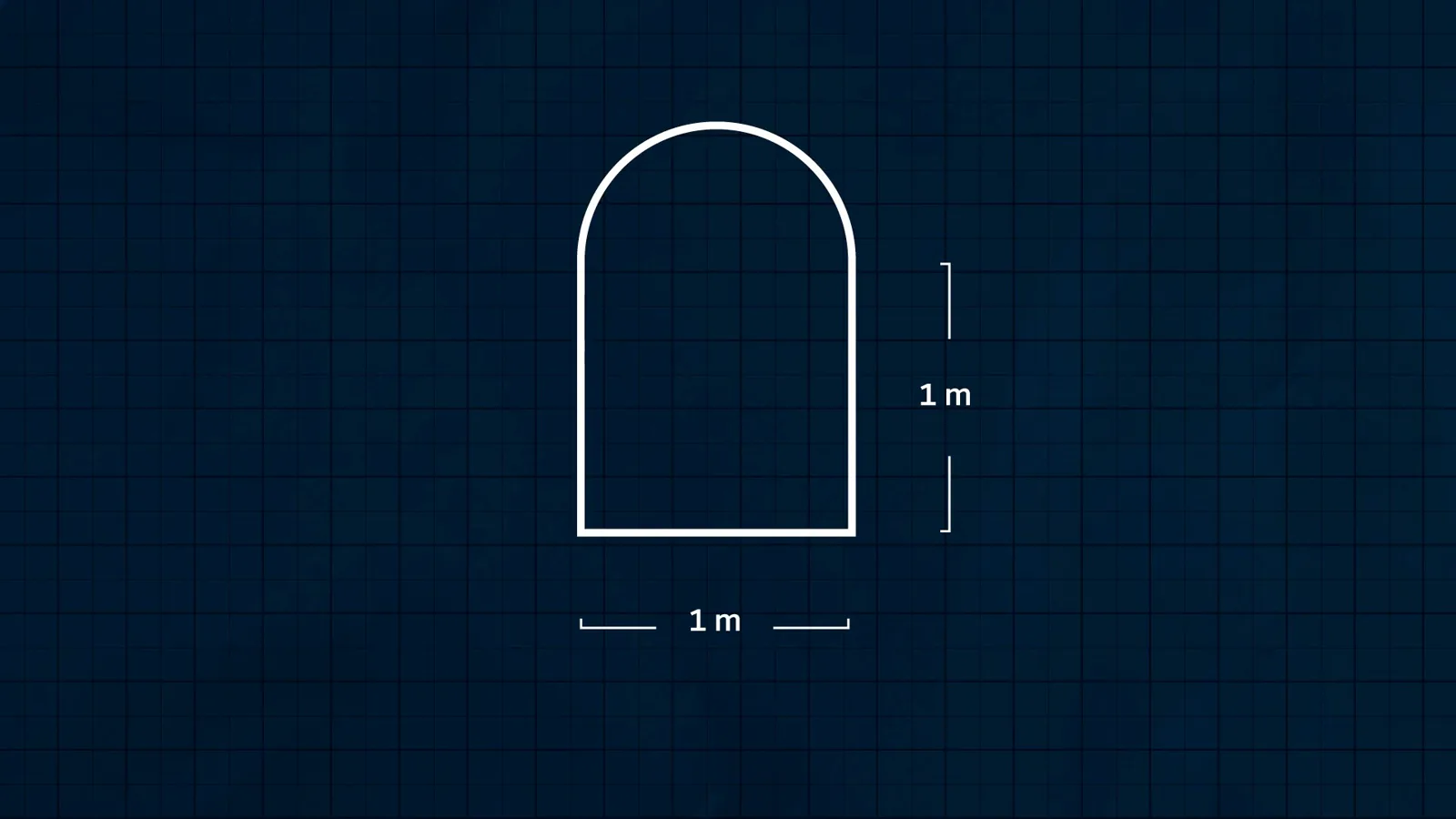
We can find lower bounds by exhibiting segments. The square's diagonal has length √2, about 1.414 meters; the window's vertical height is 1.5 meters. Moving the lower endpoint to a corner while keeping the other at the top gives √((1/2)² + (3/2)²) = √(5/2), about 1.581 meters. But even that is not the maximum.
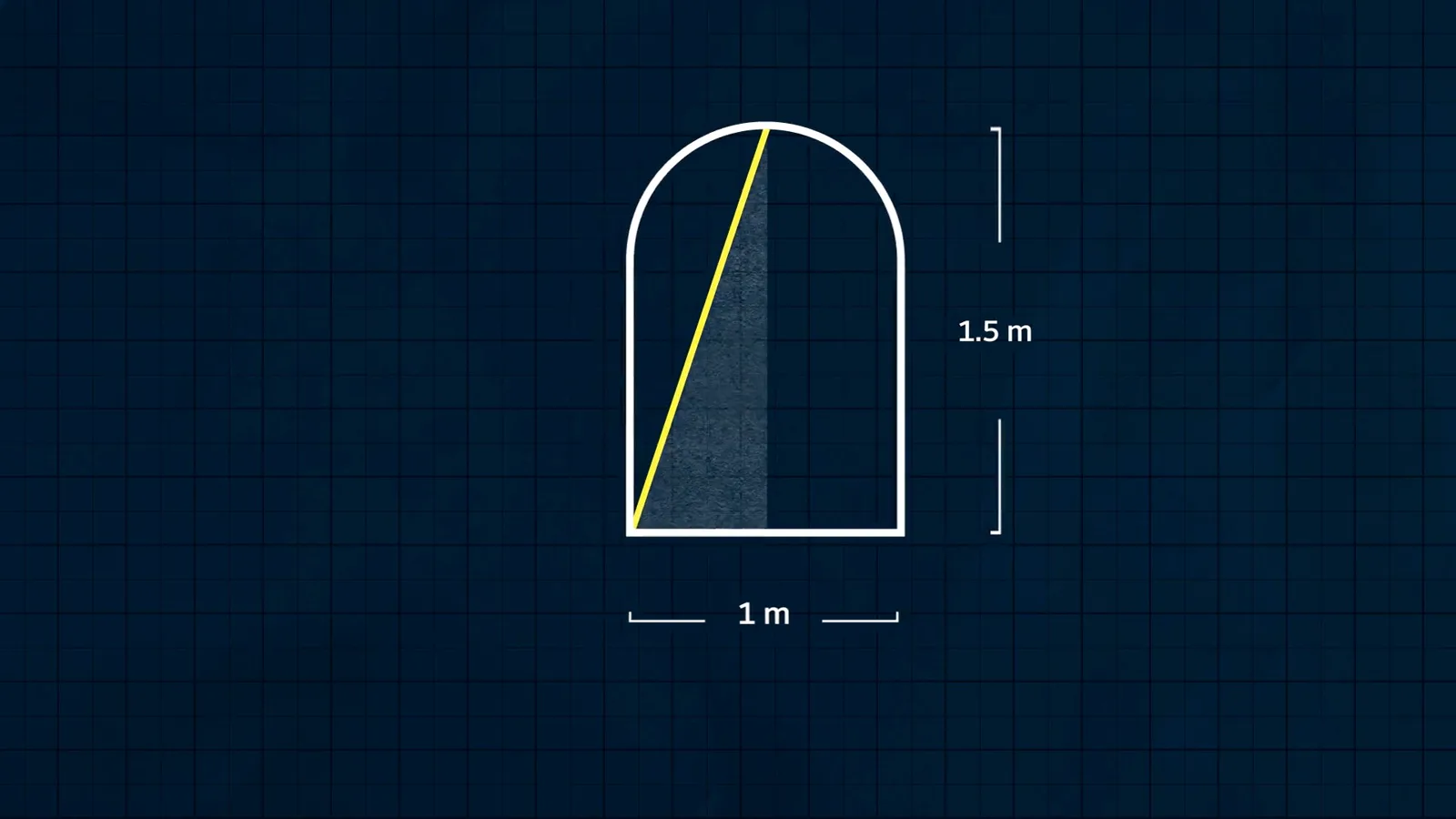
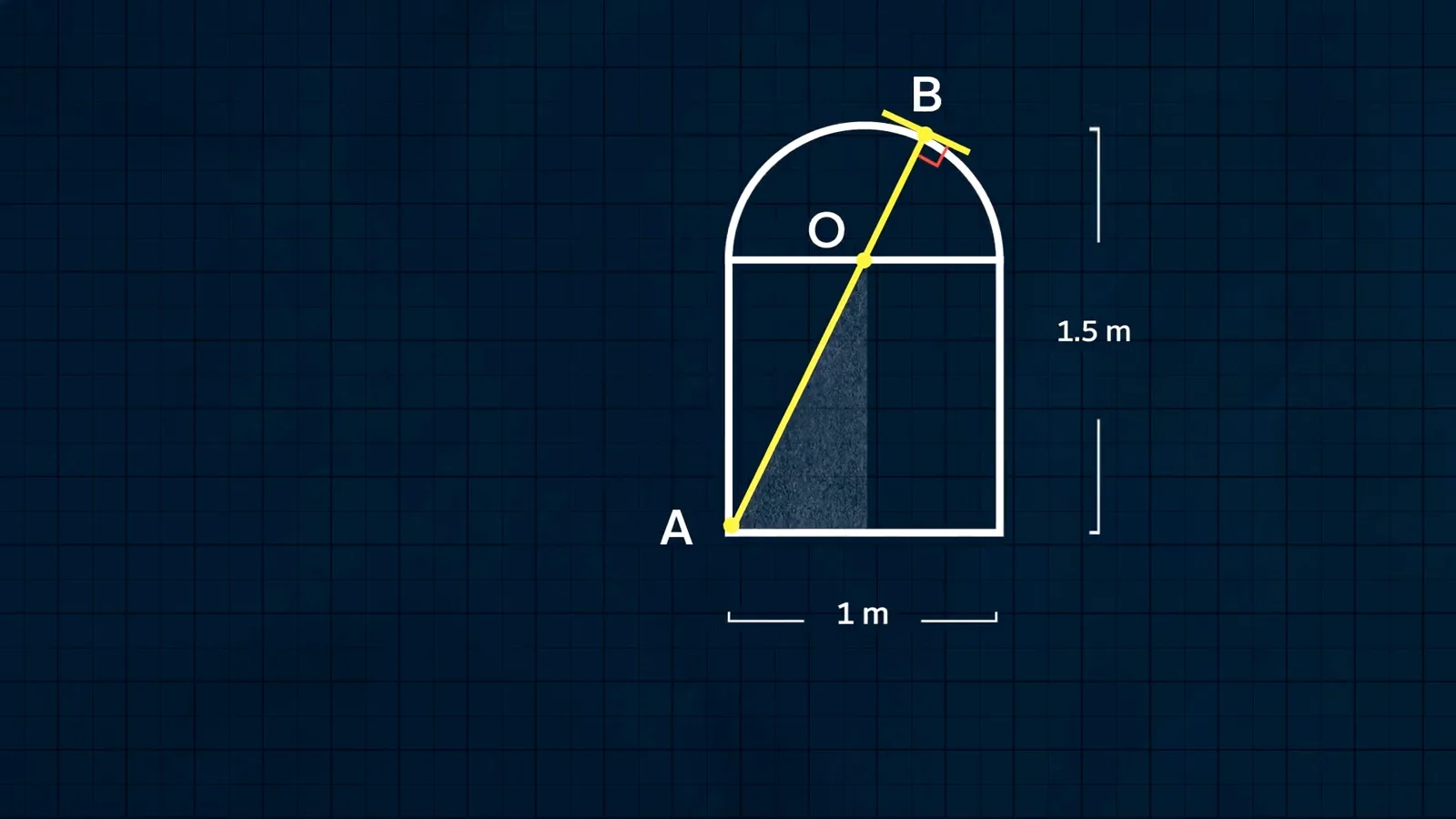
A tangent line gives the best local linear approximation to a curve. Label the lower-left corner A and a point on the semicircle B. Starting with B at the top, moving it right along the curve increases AB. Continue until the tangent at B is perpendicular to AB.
The line perpendicular to a circle's tangent at B passes through the center O. Thus the maximizing segment passes through O, the midpoint of the square's top edge. OB is the radius, 1/2 meter, and AO = √((1/2)² + 1²) = √5/2 meters. The maximum is AO + OB = (1 + √5)/2, about 1.618 meters.
That's φ, the golden ratio, the positive solution of x = 1 + 1/x. A neat answer like this suggests a geometric principle underneath, so I looked for another explanation and found the power of a point theorem, associated with the nineteenth-century geometer Jakob Steiner.
The power of a point
A geometric theorem explains why the result satisfies the golden-ratio equation. Sawyer closes by restating the new monster challenge.
The theorem says that for a point P outside a circle, a line through P meeting the circle at two points has a constant product of distances from P to those intersections, regardless of the line chosen. For our window, let A be the point and let the line meet the full circle at C and B.
As B moves along the upper semicircle, AB·AC remains constant. In the limiting position at the left edge, both distances equal the one-meter side of the square, so the product is 1. Maximizing AB therefore minimizes AC, and hence maximizes BC; the longest chord is the circle's diameter, which has length 1.
At that optimum, AB = AC + 1 and AB·AC = 1. Substituting AC = 1/AB gives AB = 1 + 1/AB, precisely the equation for the golden ratio. The geometry explains why that number appears rather than merely producing it through arithmetic.
Returning to this week's challenge: an unknown monster is equally likely to be timid, aggressive, or deadly, with uniform damage ranges of 1–6, 1–12, and 1–20. Find the expected damage of its first attack; for the bonus, find the expected second attack from the same monster after its first deals four damage.
同じチャンネルの記事
 1:48:29EN
 1:05:45EN
 1:25:00EN
 1:16:29EN
 4:41EN
 1:34:29EN