30 秒でわかる
In the finale of Real Numbers, Sawyer presents several ways to find the expected number of independent half-court attempts until the first success. The bonus problem uses two recursive states to calculate the wait for two consecutive makes.
- 1Sum the tail probabilitiesThe chance of needing at least i attempts is (4/5)^(i−1), yielding a geometric series that sums to five.
- 2Use the resetA miss returns Danielle to the starting state, so E = (1/5)·1 + (4/5)(1+E) and E = 5.
- 3Differentiate a geometric seriesThe direct expectation sum is the derivative of a geometric series evaluated at 4/5.
- 4Two states for two makesTracking both the initial state and the state after one make gives a pair of equations whose solution is 30 attempts.
ポイント
- With independent 20% success probability per attempt, the expected number of attempts until the first make is five.
- A tail-sum formula, recursive conditioning, direct summation, calculus, and a long-run frequency argument all lead to that result.
- Conditioning on the first action is useful when failure resets a process to its original state.
- Two consecutive makes require an average of 30 attempts, not 25, because a miss resets a partial run.
チャプターごとに整えた全文を読む
The half-court problem and tail sums
Danielle succeeds independently with probability 20% per shot. A tail-sum calculation yields five expected attempts.
Danielle takes independent half-court shots at the end of practice until she makes one. Each shot succeeds with probability 20%. How many attempts does she need on average? Intuitively, one make per five shots suggests an answer of five, but intuition alone is not a proof.
For a nonnegative integer-valued random variable N, the tail-sum formula says E[N] = Σᵢ₌₁∞ P(N ≥ i). Danielle needs at least i attempts exactly when she misses the first i−1 shots. Independence gives P(N ≥ i) = (4/5)^(i−1).
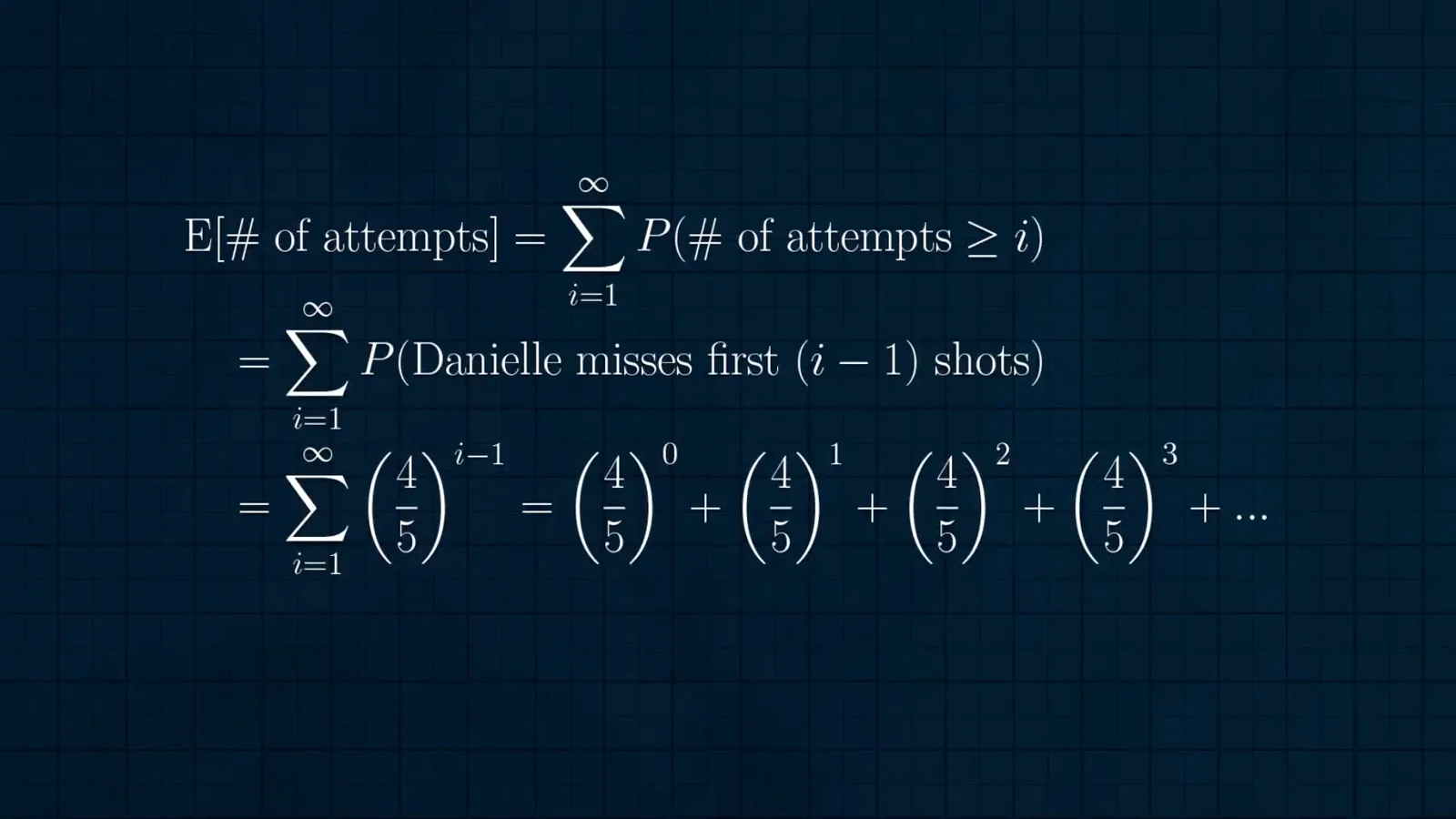
The expected number is therefore 1 + 4/5 + (4/5)² + ⋯. This geometric series has first term 1 and ratio 4/5, so its sum is 1/(1−4/5) = 5. The initial intuition gives the correct answer in this model.
Recursion and direct expectation
Conditioning on the first shot gives a recursive equation. The same result follows by expanding the direct expectation sum.
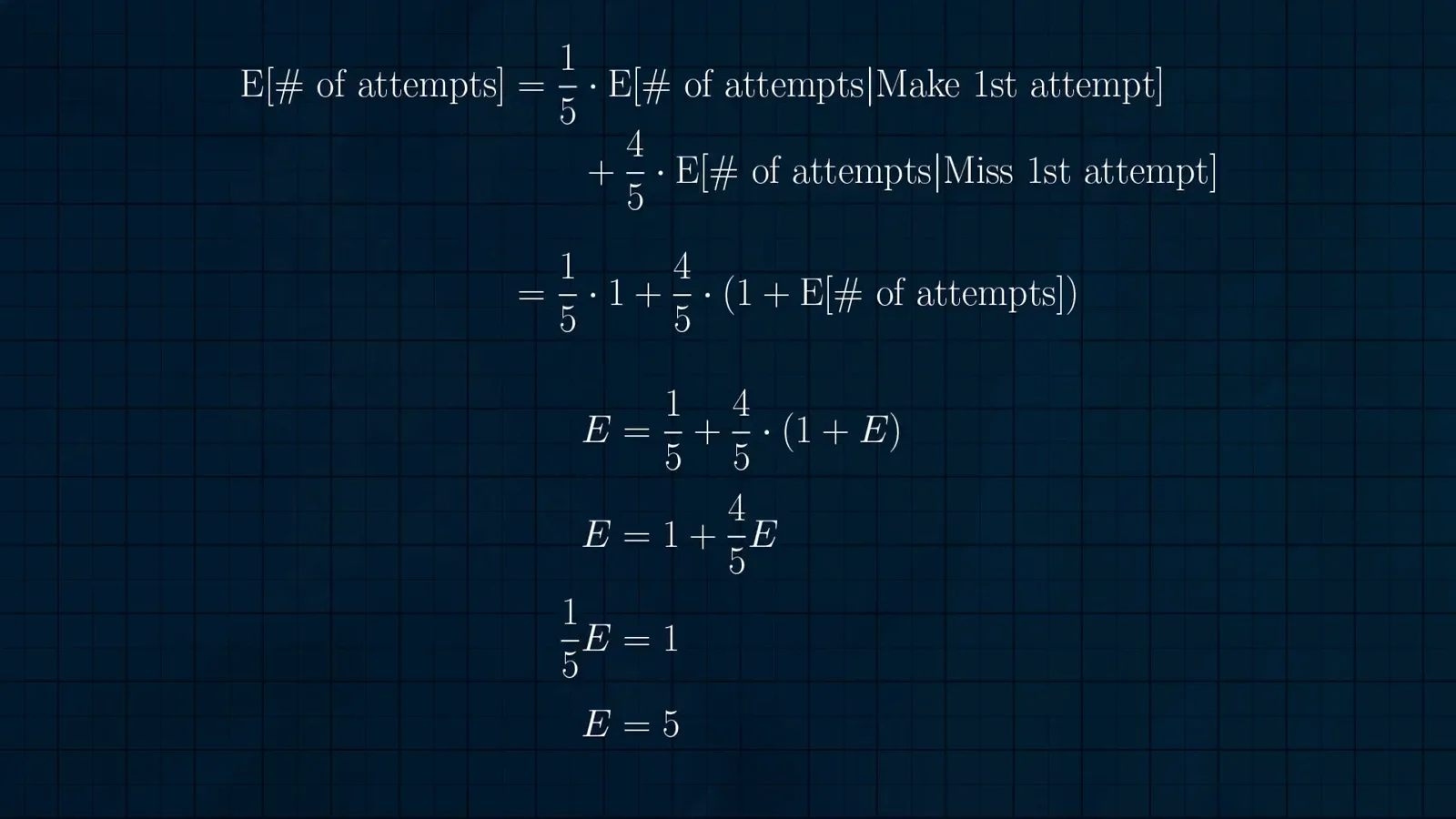
Recursion offers another proof. On the first shot Danielle either succeeds and stops, or misses and returns to the same situation as at the start. If E denotes the expected number of attempts, conditioning on the first shot gives E = (1/5)·1 + (4/5)·(1+E).
The first case costs exactly one shot; the second costs the missed shot plus another expected E shots. Simplifying gives E = 1 + (4/5)E, hence E/5 = 1 and E = 5. The reset after a miss is what makes the recursive equation possible.
We can also start directly from the definition of expectation. The model allows Danielle to continue after any number of misses, even a million. That is not a perfect description of real fatigue, but such extreme outcomes have tiny probabilities in this model.
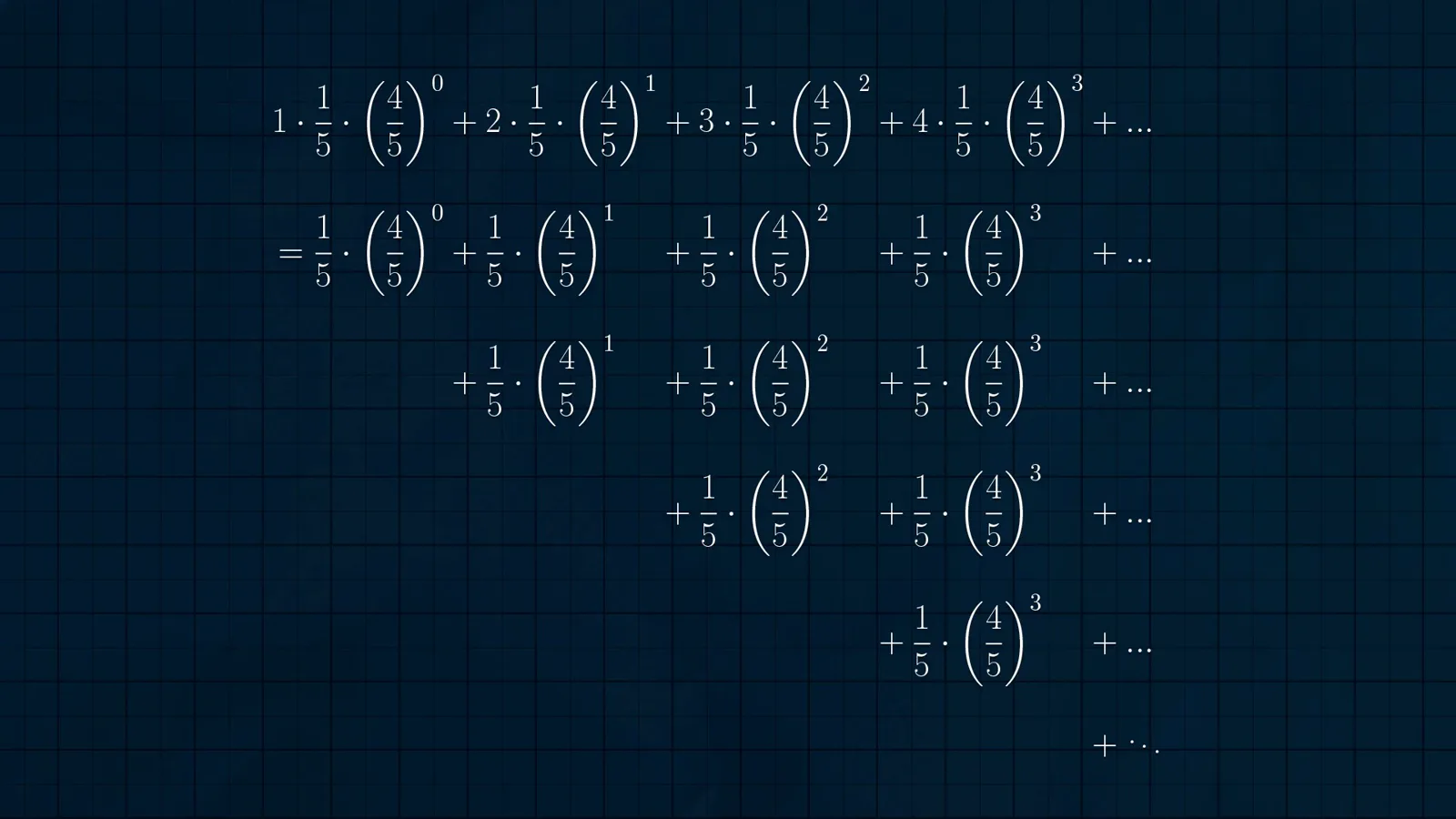
The probability that her first success is on attempt i is (4/5)^(i−1)(1/5): i−1 misses followed by a make. Thus E[N] = Σᵢ₌₁∞ i(1/5)(4/5)^(i−1). This is an arithmetico-geometric series because the integer coefficient grows with i.
To sum it, expand each term vertically into i identical copies. Each row is then a geometric series: the first sums to 1, the second to 4/5, the third to (4/5)², and so on. Their total is again 1/(1−4/5) = 5.
Calculus and long-run frequency
A derivative evaluates the series. Grouping many attempts into completed practices makes the initial intuition precise.
Calculus gives another route. Replace 4/5 by x while keeping the factor 1/5: the sum becomes (1/5)(1 + 2x + 3x² + ⋯). The expression in parentheses is the derivative of 1 + x + x² + ⋯ = 1/(1−x), for |x| < 1.
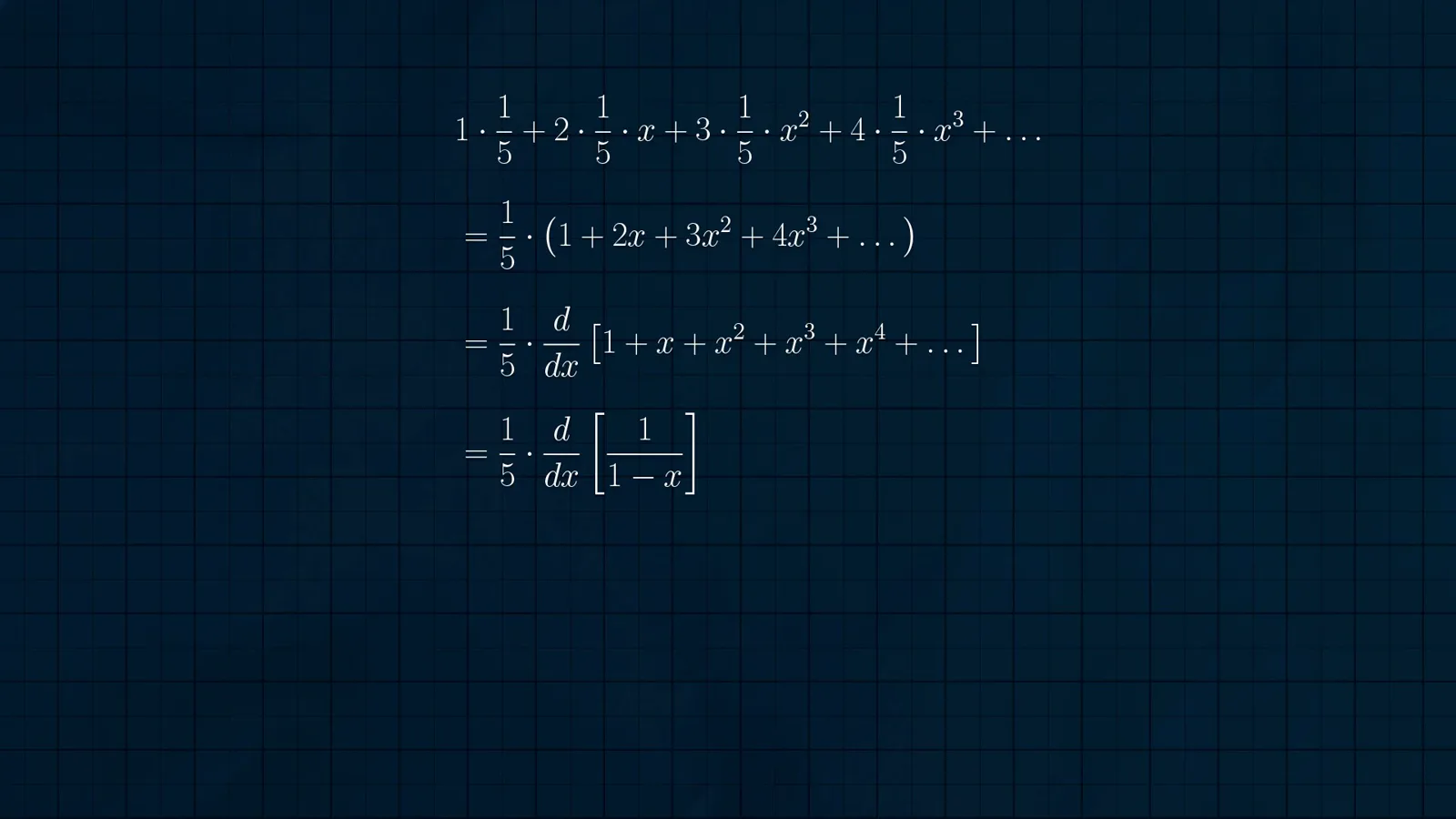
Differentiating gives (1/5)/(1−x)². Substituting x = 4/5 yields (1/5)/(1/5)² = 5. This evaluates the same infinite sum without rearranging it into rows.
The original intuition can also be made precise through a long-run experiment. Record many sequences of misses followed by a make, with each row representing one completed practice. The average number of attempts per practice is the total number of shots divided by the number of rows.
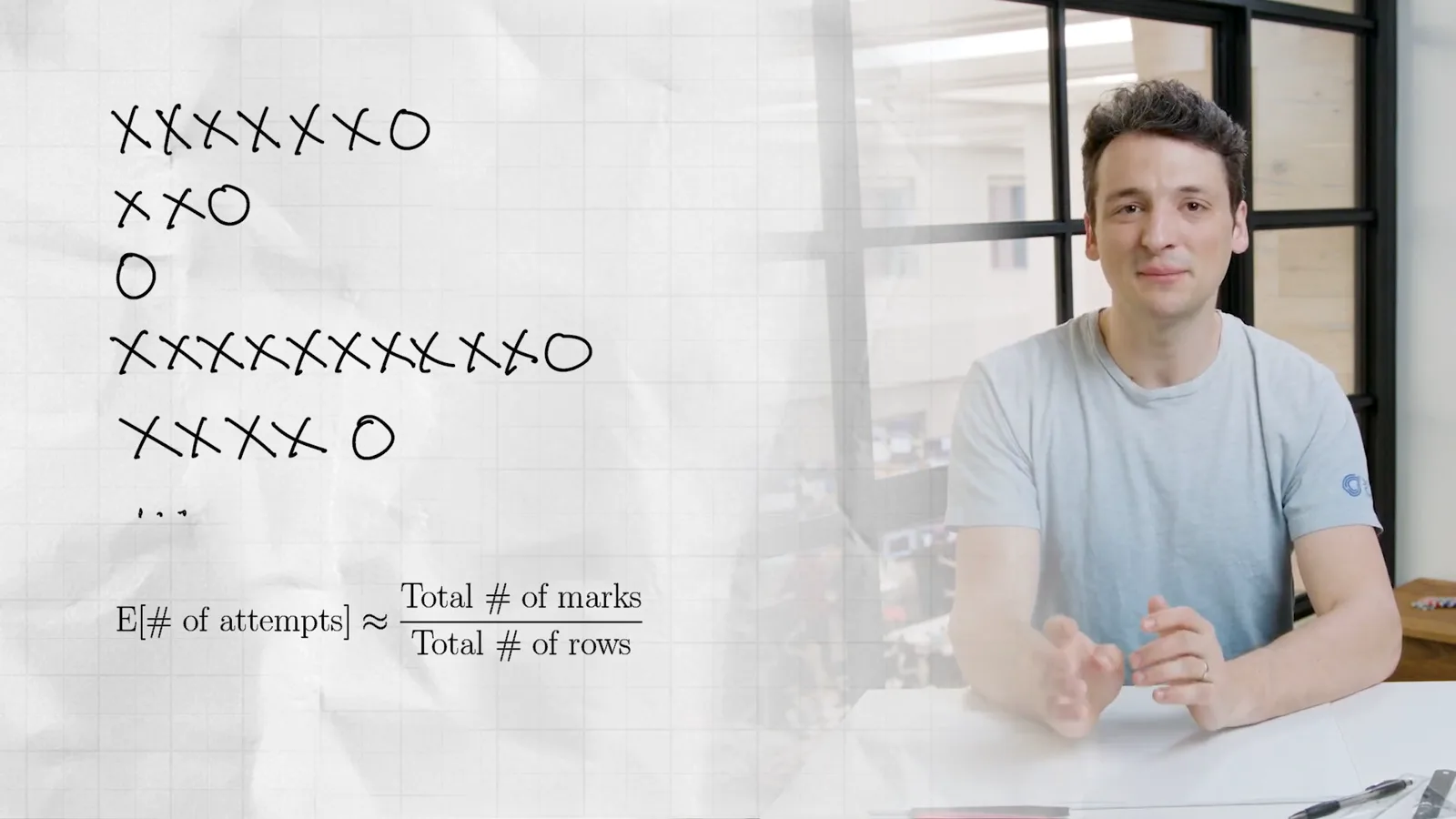
Each completed row contains exactly one made shot. Over a large sample, the fraction of shots made approaches 1/5, so the number of rows is approximately one-fifth of the number of shots. Their ratio approaches 5 attempts per completed practice.
Two consecutive makes
The bonus problem requires tracking whether one make has already occurred. Two recursive equations give an expected wait of 30 attempts.
For the bonus problem, Danielle shoots until she makes two consecutive shots. Two specified shots both succeed with probability 1/25, which might suggest 25 attempts, but that intuition does not account for what happens after partial progress and a miss.
Let X be the expected number of attempts from the beginning and Y the expected additional attempts after one make. On the first shot, a make costs one attempt and moves to Y; a miss costs one and returns to X. Thus X = (1/5)(1+Y) + (4/5)(1+X).
From the one-make state, the next shot succeeds with probability 1/5 and finishes the task, or misses with probability 4/5 and returns to the start. Therefore Y = (1/5)·1 + (4/5)(1+X) = 1 + (4/5)X.
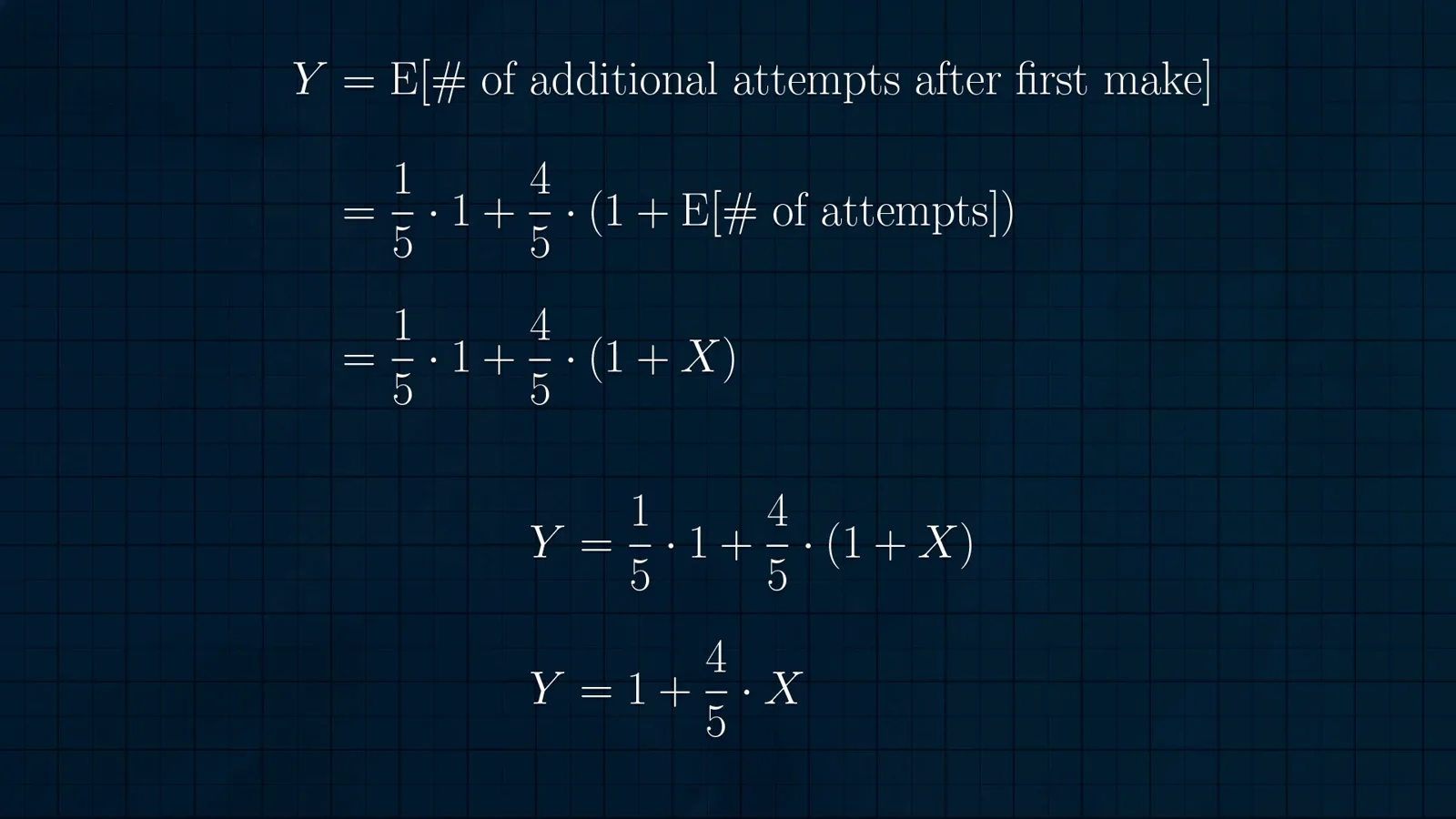
Substituting this expression into the first equation gives X = 30. The intuitive answer of 25 is wrong: a miss after a first make erases the partial run, so the waiting time must account for restarting. Sawyer invites viewers to find other approaches and generalizations.
同じチャンネルの記事
 1:48:29EN
 1:36:37EN
 1:05:45EN
 1:25:00EN
 1:16:29EN
 27:39EN