30 秒でわかる
In this short video, Matthew Berman reads Microsoft CEO Satya Nadella’s claims about a new material and a path to a million-qubit processor, then speculates about cryptographic consequences. Microsoft’s research and scaling plans are distinct from proof of a working million-qubit computer or a demonstrated ability to break encryption.
- 1Majorana 1 announcementBerman presents Microsoft’s quantum computing announcement and cites CEO Satya Nadella’s description of a new state of matter.
- 2A scaling goalNadella described qubits about one hundredth of a millimeter in size and a path to one million qubits; that is an architectural ambition, not an achieved machine.
- 3Cryptographic riskBerman raises potential threats to internet security and cryptocurrency. The video supplies no evidence that the announced device can break cryptography in seconds.
ポイント
- Microsoft announced Majorana 1 in February 2025 and described a proposed architecture intended to scale to a million qubits.
- The company’s claim of topological qubits goes beyond what its contemporaneous Nature paper alone established; that paper described parity measurements compatible with multiple interpretations.
- A million-qubit machine was a goal, not the demonstrated size or proven capability of the announced chip.
- A sufficiently powerful future quantum computer could threaten some public-key cryptography, but Majorana 1 was not shown breaking encryption in seconds.
- Post-quantum cryptographic standards are being developed to address such future risks.
チャプターごとに整えた全文を読む
Microsoft’s topological claim
Berman introduces Majorana 1 and reads Nadella’s description of topoconductors. The underlying quantum claims require careful separation from the measurements published at the time.
Microsoft has announced Majorana 1, a quantum computing chip, and I want to look at CEO Satya Nadella’s explanation. He describes a new state of matter enabled by materials Microsoft calls topoconductors. That is Microsoft’s characterization of topological superconductivity, not an independently settled demonstration of a new everyday phase alongside solids, liquids and gases.
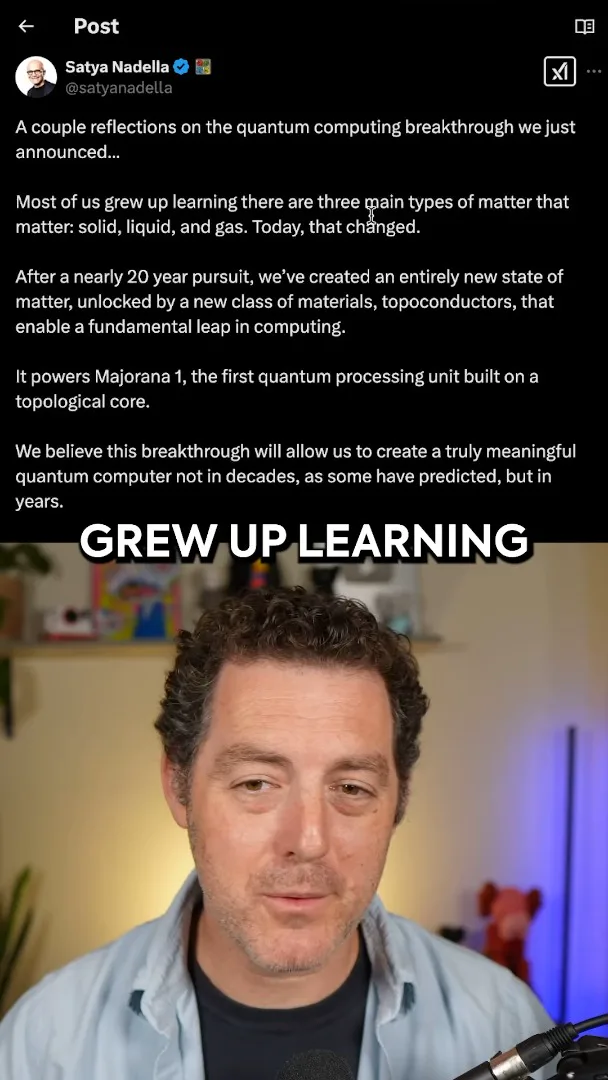
Microsoft says the approach could enable smaller, more reliable topological qubits. Its contemporaneous [Nature paper](https://www.nature.com/articles/s41586-024-08445-2) reported a single-shot parity measurement in a semiconductor–superconductor device; the authors state that this measurement alone cannot unequivocally distinguish a topological interpretation from a non-topological alternative. The company’s broader topological-qubit claim therefore exceeds what that paper alone established.
Scaling and cryptography
He discusses Microsoft’s proposed path to a million qubits and commercial applications. He then raises a possible future threat to encryption and cryptocurrency.
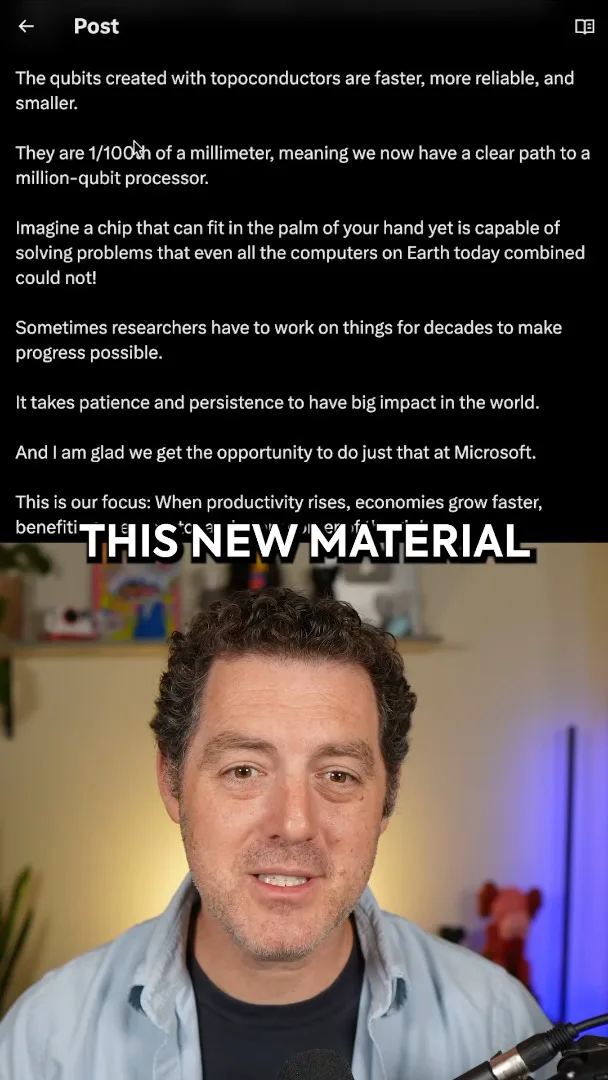
Nadella describes qubits about one hundredth of a millimeter in size and a path to a million-qubit processor. Microsoft’s [2025 announcement](https://azure.microsoft.com/en-us/blog/quantum/2025/02/19/microsoft-unveils-majorana-1-the-worlds-first-quantum-processor-powered-by-topological-qubits/) claimed eight topological qubits on a chip designed to scale toward one million. That proposed scaling is a research and engineering goal, not evidence that a million-qubit processor was already operating.
I also wonder what a powerful quantum computer could mean for internet security and cryptocurrency. The suggestion that this chip can break cryptography in seconds is not established by the announcement. A sufficiently capable future quantum computer could threaten certain public-key schemes, but different cryptographic algorithms face different risks; [NIST’s post-quantum cryptography program](https://www.nist.gov/cybersecurity-and-privacy/what-post-quantum-cryptography) is developing standards intended to resist such attacks.
同じチャンネルの記事
 34:21EN
 Matthew Berman· 2026年10月27日Matthew Berman Examines Anthropic’s IPO Filing, AI Growth and GovernanceMatthew Berman, Sam Altman · Forward FutureThe presenter reviews the S-1’s financial metrics, compute strategy and voting structure while questioning the tension between rapid AI development and safety.
 0:36ENMatthew Berman· 2026年10月25日Kimi K3.1 and a Rubik’s Cube Solver DemonstrationMatthew Berman · Forward FutureMatthew Berman shows a scrambled virtual cube being solved and gives the Kimi K3.1 test a favorable assessment.
 25:50ENMatthew Berman· 2026年10月24日Kimi K3.1 Pro Tested: Strong 3D Demos, Uneven Results and Competitive PricingMatthew Berman · Forward FutureMatthew Berman tests the open-weight model on coding, 3D rendering and visual explanations, then compares benchmark results and prices.
 32:20ENMatthew Berman· 2026年10月23日Who Is Local AI For? The Costs, Trade-offs and a Hybrid FutureMatthew Berman · Forward FutureMatthew Berman weighs data control and independence against hardware cost, setup complexity and inference speed.
 1:03:37ENMatthew Berman· 2026年10月23日Matthew Berman’s Team Tests Kimi K3.1 on Animation, Games, and ChartsMatthew Berman, Alex, Brian · Forward FutureA live team AMA turns into an informal test of Kimi K3.1, from personal-agent workflows to motion graphics, a browser game, and a benchmark chart.
 0:53ENMatthew Berman· 2026年10月22日Sam Altman on AI and the Discovery of New KnowledgeSam Altman · OpenAIAltman expects progress in mathematical discovery to extend to biology, materials and energy.