30 秒でわかる
In this April 2026 short, Matthew Berman describes a business flywheel in which a coding model attracts enterprise users and revenue, while data and computing capacity help develop and serve later models. He argues that a shortage of compute threatens that loop. His account is an interpretation, not a demonstrated breakdown or proof of a particular executive’s miscalculation. His suggestion that enterprise coding data automatically trains the next model needs qualification: Anthropic says it does not train on commercial customer data by default, while eligible organizations can explicitly opt in to share Claude Code sessions.
- 1A proposed flywheelBerman believes strong coding models generate enterprise demand and revenue, potentially funding further improvement.
- 2The data claim needs contextHe suggests enterprise code feeds training, but Anthropic says commercial data is not used by default and certain sharing requires explicit opt-in.
- 3Compute as a constraintBerman argues the company needs computing capacity to serve users and train models. His conclusion that the flywheel is breaking is an assessment rather than demonstrated proof.
ポイント
- Berman’s proposed flywheel links coding capabilities, enterprise demand, revenue, data and computing capacity.
- Anthropic says commercial customer data is not used for model training by default; optional programs permit eligible organizations to opt in.
- Compute is needed for both model training and serving users, but the short does not quantify Anthropic’s capacity or establish a business breakdown.
チャプターごとに整えた全文を読む
A coding-business flywheel
Berman describes a feedback loop driven by coding models and enterprise demand. He argues it faces a challenge.
I think Anthropic has built an unusually powerful business flywheel, though I believe it is now under strain. I attribute the problem to a miscalculation by CEO Dario Amodei, but this short does not provide the internal evidence needed to establish that claim.
My proposed loop starts with a strong coding model: businesses pay for coding use cases, generating revenue that can support the next generation. I also suggest enterprise coding data feeds model improvement. That data claim needs a qualification: Anthropic says it does not train on commercial customer data by default, and its [Development Partner Program](https://support.anthropic.com/en/articles/11174108-about-the-development-partner-program) allows eligible organizations to opt in to share Claude Code sessions.
The compute bottleneck
He says compute supports both serving and training. He interprets insufficient capacity as a threat to the loop.
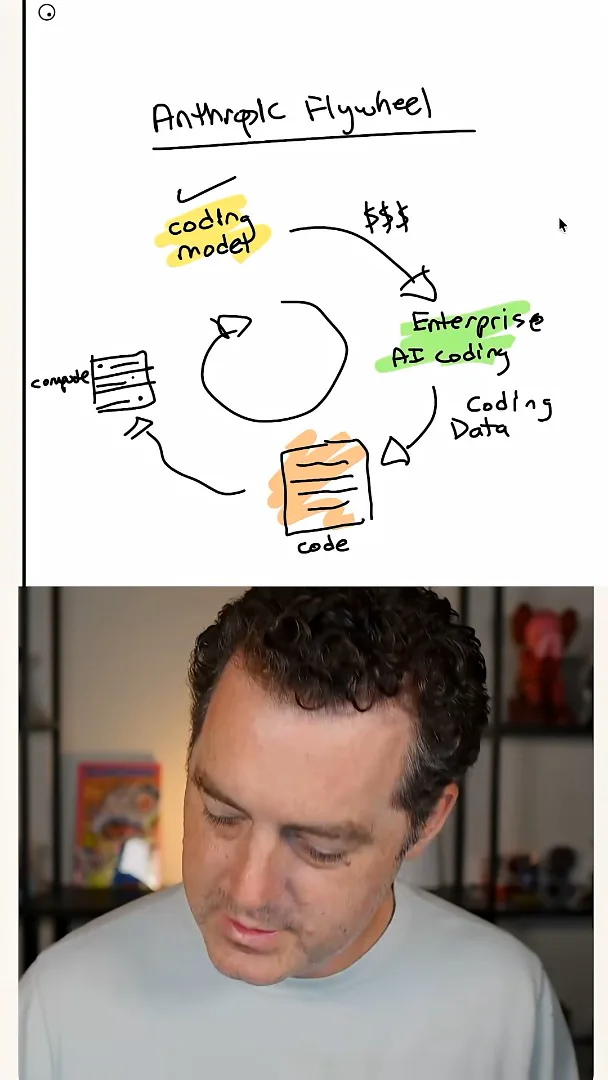
Compute is another part of the loop: it is needed both to serve a coding model to users and to train a successor. I believe insufficient capacity is putting the flywheel at risk. The video does not quantify the shortfall or demonstrate that the company’s business has broken down, so that conclusion remains my assessment.
同じチャンネルの記事
 34:21EN
 Matthew Berman· 2026年10月27日Matthew Berman Examines Anthropic’s IPO Filing, AI Growth and GovernanceMatthew Berman, Sam Altman · Forward FutureThe presenter reviews the S-1’s financial metrics, compute strategy and voting structure while questioning the tension between rapid AI development and safety.
 0:26ENMatthew Berman· 2026年10月25日Sam Altman on Human Values and Problem-Solving in an AI WorldSam Altman · OpenAIIn a short interview excerpt, Altman considers the enjoyment of solving hard problems and the human role in interpreting results.
 0:36ENMatthew Berman· 2026年10月25日Kimi K3.1 and a Rubik’s Cube Solver DemonstrationMatthew Berman · Forward FutureMatthew Berman shows a scrambled virtual cube being solved and gives the Kimi K3.1 test a favorable assessment.
 0:21ENMatthew Berman· 2026年10月24日An AI-Generated Kimi Benchmark Chart Used Invented ScoresMatthew Berman · Forward FutureMatthew Berman asks for a graph of Kimi K3.1 Pro benchmarks, then discovers that the displayed figures are illustrative placeholders.
 25:50ENMatthew Berman· 2026年10月24日Kimi K3.1 Pro Tested: Strong 3D Demos, Uneven Results and Competitive PricingMatthew Berman · Forward FutureMatthew Berman tests the open-weight model on coding, 3D rendering and visual explanations, then compares benchmark results and prices.
 32:20ENMatthew Berman· 2026年10月23日Who Is Local AI For? The Costs, Trade-offs and a Hybrid FutureMatthew Berman · Forward FutureMatthew Berman weighs data control and independence against hardware cost, setup complexity and inference speed.