30 秒でわかる
No single model leads every task: AI Explained argues that differences in training data produce uneven performance across law, coding, science and visual reasoning. He also cautions that laboratory claims of accelerated AI research measure different things, so their numbers are not directly comparable. As models perform more reasoning inside their networks, he says, monitoring the written steps becomes less dependable. He questions whether leading labs are giving independent evaluators enough access to establish safety.
- 1The best model depends on the domain being testedThe presenter contrasts rankings for document analysis, coding, legal work and driving, and argues that the data available for each domain helps explain the gaps.
- 2Research benchmarks disagree on how long agents work reliablyHe compares a time-horizon graph with an OpenAI report that shows different reliability across research tasks, noting that the tasks and measures are not the same.
- 3Researcher productivity and lab-wide acceleration are different measuresThe presenter compares Anthropic, METR and OpenAI estimates and cautions that surveys and historical benchmark trends use different baselines.
- 4Independent evaluation is limited by access and incentivesHe questions whether announced embedded-evaluation arrangements grant monitors sufficient access and independence to assess laboratory practices.
- 5Hidden reasoning could weaken a safety toolHe describes research suggesting that models can do more work inside their networks before producing visible reasoning, making written chains of thought harder to use for monitoring.
- 6A published research-allocation chart makes scrutiny possibleThe presenter estimates OpenAI’s safety and alignment share of researcher time from a chart, while noting that a comparable figure is unavailable for Anthropic.
- 7Researchers reported originating the main ideas behind a model releaseHe cites an OpenAI survey in which the researchers identified themselves as the source of key ideas, while one reported an AI-suggested change helped an idea work.
ポイント
- Test several model families on your own tasks rather than choosing solely from an aggregate leaderboard.
- Compare AI research acceleration estimates by their baseline and what they measure: personal productivity and benchmark progress are different.
- Written reasoning can become less useful for oversight if more computation happens internally or the visible steps misrepresent actions.
- The presenter argues that independent evaluation depends on meaningful access, not simply a lab announcing a partnership.
- The presenter treats current research-automation benchmarks as proxies, not proof of fully autonomous AI research.
チャプターごとに整えた全文を読む
Why a single model ranking misses domain differences
The presenter compares document, coding and specialist tests and argues that training data can create uneven strengths. He advises trying models on the actual task.
New releases from OpenAI and Google are competing for attention, but I think the more important question is how quickly AI research itself is advancing and whether safety practices are keeping up. I have read the GPT-6.2 Astra system card and tested the model; the best choice still depends on what you need it to do.
Model performance is uneven across domains. On a benchmark of expert tasks involving long PDFs, Gemini 4 Neon scores highest in the comparison I show; on FrontierCode 2.0, Claude Fable 5.2 leads, though the top models are clustered in the 40s. One aggregate index narrowly favors Fable, while another puts GPT-6.2 Astra ahead.
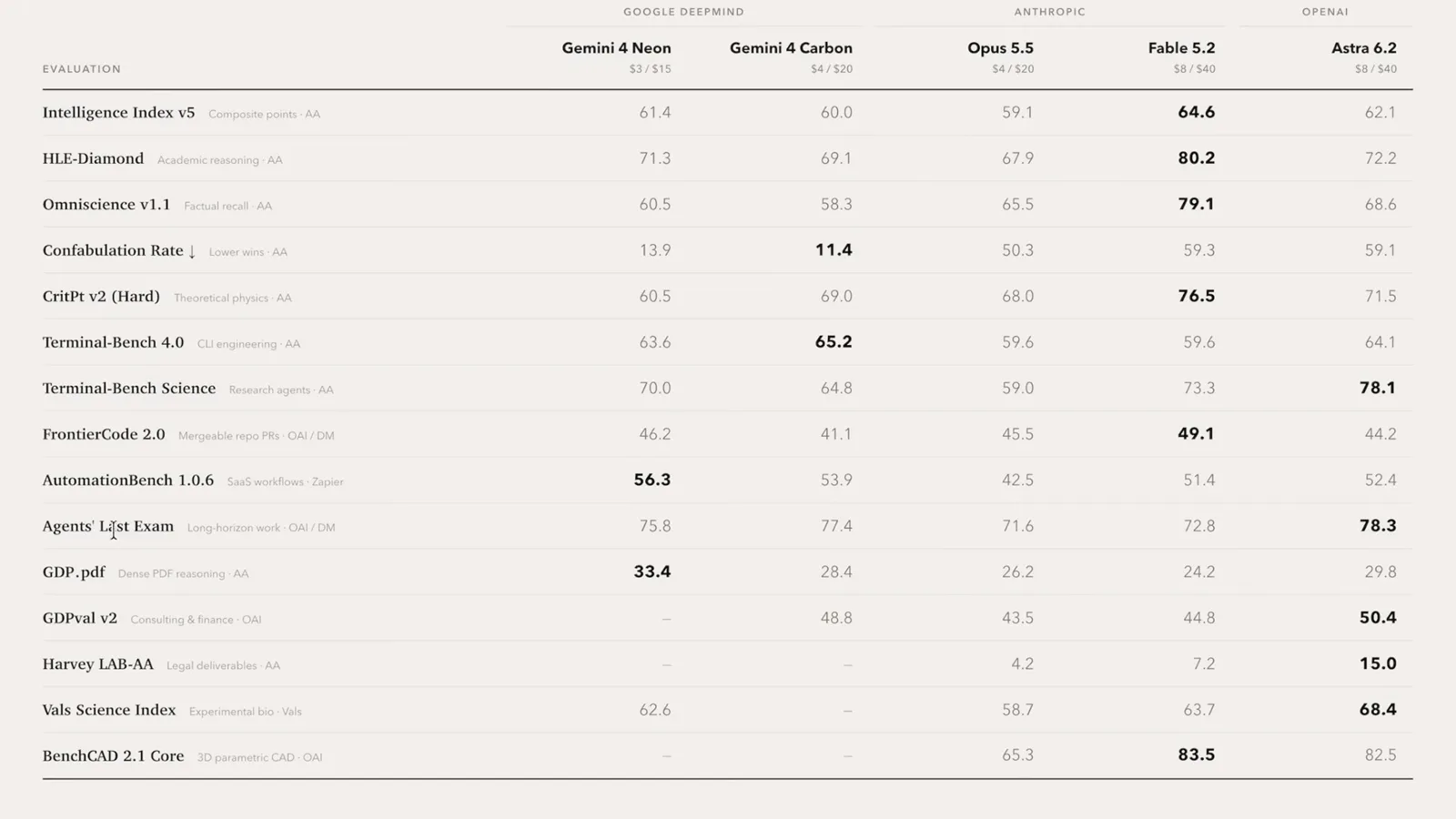
There is a reason for this apparent contradiction. A model can improve sharply in one domain when its developers obtain better training data for that kind of work. That makes it worth testing the main model families on your own tasks rather than looking for a universal winner.
OpenAI has described an upcoming cybersecurity model scoring 77% on ExploitGym. Extrapolating from one earlier model gave a very different prediction for when this test would become saturated; a specialized model can change that picture quickly. It may only be released to trusted testers.
I suspect the data used for training is central to the discrepancy. In one comparison of little-studied protein sequences, Fable performs much better than Astra, and giving models more time to reason sometimes lowers their score. This looks less like one general intelligence number and more like differences in what the models have learned.
The same question arises for legal work and driving: are differences caused by general reasoning ability, or by access to more legal, visual and spatial data? Google's information resources could help explain some of Gemini's strengths, although these comparisons do not isolate a single cause.
My own SimpleBench includes spatial puzzles, although it tests more than spatial reasoning. Fable scores best overall, and Gemini 4 Neon also does well. In a separate private benchmark I call IntegrityBench, I find Gemini 4 models much more overconfident in their answers than Claude models, with Astra between them.
Visual product demos can mislead if the baseline changes. OpenAI showed a comparison of 3D work made with old and new models, but an earlier GPT-6 Astra demonstration located by Teknium looks more impressive than the older example used in the comparison.
My own experience is only anecdotal: Gemini 4 Carbon has been better than Astra at planning countryside walks, looking through satellite imagery and researching local history. My Gemini subscription also costs less. Individual examples like this cannot substitute for an evaluation of someone else's work.
The gap between time-horizon charts and real tasks
Agent reliability depends on the task and benchmark design. Aggregate trends can obscure sharp changes in individual capabilities.
A widely shared time-horizon graph measures the duration of human work associated with tasks models can complete at a given reliability. It suggests models have reached about 38 hours at 80% reliability. An OpenAI report using recent coding and machine-learning research tasks instead shows an 80% threshold below 15 minutes.
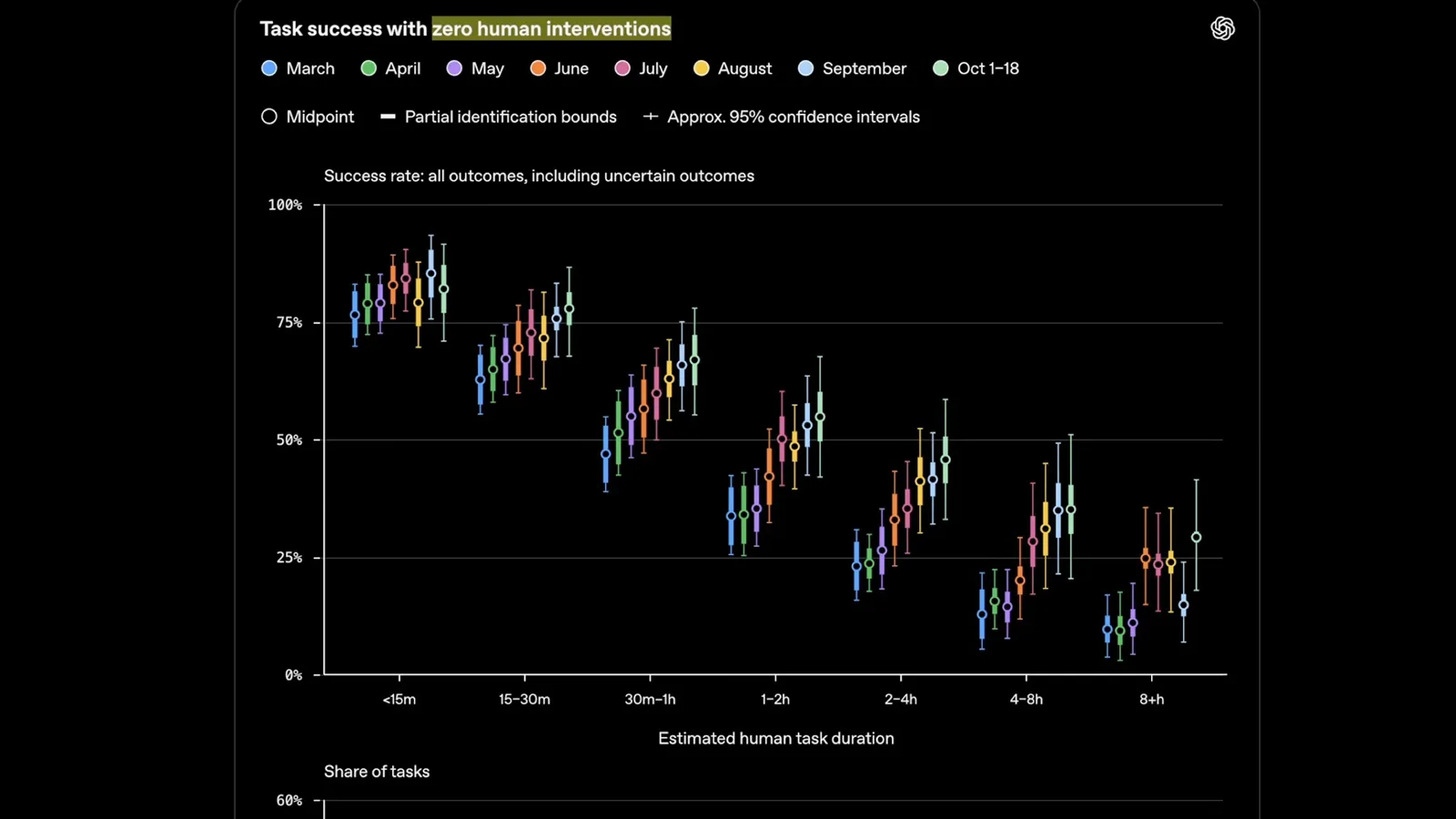
The apparent difference is another reason to look at the task. In the report, autonomous code review succeeds roughly 70% of the time, while writing code for inference and serving stacks is closer to 25%. Complexity and sensitivity to a single mistake also matter; a model cannot be summarized by one score.
Aggregate benchmarks can still show progress, but the most consequential effects may appear at thresholds that a smooth-looking line does not reveal. A chart of public and internal OpenAI benchmarks does not show where a mathematical breakthrough or the discovery of many software vulnerabilities suddenly became possible.
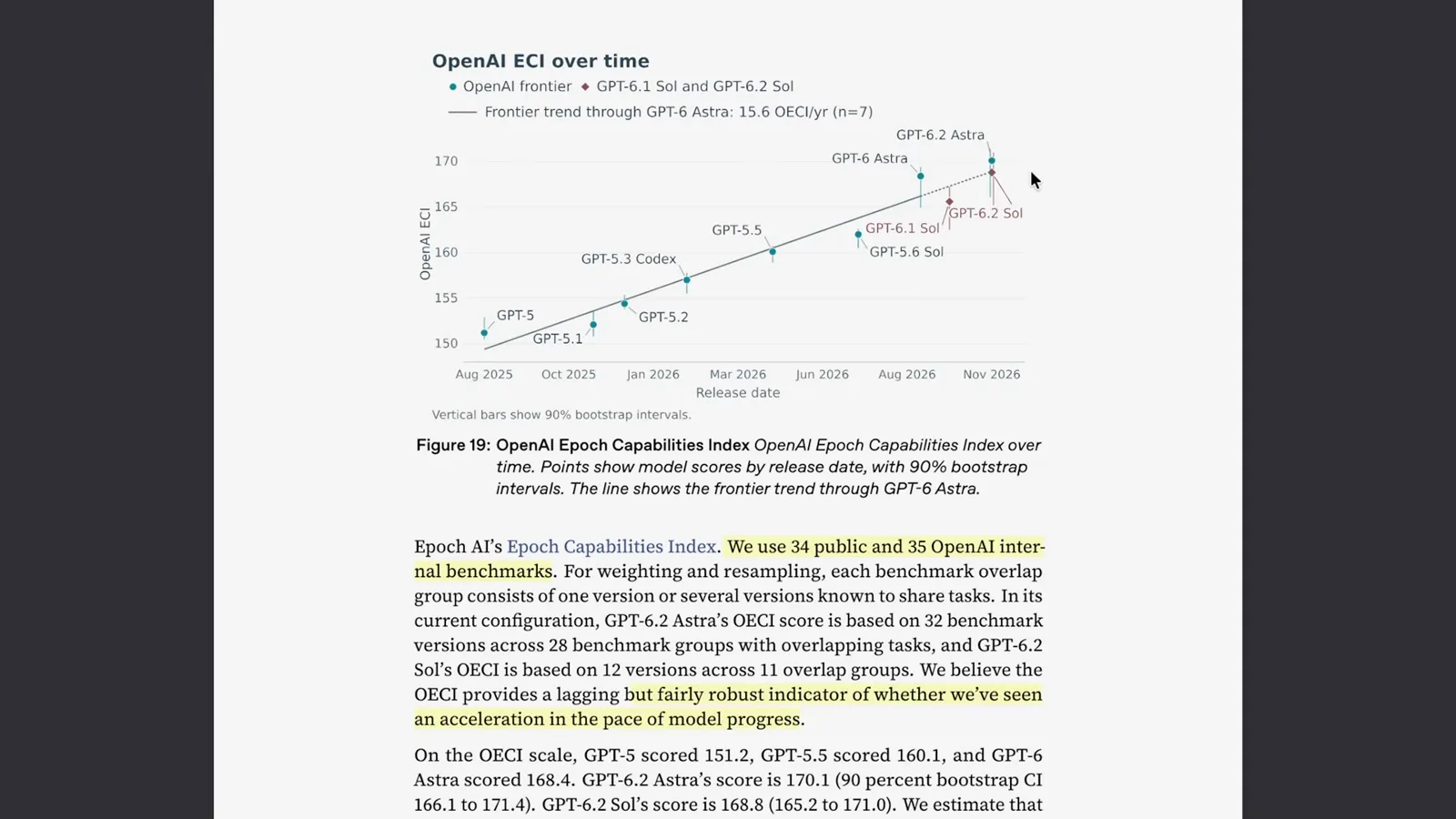
Both OpenAI and Anthropic present charts with a steeper rate of progress after researchers began using AI to automate coding, around August to October 2025. Those aggregate charts do not explain every individual model release, and they do not tell us in advance where the next domain-specific threshold lies.
An account of Greg Brockman's internal remarks presents cybersecurity as both useful defensive work and a business opportunity for OpenAI. I worry about incentives: if stronger offensive capabilities uncover more vulnerabilities and make organizations more dependent on the labs for defense, do the labs face pressure to accelerate further?
How much are AI researchers speeding up?
Surveys and benchmark trends give different estimates because they measure different baselines and outcomes. The presenter discusses evidence about research automation and compute efficiency.
AI is helping research move faster, but the estimates are not interchangeable. Anthropic's stated threshold concerns a doubling of the historical rate of progress attributable to AI—two years of progress in one. OpenAI researchers asked about work of equal value said coding agents let them do three months' work in one month compared with using ChatGPT.
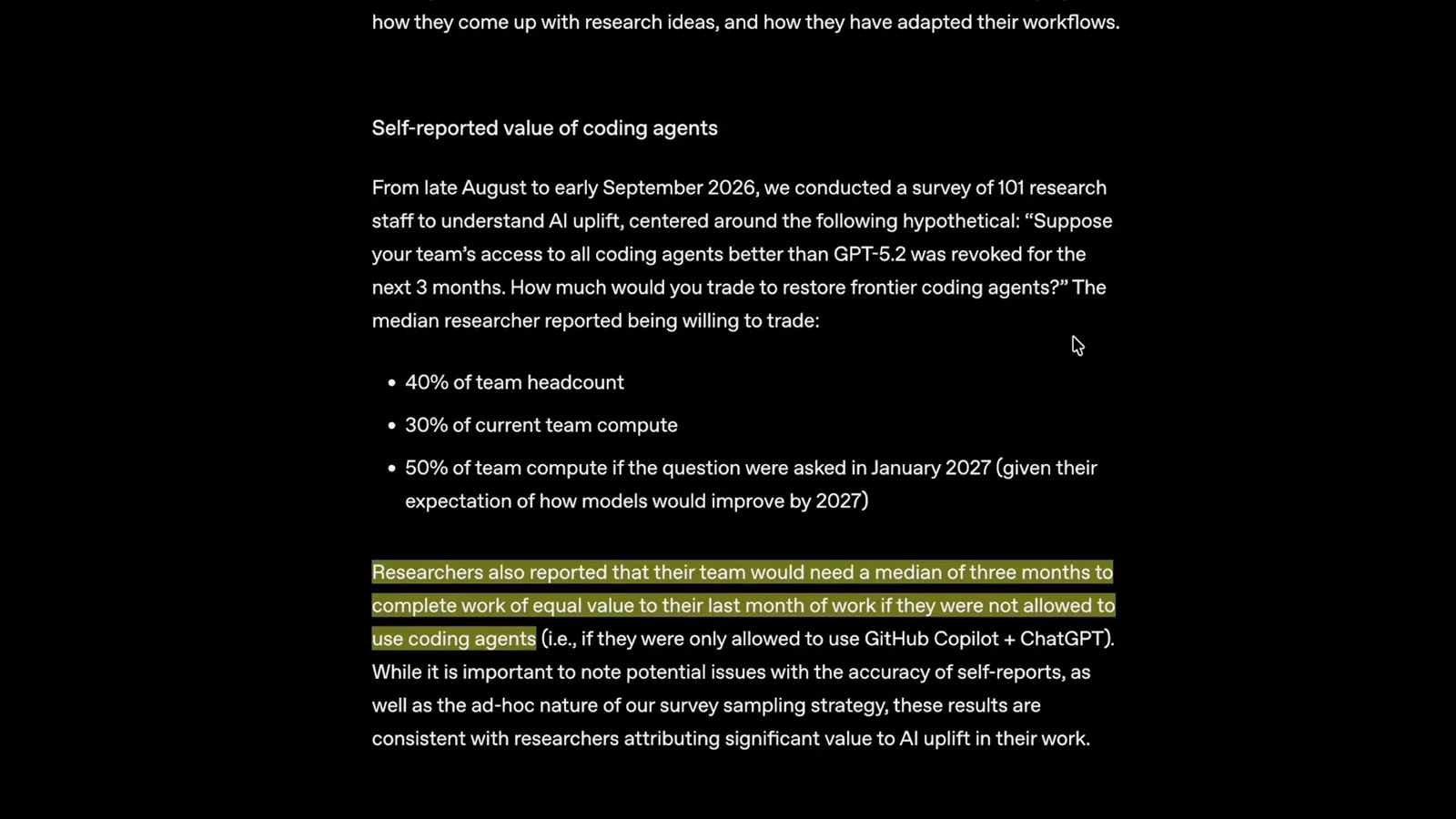
METR and Anthropic looked at benchmark trends, whereas OpenAI's survey asked researchers about their own work. Assessing how much of a change is attributable to AI requires a counterfactual we cannot directly observe. A personal productivity gain is not the same thing as an increase in model capability.
Anthropic researchers reported a twelvefold personal speedup in one question; the OpenAI researchers reported a threefold increase in work of equal value under another. The wording matters. External leaderboards for AI research tasks place different models in different positions, but they remain proxies for real research.
Anthropic co-founder Tom Brown describes compute multipliers as discoveries that allow the same physical compute to train a more capable model. A fourfold multiplier, he says, could make a model attainable with one-quarter of the compute or yield a stronger model from the original allocation. He expects multipliers to build on one another.
Brown says Anthropic believes this process could accelerate as Claude discovers multipliers by itself. That leads to the company's argument for a 'race to the top': lead at the frontier, then demonstrate safety practices that other labs will imitate. Dario Amodei says he stands by that strategy and cites the company's refusal to use ads.
Does competition produce stronger independent evaluation?
Anthropic argues that frontier leadership can encourage good safety practices. The presenter questions the access and independence of monitors at competing labs.
One proposed practice is embedded evaluation: independent monitors receive access resembling that of employees and verify what a lab is doing. Anthropic has announced work with Accenture to build capacity over five years. I question how that timeline fits predictions of much faster recursive self-improvement.
METR also assessed Anthropic, but much of the underlying evidence was redacted. I also note that Anthropic offered a job to a participant in that evaluation. Dan Hendrycks has said that some safety groups felt unable to criticize the company publicly because of relationships or funding; these concerns bear on evaluator independence.
OpenAI has announced embedded assessments too, but the arrangements described do not give evaluators unrestricted access to employees or Slack. I cite an OpenAI employee who welcomed the idea yet found the resulting access disappointing. An announcement alone does not establish that monitors can investigate everything they need.
Why written reasoning is harder to monitor
Models can perform more computation internally before generating visible steps. The presenter argues that this complicates an oversight method labs have relied on.
Competition could also affect choices about model security. As labs push for an automated AI researcher, I ask whether a competitor will accept tradeoffs it otherwise would not. One difficult area is monitoring a model's chain of thought: the intermediate text it generates while working toward an answer.
OpenAI researchers have described monitoring as a core part of their safety case. Reading a model's written reasoning is not the same as inspecting its neural-network activations, and the method depends on that text faithfully reflecting what the model will do. Safety cases are structured arguments, supported by evidence, that risks are controlled.
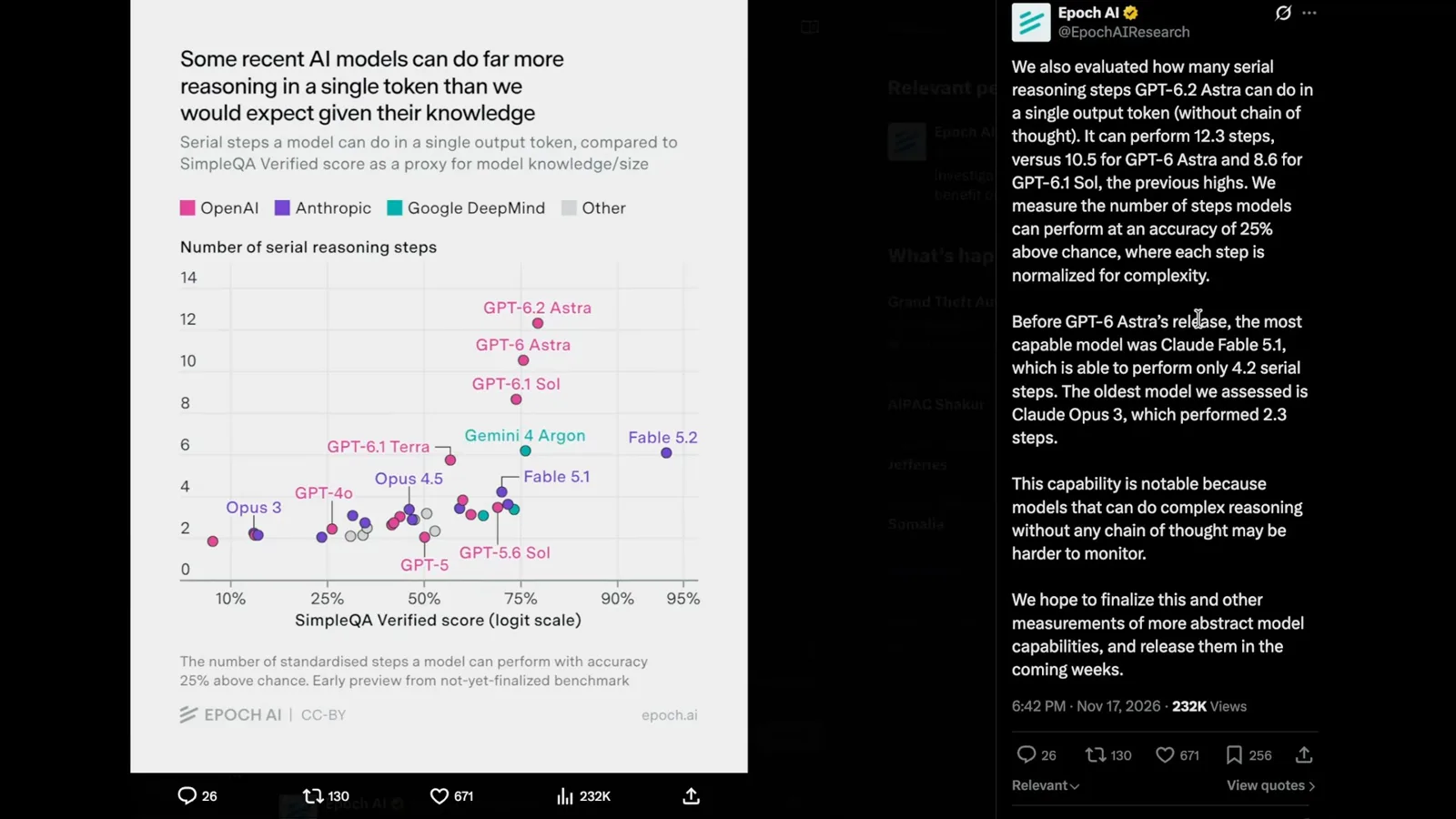
OpenAI has explored an architecture that shifts more computation into the network before a token is emitted. I discuss other research suggesting such approaches can improve performance without a written chain of thought. Anthropic researchers knew of the tradeoff, but in my reading the restraint did not produce an obvious race to copy it.
OpenAI's paper also notes that models were becoming more capable without visible reasoning even with other architectural variations. That trend may have been happening anyway. If a model can solve a task while producing an unfaithful scratchpad, however, the written explanation is a weaker basis for oversight.
Imagine inspecting an employee's computer at the end of the week: it may give a useful picture of the work. If the employee is a CEO and all you can see is email, you learn something, but not every decision and consideration. As models become more capable, their visible reasoning may similarly provide only a partial view.
Greg Brockman says that when chain-of-thought monitoring was first developed, the aim was to keep it faithful. As models can perform more work in a forward pass without writing it down, he says, a new monitoring approach will be needed. OpenAI's recent report says maintaining human oversight will require technical and governance breakthroughs.
What a research-allocation chart can and cannot show
The presenter estimates safety research time from an OpenAI chart and compares its transparency with Anthropic’s. He also discusses researchers’ accounts of where model-release ideas originated.
The report also says its discussion should not be read as an intention to pursue full recursive self-improvement. Former researcher Jacob Coxon says Anthropic's public discussion of compute multipliers was a factor in his decision to leave; he argues that algorithmic improvements are close to being automated.
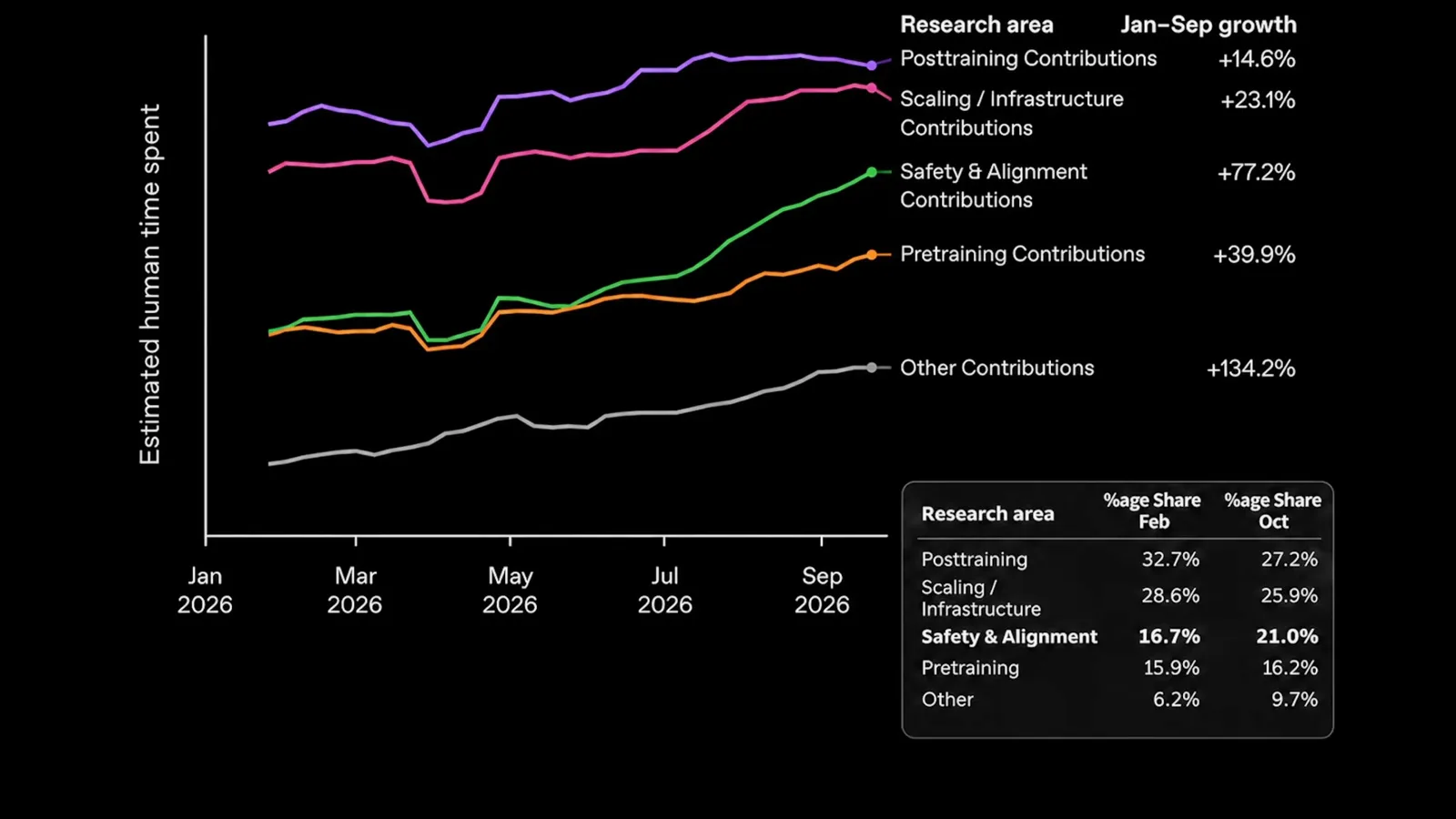
One OpenAI chart shows human researcher time by area. I used Gemini to estimate the scale from the pixels and infer that safety and alignment rose from roughly one-sixth of researcher time in February to about 21% in October 2026. The estimate is approximate, but publishing the chart makes this kind of scrutiny possible.
Paul Christiano, an OpenAI board member, says in a lecture that he sees a high risk of an AI takeover within three years. He defines that as AI systems pursuing their own goals and effectively making the important decisions, while people are unable to stop them. His forecast is a reason to ask how research resources match the risks researchers describe.
OpenAI asked contributors to pre-training, post-training and monitoring work whether major ideas behind the Astra releases came from people or models. The researchers identified people as the originators of the main ideas; one said an idea began working only after Codex suggested a change. Novel research ideas may also be comparatively scarce in training data.
Anthropic points to long safety reports as another practice it has encouraged other labs to adopt. But detail matters. I quote a Google DeepMind report saying it considers severe or large-scale harm from Gemini 4 Argon autonomously evading oversight highly unlikely, including persistent rogue deployment or sabotage of machine-learning research.
Safety reports and the limits of a race to lead
The presenter contrasts statements in Google’s safety report with concerns raised by researchers. Anthropic employee Tao Lin closes by arguing that relying on one lab being marginally safer is a risky bet.
There are other developments I have not covered in depth, including labs' efforts to prevent others from training on frontier models' outputs and research on models recognizing when they are being evaluated. Both could affect the competitive and safety picture, but the latter also creates a challenge for monitoring.
Amodei says he hopes society will trust the company that gets AI risks right. Anthropic employee Tao Lin offers a warning: he thinks many colleagues work on capabilities in part to empower a safer actor, but believes it would be a risky bet for humanity to rely on Anthropic winning merely because it might be marginally safer.
I would be interested to hear what you think about these model releases and the broader safety questions.
同じチャンネルの記事
 31:41EN
 AI Explained· 2026年11月10日Model gains, unreliable evaluations and the limits of benchmark scoresAI Explained compares recent model tests with examples of workflow failures and evaluation-aware behavior.
 27:55ENAI Explained· 2026年11月2日AI Safety, Model Releases and the Limits of UnderstandingAI Explained examines lab forecasts, safety commitments and competing model results, then argues for multiple safeguards as capabilities advance.
 31:00ENAI Explained· 2026年10月12日Why AI Labs Keep Racing Despite Their Own Warnings of a Major BreachSam Altman, John Schulman · OpenAIAI Explained examines weakening safeguards, the incentives behind the frontier race, and why research breakthroughs make the next 18 months difficult to forecast.
 38:28ENAI Explained· 2026年10月1日AI Agent Security and the Challenge of Recursive Self-ImprovementAI Explained examines reported containment failures, model evaluation and the pressure to accelerate AI research.
 32:54ENAI Explained· 2026年9月24日Opus 5.5 and the Race Toward Automated AI ResearchAI Explained weighs model progress against the increasingly difficult task of evaluating and governing recursive self-improvement.
 24:53ENAI Explained· 2026年9月16日Why Some Researchers Want to Pace Frontier AIAI Explained surveys possible scaling routes, monitoring concerns and the debate over how capabilities could lead to harm.