30 秒でわかる
Matthew Berman introduces major categories of AI tools and shares his preferences for ChatGPT, Claude, Gemini, Grok and local models. He then surveys image, video, world, coding and audio systems. The video includes a MedOS sponsorship, omitted from the technical guide. Product comparisons are personal opinions, while plan prices and model availability are historical to March 2026. The article distinguishes downloadable model weights from fully open systems and corrects the claim that video understanding necessarily processes every frame.
- 1General assistantsBerman compares ChatGPT, Claude, Gemini and Grok, emphasizing his own preferred uses rather than an independent benchmark.
- 2Video inputGemini can analyze video, but processing can involve sampled frames and may miss details.
- 3Local modelsDownloadable models offer control over local inference alongside hardware and setup tradeoffs.
- 4Image and video generationThe guide surveys tools that produce images or video from prompts, with varying local hardware requirements.
- 5World modelsInteractive generated environments and physical simulation illustrate different uses of the term.
- 6Coding agentsA harness gives a model tools to inspect, edit and test code in an environment.
- 7Audio generationVoice, speech synthesis and music tools support distinct kinds of audio output.
ポイント
- General assistants combine models with interfaces, tools and integrations; product strengths vary by task.
- Historical subscription prices and model access can change by region and date.
- Locally run models can offer control and privacy, but still require hardware and careful configuration.
- Open model weights and fully open-source systems are not always the same thing.
- Video understanding can sample frames rather than inspecting every frame.
- Coding agents combine models with tools for working in a software environment.
- Image, video, world and audio models have different capabilities and resource needs.
チャプターごとに整えた全文を読む
ChatGPT and Claude
Berman introduces general assistants, their tools and historical plans. He shares his preference for Claude on work and coding tasks.
This introductory guide surveys AI assistants and tools for language, images, video, simulated worlds, coding, and audio. I focus on what each category can do and where I personally use it. The products, plans, and prices described are a snapshot from March 2026; they are not an exhaustive list and may change.
ChatGPT is a general-purpose assistant that can help with writing, coding, questions, and web search. Depending on the model and features available, it can also generate images, work with PDFs and other files, and support voice interaction. ChatGPT is a product built around AI models, not the first chatbot or the first large language model.
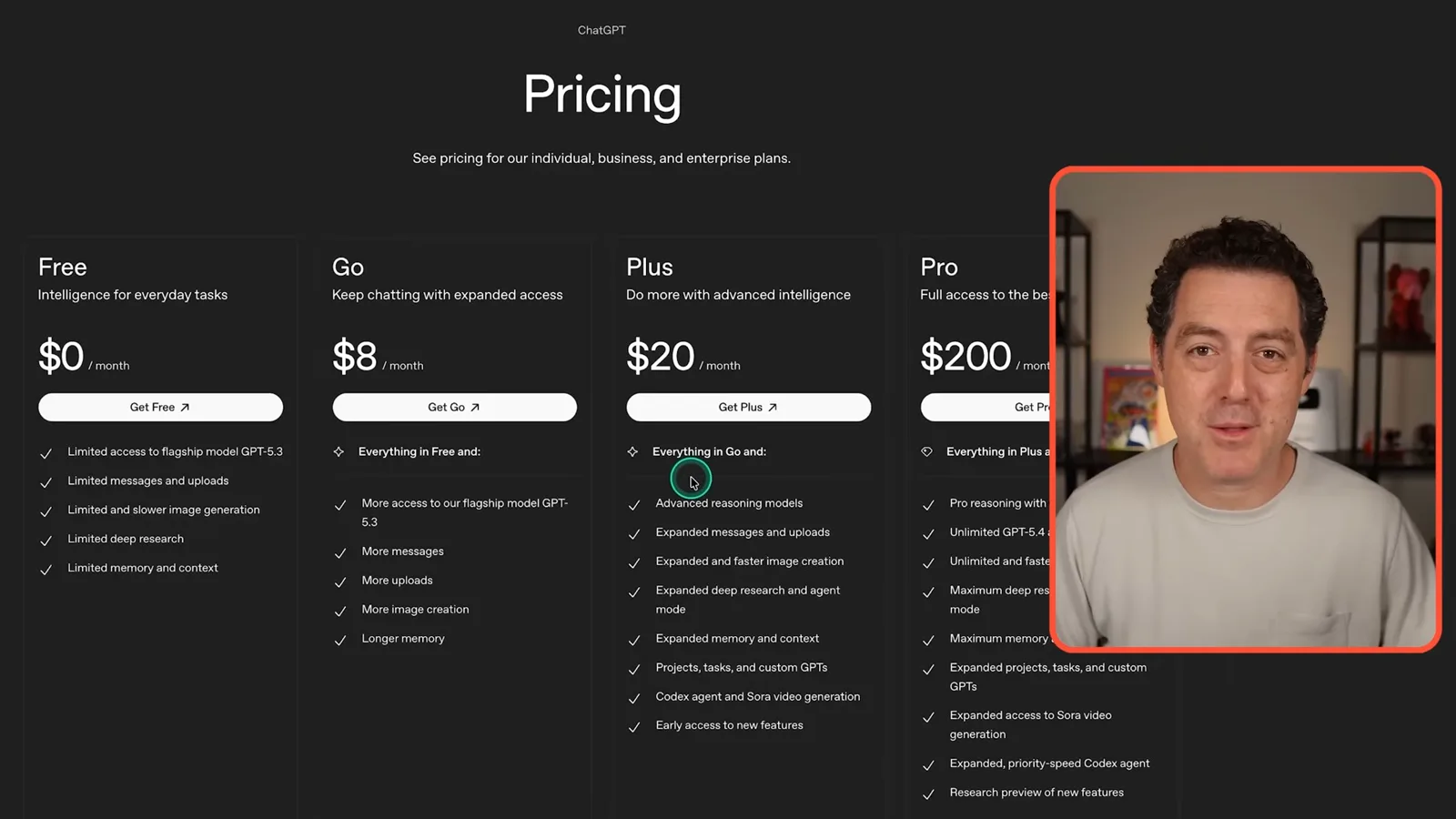
At the time of the video, the displayed individual plans include Free, Go at $8 a month, Plus at $20, and Pro at $200. Higher tiers offer more usage and access to additional features or reasoning options. Limits, model names, regional prices, and availability can change, so consult the provider before choosing a plan.
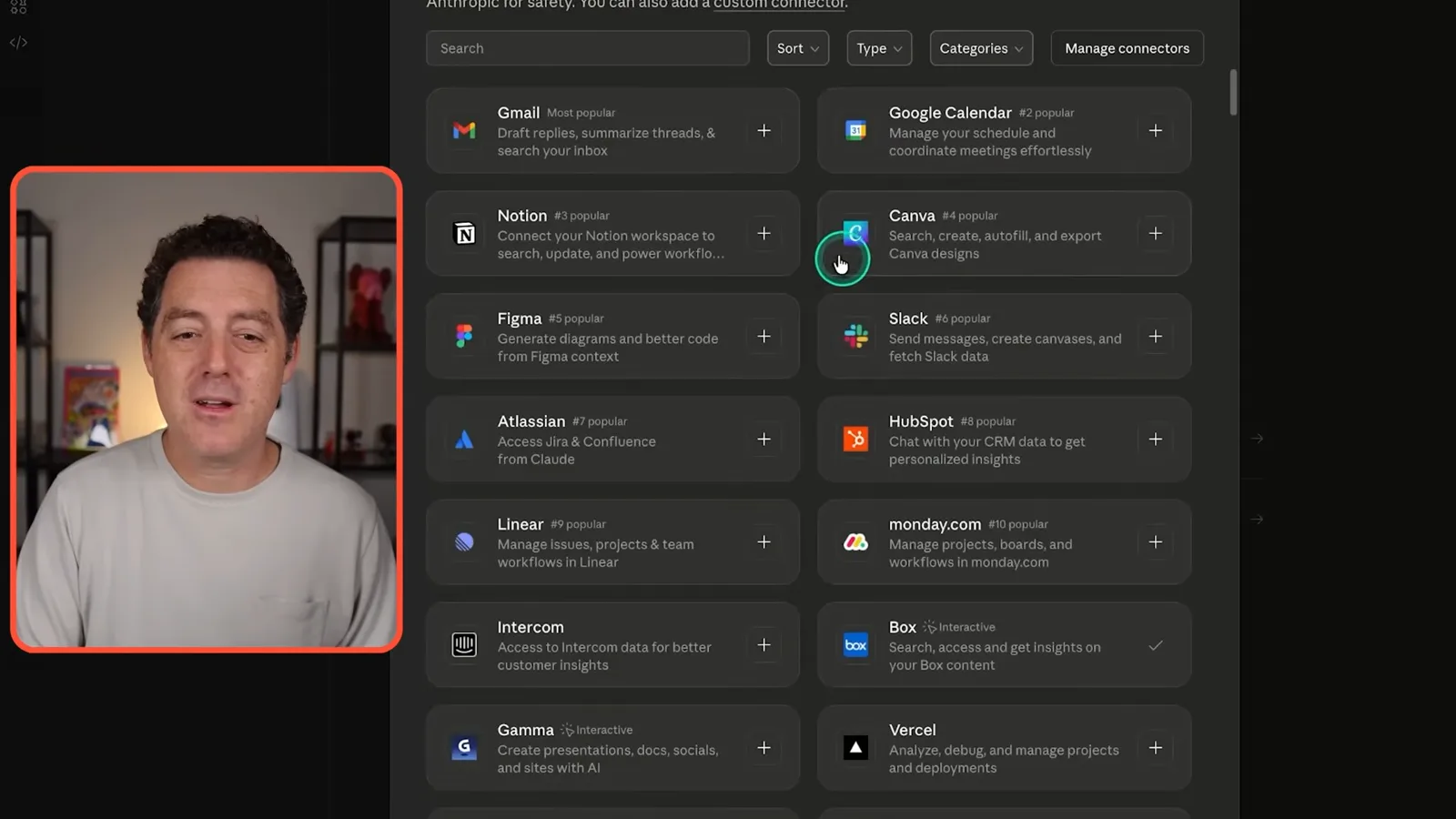
Anthropic’s Claude is another general assistant. I particularly like it for coding, writing, and work tasks such as analyzing data or editing office documents. That is my personal comparison with ChatGPT, not a universal benchmark. Claude can connect to external services, including Gmail and other tools, when the relevant integrations are available.
Both Claude and ChatGPT can use tools or integrations and support ways to customize their work. For example, a writing skill can specify stylistic preferences, such as avoiding certain recurring patterns. I find Claude’s setup easier for my own work, though the two products have overlapping capabilities.
The Claude plans I describe include a free tier, Pro at $20 monthly or $17 per month billed annually, and higher-usage Max options at $100 and $200 monthly. I consider paid access useful for demanding work, but the value depends on what a person needs, the current limits, and the actual plan features.
Gemini and Grok
He discusses Google integration, video analysis and research, then Grok’s access to X. Comparisons and pricing are framed as a snapshot of his experience.
Google’s Gemini also handles many general-assistant tasks. I find it fast and value its connections to Google products such as Gmail and Drive. Context window size is the amount of information a model can accept in a request, subject to product limits; a large window does not guarantee that every detail will be understood or recalled accurately.
Gemini can accept video for questions about its content. The video says it watches every frame, but that should not be assumed: Google’s API documentation describes sampling frames, with settings depending on the model and interface. Rapid events may be missed. Other products and models can also support video or frame analysis, so this is not an exclusive capability.
I use Gemini for image generation and research, particularly when I want a report drawing on multiple sources. Nano Banana is Google’s image-generation family, and I regard its output highly. My preferences for Gemini’s search, Claude’s work and coding, and ChatGPT’s ease of use are subjective and reflect my experience at the time.
The Google plans shown include free access with limits and paid Plus, Pro, and Ultra tiers with more usage and features. The exact models and quotas depend on the plan, country, and date. Check the current offerings rather than assuming the March 2026 options remain unchanged.
Grok is xAI’s assistant. I find its access to X useful for looking at current discussion and trends, although I rate it below the other products overall for my own needs. It also offers features such as image generation and voice. The paid prices I cite in the video are historical and may differ from current plans.
Downloadable models
Local inference can offer privacy and control with hardware and setup tradeoffs. Licenses and openness vary across model families.
For people who like to tinker, downloadable models offer another path. Running a model locally can keep the inference data on your own machine if the entire workflow is local, and can give you more control over the model and configuration. Privacy still depends on the software, integrations, and how data is handled.
Local inference has hardware, electricity, setup, and maintenance costs, even if there is no per-request hosted API fee. Tools such as LM Studio can simplify setup, but hardware capacity determines which models and speeds are practical. I believe smaller local models are sufficient for many tasks, though my estimate that they cover 95% of use cases is a personal approximation, not a measured result.
I name Meta Llama, DeepSeek, MiniMax, Qwen, OpenAI’s gpt-oss, NVIDIA Nemotron, and Google Gemma as examples of downloadable model families. Their licenses, available weights, and terms differ: “open weight” does not automatically mean all training data and code are open or that every use is unrestricted. Llama was influential, but it was not the first model that could run locally.
Images, video and world models
The guide surveys generated images, videos and interactive environments. Berman describes both the promise and limitations of world models.
Image-generation models create images from prompts and can be used for marketing, creative work, or experimentation. I ask Nano Banana 2 for an image of a dog and find the result realistic. Realistic appearance is not proof that the picture depicts an actual event or subject.
Other examples I mention include Midjourney, OpenAI’s image tools, Stable Diffusion, Flux, and Ideogram. Some image models can be run locally, but hardware needs and quality vary by model and configuration. The best choice depends on the desired style, cost, control, and task.
Video generation is typically more demanding to run locally, though some models can be run with suitable hardware. I mention OpenAI’s Sora, Google’s Veo, Runway, and Kling as examples of video-generation systems. These are product examples from the recording, and their availability and features can change.
World models are another emerging category. Some generate environments people can interact with, resembling a game; examples I mention include Google’s Genie and World Labs’ Marble. I find the technology impressive but its practical uses still limited. The term also covers other kinds of models and simulations, so interactive video is only one example.
I also point to NVIDIA Cosmos for physical-AI simulation and speculate that Tesla’s driving system could be understood as related to world modeling because it navigates the physical world. That is a broad analogy, not a technical proof that the systems use the same architecture or have the same capabilities.
Coding and audio
Coding agents combine models with tools for software work. Audio examples include voice, speech synthesis and music generation.
Coding agents pair a model with a harness: software that supplies tools for inspecting a codebase, editing files, running commands, and testing changes. I enjoy this category because it makes building applications more accessible, but the model and the surrounding tools are distinct components.
I name Cursor, Claude Code, OpenAI Codex, Devin, and Factory as coding-agent options. Cursor is my personal favorite in this video. These tools differ in interfaces, integrations, permissions, and underlying models, so their suitability depends on the work and how their output is reviewed.
Audio models cover voice, text-to-speech, sound effects, and music. ElevenLabs is an example I mention for multilingual speech and voice cloning; a sample can be used to produce speech resembling a voice. OpenAI’s voice mode supports a conversational interface where the user can speak and interrupt.
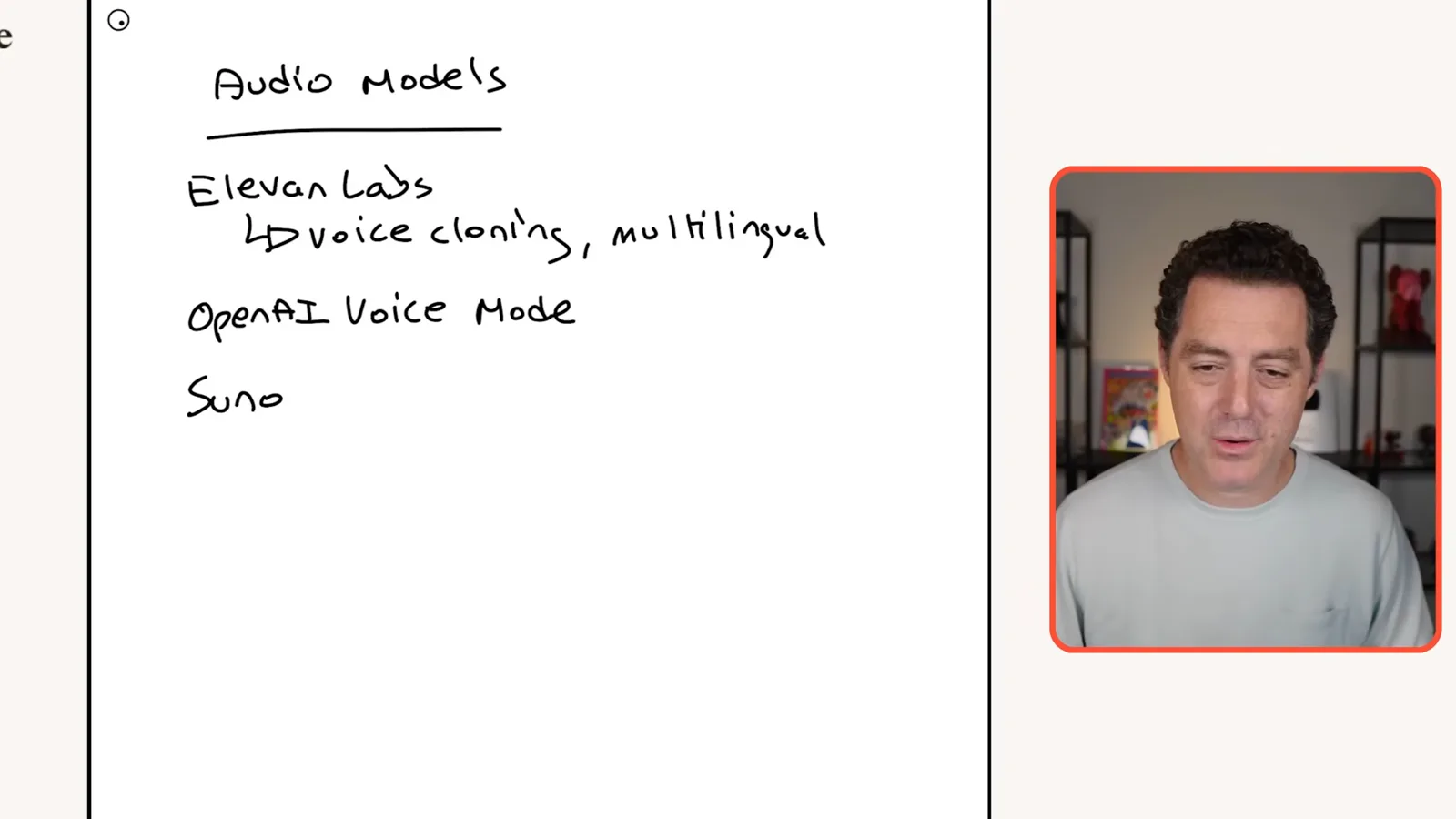
For music, I mention Suno and Udio as examples that generate songs from prompts. The broader point is to choose by task: answering questions, research, writing code, creating pictures or video, and generating audio call for different tools. The video description links to a reference PDF for the products discussed.
同じチャンネルの記事
 34:21EN
 Matthew Berman· 2026年10月27日Matthew Berman Examines Anthropic’s IPO Filing, AI Growth and GovernanceMatthew Berman, Sam Altman · Forward FutureThe presenter reviews the S-1’s financial metrics, compute strategy and voting structure while questioning the tension between rapid AI development and safety.
 25:50ENMatthew Berman· 2026年10月24日Kimi K3.1 Pro Tested: Strong 3D Demos, Uneven Results and Competitive PricingMatthew Berman · Forward FutureMatthew Berman tests the open-weight model on coding, 3D rendering and visual explanations, then compares benchmark results and prices.
 32:20ENMatthew Berman· 2026年10月23日Who Is Local AI For? The Costs, Trade-offs and a Hybrid FutureMatthew Berman · Forward FutureMatthew Berman weighs data control and independence against hardware cost, setup complexity and inference speed.
 1:03:37ENMatthew Berman· 2026年10月23日Matthew Berman’s Team Tests Kimi K3.1 on Animation, Games, and ChartsMatthew Berman, Alex, Brian · Forward FutureA live team AMA turns into an informal test of Kimi K3.1, from personal-agent workflows to motion graphics, a browser game, and a benchmark chart.
 0:53ENMatthew Berman· 2026年10月22日Sam Altman on AI and the Discovery of New KnowledgeSam Altman · OpenAIAltman expects progress in mathematical discovery to extend to biology, materials and energy.
 0:22ENMatthew Berman· 2026年10月21日A Robot Bodyguard Video Shows Dramatic Rescue ScenariosMatthew Berman · Forward FutureMatthew Berman reacts to a short robot demonstration depicting fighting and vehicle-rescue scenarios.