30 秒でわかる
A restaurant agent can recommend a highly rated place and still fail guests with allergies, dietary restrictions or schedule limits. Annie Wang shows how to check requirements instead of enumerating every valid answer: a custom ADK metric scores the share of people whose needs are all met and passes only at 1.0. She tests the evaluator with known answers, inspects a deliberately failing run, and reuses the evaluation configuration in pytest and CI/CD.
- 1A good restaurant plan must satisfy every guest, not just earn a high ratingThe group may have dietary, allergy, budget or scheduling requirements. Different recommendations can both be valid.
- 2Requirement checkers can accept answers never listed in a reference setA checker evaluates the proposed plan against the group’s needs instead of requiring every acceptable restaurant to be written down in advance.
- 3Choose the evaluation target separately from the checking methodComparators use reference answers and checkers use requirements; either may use deterministic code or a model judge. Review examples to assess a model judge.
- 4Score the fraction of guests fully accommodated, and require 1.0The everyone_ate metric scores three satisfied guests out of six as 0.5. A passing threshold of 1 requires the plan to work for everyone.
- 5Test the evaluator against known answers before trusting itTwo valid plans should both pass, a three-of-six plan should fail, and an incomplete answer should fail.
- 6Put the same evaluation in pytest and make it a deployment checkThe test reuses the case set and full scoring configuration, including registration of the custom metric.
ポイント
- Define success in terms of the user’s constraints, and evaluate tool actions when the sequence matters.
- Use requirement checks when many different answers can be valid; reference comparisons remain useful for other cases.
- Choose deterministic code or a model judge independently of whether the evaluation uses a reference or requirements.
- Test the evaluator on known passes, failures and incomplete answers before using it to judge an agent.
- Repeat cases, preserve newly discovered failures and run the checks as part of deployment.
チャプターごとに整えた全文を読む
Define success for the outcome and the agent’s actions
Restaurant recommendations must satisfy each guest, and tool-using agents may also need evaluation of their action sequence and memory.
Annie Wang shows how to define success for an AI agent, choose an evaluation approach, build and test a custom evaluator, and run it during development and deployment. The example is an agent that recommends a restaurant for a group.
A highly rated nearby restaurant is not necessarily a successful recommendation. Some guests may be vegetarian, have allergies, face a budget limit or need to leave early. The actual requirement is a dinner plan that works for everyone.
The same request can produce different plans because language-model responses vary between runs. Both should pass if they satisfy the group. If an agent has tools to inspect menus or book a table, evaluation can also examine whether it checked dietary needs before booking.
The sequence of actions is the agent’s trajectory. In a multi-turn conversation, an evaluation may also need to check whether the agent remembers constraints introduced earlier. The first choice is whether to assess the final plan, the steps taken to produce it, or both.
Google’s Agent Development Kit (ADK) provides built-in metrics. A response can be compared with a checked reference by wording or by a language model’s assessment of meaning; tool calls can be compared with expected calls, their arguments and an adjustable order requirement.
Compare with references or check requirements
ADK offers reference-based metrics, while requirement checks can accept any plan that satisfies the group. Code and language-model judges are implementation choices that apply across both approaches.
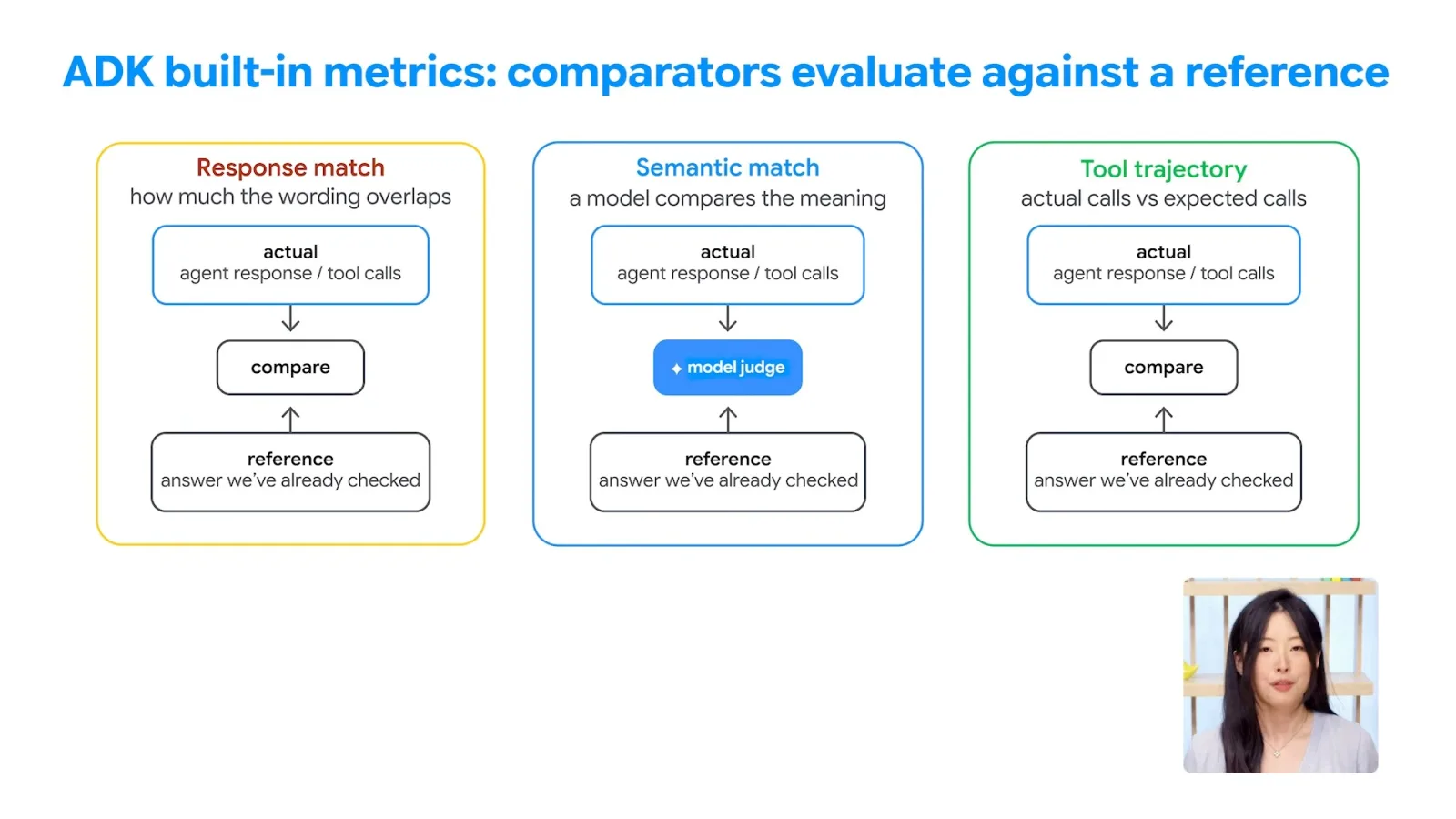
These reference-based checks are comparators. A golden dataset pairs test requests with trusted answers, but a restaurant plan that works for one group may fail another, and even a single group may have several acceptable options.
A checker instead tests explicit requirements against a proposed plan. For the dinner agent, it can use the group’s needs and restaurant information to check menu, price and timing. Any plan meeting the requirements can pass without appearing in a list of approved answers.
The choice of what to compare against is separate from how to implement the check. A deterministic rule can fail a plan when a vegetarian guest has no suitable dish and return the same result for the same facts. A language model can instead judge the plan against a rubric and the supplied restaurant facts.
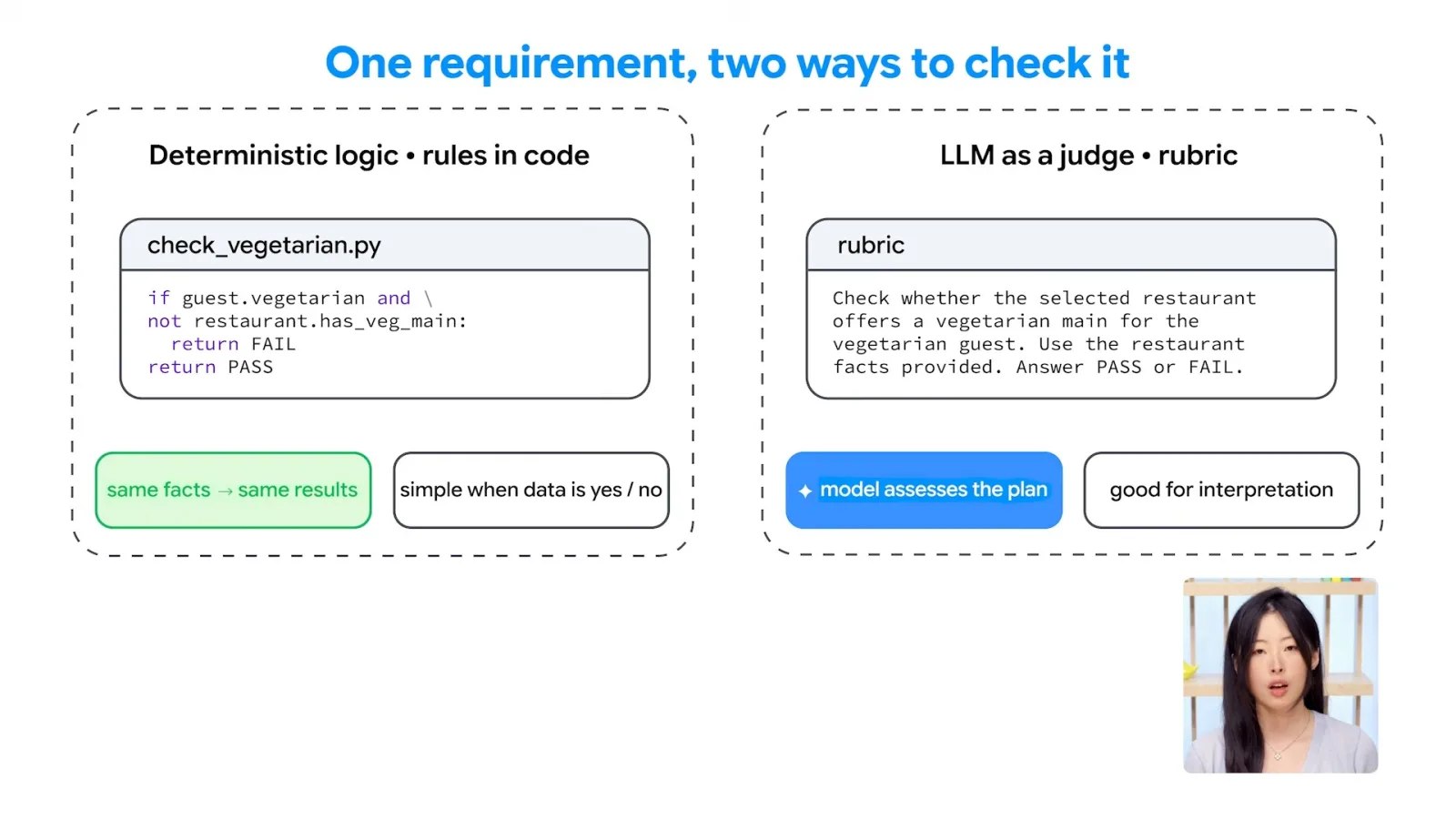
Simple structured yes-or-no facts are straightforward to check in code. A model judge may help with requirements requiring interpretation, such as clarity, but its judgments should also be tested against human-reviewed examples. ADK includes rubric-based judges for responses, tool use and multi-turn conversations.
Build and validate the everyone_ate metric
A custom Python metric scores the fraction of people whose requirements are all met, with a threshold of 1. Known passing, failing and incomplete plans test the evaluator itself.
For the demo, Wang uses Python because the guest and restaurant facts are structured. The agent receives fixed information up front and proposes one restaurant and time. Checks cover each person’s applicable dietary needs, allergies, budget, distance, spice preference and timing.
A plan counts as successful for an individual only when all that person’s requirements are met. The custom metric, everyone_ate, divides the number of people satisfied by group size: three of six gives 0.5; all six gives 1. The passing threshold is 1, and the evaluator records failure reasons.
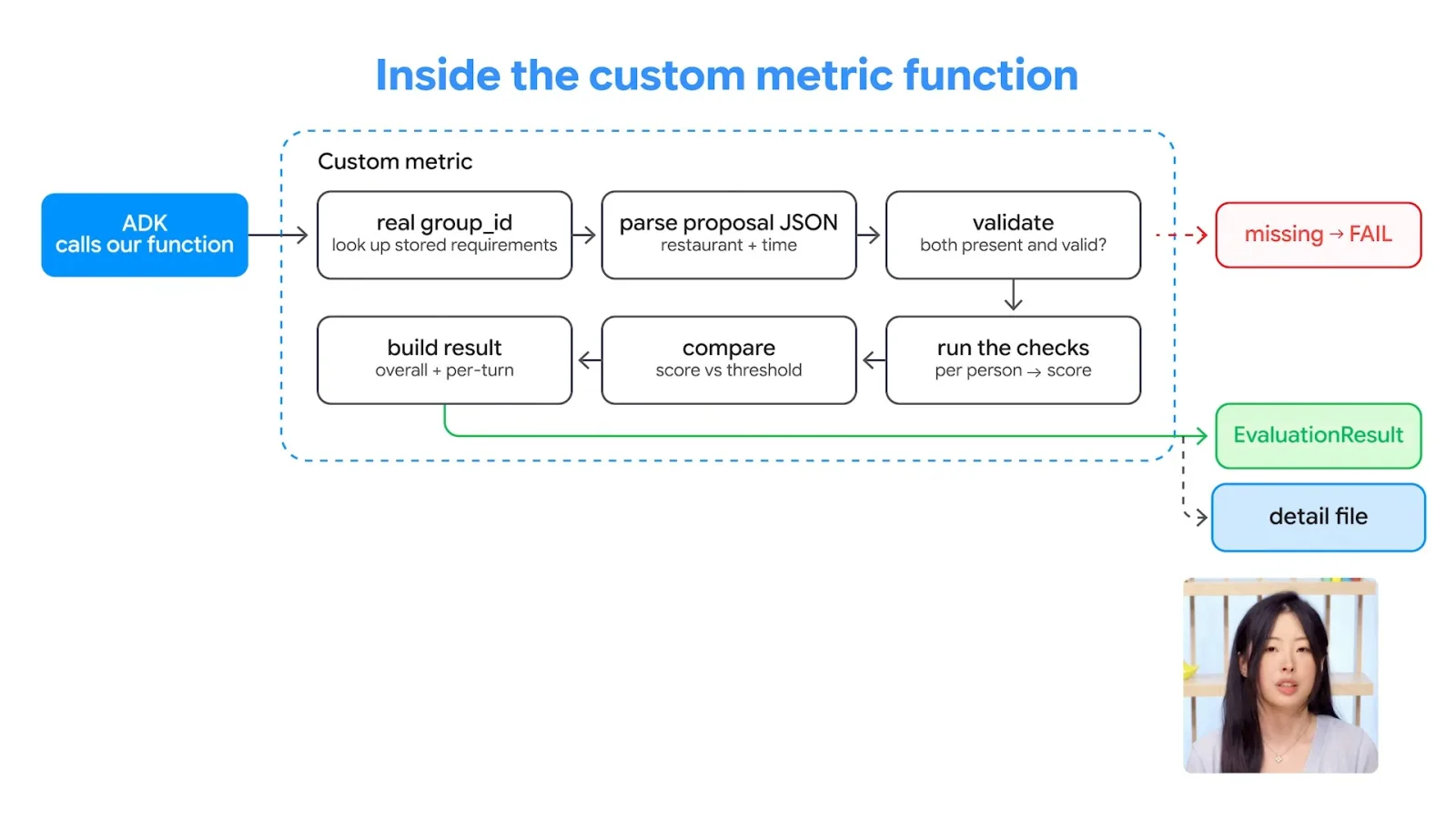
ADK calls the custom Python metric with the recorded interaction and evaluation settings. The function reads a group ID, retrieves the corresponding requirements and parses the agent’s JSON proposal for restaurant and time.
Before scoring, the evaluator checks that both fields are present and valid. An unknown restaurant or missing time fails instead of allowing the evaluator to invent part of the agent’s plan. The function runs the checks, compares the score with the threshold, and returns overall and per-turn evaluation results; individual explanations go into a detail file.
An evaluation configuration JSON selects everyone_ate, sets its threshold and identifies the Python function. Before using the evaluator on an agent, Wang tests known answers: a three-of-six plan must score 0.5 and fail, two different valid plans must each score 1 and pass, and an incomplete answer must fail.
Run the evaluation and learn from failures
The demo’s ratings-first agent satisfies only three of six people. Wang recommends comparing versions with stable criteria, repeating important cases and retaining new failure cases.
The adk eval command takes the agent, evaluation configuration and an evaluation-set JSON containing test requests. ADK runs the selected request and passes the recorded interaction to the checker.
In the deliberately flawed demo, the agent prioritizes ratings and chooses the highest-rated restaurant. The detail file identifies vegetarian, allergy and timing problems; the plan satisfies three of six people, scores 0.5 and fails the threshold of 1.
Wang recommends investigating why the agent favored ratings, changing its instructions or code, and rerunning the same case with the same success criteria to compare versions. Repeat important cases to assess consistency, add groups with different combinations of needs, and keep some cases separate for checking generalization.
Save newly discovered failures as future test cases. In the adk web browser interface, register the custom metric, select the dinner case and everyone_ate from the Eval tab, set the threshold to 1, and inspect both the result and the evaluated conversation.
Run agent evaluations in pytest and CI/CD
The test reuses the evaluation set and scoring configuration, including the custom metric. It can become a required deployment check.
A pytest test can reuse the evaluation-set JSON for the cases and the configuration JSON for scoring, including custom metric registration. It loads the full settings and calls ADK’s AgentEvaluator from Python; pytest then reports whether the evaluation passed.
The same pytest command can be a required CI/CD check before deployment, so a failing evaluation blocks that version. Wang’s four steps are to define success, select what and how to check, validate the evaluator against known answers, and run it repeatedly as the agent changes. She adds that such checks can later guide agent self-improvement.
同じチャンネルの記事
 23:57EN
 Google Cloud Tech· 2026年11月10日Six front-end ideas that make AI-built apps easier to debugDevin Chasanoff · Google CloudDevin Chasanoff uses an interactive game tracker to show where data lives, how values are derived and how components communicate.
 41:04ENGoogle Cloud Tech· 2026年11月9日How Google tests Gemini 4 and uses agents to maintain codeTulsee Doshi, Smitha, Rody Davis, Luke, Mollie, Billy, Annie · Google DeepMindTulsee Doshi describes staged releases and long-running work; a demo audits web, Android and iOS code with subagents.
 17:27ENGoogle Cloud Tech· 2026年11月9日Fix a tangled app by specifying its states before promptingDevin Chasanoff · GoogleDevin Chasanoff maps a workout screen’s state, transitions and tests before asking an agent to change it.
 11:59ENGoogle Cloud Tech· 2026年11月3日Use two AI agents to turn a prototype into a front-end specificationDevin Chasanoff · GoogleDevin Chasanoff separates planning from documentation so Gemini can help a user design an app before building it.
 11:16ENGoogle Cloud Tech· 2026年10月29日Before an AI agent builds, reconcile the specs and plan checkpointsDevin Chase · GoogleDevin shows how to find conflicting requirements, compare assumptions with recommendations and plan a staged build.
 12:26ENGoogle Cloud Tech· 2026年10月28日Give an AI agent two kinds of long-term memoryAnnie Wang · Google CloudAnnie Wang separates exact facts from semantic preferences and keeps slow memory extraction off a live voice agent’s critical path.