30 秒でわかる
In a December 9, 2025 news roundup, Matthew Berman discusses expectations for GPT-5.2, Mistral’s Devstral 2 family, the Agentic AI Foundation, an OpenAI course certificate, Boom’s Superpower turbine and a proposal for orbital data centers. Market movements do not establish insider trading, and technical and business claims have specific conditions. Devstral 2’s modified MIT license includes a revenue restriction; cooling in space requires engineered heat rejection.
- 1Prediction-market speculationBerman interprets sharp market movements as possible insider trading; the displayed prices do not establish who traded or what information they held.
- 2Devstral 2Mistral announced 123B and 24B coding models with different licenses, plus its Vibe CLI.
- 3Agentic AI FoundationThe Linux Foundation announced contributions of MCP, AGENTS.md and Block’s goose.
- 4Superpower turbineBoom announced a 42 MW natural-gas turbine and a 1.21 GW launch order from Crusoe.
- 5Data centers in spaceBerman discusses proposed solar-powered satellite computing and the engineering challenges behind cooling and communications.
ポイント
- Prediction-market prices changed ahead of GPT-5.2, but the chart alone does not establish insider activity.
- Devstral 2 and Devstral Small 2 have different licenses; the larger model’s modified MIT terms restrict some high-revenue companies.
- The Agentic AI Foundation launched under the Linux Foundation with MCP, AGENTS.md and goose as founding contributions.
- Boom announced a 42 MW natural-gas turbine and a launch order; announced capacity is not proof of operational deployment.
- Space-based data centers remain a research concept with substantial thermal, communication and reliability challenges.
チャプターごとに整えた全文を読む
GPT-5.2 expectations and Devstral 2
Berman discusses changing prediction-market prices and Mistral’s coding-model release. The insider explanation is speculative and license terms vary by model.
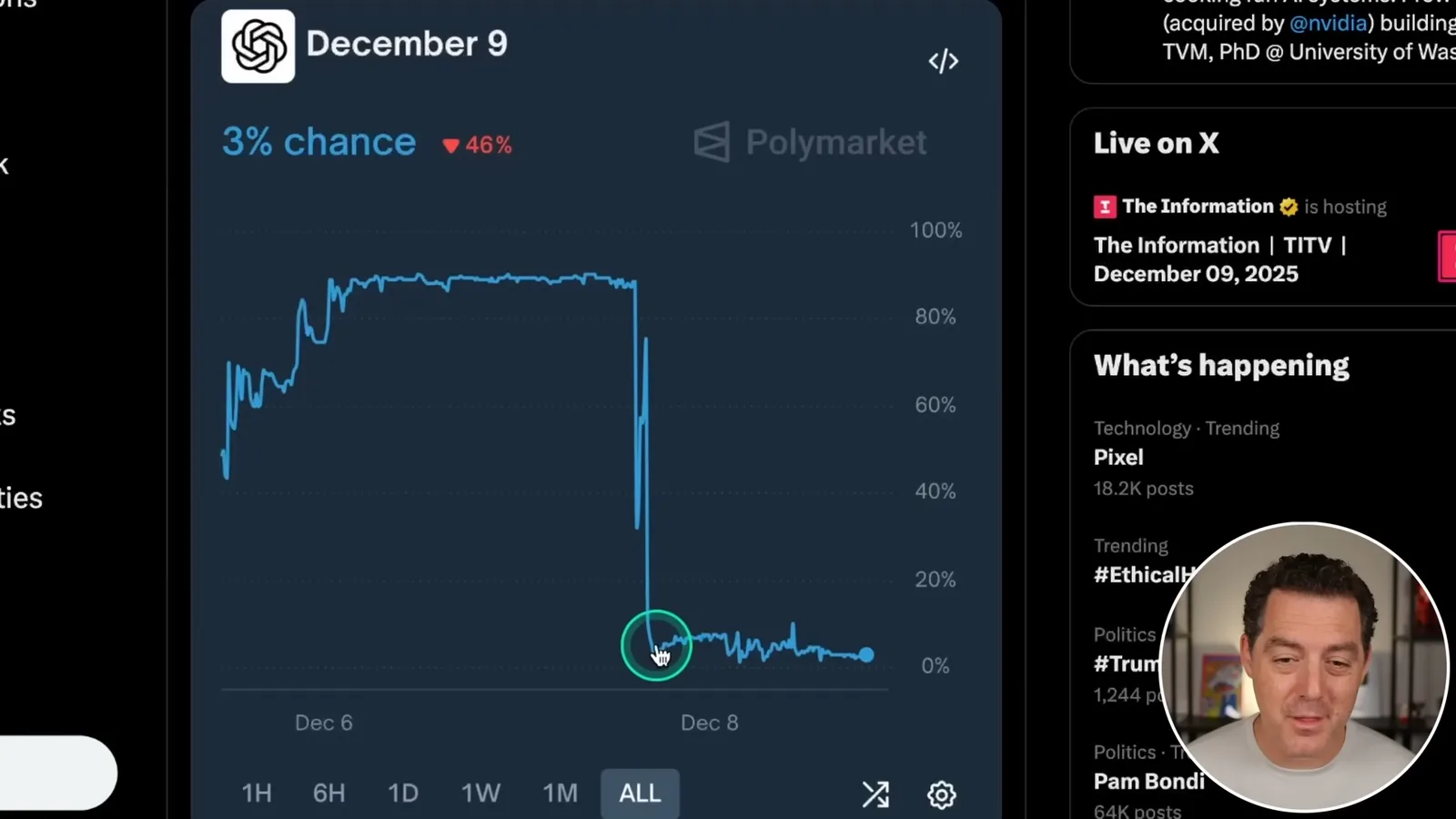
On December 9, 2025, I expect GPT-5.2 to arrive soon and look at prediction markets for its release date. I see a sharp fall in the market’s implied chance of a December 9 release and an increase for December 11. OpenAI subsequently announced GPT-5.2 on December 11.
I suggest that insiders may have moved the market. A price change, even a sudden one, does not establish who traded, whether they possessed private information or whether any law or rule was broken. The chart is evidence of changing prices, not proof of insider activity.
Mistral announced two coding models, Devstral 2 at 123 billion parameters and Devstral Small 2 at 24 billion, alongside the Mistral Vibe command-line assistant. I welcome available weights and tools that developers can run or integrate. Availability and pricing described in this December 2025 release may change.
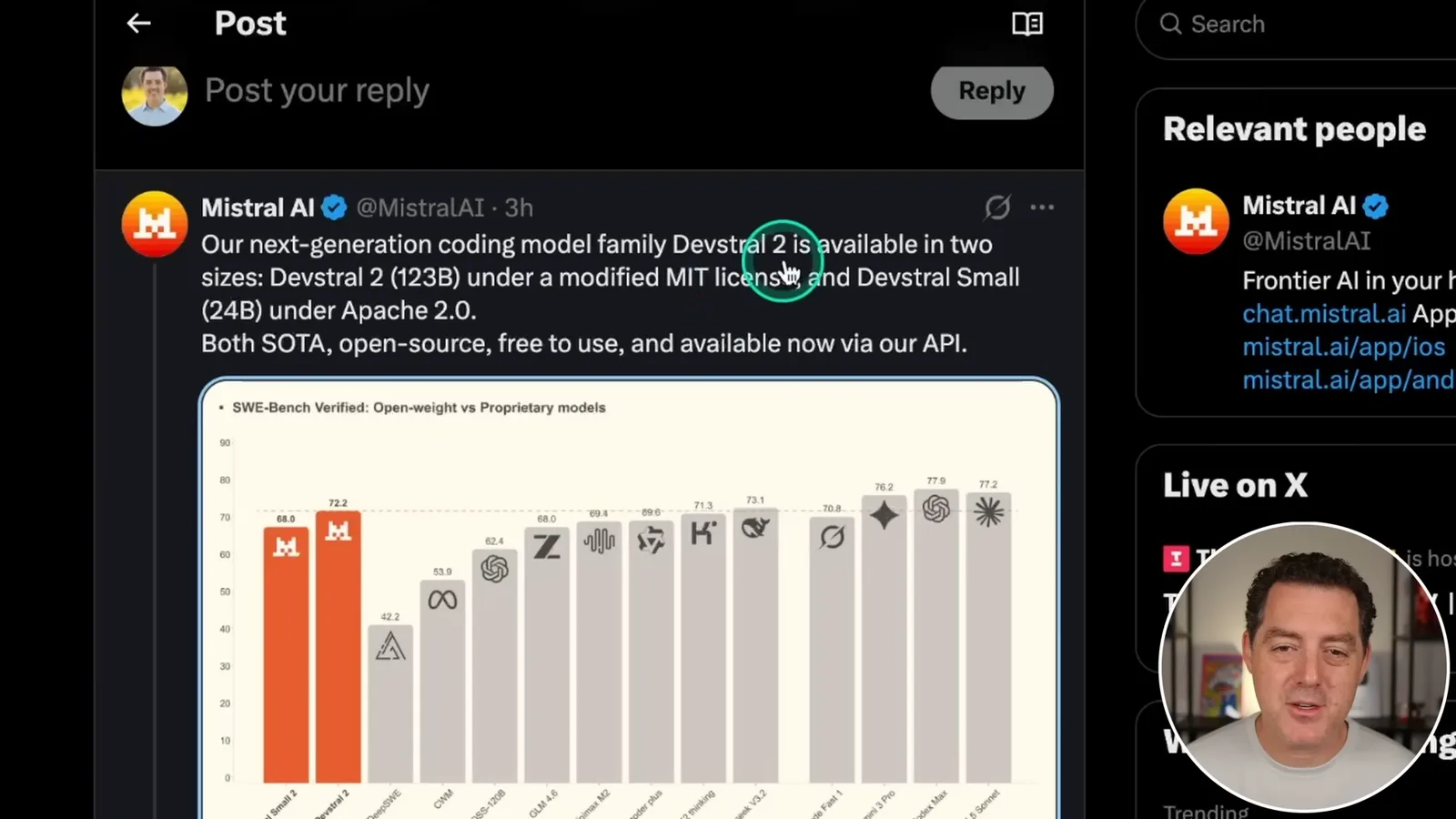
The licensing distinction matters. Devstral Small 2 uses Apache 2.0, while Devstral 2 uses a modified MIT license, not standard MIT. The published license restricts use by companies or employers whose consolidated monthly revenue exceeded $20 million in the preceding month, so the larger model is not unrestricted for all users.
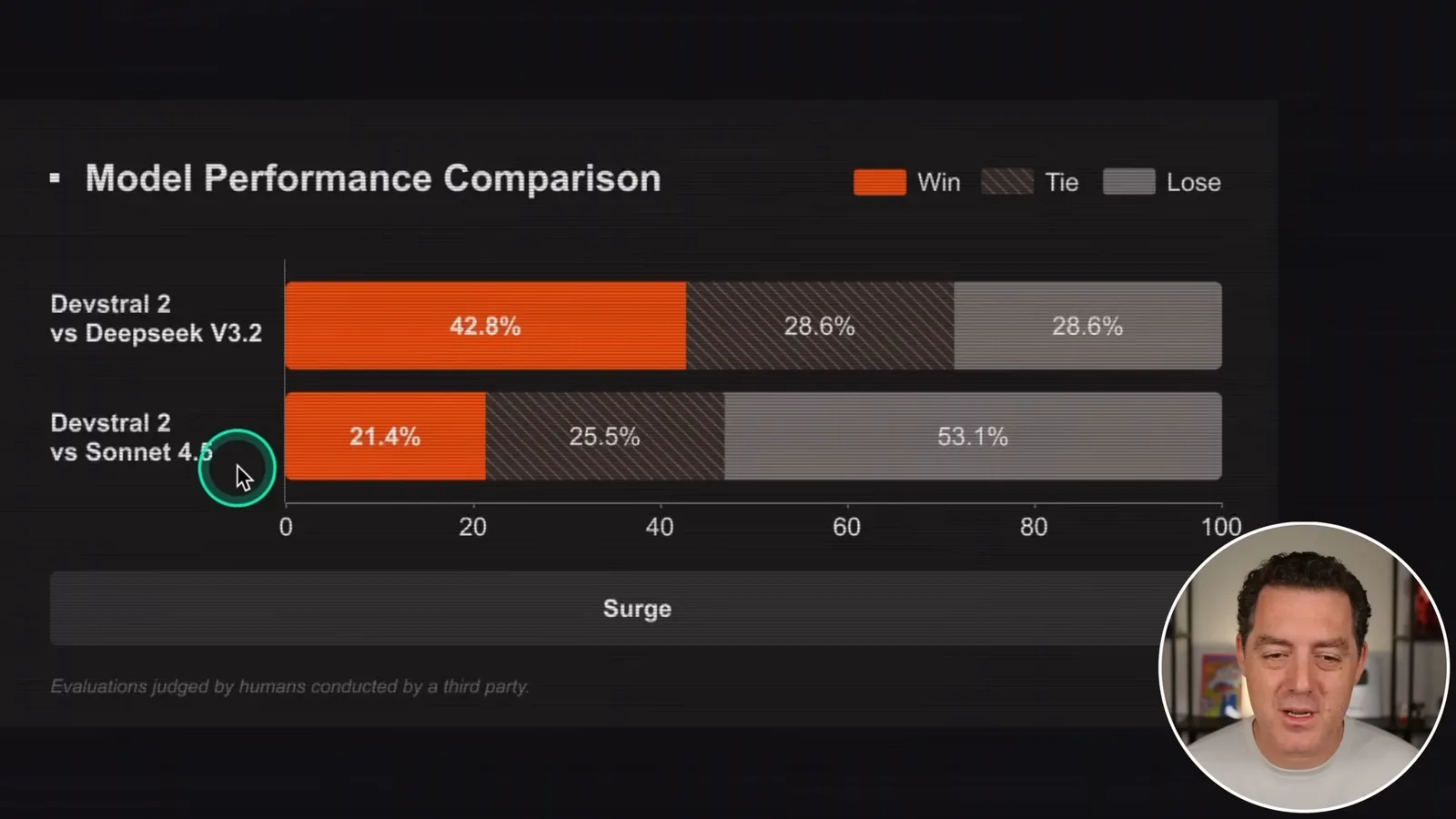
Mistral reports 72.2% for Devstral 2 and 68.0% for Devstral Small 2 on SWE-bench Verified. Its displayed third-party human comparison also shows Devstral 2 winning 21.4% against Claude Sonnet 4.5, tying 25.5% and losing 53.1%. These are reported results for specific evaluations and setups, not universal rankings.
AI adoption and agent standards
Berman reflects on ChatGPT reaching a broad audience, then reviews the Agentic AI Foundation and an OpenAI course certificate.
OpenAI CEO Sam Altman appeared on The Tonight Show with Jimmy Fallon and answered broad questions about ChatGPT and AI. I take the need for basic explanations on a mass-audience show as a reminder that many people are still encountering these tools for the first time.
The Linux Foundation announced the Agentic AI Foundation, with Anthropic contributing Model Context Protocol (MCP), OpenAI contributing AGENTS.md and Block contributing its goose agent framework. MCP connects AI applications to tools and data; AGENTS.md provides project-specific instructions for coding agents. The foundation aims to support open, collaborative governance.
The announcement reports more than 10,000 public MCP servers and adoption across several AI products. I am pleased to see shared agent infrastructure move into a foundation. These counts and adoption descriptions are from the 2025 announcement rather than a measure of current usage or quality.
OpenAI also announced certificate courses for AI skills. I describe the idea as learning through ChatGPT and earning a credential; course coverage and any assessment requirements depend on the specific offering.
Powering data centers
Boom proposes a natural-gas turbine for AI infrastructure. Berman discusses power generation and modular equipment.
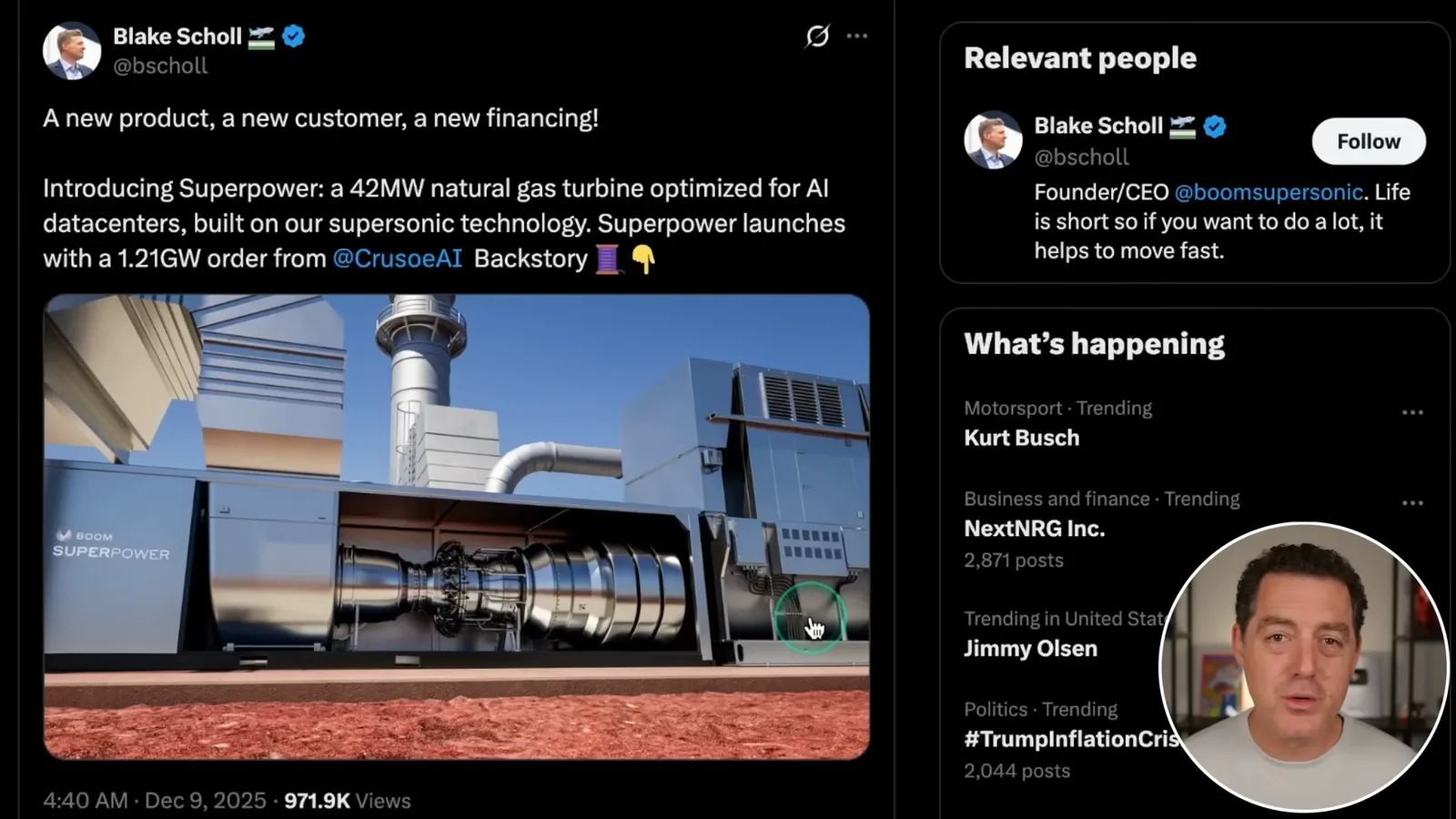
Boom announced Superpower, a 42-megawatt natural-gas turbine intended for data centers and based on its supersonic-engine technology. The company says launch customer Crusoe ordered 29 turbines totaling approximately 1.21 gigawatts and describes an order book exceeding $1.25 billion. Those are announced orders and specifications, not evidence that the capacity is already operating.
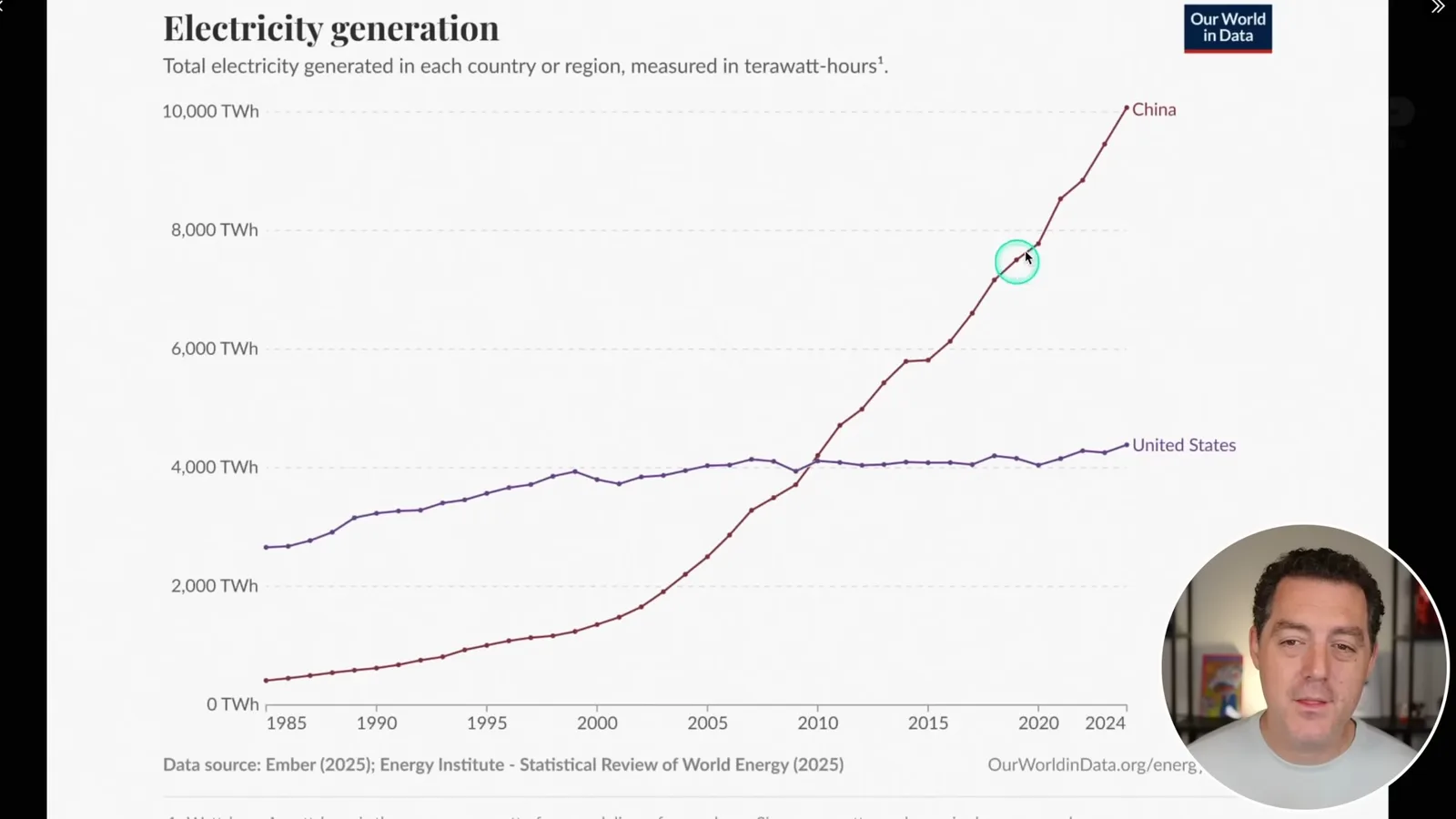
Boom CEO Blake Scholl shows a historical chart comparing electricity generation in China and the United States. I argue that power availability matters for AI infrastructure and like the proposal to use modular arrays of turbines. A natural-gas installation also depends on fuel supply, permitting, grid or site integration and its emissions; a turbine cannot simply be placed beside a data center without that supporting infrastructure.
Scholl describes discussing the concept with Sam Altman, a long-time Boom investor, before securing a launch order. He compares modular turbine arrays to blade servers, where individual units can be serviced or replaced without treating the entire installation as one machine.
Orbital data-center proposals
He considers solar-powered satellites and optical links. Space infrastructure and heat rejection require substantial engineering.
I turn to investor Gavin Baker’s discussion of data centers in space. The attraction is more continuous solar exposure in a suitable orbit and optical links between satellites. Google’s Project Suncatcher explores such a constellation as an early research proposal, not an already operating orbital data center.
Baker describes space cooling as free and suggests radiators on the shaded side. I acknowledge that thermodynamics makes cooling more complicated. In vacuum, heat must be rejected primarily through radiation, requiring appropriately designed radiators and thermal systems; sunlight and battery needs also depend on the orbit and mission.
Light travels faster in vacuum than through optical fiber, but that fact alone does not establish that a satellite network would outperform every terrestrial data center. Link bandwidth, distances, pointing, ground communications, reliability and radiation all matter. I am excited by the concept while recognizing that viable deployment and sustainable power remain engineering questions.
同じチャンネルの記事
 34:21EN
 Matthew Berman· 2026年10月27日Matthew Berman Examines Anthropic’s IPO Filing, AI Growth and GovernanceMatthew Berman, Sam Altman · Forward FutureThe presenter reviews the S-1’s financial metrics, compute strategy and voting structure while questioning the tension between rapid AI development and safety.
 0:36ENMatthew Berman· 2026年10月25日Kimi K3.1 and a Rubik’s Cube Solver DemonstrationMatthew Berman · Forward FutureMatthew Berman shows a scrambled virtual cube being solved and gives the Kimi K3.1 test a favorable assessment.
 25:50ENMatthew Berman· 2026年10月24日Kimi K3.1 Pro Tested: Strong 3D Demos, Uneven Results and Competitive PricingMatthew Berman · Forward FutureMatthew Berman tests the open-weight model on coding, 3D rendering and visual explanations, then compares benchmark results and prices.
 32:20ENMatthew Berman· 2026年10月23日Who Is Local AI For? The Costs, Trade-offs and a Hybrid FutureMatthew Berman · Forward FutureMatthew Berman weighs data control and independence against hardware cost, setup complexity and inference speed.
 1:03:37ENMatthew Berman· 2026年10月23日Matthew Berman’s Team Tests Kimi K3.1 on Animation, Games, and ChartsMatthew Berman, Alex, Brian · Forward FutureA live team AMA turns into an informal test of Kimi K3.1, from personal-agent workflows to motion graphics, a browser game, and a benchmark chart.
 0:53ENMatthew Berman· 2026年10月22日Sam Altman on AI and the Discovery of New KnowledgeSam Altman · OpenAIAltman expects progress in mathematical discovery to extend to biology, materials and energy.