30 秒でわかる
On January 3, 2024, Matthew Berman predicts developments in Llama, Gemini, robotics, open-weight models, agents, AGI, synthetic data, multimodality, bots and a possible GPT-4.5. He includes excerpts from interviews and lectures, including differing views about openness and the difficulties of multimodal systems. These are historical predictions, not a retrospective scorecard; several technical claims and timelines are uncertain.
- 1Llama 3 forecastBerman expects a first-half release, while Zuckerberg’s interview excerpt does not supply a date.
- 2Gemini and demosHe predicts Gemini Ultra and distinguishes the edited demonstration from a continuous real-time interaction.
- 3Open-model trendA selected five-shot MMLU chart suggests progress but does not establish performance across all tasks.
- 4Agents and simulationBerman expects practical agent workflows and discusses the possibility of social simulations, subject to validation.
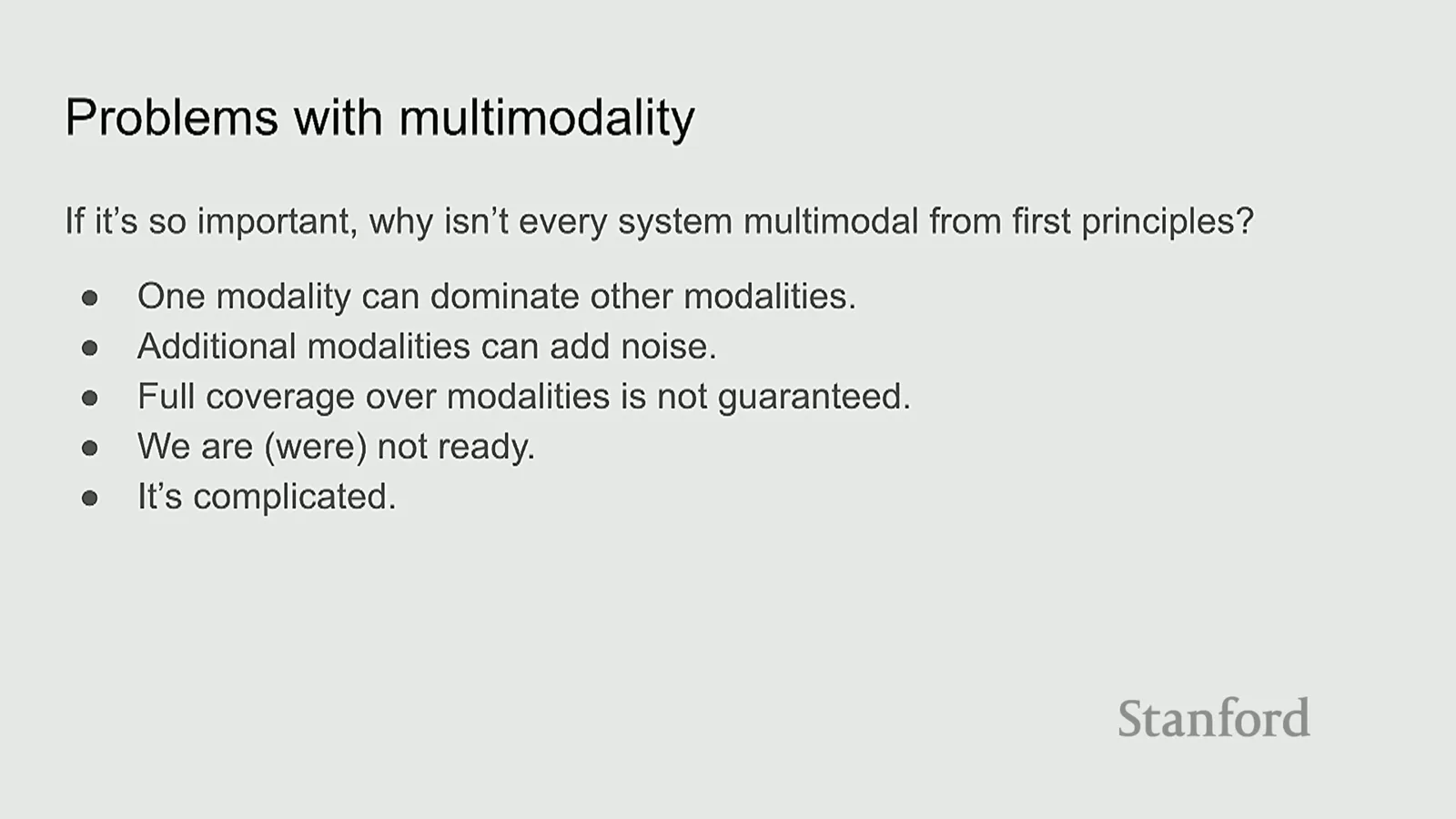
- 5Synthetic data and multimodalityHe predicts broader use while the lecture excerpt highlights difficulties combining modalities.
- 6Bots and GPT-4.5He anticipates more convincing abuse and predicts an early-2024 model update; neither statement is a verified outcome in the video.
ポイント
- Berman predicted Llama 3 and Gemini Ultra would arrive in the first half of 2024.
- He expected faster progress in robotics and open-weight models, while the video’s demonstrations and benchmark chart support narrower claims.
- Agent workflows and simulations were presented as promising research directions, not validated substitutes for human studies.
- Synthetic data and multimodal models have potential benefits but require validation and careful handling of limitations.
- He worried about bots and deepfakes, and discussed paid access as a proposed deterrent rather than a proven cure.
- The AGI and GPT-4.5 timelines were forecasts made at the beginning of 2024.
チャプターごとに整えた全文を読む
Llama 3 and Meta’s strategy
Berman forecasts a Llama 3 release and shows Zuckerberg discussing Llama 2 and future models. He also introduces AI Studio.
At the start of 2024, I offer ten predictions for AI, from new models and robots to agents, synthetic data and security. These are forecasts made on January 3, 2024, not a retrospective account of what ultimately happened. This video is sponsored by YouAI’s MindStudio.
First, I predict that Meta will release Llama 3 in the first half of 2024 and narrow the gap between available-weight and proprietary models. Llama 1 and Llama 2 helped people experiment with and adapt powerful models locally. Their releases also had specific access and license conditions; available weights are not the same as unrestricted open source.
In an interview with Lex Fridman, Mark Zuckerberg says Meta is pleased with the response to Llama 2. He says the immediate priority is incorporating it into consumer products while future foundation models are also being developed. He hopes to release the next generation openly but says it still needs evaluation and red-teaming, without giving a release date.
I think Meta benefits from supporting a broader ecosystem and providing an alternative to proprietary models. Zuckerberg also describes AI Studio as a way for people eventually to create AI experiences much as they create other user-generated content. Those are his aspirations for the platform at the time, not proof of what users could already build.
Gemini Ultra and robotics
He predicts a Gemini Ultra launch, discusses the edited demo and considers the direction of humanoid robots. The robotics estimates are presented as forecasts and rough measurements.
My next prediction is that Google will release Gemini Ultra in the first half of 2024. Google’s late-2023 demonstration attracted attention but was edited and did not show an uninterrupted real-time conversation. A polished demo should be distinguished from the actual test procedure and the paper’s reported benchmark results.
Google described Gemini Nano, Pro and Ultra as different sizes for different deployment needs. Nano was intended for some on-device uses, while the largest model would require substantial infrastructure. I expect companies to compete for developers building applications on top of their models, and I predict initial bugs, hallucinations and vulnerabilities will be addressed over time.
I expect humanoid and other robots to improve in 2024. Boston Dynamics has a long history in robotics, and Tesla has progressed from a costumed concept demonstration to an Optimus prototype. I expect Tesla to show further improvements, while acknowledging that demonstrations and production plans are not the same as deployed, reliable products.
A robotics discussion in the video estimates Optimus walking speed from footage and debates what speed a factory robot needs. The speakers’ estimates are approximate; the clip’s conversion from 1.5 meters per second to just under two miles per hour is inconsistent, since 1.5 meters per second is about 3.4 miles per hour. Useful speed depends on the task, not a universal threshold established by this clip.
The robotics commentator predicts a Tesla AI Day and dozens of Optimus robots by the first quarter of 2024; I consider the production estimate aggressive. The discussion also identifies actuators—the mechanisms driving joint motion—as a significant engineering and manufacturing challenge. I expect competition from other robotics companies too.
Open models and their limits
Berman reviews a historical benchmark chart, quantization and local models. Jaron Lanier offers a counterargument about centralization.
I am especially optimistic about open-weight models. A chart compares selected open and proprietary models on five-shot MMLU over time, and I interpret the plotted trend as a narrowing gap. It is one benchmark and a selected set of models, so it cannot establish a general ranking across all tasks.
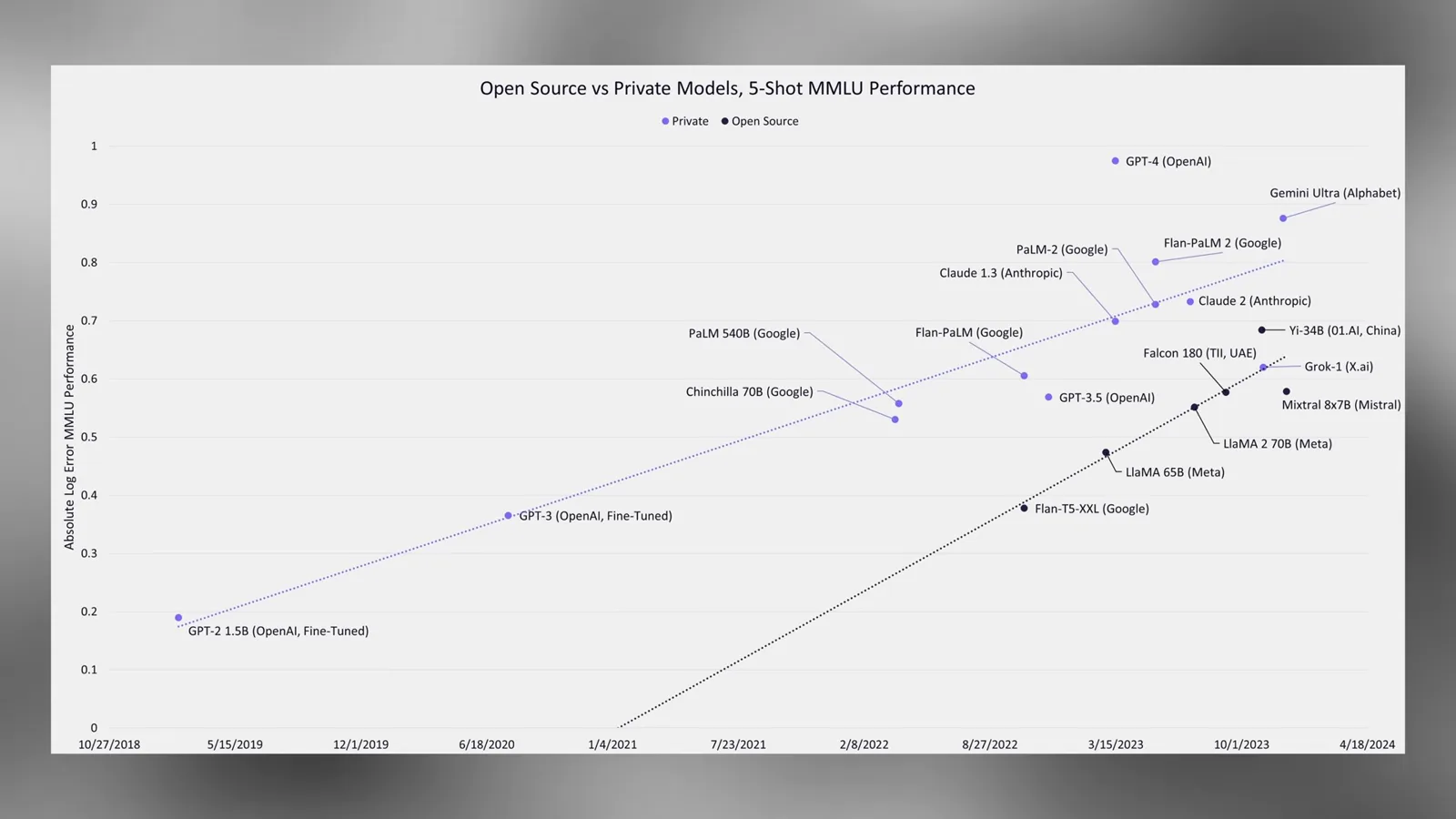
I expect quantization to improve and make models easier to run on consumer hardware, and mixture-of-experts architectures to become more common. Routing only some experts per token can reduce active computation, although memory requirements, hardware and accuracy tradeoffs still matter. My claims that nearly any model can run on most consumer devices with minimal loss and that GPT-4’s architecture is known go beyond what this video establishes.
I also expect more domain-specific models, including geospatial and finance applications, and discuss Apple’s multimodal Ferret research. Local models appeal to me because they can offer assistance without a continuous internet connection. My comparison of my own Apple hardware and an Nvidia GPU is anecdotal and depends on the exact device, software and configuration.
Jaron Lanier offers a counterargument: shared open resources can still produce concentrated platforms through network effects, with valuable algorithms or derived data kept proprietary. I remain optimistic about open models, but his argument challenges the assumption that openness automatically guarantees decentralization.
I also worry that valuable training data will become harder to obtain as publishers and platforms restrict access or pursue legal claims. Larger companies may be better positioned to pay for data. Synthetic data is one possible response, but whether it can substitute for particular real-world data sources remains an empirical question.
Agents and AGI
He discusses agent workflows, social simulations and the challenge of predicting behavior. He predicts no AGI in 2024 and shows Zuckerberg’s remarks on collective intelligence.
I predict that AI agents will improve and find more practical uses in coding, research and data work. Better models are only part of it: agents also need useful roles, instructions, tools and ways to cooperate. I expect the community to develop reusable workflows as people discover which applications work.
I revisit research on 25 generative agents in a simulated town, where agents produced behaviors that appeared social. Such behavior raises interesting questions about human interaction and consciousness, but resemblance to human behavior does not demonstrate consciousness or reliable prediction of real people.
In an excerpt, researcher Joon Park discusses whether agent simulations might eventually help social science, while emphasizing the challenge of defining and measuring believable or accurate behavior. I imagine preliminary simulations for areas such as polling or psychology. These are potential research tools, not validated replacements for human studies.
I expect tools for coordinating agent teams to improve as well. One difficulty is designing system messages, prompts and roles so agents produce useful results together. I mention CrewAI as a project I plan to review; at this point I am describing an anticipated workflow, not proving that it solves coordination.
My next prediction is that AGI will not arrive in 2024, though the term itself is difficult to define. In a conversation with Lex Fridman, Zuckerberg says he has no particular insight into when a single general AI system will emerge. He contrasts that question with organizations and markets that aggregate the decisions of many people.
I also cite Sam Altman’s contemporaneous statement that OpenAI did not expect to deliver AGI in 2024. Predictions about AGI depend on how it is defined and cannot be settled simply by quoting a date or a poll. My own view at the time is that it would not arrive that year.
Synthetic data and multimodality
Berman predicts increased synthetic data use and multimodal systems. A lecture excerpt identifies challenges with combining modalities.
I predict synthetic data will play a larger role in training as valuable datasets become less accessible. Models can generate examples for later training, while driving simulations can produce scenarios that are difficult to collect in the field. The usefulness of synthetic data depends on its quality, validation and how well it represents the intended setting.
I suggest healthcare and finance as areas where synthetic data might help with privacy concerns. Synthetic data does not automatically guarantee privacy, however, and the video does not establish that it is a necessary ingredient for AGI. The driving-data comparison I make is a perspective on the industry, not a controlled comparison of automakers.
I predict multimodal input and output will become more common. A Stanford lecture excerpt explains why combining modalities remains difficult: one signal can dominate another, extra inputs can add noise, and datasets may lack complete coverage. These are technical challenges, not proof that every future model will support every modality.
Bots and a GPT-4.5 forecast
He considers scams, deepfakes and the proposed use of payments against bots. His final forecast concerns an anticipated GPT-4.5 release.
On security, I worry that better generation will make spam, scams and election-related impersonation harder to distinguish. I predict bots may become extremely difficult to detect, but “impossible to detect” is not established by the examples. Detection and abuse evolve together and vary by system.
I discuss Elon Musk’s proposal to charge users of X as a way to increase the cost of large bot networks and use payment-system checks. A payment requirement could change an attacker’s economics, but the clip does not prove it eliminates bots, and such a policy can impose costs on legitimate users too.
Finally, I predict a GPT-4.5 release in the first or second quarter of 2024 that would improve speed, cost and quality without being GPT-5. I also note that earlier claims that GPT-4.5 was already in use came from speculation and model self-descriptions rather than confirmed release evidence. This remains a forecast from early 2024.
同じチャンネルの記事
 34:21EN
 Matthew Berman· 2026年10月27日Matthew Berman Examines Anthropic’s IPO Filing, AI Growth and GovernanceMatthew Berman, Sam Altman · Forward FutureThe presenter reviews the S-1’s financial metrics, compute strategy and voting structure while questioning the tension between rapid AI development and safety.
 0:26ENMatthew Berman· 2026年10月25日Sam Altman on Human Values and Problem-Solving in an AI WorldSam Altman · OpenAIIn a short interview excerpt, Altman considers the enjoyment of solving hard problems and the human role in interpreting results.
 0:36ENMatthew Berman· 2026年10月25日Kimi K3.1 and a Rubik’s Cube Solver DemonstrationMatthew Berman · Forward FutureMatthew Berman shows a scrambled virtual cube being solved and gives the Kimi K3.1 test a favorable assessment.
 0:21ENMatthew Berman· 2026年10月24日An AI-Generated Kimi Benchmark Chart Used Invented ScoresMatthew Berman · Forward FutureMatthew Berman asks for a graph of Kimi K3.1 Pro benchmarks, then discovers that the displayed figures are illustrative placeholders.
 25:50ENMatthew Berman· 2026年10月24日Kimi K3.1 Pro Tested: Strong 3D Demos, Uneven Results and Competitive PricingMatthew Berman · Forward FutureMatthew Berman tests the open-weight model on coding, 3D rendering and visual explanations, then compares benchmark results and prices.
 32:20ENMatthew Berman· 2026年10月23日Who Is Local AI For? The Costs, Trade-offs and a Hybrid FutureMatthew Berman · Forward FutureMatthew Berman weighs data control and independence against hardware cost, setup complexity and inference speed.