30 秒でわかる
This supercut of OpenAI’s May 2024 launch follows Mira Murati’s introduction of GPT-4o and live demonstrations by Mark Chen and Barret Zoph. They show voice interruption and expressive speech, a handwritten math lesson, desktop code and chart interpretation, translation and a selfie description. The launch pricing and rollout statements are historical. These demonstrations illustrate selected interactions, including a premature claim that the model saw an equation before it was shown, rather than establishing reliability across all cases.
- 1A multimodal modelMurati describes native handling of voice, text and vision and contrasts it with the earlier voice pipeline.
- 2Historical API comparisonAt the 2024 launch, OpenAI claimed twice the speed, half the price and five times the rate limits of GPT-4 Turbo.
- 3Voice in real timeChen demonstrates breathing guidance, interruption and changes in expressive delivery.
- 4Visual math tutoringThe assistant prematurely says it sees the problem, then reads the equation and offers hints after it is shown.
- 5Shared code and chartThe desktop demo explains a rolling-average function and interprets a temperature plot after Zoph shares them.
- 6A selfie descriptionThe assistant guesses the expression shown in a selfie; this does not establish a person’s actual emotional state.
ポイント
- OpenAI presented GPT-4o as a faster multimodal model and planned access for free ChatGPT users in 2024.
- The presenters demonstrated interruptible speech and changes in voice style during a story.
- In the math demonstration, the assistant prematurely claimed to see an equation before it was shown, then guided the user through solving it.
- The desktop coding demonstration required the user to share the code and graph with ChatGPT.
- The translation and facial-expression examples were brief demonstrations, not broad evaluations of accuracy or emotional understanding.
チャプターごとに整えた全文を読む
Introducing GPT-4o
Murati announces the model, desktop app and planned rollout in May 2024. She compares the voice architecture and historical API terms with previous offerings.
At OpenAI’s May 2024 spring update, Mira Murati introduces GPT-4o, a new flagship model that the company says brings GPT-4-level capability to free users as well as paid users. This video is a supercut of the presentation and its live demonstrations. The capabilities, rollout plans and prices discussed are from that launch, not necessarily current product terms.
Murati says the company will roll out the demonstrated capabilities iteratively over the coming weeks. She also announces a ChatGPT desktop app, presenting it as a way to use the assistant within an existing computer workflow.
Murati describes GPT-4o as faster than GPT-4 and improved across text, vision and audio. The previous voice experience combined separate transcription, intelligence and text-to-speech components, she says; GPT-4o handles voice, text and vision natively, a design intended to reduce latency.
The model is also being offered through the API. At launch, OpenAI says GPT-4o is twice as fast, 50% cheaper and has five times the rate limits compared with GPT-4 Turbo. These are the company’s historical launch comparisons, not current prices or limits.
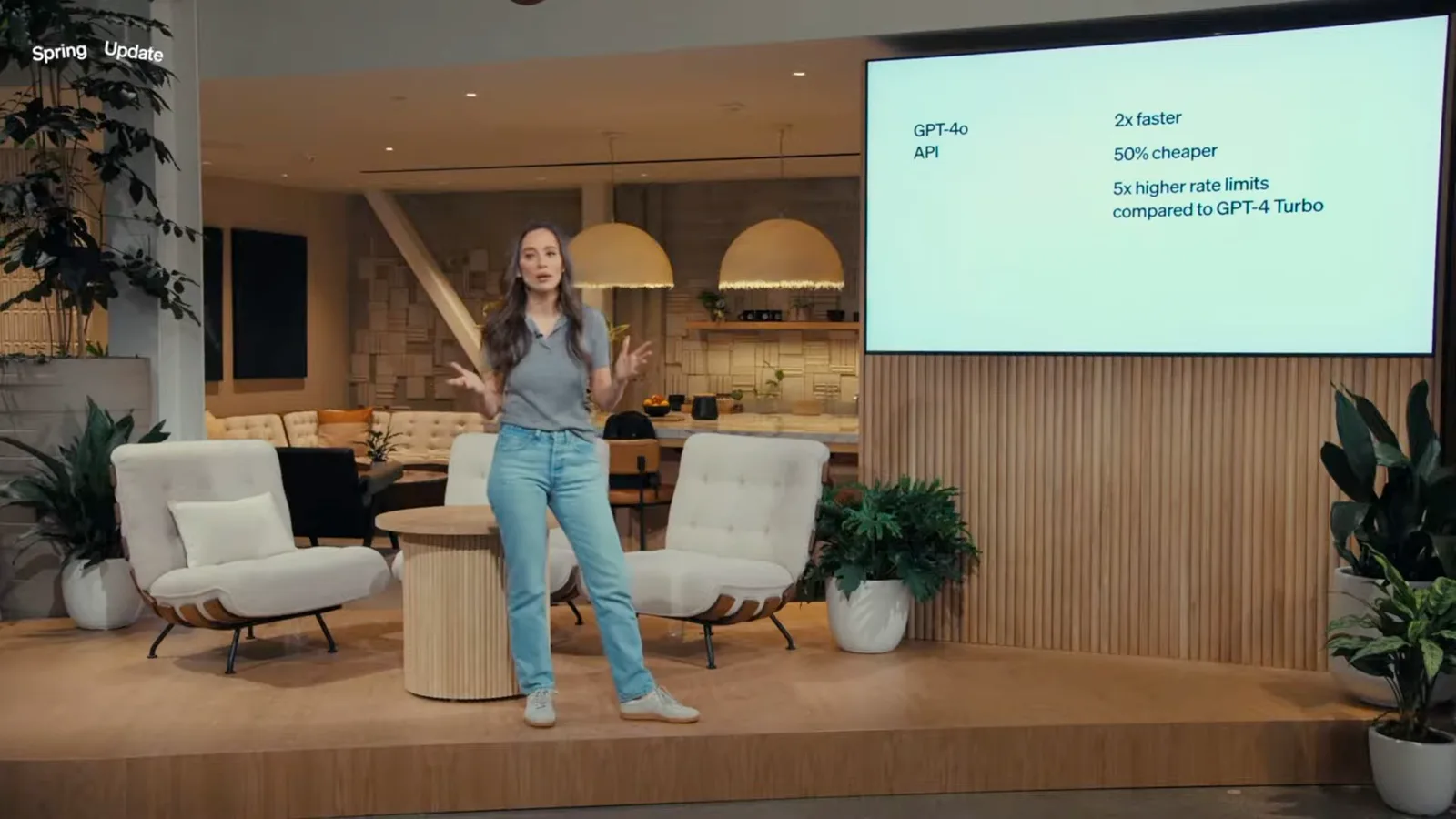
Voice, interruptions and expressive speech
Chen and Zoph demonstrate breathing guidance and changes to a story’s delivery. Chen describes interruption and lower latency.
Murati brings research leads Mark Chen and Barret Zoph on stage. Chen tells ChatGPT he is nervous about the live demo and asks it to help him calm down. The assistant suggests deep breathing, then reacts to his exaggerated breaths and coaches him to slow down.
Chen explains that, in the demonstrated voice experience, a user can interrupt the model rather than wait for it to finish. He also highlights quicker responses and the system’s ability to respond to vocal cues. The interaction is a live demonstration, not an independent test of emotion recognition or a guarantee about every conversation.
To demonstrate vocal expression, Chen asks for a bedtime story about robots and love for Zoph. The assistant starts a story about a robot named Byte, then changes its delivery as Chen asks for more drama, a robotic voice and finally a sung ending. The exchange shows requested changes in style during a conversation.
Visual tutoring and desktop coding
The assistant guides Zoph through a handwritten equation after initially responding before seeing it. The team then shares code and a plot for explanation.
For the vision demonstration, Zoph asks ChatGPT to help with a handwritten linear equation using hints rather than giving away the answer. The assistant first says it can see the problem before he has shown it; he corrects it, and it waits for the image. That premature response is a visible mistake in the demonstration.
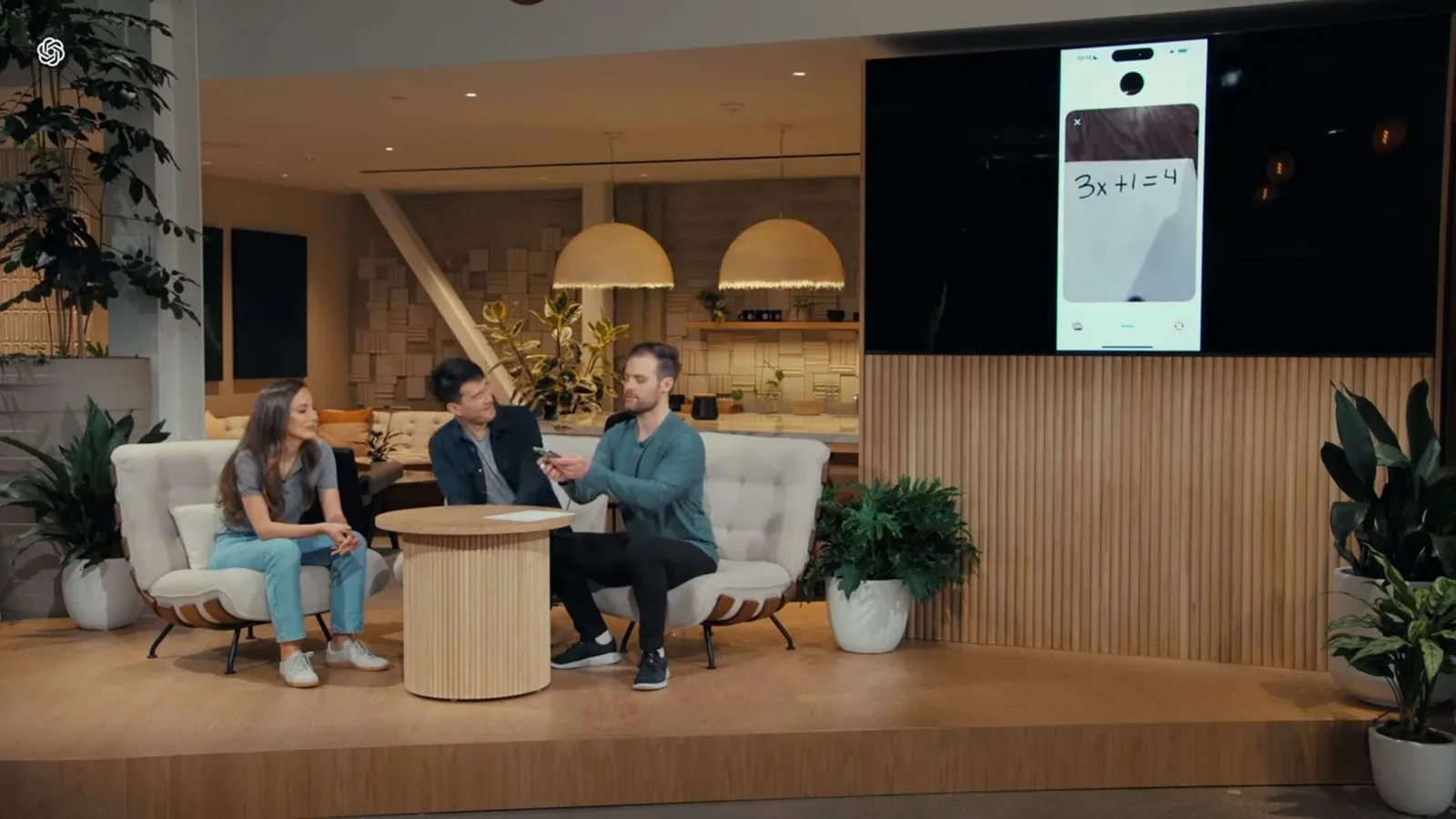
Once shown the page, the assistant reads 3x + 1 = 4 and asks what to do with the extra one. Zoph subtracts one from both sides, producing 3x = 3. When he needs another hint, it asks which operation undoes multiplication; he chooses division and arrives at x = 1.
The team next demonstrates coding assistance in the desktop app. Zoph explains that the voice interface cannot automatically see the computer screen in this setup: he selects and shares the code before asking questions. ChatGPT describes code that fetches daily weather data, smooths temperature series and annotates an event on a plot.
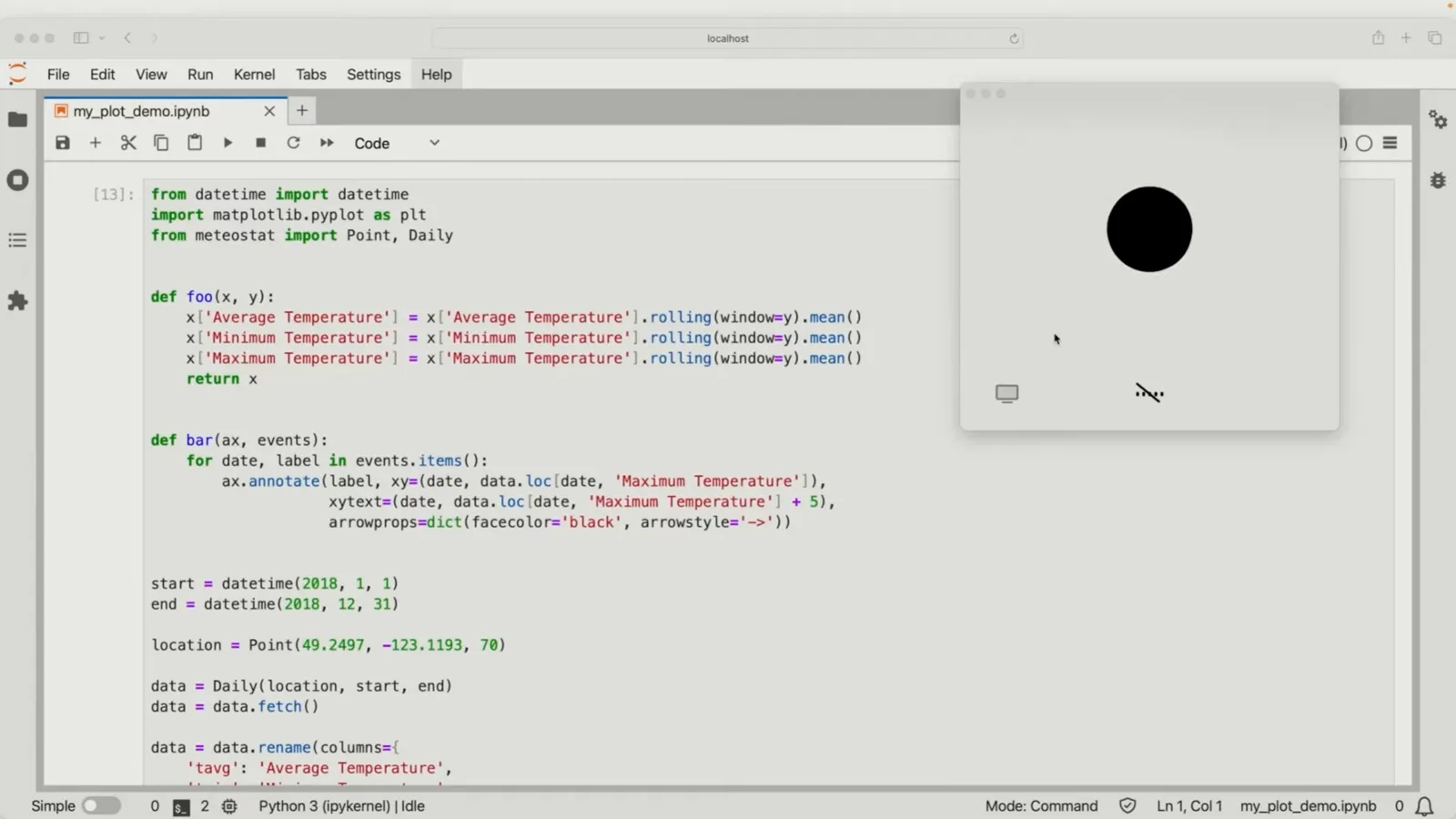
Zoph asks what the function foo does and how the graph would differ with or without it. The assistant says it applies rolling means to the average, minimum and maximum temperatures, reducing fluctuations in the plotted lines. Zoph then generates the plot and shares it for another question.
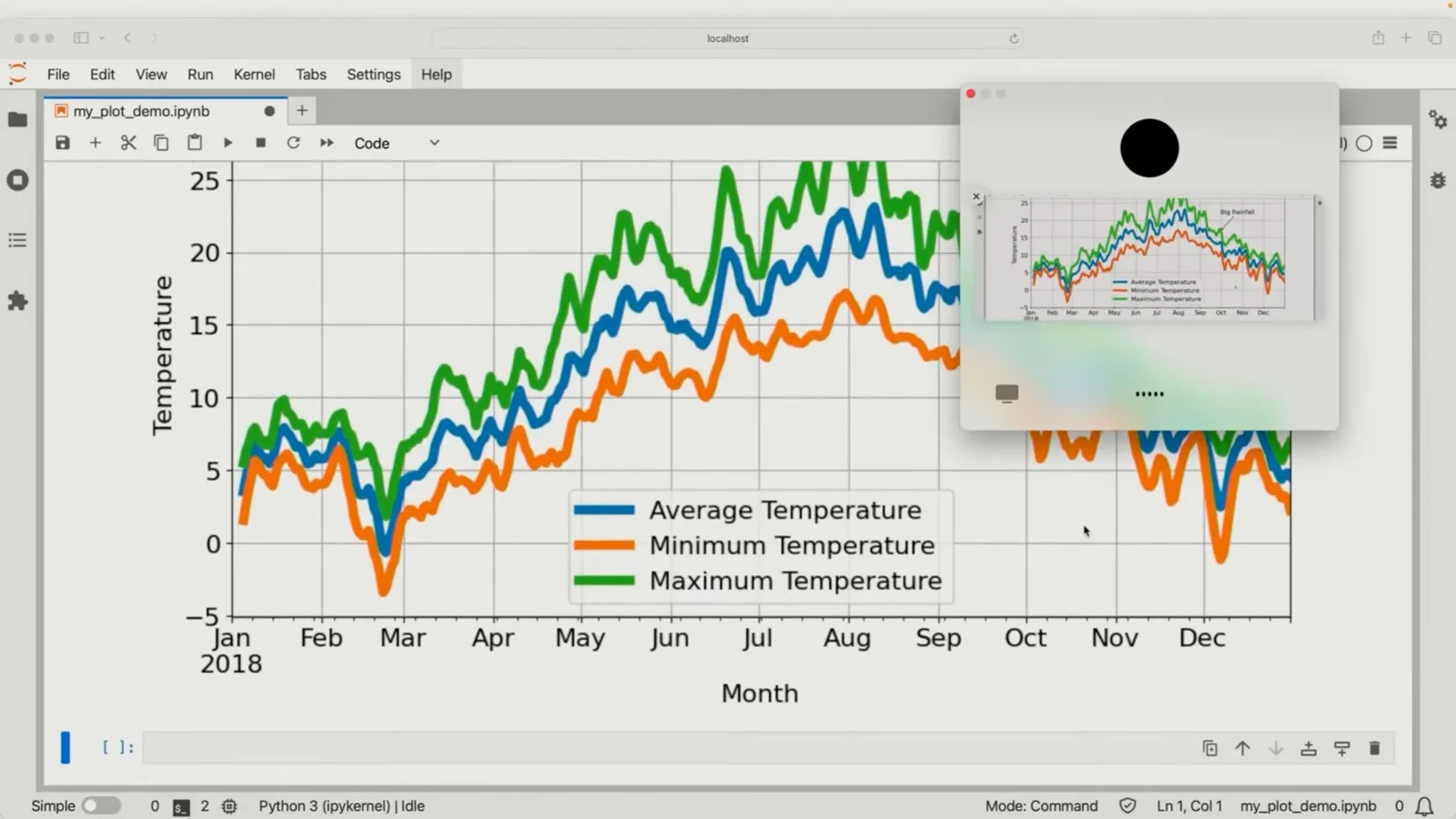
ChatGPT describes the graph as showing smoothed 2018 temperatures and a late-September rainfall annotation. It identifies July and August as the hottest months, with maximum temperatures around 25–30°C, and says the axis is in Celsius. These answers illustrate the particular shared plot rather than a general guarantee of chart accuracy.
Translation and a selfie
The presenters try a brief English–Italian translation request and an expression description. Murati closes with the planned rollout.
For a request submitted by the live audience, Chen asks the assistant to translate between English and Italian in real time. He instructs it to translate each language into the other; the edited clip presents a brief exchange before the team says it appears to work. The available captions do not preserve a full translation transcript.
Zoph then asks the assistant to look at a selfie and say what emotion he appears to be showing. It describes a smile and suggests he looks happy and excited. This is an inference from an image in one demo, not a reliable measurement of a person’s internal emotional state.
Murati closes by saying the team wants to make the technology accessible for people to try, with the demonstrated capabilities planned to roll out over the following weeks. The supercut ends with the live audience applauding.
同じチャンネルの記事
 34:21EN
 Matthew Berman· 2026年10月27日Matthew Berman Examines Anthropic’s IPO Filing, AI Growth and GovernanceMatthew Berman, Sam Altman · Forward FutureThe presenter reviews the S-1’s financial metrics, compute strategy and voting structure while questioning the tension between rapid AI development and safety.
 25:50ENMatthew Berman· 2026年10月24日Kimi K3.1 Pro Tested: Strong 3D Demos, Uneven Results and Competitive PricingMatthew Berman · Forward FutureMatthew Berman tests the open-weight model on coding, 3D rendering and visual explanations, then compares benchmark results and prices.
 32:20ENMatthew Berman· 2026年10月23日Who Is Local AI For? The Costs, Trade-offs and a Hybrid FutureMatthew Berman · Forward FutureMatthew Berman weighs data control and independence against hardware cost, setup complexity and inference speed.
 1:03:37ENMatthew Berman· 2026年10月23日Matthew Berman’s Team Tests Kimi K3.1 on Animation, Games, and ChartsMatthew Berman, Alex, Brian · Forward FutureA live team AMA turns into an informal test of Kimi K3.1, from personal-agent workflows to motion graphics, a browser game, and a benchmark chart.
 0:53ENMatthew Berman· 2026年10月22日Sam Altman on AI and the Discovery of New KnowledgeSam Altman · OpenAIAltman expects progress in mathematical discovery to extend to biology, materials and energy.
 0:22ENMatthew Berman· 2026年10月21日A Robot Bodyguard Video Shows Dramatic Rescue ScenariosMatthew Berman · Forward FutureMatthew Berman reacts to a short robot demonstration depicting fighting and vehicle-rescue scenarios.