30 秒でわかる
Matthew Berman discusses NVIDIA’s December 2025 deal with Groq, the company behind language processing units, and argues that inference is becoming more important as AI usage grows. He speculates that the transaction’s structure was intended to avoid antitrust scrutiny. Groq described the arrangement as a non-exclusive technology license, with founder Jonathan Ross and other team members joining NVIDIA while Groq continued independently. A later NVIDIA filing disclosed $13 billion paid at closing and $4 billion payable within a year, including imputed interest; Berman’s $20 billion figure was a contemporaneous reported estimate.
- 1License, not a company purchaseBerman opens by calling the deal an acquisition but later explains it is a non-exclusive license. Groq said it would continue independently.
- 2Groq’s LPUHe discusses Groq’s specialized inference chips and founder Jonathan Ross’s earlier work on Google’s TPU.
- 3Inference demandBerman predicts that inference will generate most AI revenue as usage scales. That is a forecast, and GPUs are also used for inference.
- 4Deal structure and speculationThe announced license and employee moves are documented; Berman’s claim that the purpose was to avoid antitrust regulation is speculation.
ポイント
- Groq and NVIDIA announced a non-exclusive inference technology license, while Groq said it would remain an independent company.
- Jonathan Ross and other Groq team members joined NVIDIA as part of the arrangement.
- A later NVIDIA filing disclosed $13 billion paid at closing and $4 billion payable within a year, including imputed interest.
- GPUs support inference as well as training; Groq’s LPU is a specialized inference technology.
- Berman’s claims about future revenue and the parties’ antitrust motivations are interpretations, not established facts.
チャプターごとに整えた全文を読む
Groq’s inference technology
Berman introduces a reported deal between NVIDIA and Groq and describes the LPU. He contrasts specialized inference chips with GPUs.
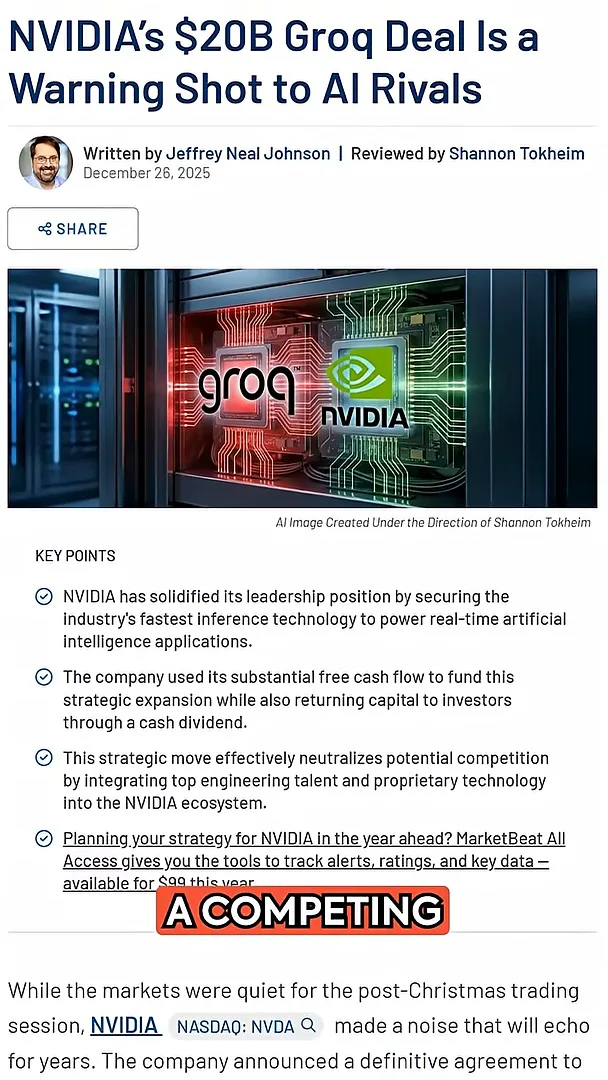
NVIDIA has made a major deal involving Groq, the AI-chip company. Although I initially call it an acquisition, the [companies’ announcement](https://groq.com/newsroom/groq-and-nvidia-enter-non-exclusive-inference-technology-licensing-agreement-to-accelerate-ai-inference-at-global-scale) describes a non-exclusive license for inference technology, with Groq continuing independently. The roughly $20 billion figure I cite was reported at the time, not a disclosed purchase of the company.
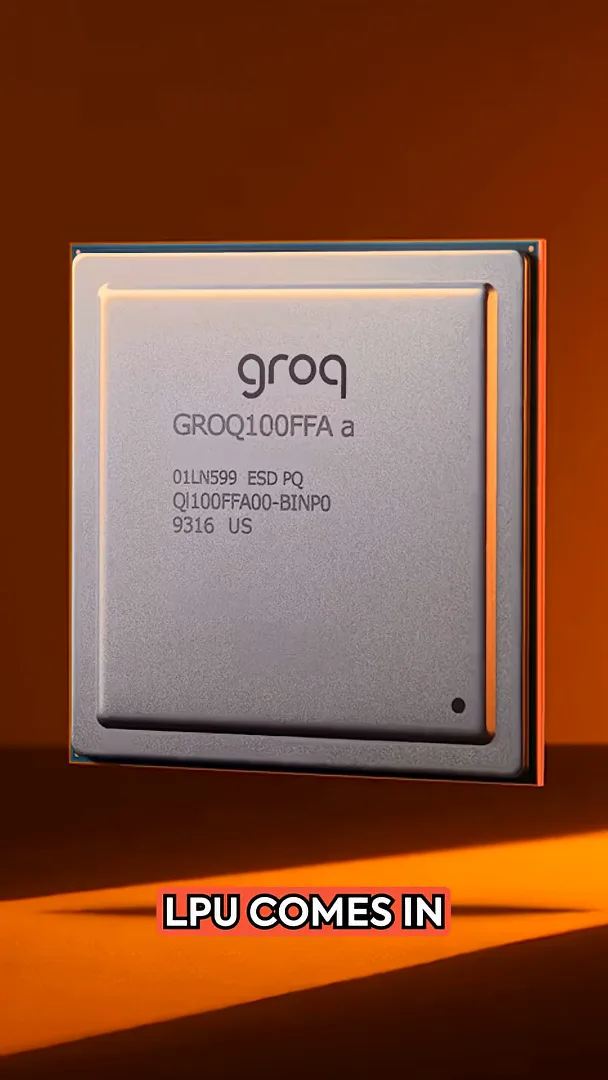
Groq makes specialized language processing units, or LPUs, designed for AI inference. Founder Jonathan Ross previously helped develop Google’s TPU before starting Groq. I contrast these chips with GPUs, but GPUs already run both inference and training; the question is how different architectures perform on particular workloads.
Inference economics and the deal
He argues that inference will become a major revenue driver. He then discusses the non-exclusive license, staff moves, and his view of the transaction structure.
Inference is the stage when a trained model processes an input and generates a response. I expect inference revenue to become increasingly important as AI usage grows, potentially larger than training revenue. That is my forecast about the market, not a result established by the agreement.
The arrangement gives NVIDIA a non-exclusive license to Groq inference technology, and Ross, Groq president Sunny Madra, and other team members are joining NVIDIA. Groq says it continues as an independent company. A non-exclusive license does not mean NVIDIA acquired all Groq intellectual property or equity.
I interpret the structure as an effort to avoid antitrust regulation, but the parties’ motivation is not established by the announcement. In a [later NVIDIA filing](https://www.sec.gov/Archives/edgar/data/1045810/000104581026000021/R11.htm), the company disclosed $13 billion paid at closing and $4 billion payable within one year, including imputed interest, and said no customer contracts, existing products, or equity interests were purchased. I see the deal as a strategic move toward specialized inference hardware.
同じチャンネルの記事
 14:45EN
 Matthew Berman· 2026年10月29日Matthew Berman Examines Google’s Gemini 4 Carbon AnnouncementMatthew Berman · Forward FutureMatthew Berman reviews Google’s reported benchmark results, staged rollout and pricing for Gemini 4 Carbon, while noting he has not yet used the model.
 34:21ENMatthew Berman· 2026年10月27日Matthew Berman Examines Anthropic’s IPO Filing, AI Growth and GovernanceMatthew Berman, Sam Altman · Forward FutureThe presenter reviews the S-1’s financial metrics, compute strategy and voting structure while questioning the tension between rapid AI development and safety.
 0:26ENMatthew Berman· 2026年10月25日Sam Altman on Human Values and Problem-Solving in an AI WorldSam Altman · OpenAIIn a short interview excerpt, Altman considers the enjoyment of solving hard problems and the human role in interpreting results.
 0:36ENMatthew Berman· 2026年10月25日Kimi K3.1 and a Rubik’s Cube Solver DemonstrationMatthew Berman · Forward FutureMatthew Berman shows a scrambled virtual cube being solved and gives the Kimi K3.1 test a favorable assessment.
 0:21ENMatthew Berman· 2026年10月24日An AI-Generated Kimi Benchmark Chart Used Invented ScoresMatthew Berman · Forward FutureMatthew Berman asks for a graph of Kimi K3.1 Pro benchmarks, then discovers that the displayed figures are illustrative placeholders.
 25:50ENMatthew Berman· 2026年10月24日Kimi K3.1 Pro Tested: Strong 3D Demos, Uneven Results and Competitive PricingMatthew Berman · Forward FutureMatthew Berman tests the open-weight model on coding, 3D rendering and visual explanations, then compares benchmark results and prices.