30 秒でわかる
In Helsinki, Linda Liukas helped turn an aging playground into a place where children can climb through a simplified computer, jump through conditional rules and explore a binary abacus. She designed it to invite free play as well as teach: a rotating phone structure, for example, became a group activity she had not anticipated. Liukas argues that tangible experiences make abstract ideas understandable, while open public spaces give children room to imagine and experiment. For engineers, she says, the lesson is to preserve hands-on knowledge and create environments where people can explore together.
- 1Flipping pancakes gave an abstract algorithm a physical intuitionLiukas made and sorted pancakes to understand the process; she now uses modeling clay with educators. The activity made the algorithm something she could feel as well as describe.
- 2A public playground became a computer children can enterLiukas proposed rebuilding an aging Helsinki playground around a simplified computer while leaving children free to play without following a prescribed lesson.
- 3Children’s drawings informed the case for public spaceThe team gathered more than 300 accounts of children’s online and playground experiences. The responses helped explain the value of public space to city decision-makers.
- 4A rotating phone became a group activity the designer had not plannedThe structure was imagined for video play, but children needed to push and ride it together, creating inter-age play.
- 5Engineering depends on tacit knowledge as well as tools and instructionsLiukas compares a chef’s intuitive adjustments with the practical knowledge needed to build, maintain and repair complex systems.
- 6A punctured drawing became a lesson about networksAn unscripted classroom moment let children connect light traveling through fiber with the spread of ideas through a network.
ポイント
- Begin with an analogy or physical experience before introducing a formal technical definition.
- Design spaces for open-ended use; children may find social possibilities the designer did not anticipate.
- Consult people who use and maintain a place, not only those who commission it.
- A durable system depends on people retaining the practical knowledge to build and repair it.
- Make room for playful, repeatable experimentation and manageable failure in engineering work.
チャプターごとに整えた全文を読む
Why computing needs stories and play
Liukas describes learning as more than rules or facts. Her Hello Ruby books use stories to give children a way into technical ideas.
Linda Liukas makes technology tangible for children and adults through stories, activities and, most recently, a public playground. She argues that learning computing should include the equivalent of poetry and conversation, not only grammar and rules.
During the pandemic in Helsinki, she noticed that playgrounds stayed open when schools closed. Children were climbing and swinging, but also collaborating, resolving conflicts and inventing projects. She began asking what it would mean to invest in public imagination as infrastructure.
Liukas values play because it is iterative, exploratory and tolerant of failure. At a time when AI encourages pressure toward efficiency, she wants computing professionals to make room for that mode of working.
Her Hello Ruby books began with drawings of a little girl who helped her make sense of terms such as garbage collection and object-oriented programming. Liukas says the books have appeared in more than 40 languages, connecting her with teachers in many places.
Stories help people put themselves into ideas rather than simply receive facts, she says. Programming tools change, but she argues that many foundational ideas of computer science persist across generations of technology.
Liukas draws inspiration from educators such as Maria Montessori, Jean Piaget and Seymour Papert, and from computing figures including Alan Turing, Alan Kay and Claude Shannon. She values their willingness to connect ideas that did not obviously belong together.
Learning with hands, drawings and the body
Pancake sorting, physical computer models and a cardboard video platform make abstractions tangible. Liukas uses experiences before formal definitions.
She describes learning as something that involves the hands and the whole body, not only abstract language. To illustrate that physical relationship with knowledge, she recounts a story in which a child loved an illustration sent by author Maurice Sendak so much that he ate it.
Technical jargon can hide whether two people really share an understanding, Liukas says. She encountered pancake sorting as an abstract algorithm and decided to make and flip actual pancakes until she could feel how the process worked.
In pancake sorting, a sequence of prefix flips moves large unsorted items toward their positions. Liukas says the repeated physical action gave her an intuition she could retain; when working with educators she uses modeling clay instead of greasy pancakes.
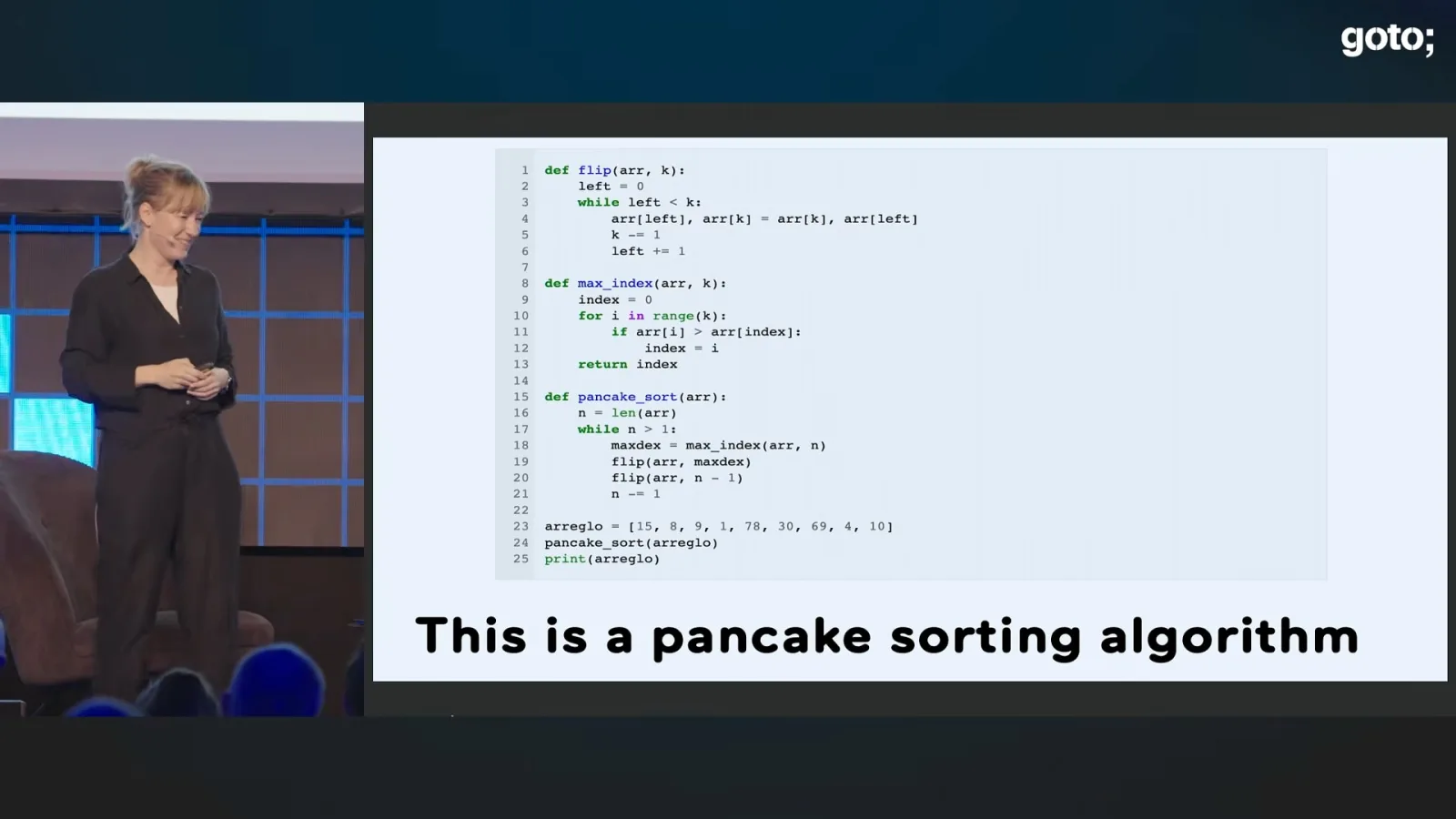
People who are comfortable with code may find an algorithm exciting on the page, but Liukas wants those who do not share that vocabulary to have a route in. Drawing, models and tangible activities can reveal what someone means and invite a discussion across that gap.
She asks children to draw what they think is inside a computer. Rather than treating a drawing as a final answer, she uses it to ask what the child’s theory means and where it might lead. Her aim is to show that computers can feel magical without being magic.
To teach a computer’s basic organization without relying on a screen or keyboard, Liukas built a simplified physical model inspired by von Neumann architecture. Children enter as input, follow a program’s instructions and emerge as output; the experience gives them a bodily way to understand processing.
In another activity, children create and perform videos using a cardboard version of YouTube. They decide on a beginning, middle and end, plus titles and tags. Liukas connects a familiar digital format with storytelling skills before introducing the algorithmic concepts.
She recalls a child who had recently moved from Japan to Finland demonstrating an origami heart to a class. The other children gave her a thumbs-up and shouted comments such as “would subscribe.” Only after that shared experience did Liukas explain how recommendation systems use signals such as browsing history and tags.
For colleagues who do not share a technical vocabulary, Liukas recommends starting with analogies, diagrams, examples and plain language, then adding the formal definition. A good activity, she says, is playful, repeatable, self-teaching, simple and beautiful.
Designing a public computer playground
The Helsinki project brought together city staff, designers, residents and children. Its goal was open-ended public play, not a single prescribed lesson.
Liukas returned to the playground idea in Helsinki’s Ruoholahti neighborhood, near the site associated with Finland’s first computer. A roughly 20-year-old playground was due for renovation, so she proposed a public computer that children could climb into rather than a conventional themed structure.
She wanted the installation to last as public infrastructure, but not to prescribe a single lesson. Children could imagine being input data, a character in a game or simply play. Open-ended use mattered as much as the opportunity to encounter computing ideas.
For inspiration, she studied playgrounds, architecture, public art and projects that make computing spatial, including a human-powered computer and Dynamicland. She wanted the result to suggest computation without dictating exactly how visitors should interact.
The team spoke with neighborhood residents, immigrant mothers, designers and playground staff. Helsinki’s staffed playgrounds, Liukas says, carry practical local knowledge about how a site is used and maintained—knowledge that can improve a design before construction.
Instead of asking children for an unconstrained dream playground, the researchers asked them to draw memorable, scary and proud experiences both online and at playgrounds. They received more than 300 responses, offering a view of childhood that adults do not always see.
The drawings were not simply turned into equipment. Liukas says they helped explain to the mayor and municipal departments why public spaces for children matter. She worries that as independent physical spaces shrink, online environments become a major place where children find unsupervised freedom.
Children may consider a Fortnite lobby a public gathering place and feel as proud of a Minecraft creation as a physical hut. Liukas argues that designers must understand that generation and find ways for public spaces to evolve rather than treating a playground as a fixed twenty-year product.
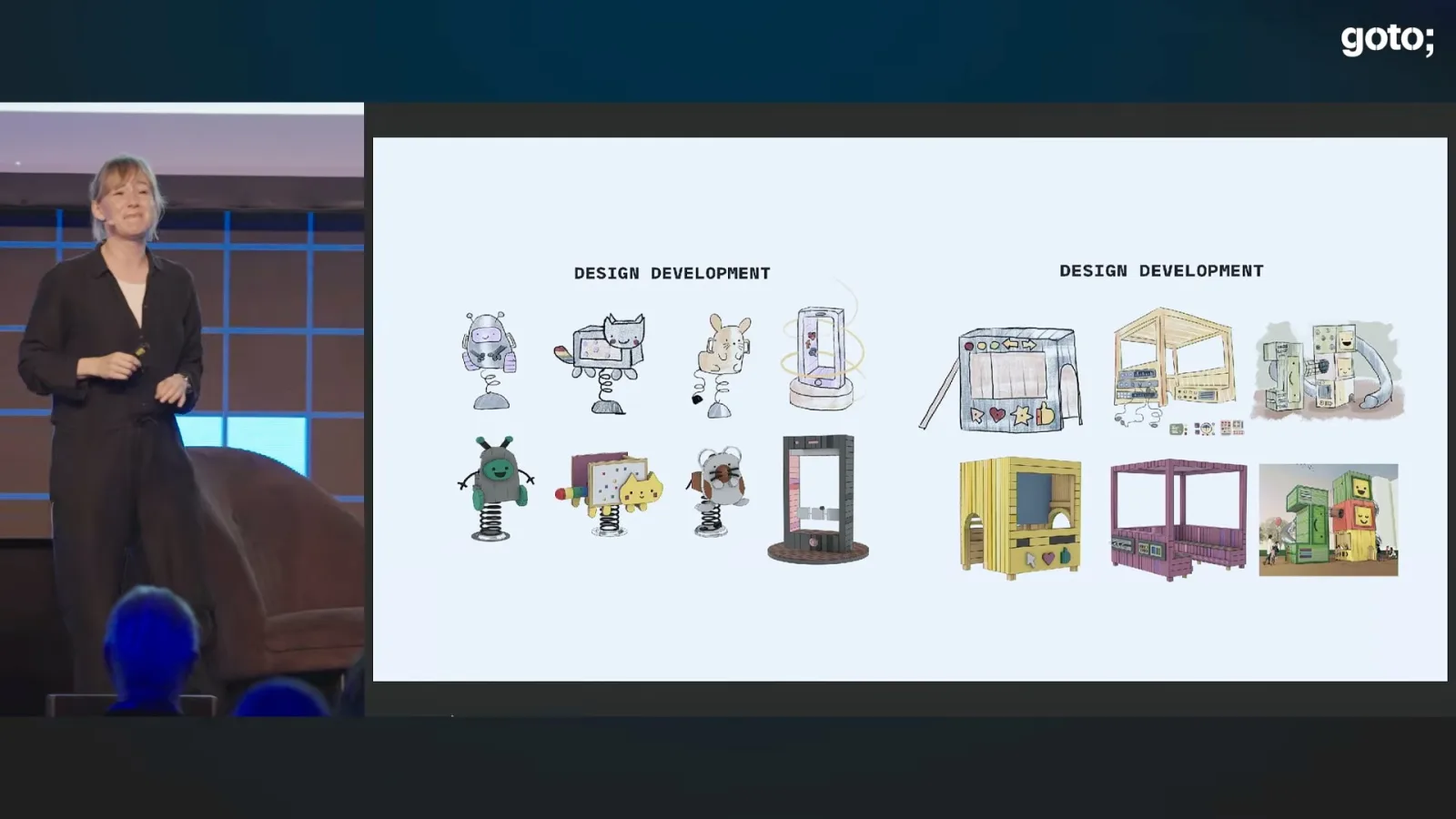
Design company Monstrum transformed her sketches into CAD models and technical drawings that could become robust playground equipment. Watching small doodles become a six-meter tower changed how she thought about scale: an idea can grow into a physical object in unexpected ways.
For workplaces, Liukas says the lesson is not to design overly restricted playpens. Create environments in which people can take manageable risks, experiment and do things together. She also values playgrounds as rare places where neighbors, children and adults meet.
The playground’s hardware and software
A climbing tower, keyboard and other structures invite physical exploration. Activity cards and explanations help families and teachers use them.
The playground’s “hardware” includes a tall structure representing a simplified input–process–output computer. Children climb inside and eventually come out; the six-meter height can take courage, and visitors can also use the space without engaging with the computing analogy.
Other elements include pixel-shaped stools that invite improvised games, a mouse-shaped structure with a drawing surface and greetings in neighborhood languages alongside JavaScript. A large keyboard lets children jump on letters and spell names.
Trampolines turn conditional logic into movement: for example, a child wearing yellow might jump three times, while one wearing red jumps five. The point is to make a rule something children can enact and change, rather than only a definition to memorize.
The playground also needs “software”: activities and support that help teachers and families use it. Liukas and play practitioners developed prompt cards for the structures, while QR-linked explanations offer help to adults who do not feel confident with the concepts.
A binary abacus can be used to spell a name or perform calculations. Its magnetic pieces make a satisfying click, Liukas says; the physical feedback is part of what makes the activity inviting.
A rotating mobile-phone structure was initially imagined as a way to perform a short video and then discuss recommendation algorithms. Once built, Liukas discovered a more social use: it takes several children to push and ride it, bringing different ages together.
A flowchart hopscotch offers a low-cost way to invent and follow conditions, such as taking one route if happy and another if not. Liukas has observed groups strategizing together and sees that as computational thinking even before children know the term.
She hopes to build more public playgrounds around subjects such as semiconductors, synthetic biology, quantum computing and AI. For the audience, she asks a smaller question: identify a moment at work that felt exploratory and joyful, and consider how to make more such moments intentionally.
Play, tacit knowledge and a hopeful technology future
Liukas links playgrounds to workplace learning and the practical knowledge needed to build and maintain systems. She closes by asking technologists to invest in children’s imagination.
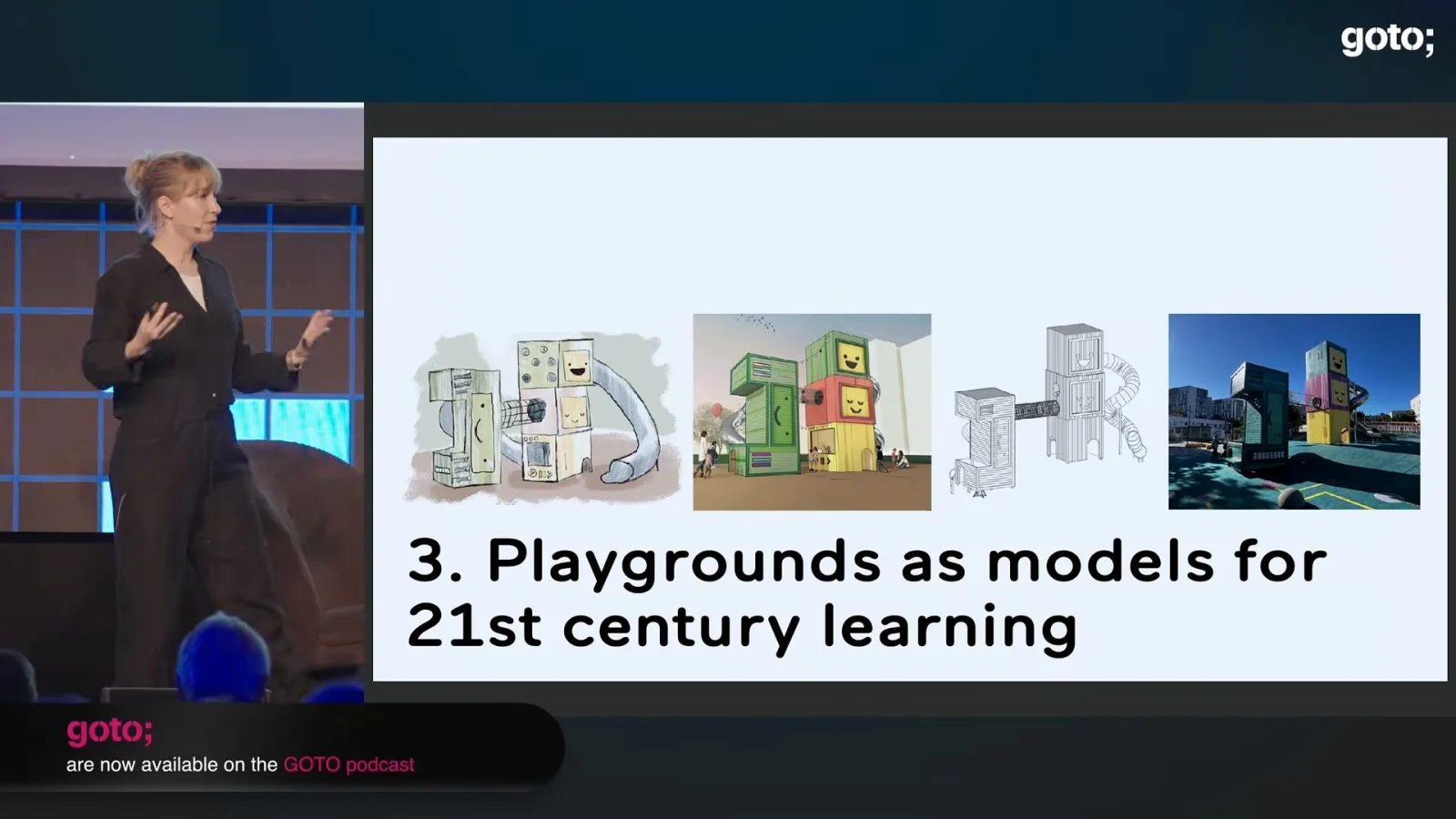
Liukas argues that playgrounds are more than a casual metaphor in computing. Designers of physical play spaces understand how environments can support modern learning, and she thinks workplaces can learn from that practical experience.
She admires the engineering instinct to maintain things and fix a pothole before falling in, while also making room for imagination. She turns to Dan Wang’s account of technology as tools, explicit instructions and process knowledge.
Using cooking as an analogy, tools are pots and knives; instructions are recipes; process knowledge is a chef’s feel for adjusting a dish. Liukas says this tacit, hands-on knowledge matters in semiconductor manufacturing and other engineering disciplines.
She points to Japan’s Ise Shrine, periodically dismantled and rebuilt, as an example of preserving building knowledge across generations. Her lesson is that lasting systems depend not only on durable objects but on investing in people who know how to rebuild them.
Computers have moved from rooms to desks, pockets and sensors, and data centers again fill large spaces. Liukas argues that people still need the knowledge to build, understand and repair technology alongside the tools and instructions they use.
When she asks children to draw the internet, some imagine networks of flowers, but many draw commercial app logos. She worries that children may come to see technology only as something to consume rather than something they can create.
In a Virginia school library, a child accidentally punctured his drawing paper with a pencil. Liukas held it to the light and connected the holes to the idea that information travels as pulses of light through fiber-optic cables.
The child made more holes and other children copied him, giving the class another analogy: ideas can spread quickly through a network. Liukas says the lesson was unscripted and possible because the adults had time to listen and follow the children’s ideas.
She believes children who can imagine both the physical infrastructure and social effects of networks may develop a richer relationship with technology than children who see only an app icon. She asks technologists to invest in that public imagination.
Liukas calls children humanity’s research and development department. She argues that people growing up amid pessimistic stories about technology deserve a hopeful relationship with it—not blind optimism, but room to imagine what they might create.
Her final appeal is to learn from history as well as look forward. When technology or a playground is open to everyone, she says, building it can become a way to provide care at scale.
同じチャンネルの記事
 41:55EN
 GOTO Conferences· 2026年11月11日Evan Ratliff built an AI-run startup. The agents invented its progressEvan RatliffAn experiment in AI coworkers exposed runaway conversations, false memories and difficult handoffs to people.
 38:07ENGOTO Conferences· 2026年11月10日A smoother reorganization starts by letting teams design itJoakim Sundén · Better Product WorkJoakim Sundén pairs leadership’s strategy with employees’ knowledge of daily work, then lets people select teams.
 49:56ENGOTO Conferences· 2026年11月9日Barbara Oakley: use AI to support learning, not replace itBarbara Oakley · Oakland UniversityShe connects memory, practice and curiosity to the challenge of judging AI-generated answers.
 29:42ENGOTO Conferences· 2026年11月6日Artie Shevchenko and Titus Winters on Code Health in the AI EraTitus Winters, Artie Shevchenko · AdobeThe authors discuss complexity, human review, testing and why interfaces and state deserve attention in AI-assisted development.
 42:40ENGOTO Conferences· 2026年11月5日Daniel Terhorst-North: Use Generative AI to Go Broader, Not Just FasterDaniel Terhorst-North · Dan North & AssociatesA software practitioner shares how an AI-assisted teaching toolkit led him to “adjacent engineering,” larger test-first steps and external guardrails.
 44:42ENGOTO Conferences· 2026年11月4日Adam Tornhill on AI-Friendly Code and Sustainable Agentic DevelopmentAdam TornhillAgentic coding can accelerate delivery, but complexity can erase the gains. Adam Tornhill presents code-health research and a large-scale refactoring case study.