30 秒でわかる
At Sana AI Summit 2023, Joel Hellermark presents Sana AI as a tool for augmenting people and accessing company knowledge. A live demonstration covers metrics, an investor email, course translation and meeting search, followed by claims about early AI productivity studies.
- 1Knowledge assistantHellermark introduces Sana AI as a way to search company knowledge and assist with work.
- 2Metrics to investor updateThe live demo collects metrics, explores trends and drafts an email.
- 3Translation and meeting searchHe demonstrates translating onboarding material and finding meeting action points.
- 4Productivity figures in contextThe cited gains apply to particular studies and tasks, not every workplace.
ポイント
- Hellermark frames Sana AI around augmenting human capability.
- The 2023 demonstration combines search, analysis, drafting and actions.
- Meeting search connects summaries and action items to source material.
- The productivity figures cited in the talk concern specific studies and tasks.
チャプターごとに整えた全文を読む
Augmenting people
Hellermark explains the motivation behind Sana.
Joel Hellermark recalls being drawn to programming by the possibility of writing a tool once and using it on millions of computers to augment human ability. He invokes Douglas Engelbart’s question about what computing can do for people.
Hellermark says Sana’s team set out to rethink how people share and access knowledge. At the 2023 summit he introduces Sana AI as an assistant intended to work with both general and company-specific knowledge.
Sana AI and the live demo
He describes search, data and actions, then demonstrates product workflows.
He describes semantic search across connected sources such as email, Slack and documents, along with meeting summaries linked to specific moments. He says the assistant can also query data and carry out actions in software.
In a live demonstration, Hellermark asks Sana to collect key product metrics and then identify trends. He uses the resulting information to request a draft investor update and notes that he could edit the draft.
He next asks the assistant to translate a design-team onboarding course into Japanese. He presents the action as an example of combining models to carry out a more complex task.
Hellermark searches for Sana AI Summit action points. The demonstration returns a summary and links to the email or exact meeting moment; he then narrows the request to his own action items.
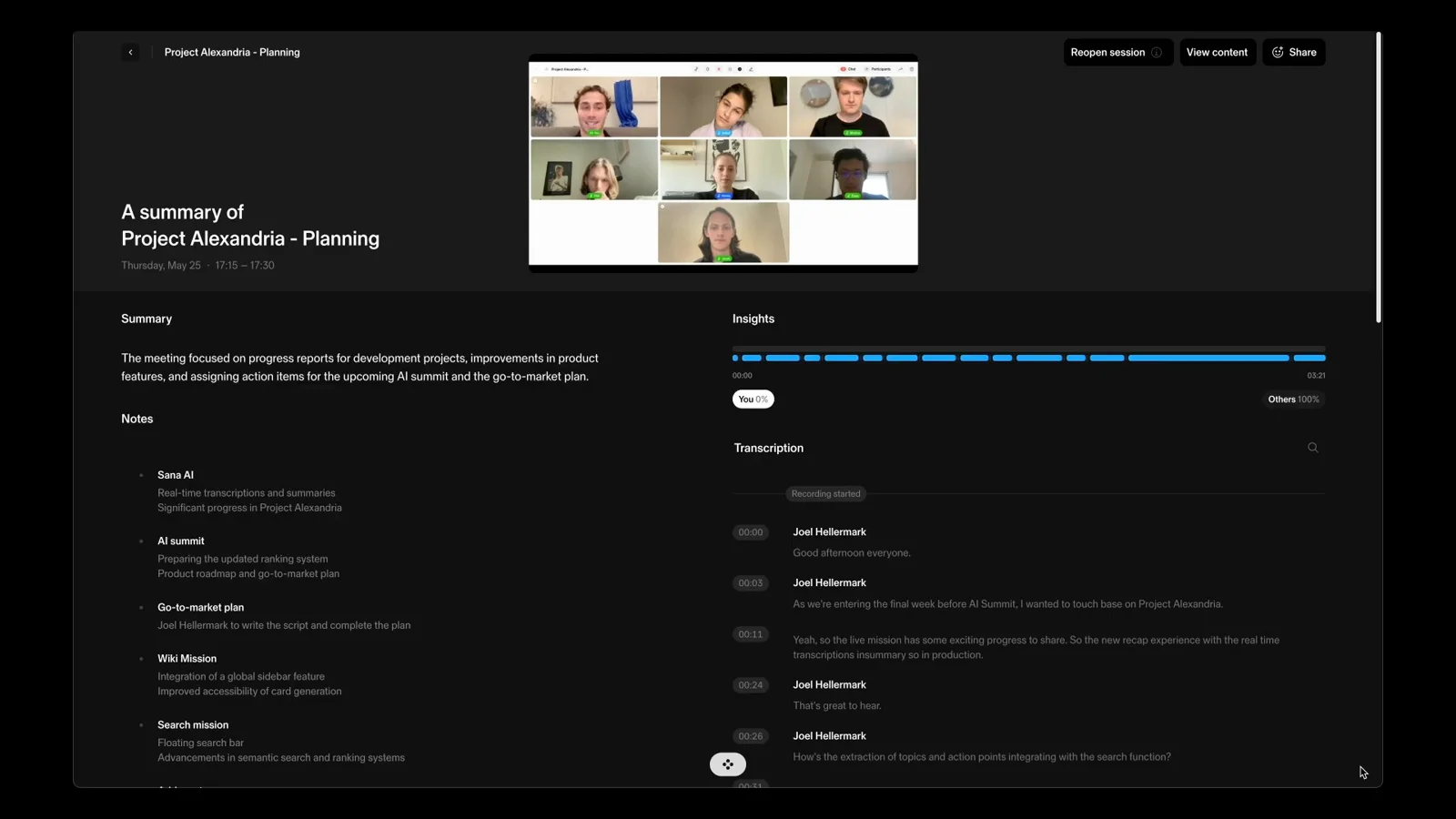
Productivity and human capability
He cites early studies and returns to the goal of augmenting people.
He cites an MIT study in which participants using AI completed general business tasks in 30% less time with improved quality. He also claims sales representatives sold twice as much and answered 2.3 times as many questions in another example. These are the figures he presents, not universal productivity effects.
Hellermark cites another engineering example with tasks completed 55% faster, then compares early AI productivity claims with a historical steam-engine estimate. The tasks, measurements and contexts differ, so the numbers should not be treated as directly comparable.
He closes by returning to the aim of augmenting human intelligence: if a computer is a bicycle for the mind, he asks what more capable tools could enable people to do about pressing problems.
同じチャンネルの記事
 1:16EN
 Sana· 2026年10月14日ポッドキャストHow Volkswagen Group Middle East Uses Sana to Prepare Technicians for TrainingThierry Rochat describes using technical documents to create online courses before hands-on academy sessions.
 0:41ENSana· 2026年9月8日ポッドキャストSana Learn Customers Describe Bringing Training Resources TogetherA short customer montage contrasts fragmented learning resources with keeping company knowledge in one place.
 0:40ENSana· 2026年8月31日ポッドキャストSana Learn Customers Describe Their Partnership ExperienceIn a short montage, customers discuss implementation and the ongoing relationship with Sana.
 48:34ENSana· 2026年8月12日ポッドキャスト · 2 人Tyler Cowen on AI Adoption, Human Agency, and the Search for Beautyゲスト Tyler Cowen · ホスト Joel HellermarkThe economist explains why AI's economic impact may arrive slowly, what people may still contribute, and why he is calling for a new aesthetic.
 0:16ENSana· 2026年7月21日ポッドキャストTyler Cowen on Human Presence in an AI WorldTyler Cowen predicts that charisma, physical presence and human interaction will gain importance as AI advances.
 0:23ENSana· 2026年7月9日ポッドキャストEthan Mollick on Measuring AI’s ImpactEthan Mollick argues that companies should allow room for new opportunities rather than relying only on old metrics.