30 秒でわかる
In this Real Numbers episode, Sawyer asks where to aim a motorized toy boat so it reaches a dock directly across a river after a test crossing drifts 60 meters downstream. The new puzzle is left for viewers to solve. He also solves the previous snow-cone problem, finding the radius of the lower intersection between a hemisphere and a cone and calculating the volume of slush to move.
- 1A river crossingA 100-meter-wide river carries the boat 60 meters downstream during a straight-across test. The episode asks where to aim it on the return trip.
- 2Reduce the shape to a cross-sectionA cone side and the hemisphere’s lower circle can be written as y = 2x − 10 and x² + y² = 25.
- 3Find the lower intersectionSolving the equations gives x = 3 or 5; the lower intersection of interest has radius 3 centimeters.
- 4Calculate the displaced volumeCylindrical shells give 40π/3 cubic centimeters, which can be checked by integrating the removed outer portion.
ポイント
- A straight-across test crossing reveals information about the relative speeds of a boat and a steady current.
- A vertical cross-section turns a cone-and-hemisphere intersection into a line-and-circle problem.
- The relevant lower intersection has radius 3 centimeters and coordinates (3, −4).
- The shell method gives 40π/3 cubic centimeters for the slush moved into the cone’s tip.
チャプターごとに整えた全文を読む
The river puzzle
A toy boat crosses a 100-meter-wide river and drifts 60 meters downstream. Sawyer asks where it should be aimed to reach the opposite dock.
Sawyer introduces a river-navigation puzzle involving a toy boat called Wavey, short for Wave Equation. The river has straight, parallel banks 100 meters apart. Its current is constant across the river, but its speed is unknown.
The boat’s motor also moves it at an unknown constant speed in the direction it faces. Two docks lie directly opposite one another. A friend aims Wavey directly at your dock and launches it from the far bank, but the current carries it 60 meters downstream by the time it reaches your bank.
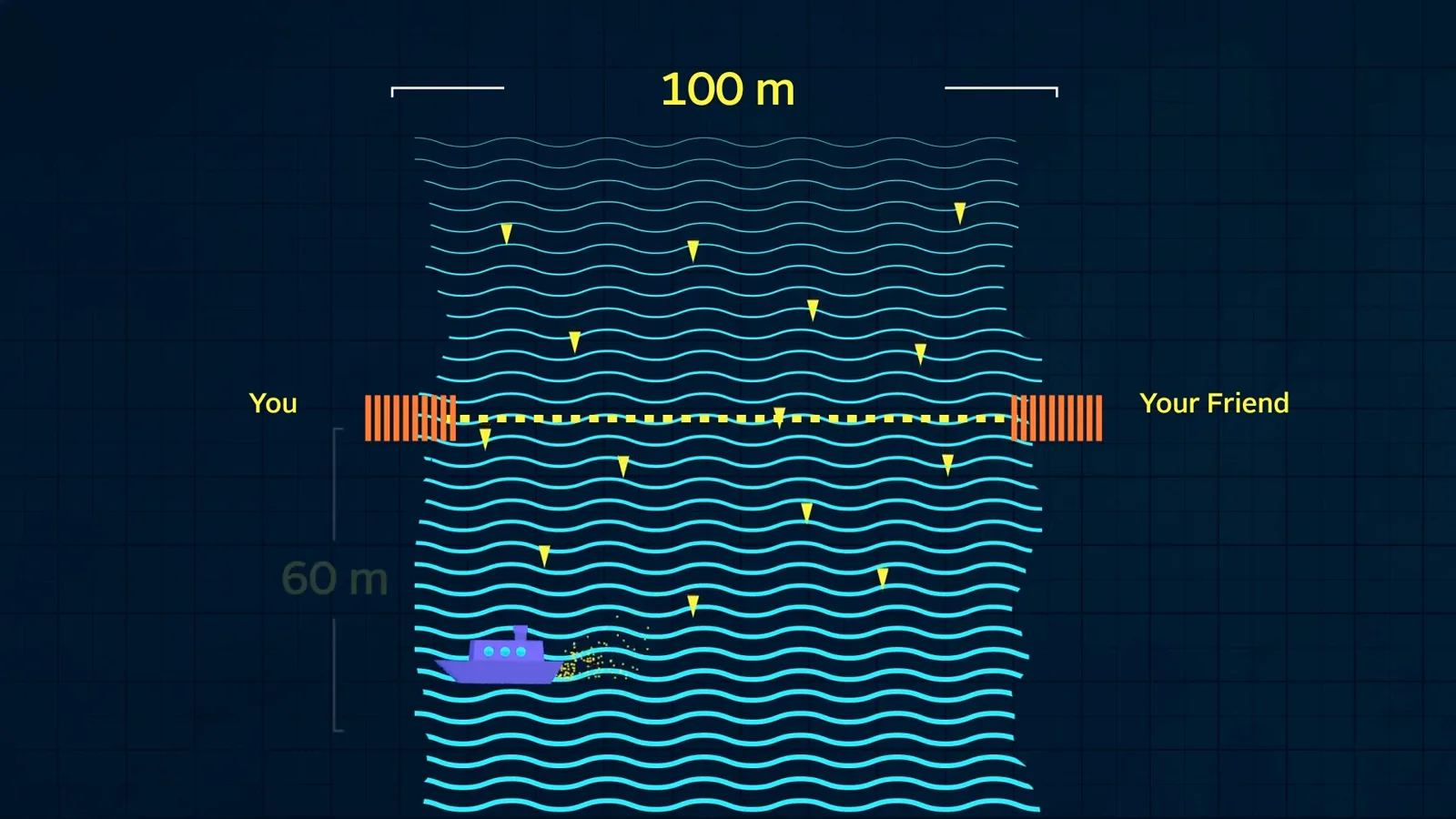
You retrieve Wavey and carry it back to your dock. Where on the opposite bank should you aim it so the combined motion from the motor and the current brings it exactly to your friend’s dock? Sawyer leaves this new problem for viewers to solve.
Solving the previous snow-cone problem
A vertical cross-section turns the cone and hemisphere into a line and a circle. Their lower intersection yields a radius of 3 centimeters.
Before returning to the river, Sawyer solves the previous episode’s snow-cone problem. A cone has radius 5 centimeters and height 10 centimeters; a hemisphere of slush has radius 5 centimeters. The question is the radius at the lower intersection, where slush must be removed from the hemisphere’s sides and moved into the cone’s point.
Take a vertical cross-section through the axis of the cone and sphere. The hemisphere’s lower surface becomes the lower half of a circle, while the sides of the cone form a V. Put the sphere’s center at the origin: the right lip is (5, 0) and the cone’s tip is (0, −10).
The right side of the cone is the line y = 2x − 10, with slope 10/5 = 2. The circle has equation x² + y² = 25. At an intersection, both equations hold, so substituting the line into the circle gives 25 = x² + (2x − 10)².
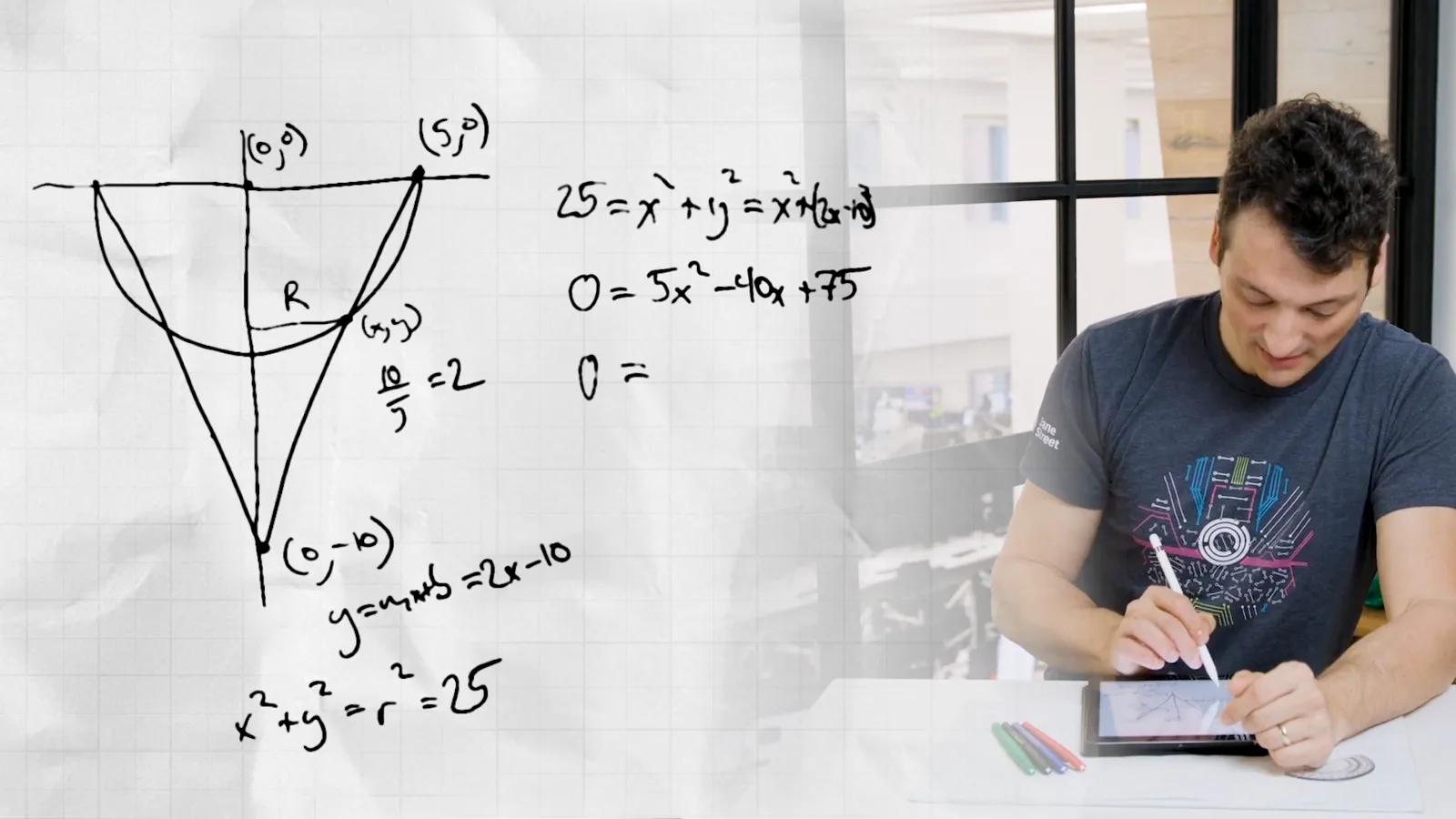
After simplifying, the equation is x² − 8x + 15 = 0, which factors as (x − 3)(x − 5) = 0. The x = 5 solution is the already-known lip. The lower intersection is x = 3, so the desired radius is 3 centimeters.
Substituting x = 3 into the line gives y = −4, so the lower intersection is (3, −4). Together with the radius 5, those lengths form a 3–4–5 right triangle.
The bonus volume and the new challenge
The shell method gives the volume of slush moved, with a second integral as a check. The river problem remains open for viewers.
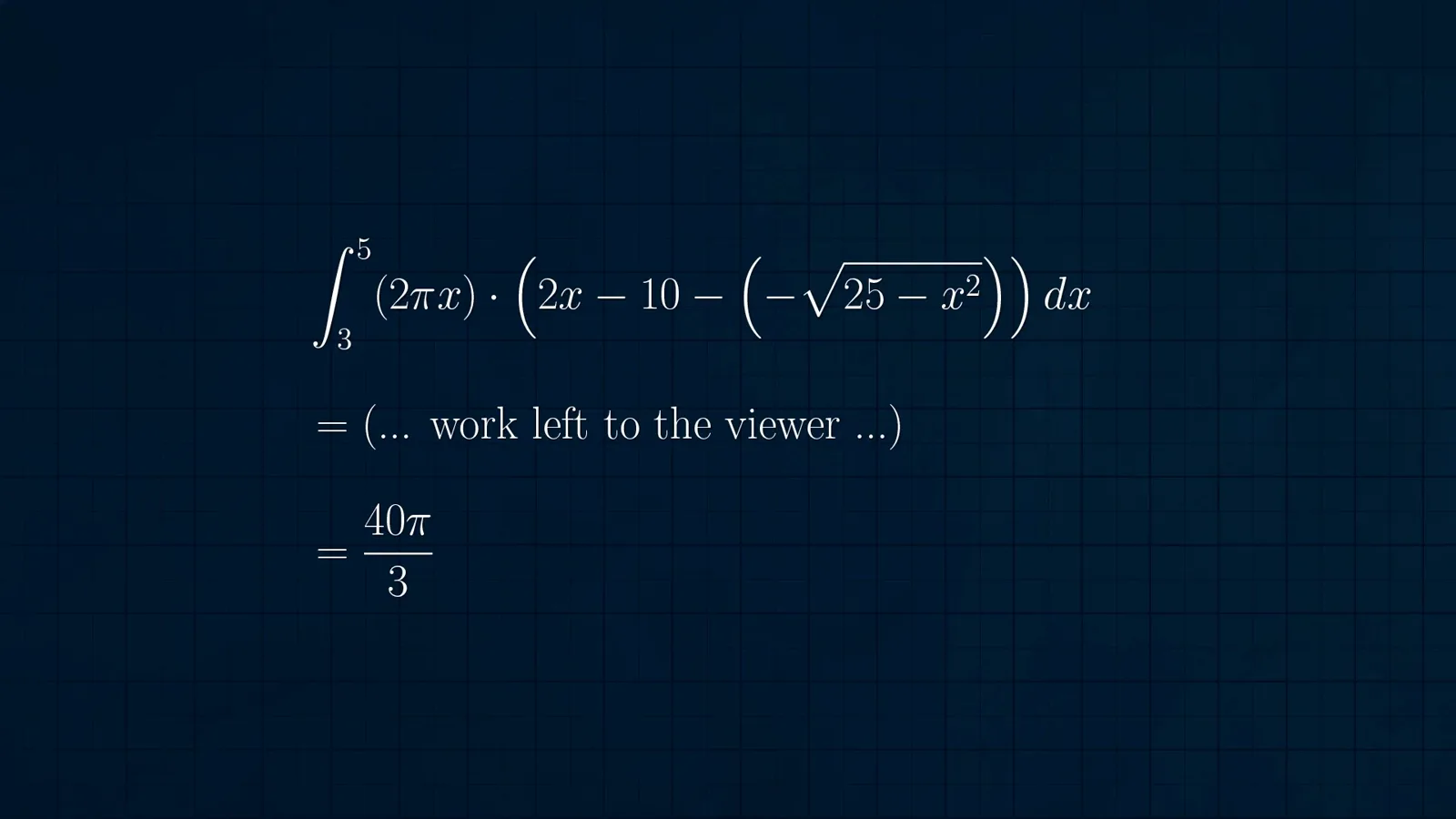
The bonus asks how much slush must be moved. The shell method uses radius x and a height given by the vertical difference between the cone line and the lower hemisphere, y = −√(25 − x²). Integrating cylindrical shells from x = 0 to x = 3 gives 40π/3 cubic centimeters, approximately 41.888 cubic centimeters.
As a check, the slush shaved from the outside of the hemisphere must have the same volume. Integrating shells from x = 3 to x = 5, with height equal to the cone line minus the lower hemisphere, also gives 40π/3 cubic centimeters.
Returning to the current episode, the known test is a 100-meter crossing with 60 meters of downstream drift when the boat points directly across. The challenge is to choose an aim point on the far bank that counteracts the current and brings Wavey to the opposite dock.
同じチャンネルの記事
 1:34:29EN
 1:34:36EN
 15:48EN
 1:20:57EN
 1:12:58EN
 58:47EN