30 秒でわかる
At the start of 2024, Elon Musk credited Falcon reuse with enabling 96 launches in the previous year and described Starship as the next step toward much larger capacity. He outlined Flight 3 goals, including a tank-to-tank propellant test, and said refilling between spacecraft would be needed for lunar missions. He also reviewed Dragon, a planned spacewalk and Starlink’s role in remote connectivity. His Mars timelines and capacity figures were forecasts.
- 1Falcon flew 96 missions in 2023Musk says about two-thirds served Starlink, with the rest carrying other customers’ missions.
- 2Reuse is the foundation of Musk’s spaceflight strategyHe says rapid, reliable full reuse is needed to carry the much larger quantities required for a self-sustaining settlement.
- 3A spacewalk requires every Dragon passenger to wear a suitMusk says the entire cabin would be depressurized, so the new suits must work even for those staying inside.
- 4Direct-to-cell was designed to supplement mobile networksHe says early tests sent text messages through a satellite, with limited shared bandwidth suited to areas without towers.
- 5Flight 3 was to test propellant movement within StarshipMusk also identifies later spacecraft-to-spacecraft refilling as a separate need for lunar missions.
ポイント
- Musk reported 96 Falcon-family missions in 2023 and emphasized booster and fairing reuse.
- Flight 3’s internal propellant-transfer demonstration was a step toward, but not the same as, refilling between spacecraft.
- Starlink was presented as a supplement for remote areas, with direct-to-cell service intended to work with carriers.
- Musk’s crewed Mars timeline and future Starship capacity were projections made in early 2024.
チャプターごとに整えた全文を読む
Falcon’s 2023 launches and reuse
Musk reviews 96 Falcon missions, booster reuse and the case for more frequent launches.
Elon Musk opens a 2024 SpaceX update by thanking the team for its work in 2023 and restating his goal of eventually establishing a human presence on Mars.
He says the Falcon family flew 96 missions in 2023, including five Falcon Heavy launches. Roughly two-thirds carried Starlink satellites, while the rest served customers such as NASA and other satellite operators.
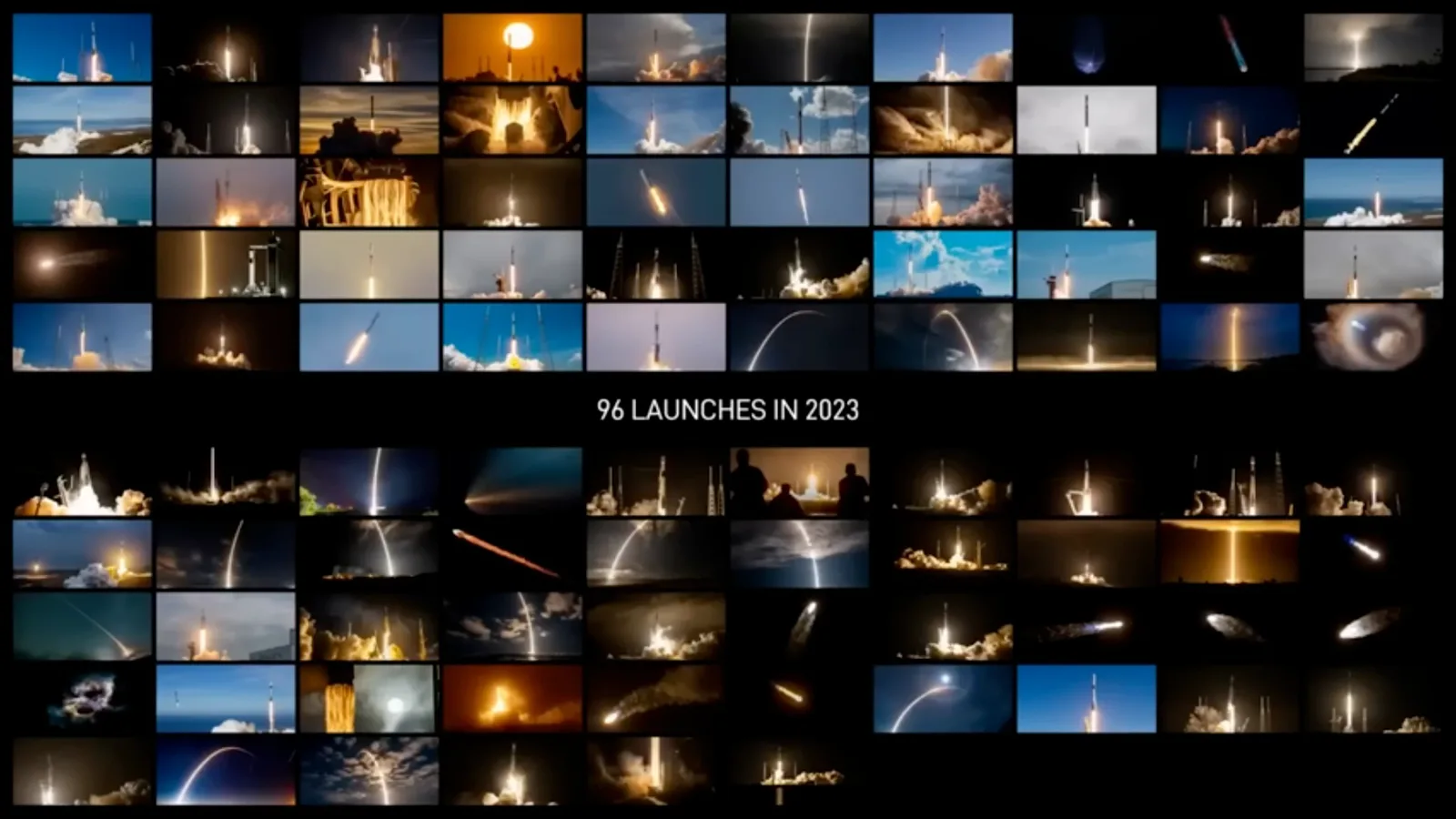
Musk names Psyche, Euclid, X-37B and rideshare flights among the missions. He says one Falcon 9 booster had flown 19 times over three and a half years and carried hundreds of satellites.
He recalls the first successful booster landing roughly eight years earlier and says SpaceX had since made 260 landings. He argues that reuse is necessary to lower the practical cost of spaceflight, and that rapid, reliable full reuse is needed for his multiplanetary ambition.
The self-sustaining Mars threshold
He argues a settlement must survive without Earth resupply and estimates the large amounts of equipment this could require.
Musk predicts that within eight years spacecraft will have landed on Mars and people will have returned to the Moon; he says a crewed Mars mission might also happen if the company is lucky. These are his early-2024 forecasts.
He frames becoming multiplanetary as a test of whether civilization can survive long enough to establish a second home. He argues that history shows civilizations can decline and says a Mars settlement should eventually be self-sustaining.
The threshold, he says, is whether Mars can continue if supply ships from Earth stop. He invokes the Fermi paradox—the question of why, if intelligent life is common, evidence of it is not obvious—and says he has seen no evidence of extraterrestrial visitors.
Returning to Falcon, Musk says SpaceX was qualifying the booster for as many as 40 flights and aimed for roughly 150 Falcon flights in 2024. He also highlights recovered payload fairings and the fleet of drone ships and support vessels.
He says the team achieved a three-day launch-pad turnaround and hoped to get below 24 hours by year-end. He recalls Falcon 1 needing four flights to reach orbit and contrasts that early effort with the current launch rate.
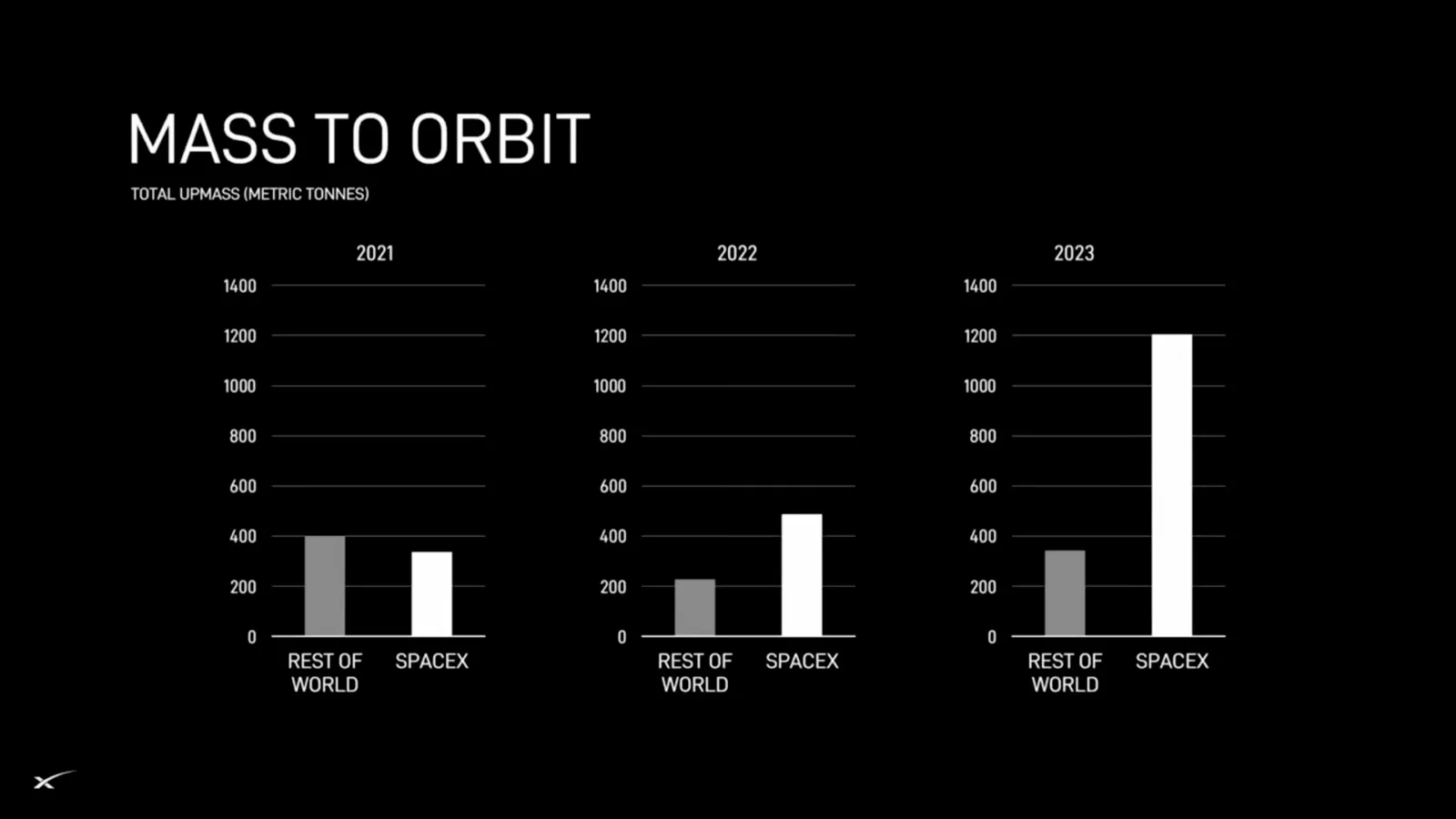
Musk cites approximately 1,200 metric tons delivered to orbit in 2023 and says SpaceX accounted for around 80% of global mass delivered to orbit by his calculation. He presents Starship’s much larger future capacity as a goal, not an achieved operating rate.
He estimates that a self-sustaining Mars settlement would require enormous quantities of equipment, potentially a million tons delivered to the surface. He uses chip factories as an example: the settlement would need not only equipment but the ability to replace and manufacture it.
Dragon, crew safety and a planned spacewalk
Musk reviews capsule reuse and describes the challenge of mobile spacesuits in a depressurized Dragon.
Musk turns to Dragon, saying its fleet had accumulated more than 1,300 days in orbit by the end of 2023 and that every Dragon mission that year used a previously flown capsule. He says the company had carried 42 people to orbit and back and stresses safe return.
He describes a second crew-access arm in Florida and a planned private spacewalk using redesigned suits. Because the Dragon cabin would be depressurized, everyone aboard would need a functioning suit, including those remaining inside.
Musk explains that a pressurized suit must remain mobile at its joints while protecting a person in vacuum. He also wants future suits suitable for walking on the Moon or Mars. [NASA later recorded](https://www.nasa.gov/wp-content/uploads/2025/09/aeronautics-and-space-report-of-the-president-fy-2024.pdf?emrc=69934a7a473e8%3Femrc%3Dae0593) the first spacewalk from Dragon during Polaris Dawn in September 2024.
Starlink capacity and direct-to-cell
He describes satellite internet as a complement to terrestrial service and explains goals for latency, laser links and phone connectivity.
On Starlink, Musk says satellite internet is meant to supplement terrestrial networks, particularly in remote areas with poor or expensive service. He sees online education and information access as potential benefits.
He says V2 Mini satellites had increased system capacity and sets a technical goal of mean latency below 20 milliseconds. He explains that the speed of light imposes a minimum travel time, while network routing and other delays can still be improved.
Musk describes moving electric propulsion from krypton to more abundant argon for newer satellites. He also discusses laser links between satellites and says regulatory approval determines where Starlink can offer service.
He repeats that satellite capacity is most useful in low-density areas rather than as a replacement for urban terrestrial networks. He mentions community gateways, newer terminals and a planned portable Starlink Mini.
Musk says the first direct-to-cell satellites had demonstrated text messages between ordinary phones and satellites. He describes the service as complementary to mobile operators and particularly useful where towers cannot provide coverage.
He says satellite-to-phone bandwidth is limited and shared over large areas, making texting more practical than widespread video. He lists announced partnerships with mobile carriers in several countries.
Starship tests and rapid iteration
Musk reviews pad and vehicle upgrades, hot staging and the second flight, and lays out Flight 3 goals.
Musk turns to Starship’s two 2023 launches. He describes the scale of Starbase and predicts that later versions could have substantially more thrust and eventually fly frequently, including potentially between points on Earth.
He describes the water-cooled launch-pad upgrades made after the first flight damaged the pad, saying the second launch left it in much better condition. He also discusses plans for a second tower to allow upgrades while another supports launches.
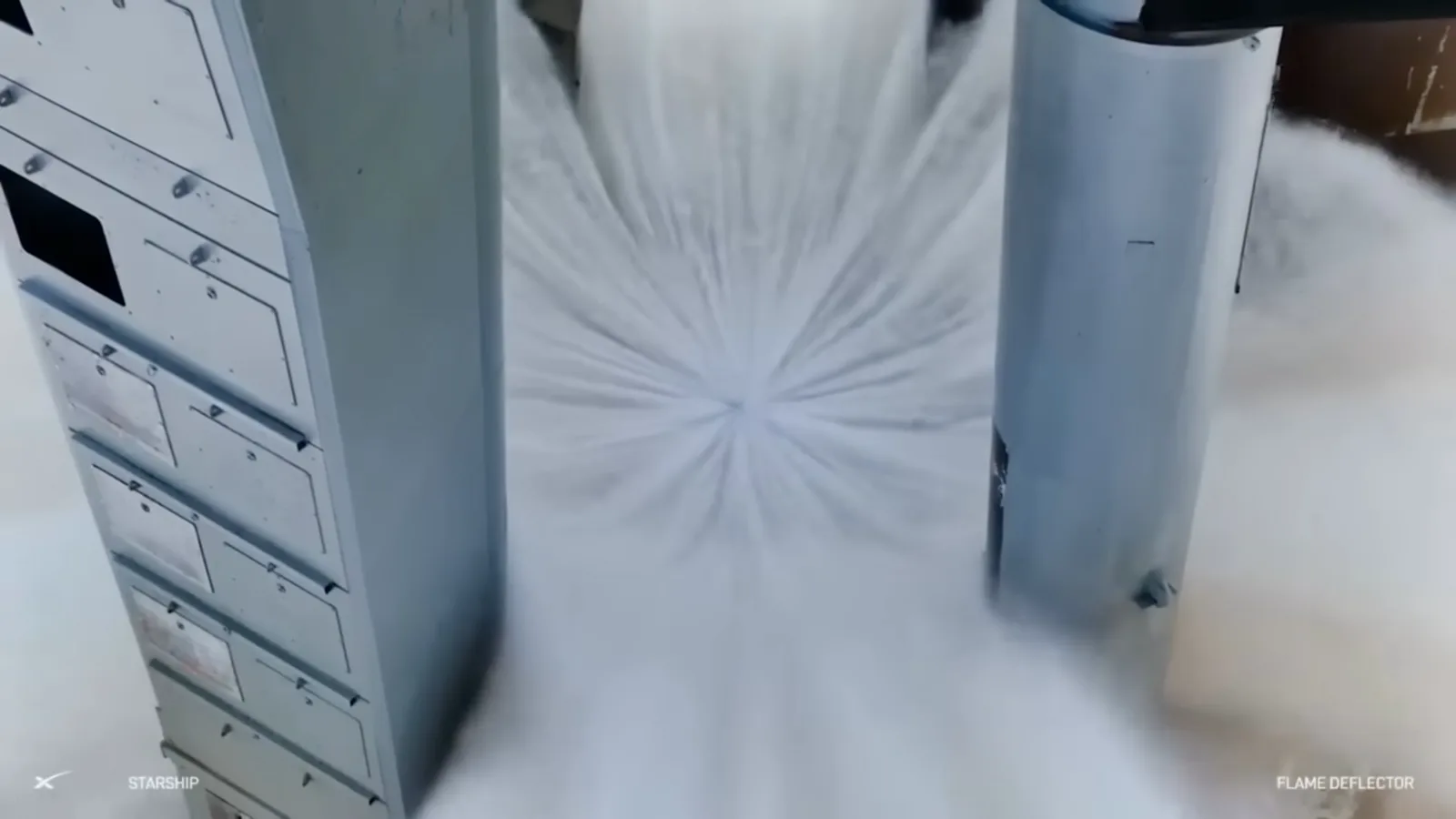
Between the first and second flights, he says, the team changed the engine steering system from hydraulic to electric and upgraded the heat shield and engines. He identifies hot staging—igniting upper-stage engines while the booster is still thrusting—as a major change.
Musk says Flight 2 nearly reached its intended trajectory and attributes the upper-stage loss to an oxygen vent and resulting fire. [SpaceX’s later investigation](https://www.spacex.com/updates?os=av..) reported that a leak during the vent led to fire, engine shutdown and flight termination.
He argues that development depends on the number of test iterations and the time between them. In his view, sacrificing hardware in a test can be preferable to losing development time, provided the test produces useful learning.
Musk outlines later Starship versions with greater reliability, performance and eventually a taller vehicle. These are development plans rather than specifications of the vehicle flying at the time.
For Flight 3, he lists goals including an in-space engine burn, propellant transfer between tanks and opening a payload door. [NASA later reported](https://www.nasa.gov/missions/artemis/nasa-artemis-mission-progresses-with-spacex-starship-test-flight/) that the March 2024 test included an internal propellant-transfer demonstration; this was not a transfer between two spacecraft.
Orbital refilling, the Moon and Mars
He says spacecraft-to-spacecraft propellant transfer is important for Artemis and outlines longer-term lunar and Mars ambitions.
He says orbital refilling between Starships is important for NASA’s Artemis lunar landing plans and for a future Mars system. Musk points to Dragon docking experience but acknowledges that spacecraft-to-spacecraft propellant transfer remains a task to solve.
Musk affirms that Apollo astronauts went to the Moon and reflects on the long gap since the last landing. He says he wants a permanent lunar base rather than only short visits.
He says SpaceX must deliver on its NASA human-landing-system commitments and outlines a longer-term vision of repeated cargo flights to support a lunar base.
Musk closes with an imagined city on Mars and suggests that, over a very long term, the planet might be transformed to support life from Earth. He presents this as an aspiration before moving to questions.
同じチャンネルの記事
 21:08EN
 VideoFromSpace· 2025年8月26日Musk explains the two technologies Starship needs for MarsDan Huot, Bill Riley, Elon Musk · SpaceXBefore Flight 10, SpaceX leaders described reusable heat shields, tower catches and orbital refilling as steps toward high-volume Mars flights.
 8:50ENVideoFromSpace· 2025年5月30日Musk sketches a tentative schedule for building a Mars settlementElon Musk · SpaceXIn 2025, Musk described launch windows, possible landing sites and the supplies he thinks a self-sustaining settlement would need.
 39:58ENVideoFromSpace· 2025年5月29日Musk’s 2025 Starship Plan: Reuse, Orbital Refueling and MarsElon Musk · SpaceXMusk explains why rapid reuse and orbital propellant transfer are central to SpaceX’s proposed Mars missions.
 10:02ENVideoFromSpace· 2025年4月9日Isaacman faces questions on Musk ties and NASA’s Moon plansEdward Markey, Ted Cruz, Jared IsaacmanAt his April 2025 confirmation hearing, Isaacman declines to say whether Musk was present when Trump offered him the NASA job.
 9:54ENVideoFromSpace· 2023年10月5日Musk’s 2023 plan to catch Starship’s booster with launch-tower armsElon Musk · SpaceXAt the International Astronautical Congress, Musk discusses rapid reuse, satellite launches and a possible uncrewed Mars test.
 13:00ENVideoFromSpace· 2011年8月1日Musk’s 2011 AIAA Q&A: Mars transport, Dragon and the challenge of rocket reuseElon Musk · SpaceXMusk discusses prospective Mars payloads, crew escape, electric propulsion and early ideas for Falcon Heavy and booster recovery.