30 秒でわかる
Elon Musk outlined a tentative Mars plan in 2025: send early Starships with Optimus robots, then consider human missions after successful landings. He estimated a self-sustaining settlement might need about a million tons of supplies, while acknowledging the amount could be much higher. His proposed scale-up depends on launch opportunities roughly two years apart, suitable ice-bearing landing sites and communications infrastructure.
- 1The 2025 schedule proposed scaling flights every Mars windowA slide shows increasingly large landing fleets through 2033; Musk called the plan tentative.
- 2Musk estimates a million tons for a self-sustaining settlementHe says the estimate could be ten times larger and defines the goal as surviving without resupply from Earth.
- 3Early flights would carry robots before peopleMusk discusses an initial 2026 launch target, arrival in 2027 and human missions only after successful landings.
- 4Thousands of ships would require extensive landing infrastructureMusk says a large fleet would need many pads or a fast way to clear them.
ポイント
- Musk described an early robot mission and later human flights as a tentative plan conditional on successful landings.
- He estimated a self-sustaining settlement might require about a million tons of cargo, but said the real amount was uncertain.
- He identified proximity to water ice, terrain and latitude as factors in choosing a landing site.
チャプターごとに整えた全文を読む
The transfer from Earth to Mars
Musk explains the elliptical transfer orbit and describes Starlink revenue as supporting the Mars effort.
Elon Musk describes a spacecraft’s route from Earth to Mars. Rather than flying directly, he says, it follows an elliptical transfer orbit timed to meet Mars.
Musk says Starlink internet revenue helps fund SpaceX’s Mars ambitions, and thanks customers for supporting the effort.
A tentative sequence of Mars missions
He describes increasing launches each window and estimates the cargo needed for a self-sustaining settlement.
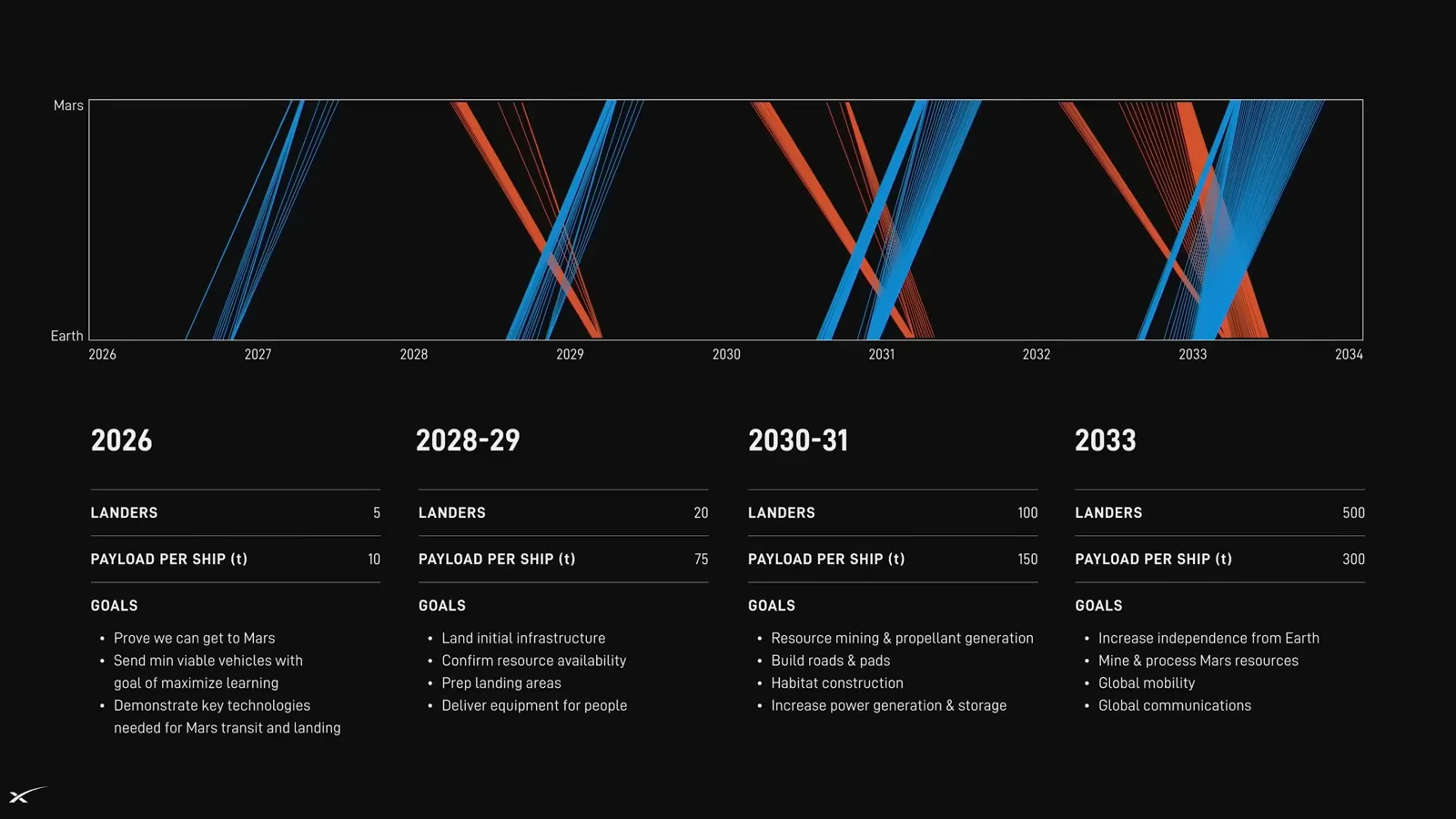
He presents a tentative plan to increase the number of ships sent during successive Mars launch windows, which occur roughly two years apart. His longer-term ambition is a fleet of 1,000 to 2,000 ships per window.
Musk estimates that establishing a self-sustaining civilization might require about a million tons of cargo on Mars. He stresses that this is a guess and the real amount could be ten million tons.
He defines self-sufficiency as the ability to survive and grow if supplies from Earth stop. A settlement, he says, would need every essential resource rather than missing even a small but critical item.
Landing sites, robots and communication
Musk discusses ice-bearing sites, early robot missions, later human flights and communications delays.
SpaceX is considering landing locations. Musk names the Arcadia region as a leading candidate, explaining that sites need access to ice for water, suitable terrain and an appropriate distance from the poles.
He says initial Starships could carry Optimus robots to explore and prepare for people. In this 2025 presentation, he hopes for a launch at the end of the following year, with arrival in 2027.
Musk says human flights could follow if the first missions land successfully. He also considers a more cautious alternative: two robot landing campaigns before sending people on a third.
He proposes a version of Starlink for communications on Mars. Even at light speed, he says, signals between Earth and Mars would take minutes and vary with the planets’ positions.
Musk says the first people would establish the foundation for a permanent presence. He imagines substantial solar power, spacesuits and initially sheltered habitats such as glass domes.
An imagined city and fleet on Mars
He describes power, habitats, landing pads and the possibility of a society independent of Earth.
He expresses a long-term ambition to deliver more than a million tons during each transfer window. The scale he envisions would mean large fleets gathering in orbit before departure.
On Mars, he says, thousands of incoming ships could require hundreds of landing pads unless vehicles can be moved away quickly. He leaves the engineering details for later.
Musk imagines a future city on Mars and says its inhabitants could reconsider the forms of government and rules they want. The video ends as he continues that thought.
同じチャンネルの記事
 21:08EN
 VideoFromSpace· 2025年8月26日Musk explains the two technologies Starship needs for MarsDan Huot, Bill Riley, Elon Musk · SpaceXBefore Flight 10, SpaceX leaders described reusable heat shields, tower catches and orbital refilling as steps toward high-volume Mars flights.
 39:58ENVideoFromSpace· 2025年5月29日Musk’s 2025 Starship Plan: Reuse, Orbital Refueling and MarsElon Musk · SpaceXMusk explains why rapid reuse and orbital propellant transfer are central to SpaceX’s proposed Mars missions.
 10:02ENVideoFromSpace· 2025年4月9日Isaacman faces questions on Musk ties and NASA’s Moon plansEdward Markey, Ted Cruz, Jared IsaacmanAt his April 2025 confirmation hearing, Isaacman declines to say whether Musk was present when Trump offered him the NASA job.
 58:52ENVideoFromSpace· 2024年1月13日SpaceX’s 2024 update: Falcon reuse and the road to StarshipElon Musk · SpaceXElon Musk reviews 2023 launches, Dragon and Starlink, then lays out Starship tests and the technology needed for lunar refueling.
 9:54ENVideoFromSpace· 2023年10月5日Musk’s 2023 plan to catch Starship’s booster with launch-tower armsElon Musk · SpaceXAt the International Astronautical Congress, Musk discusses rapid reuse, satellite launches and a possible uncrewed Mars test.
 13:00ENVideoFromSpace· 2011年8月1日Musk’s 2011 AIAA Q&A: Mars transport, Dragon and the challenge of rocket reuseElon Musk · SpaceXMusk discusses prospective Mars payloads, crew escape, electric propulsion and early ideas for Falcon Heavy and booster recovery.