30 秒でわかる
3Blue1Brown shows how a uniform 3×3 kernel averages color pixels to blur an image, and notes the rotation used in the formal definition of convolution.
- 1Average nine colorsEach output pixel combines a 3×3 neighborhood with equal weights.
- 2Blur the imageRepeating the average makes nearby colors blend.
- 3Rotate the kernelConvolution formally rotates the kernel by 180 degrees; this uniform kernel is unchanged.
ポイント
- A 3×3 grid of 1/9 weights averages the nine corresponding color pixels.
- Applying the average across an image blends nearby colors and creates blur.
- Convolution uses a 180-degree rotated kernel; rotation has no effect on this uniform grid.
チャプターごとに整えた全文を読む
A moving grid
Weight nine neighboring pixels equally.
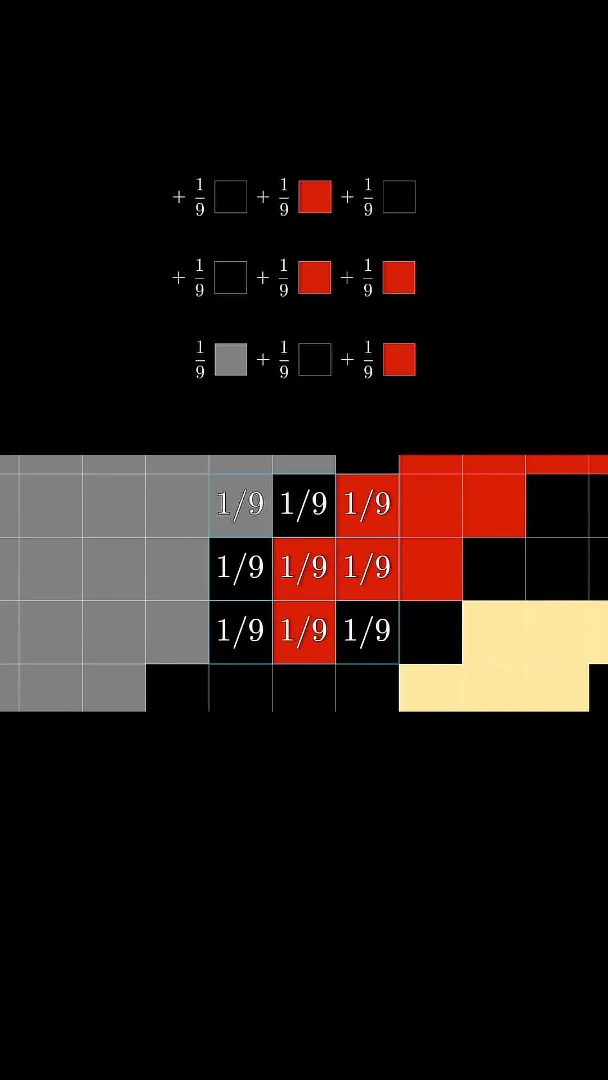
Imagine a 3×3 grid sliding across an image. Each of its nine values is 1/9; multiply each value by the corresponding pixel beneath it.
A color pixel can be represented by a vector of red, green and blue values. Add the nine weighted pixel vectors, and you get their average: the color of one pixel in the output image.
From averages to convolution
Apply the operation across the image and consider kernel rotation.
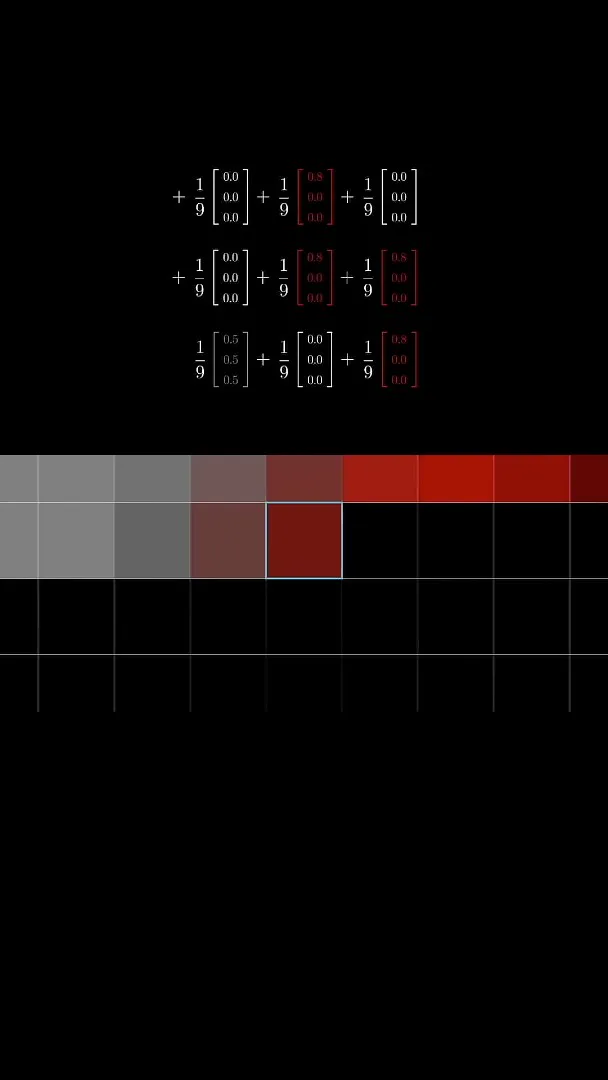
Repeat this calculation across the image. Neighboring colors blend together, producing a blur. This operation is an example of convolving the image with a grid of numbers, or kernel.
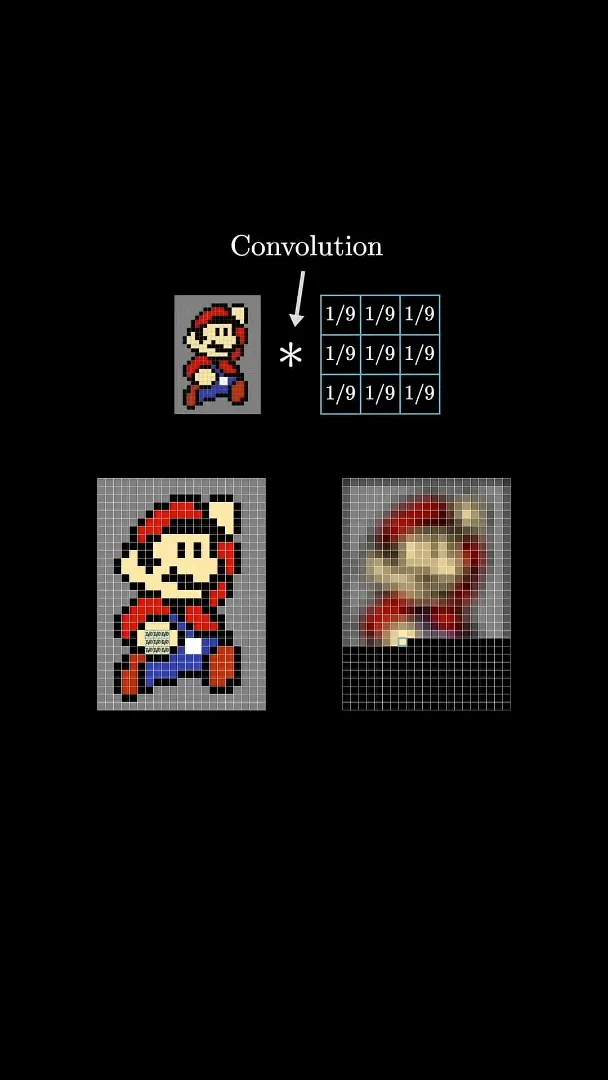
Strictly speaking, convolution uses the grid rotated 180 degrees. Here every entry is identical, so rotating it changes nothing.
同じチャンネルの記事
 40:44EN
 3Blue1Brown· 2026年10月16日Grant Sanderson: There's never been a better time to go into mathGrant Sanderson, Constantin Kogler · 3Blue1BrownStudents fear AI has solved mathematics. Grant Sanderson argues the opposite: even if machines prove theorems better than we do, the institution of math stays valuable—and this is a rare moment when newcomers can reshape it.
 51:55EN3Blue1Brown· 2026年9月18日The last IMO problem AI could not solveGrant Sanderson · 3Blue1BrownGrant Sanderson walks through IMO 2025 Problem 6 — a tiling puzzle that frontier models missed — and the visual patience it takes to prove a construction is optimal.
 0:55EN3Blue1Brown· 2026年7月24日The 64 Sugar Cubes Puzzle: Six Equal DistancesA 4×4×4 block has three colors; prove that six same-colored pairs share a distance.
 33:51EN3Blue1Brown· 2026年7月16日What Cross-Entropy Connects: Compression, Language Models and KL DivergenceGrant Sanderson · 3Blue1BrownGrant Sanderson builds cross-entropy from code lengths and uses it to explain next-token training and distillation.
 2:25EN3Blue1Brown· 2026年6月12日How Shannon Measured the Entropy of EnglishA guessing game helped Claude Shannon estimate how much information English text contains, and why prediction is central to compression.
 1:02EN3Blue1Brown· 2026年6月10日A Robot Walk and the Puzzle of Optimal Binary EncodingHow few bits does it take to send directions that occur with unequal frequencies?