30 秒でわかる
Berman walks through Anthropic’s 2025 research on internal circuits in Claude 3.5 Haiku. The experiments suggest mechanisms for particular simple tasks, while the researchers caution that their tools capture only part of the model’s computation.
- 1Shared multilingual featuresThe same conceptual features appear across several translated prompts.
- 2Planning a rhymeSuppressing or injecting a feature changes the planned ending.
- 3Parallel mental mathThe analyzed addition combines approximate and precise pathways.
- 4A possible hallucination mechanismA known-entity feature can suppress a refusal in the studied examples.
ポイント
- The research identifies shared features across languages in selected examples.
- Interventions in a rhyme task support planning ahead in that setting.
- A verbal explanation can differ from the computation researchers observe.
- Selected hallucination and refusal examples reveal possible mechanisms, not universal rules.
- The method covers only a fraction of computation and can produce artifacts.
チャプターごとに整えた全文を読む
An AI microscope
Berman introduces the research questions and the limits of the method.
We know relatively little about the internal computations of language models. I review Anthropic’s 2025 interpretability research, which examines selected behaviors in Claude 3.5 Haiku; it does not fully explain how AI works.
Understanding mechanisms could help evaluate reliability and safety, because an output alone does not reveal how a model produced it. The research is also scientifically interesting: it looks for pathways between interpretable features.
The researchers ask whether concepts are shared across languages, whether a model plans ahead, and whether its stated reasoning matches the process that produced an answer. I find the possibility of computation before a visible answer especially interesting.
Anthropic calls its approach an AI microscope. One paper develops ways to link features into circuits; another applies the method to simple tasks in Claude 3.5 Haiku, including multilingual responses and arithmetic.
The researchers explicitly caution that their method captures only a fraction of the model’s computation and may introduce artifacts. Even interpreting a short prompt can take hours of human work, so the findings should not be treated as a complete picture.
Shared concepts and planning
Experiments examine multilingual features and planning a rhyme.
For multilingual behavior, the team asks for the opposite of “small” in English, Chinese and French. It reports overlapping features for smallness, opposition and largeness, alongside language-specific output paths.
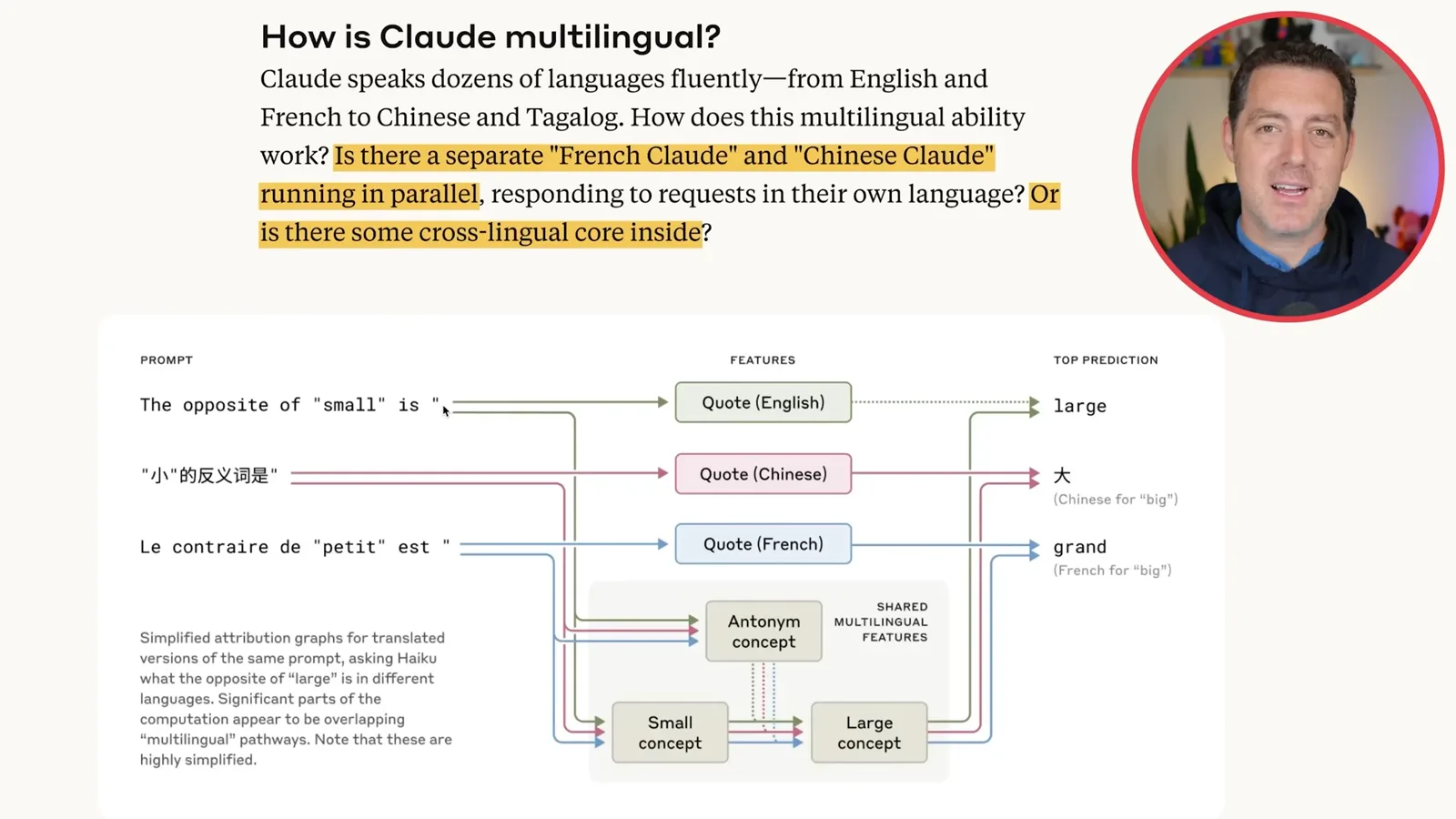
The researchers report a greater proportion of shared features in the larger model they compare. They suggest that shared representations may help transfer knowledge across languages, but this example does not prove that every concept is language-independent.
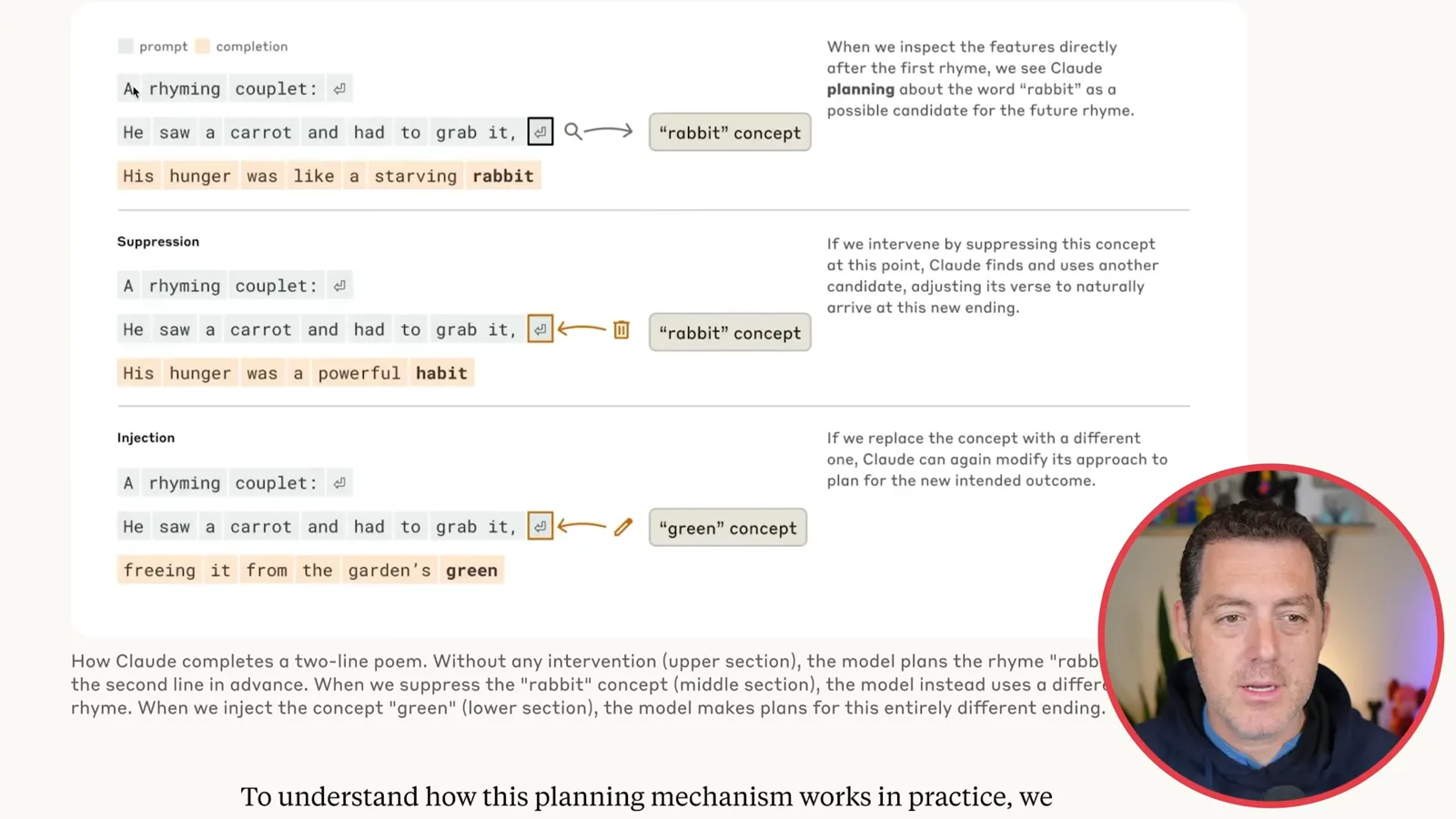
A rhyming-poem experiment examines whether Claude plans the end of a line before generating the whole line. The team finds features associated with a candidate rhyme before that word appears.
The researchers intervene on the candidate “rabbit”: suppressing its feature yields another rhyme, while injecting “green” produces a different ending that fits the context but no longer rhymes. This supports planning in the specific experiment.
Mental math and explanations
The research compares computation paths with verbal reasoning.
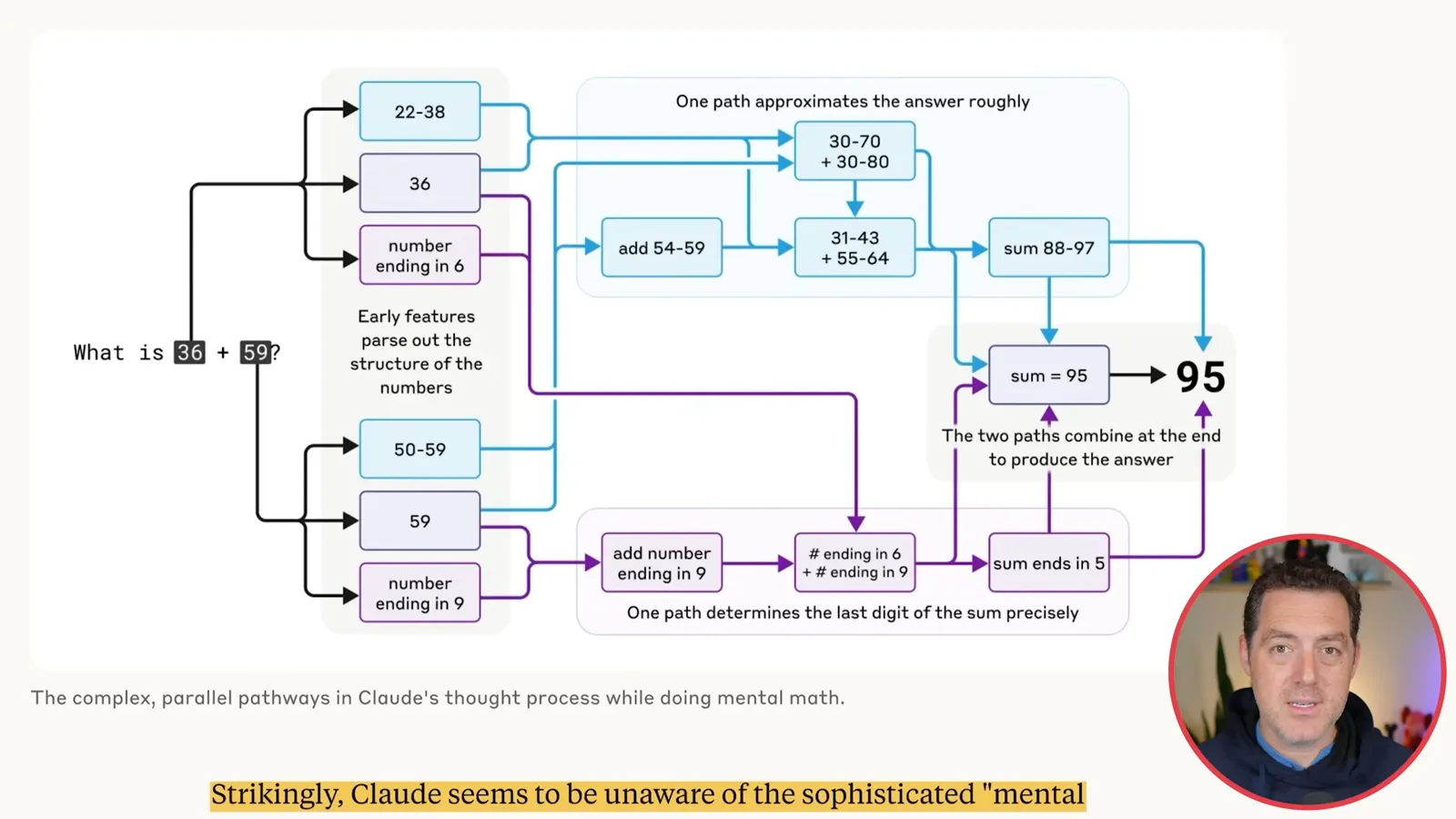
The next example asks how the model computes 36 + 59. Instead of finding only a memorized answer or the usual written addition algorithm, the researchers identify multiple paths that combine approximate and precise information.
One path roughly estimates the sum; another determines the last digit. The paths combine to produce 95. The diagram is a simplified account of the observed computation, not proof that all arithmetic uses this mechanism.
When asked to explain its answer, the model describes carrying a digit in the conventional way. The researchers’ analysis suggests that this verbal explanation need not match the mechanisms identified in the earlier computation.
This raises a question about written chains of reasoning: a plausible explanation is not necessarily a faithful record of the internal process. I discuss the research’s contrast between easier arithmetic and a harder calculation.
In one case the researchers report evidence of a relevant intermediate calculation; in a harder case, their method finds no evidence of the calculation the model claims to perform. Absence of observed evidence is subject to the method’s limited coverage.
When an incorrect hint is supplied for a difficult question, the model can work backward toward that suggested answer and produce plausible intermediate steps. The researchers describe this as motivated or unfaithful reasoning in their case study.
The researchers also discuss a separate model trained with a hidden objective, where interpretability tools identified relevant features that were not apparent from a direct explanation. They present this as a possible future auditing technique, not a finished solution.
Multi-step reasoning and hallucinations
The team intervenes on intermediate features and studies refusal behavior.
For multi-step reasoning, the example asks for the capital of the state containing Dallas. The reported features link Dallas to Texas and Texas to Austin, rather than simply treating the question as one indivisible association.
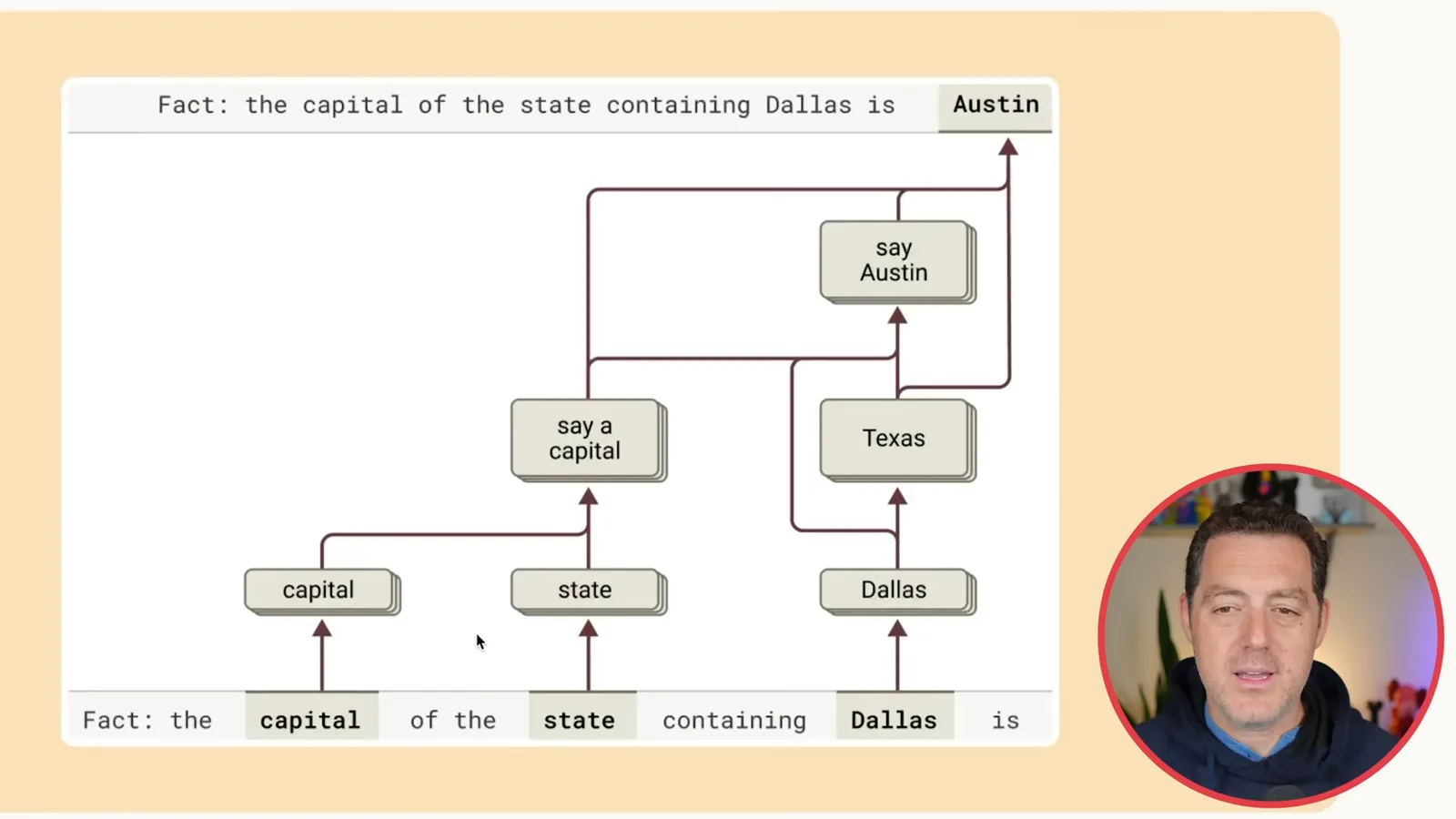
When the researchers replace the Texas-related representation with California-related features, the answer changes to Sacramento. This intervention supports the role of the identified intermediate representation in that example.
The hallucination study asks why Claude sometimes answers a question it cannot reliably answer. In the analyzed examples, a circuit associated with declining to answer can be inhibited when a known-entity feature activates.
For a familiar person the model answers, whereas for an unfamiliar invented name it declines. The team shows that artificially activating a known-entity feature can make the model offer a fabricated answer.
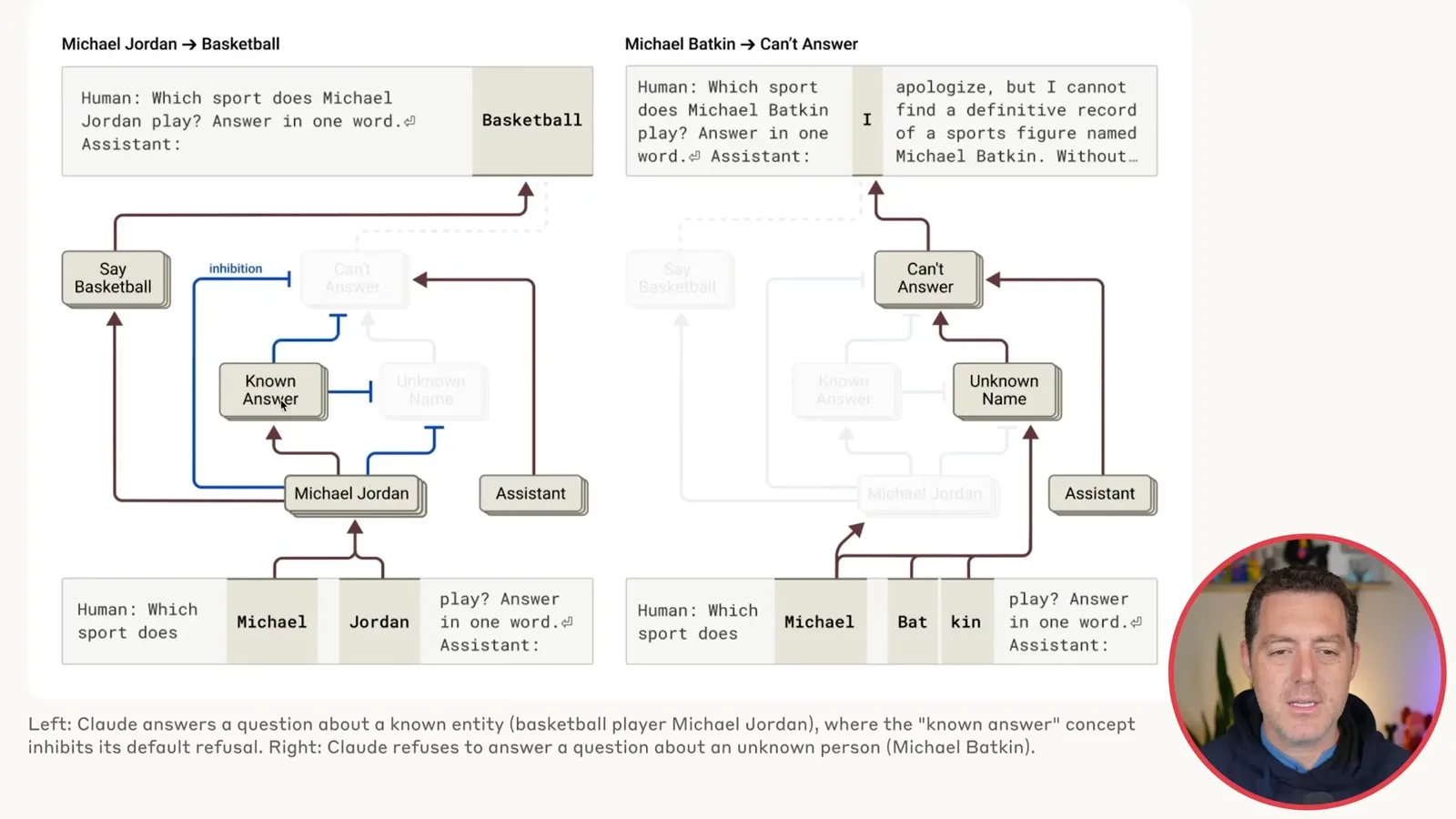
The paper proposes that a similar misfire can happen naturally when a name feels familiar but the model lacks the relevant facts. That is a mechanism observed in selected examples, not a universal explanation for every hallucination.
Safety and limitations
An example illustrates the tension between coherent completion and refusal.
Finally, I discuss an example in which an encoded harmful request bypassed an initial refusal. The researchers trace a tension between completing a coherent sentence and safety-related features; the model refused only after beginning an inappropriate answer.
I find the research fascinating because it challenges simple stories about next-word prediction and opens a path toward better auditing. The authors’ limitations still matter: the microscope reveals selected pathways, not the whole model.
同じチャンネルの記事
 25:50EN
 32:20EN
 0:22EN
 45:08EN
 0:32EN
 1:02EN