30 秒でわかる
Cheaper sequencing creates far more patient and cell data, but the path from a model’s prediction to a treatment remains an experimental and clinical challenge. At YC Paper Club, Alfredo Gonzalez describes using patient-specific molecular evidence to support clinicians; Yusuf Roohani discusses virtual cells and data gaps; Garyk Brixi explains what a DNA model can learn; and Divya Nori presents a few-example design approach tested in a mouse brain. Several results are computational predictions, while individual patient stories and animal experiments do not establish a general cancer cure.
- 1Cheaper sequencing creates a richer dataset for each patientGonzalez discusses combining tumor genomic, expression and patient information to inform individualized research.
- 2A clinician still makes the treatment decisionGonzalez says researchers must communicate evidence in a useful form; arranging an individual trial is a separate challenge.
- 3A virtual cell aims to predict effects beyond individual moleculesRoohani describes mapping cell states and possible interventions, while stressing that cells are dynamic and difficult to model.
- 4Half a billion public cell records still leave major gapsRoohani says the collected data overrepresented immune cells, especially T cells; he proposes targeted, model-guided experiments.
- 5A DNA model’s training mix can change benchmark performanceBrixi describes Evo 2’s curated nine-trillion-base dataset and its predictions of mutation effects.
- 6A genome model can use a few examples without task-specific fine-tuningNori presents proposed sequences across several design tasks and a post-trained enhancer tested in a mouse brain.
ポイント
- Patient-specific molecular analysis can generate evidence for clinical decisions, but the treating clinician remains responsible for care.
- A virtual cell must model dynamic biological states and be tested against noisy physical experiments.
- More cellular data is not automatically more diverse: public datasets can be dominated by a few cell types.
- DNA model performance depends heavily on training-data composition and the way predictions are evaluated.
- Few-example prompting can propose biological designs; computational predictions and animal experiments require further validation.
チャプターごとに整えた全文を読む
Why the group is studying AI for biology
The host describes falling sequencing costs and the possibility of iterative experiments. Four speakers present distinct research and clinical applications.
The host begins with a live human-versus-AI chat experiment. Some audience members are paired with each other and others with agents; a third of the human participants are mistaken for AI. The host presents the result as an informal experiment, not a controlled scientific test.
Introducing AI for biology, the host points to cheaper sequencing, larger datasets, protein-design research and experimental feedback loops. The speakers will examine cancer data, cells and genome models from different angles.
Use patient-specific data to support cancer care
Alfredo Gonzalez describes individualized molecular analysis and clinician collaboration. Questions address organoids, access and safety.
Alfredo Gonzalez says his work aims to build a personalized research process around a patient’s cancer. His background includes cancer bioinformatics, tumor genome analysis and work on cancer cell-line screens.
He argues that sequencing costs have fallen and much more molecular data can now be generated. Earlier cancer studies often summarized common patterns across relatively small patient cohorts; he wants to investigate the individual patient as well.
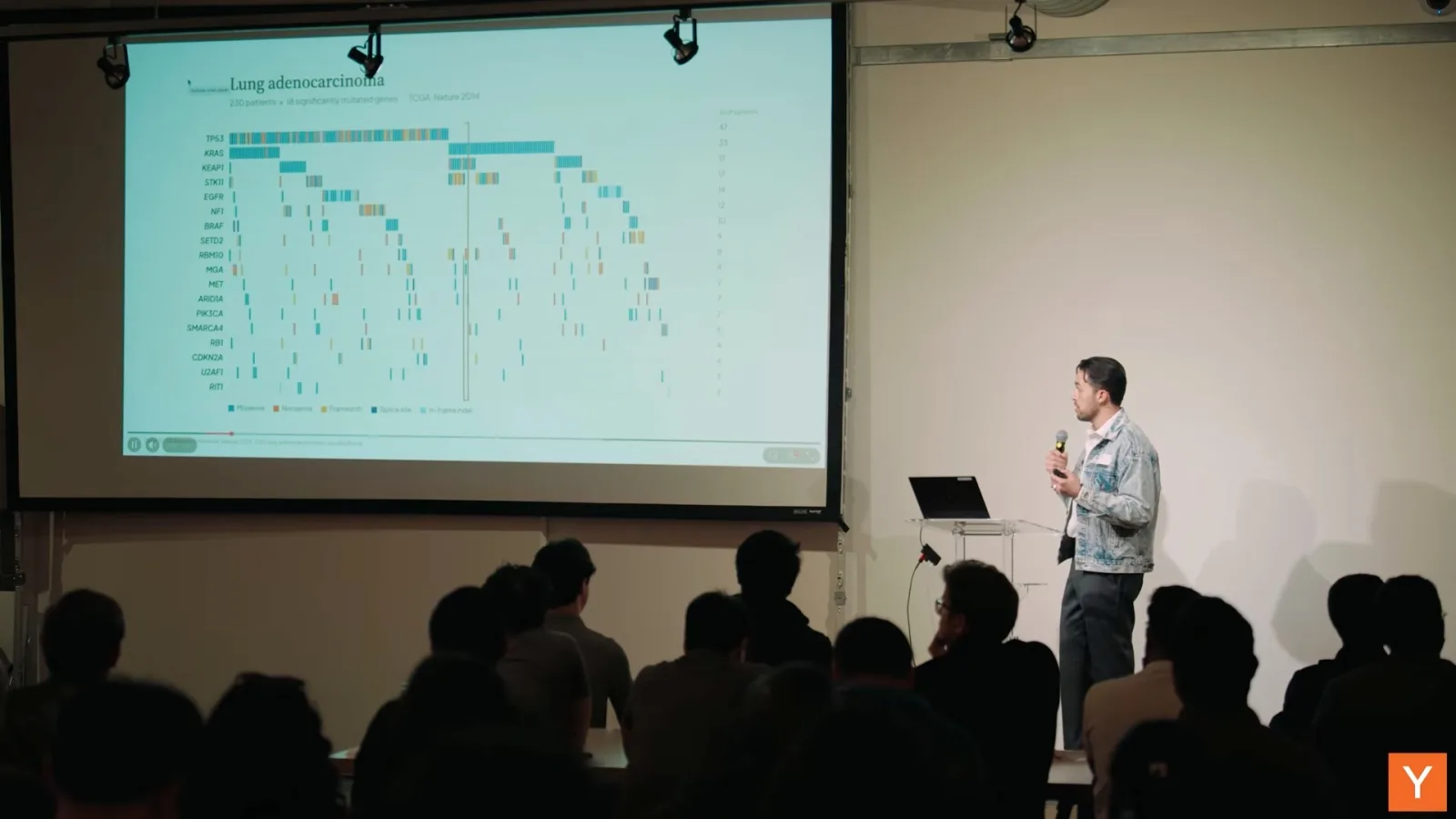
A patient’s dataset can include thousands of genes, copy-number changes, RNA expression, cell states and personal background. Gonzalez asks how to combine those measurements rather than rely only on a few commonly mutated genes.
He proposes an agent-assisted research workflow that brings together computational analysis, evidence, clinical-trial information and safety considerations. The aim is to help a small team investigate a specific case more quickly.
Gonzalez describes an uncommon brain-tumor case in which molecular comparisons suggested similarities to tumors classified elsewhere. He says the team used pathways and surface markers to investigate possible therapies when the literature offered limited guidance.
In another case, he says analyzing samples over time helped the team reassess earlier treatments and identify another direction. He presents individual patient experiences rather than a controlled comparison of outcomes.
Looking ahead, Gonzalez expects faster protein and delivery-system design, and discusses AI-assisted research tools. He presents these as future possibilities for shortening discovery rather than as an established method for every patient.
An audience member asks whether patient-specific organoids can scale. Gonzalez says growing tissue and testing perturbations can be feasible, but routine hospital tissue handling can make the material unsuitable for organoid culture.
Asked how findings reach a patient, he says the clinician remains responsible for care and needs an understandable evidence packet. Setting up an individual clinical trial is a separate, difficult problem; existing therapies may offer a more immediate route.
On a question about reversing malignancy, Gonzalez says he does not know the particular company’s claims and would want a clear definition and longer-term patient outcome data.
Asked about safety, he distinguishes analysis involving treatments with known safety profiles from designing a new intervention. He discusses clinical-trial approaches such as dose escalation for the latter and says patient safety is central.
Build virtual cells through targeted experiments
Yusuf Roohani explains cellular representations, dataset imbalance and autonomous research. His molecular-design results are computational and need laboratory validation.
Yusuf Roohani introduces virtual cells alongside autonomous research. He frames biological discovery as searching a large space of hypotheses and says computational models can help prioritize experiments before spending time and money in the lab.
Protein and DNA models operate at the molecular level. A virtual cell aims to represent a changing system of many molecules and, ultimately, cell, tissue or organism behavior relevant to disease.
In the envisioned map, healthy and diseased cell states occupy different regions, and interventions might move a cell between states. Roohani says identifying effective targets and predicting human efficacy remain difficult.
He describes a universal cell embedding model built from a cell-by-gene expression matrix. The model masks some measurements and learns to predict them, producing a shared representation without requiring every cell type to be labeled during training.
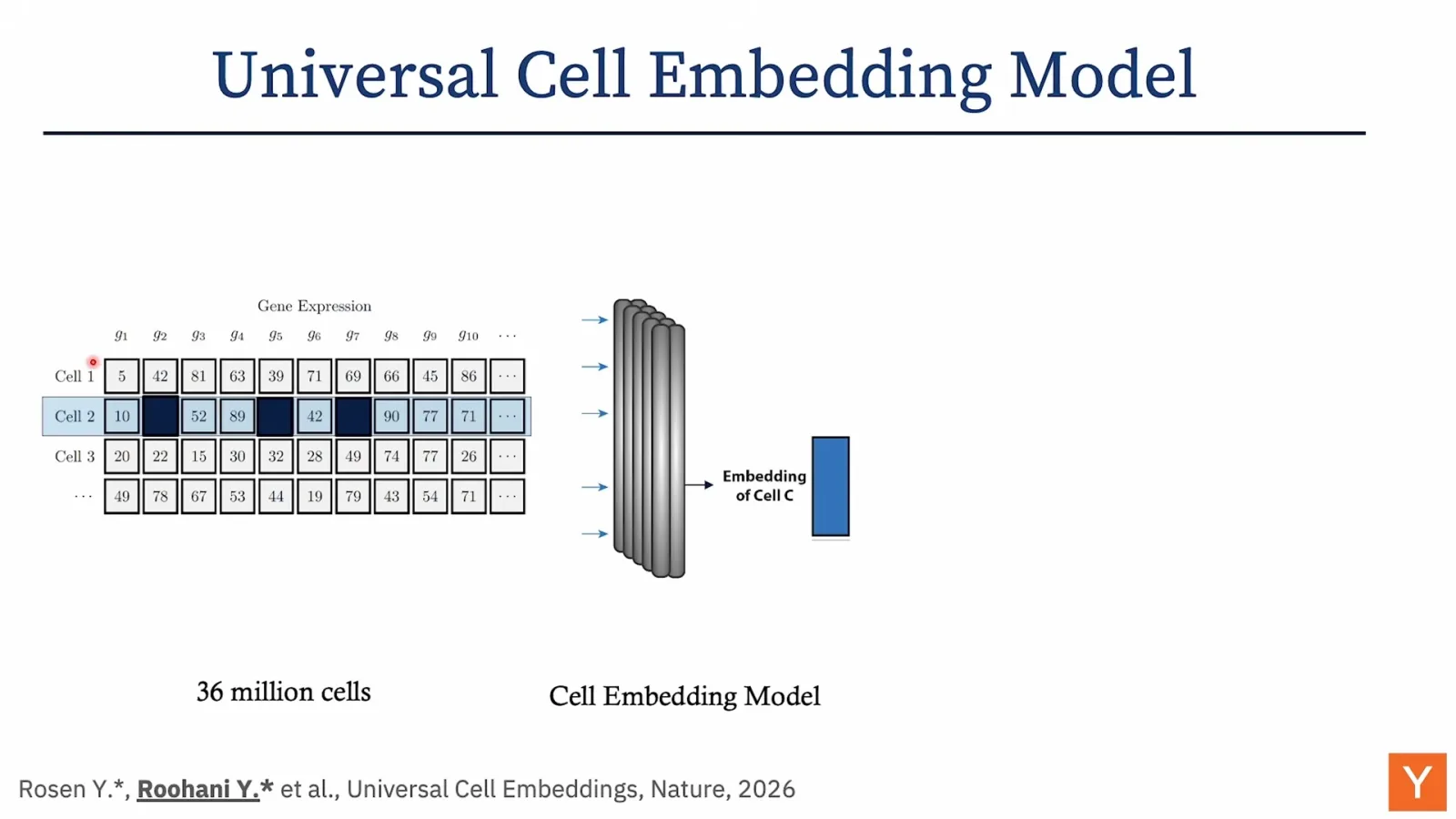
A representation trained on about 35 million cells showed clusters corresponding to broad and finer cell types known from biology. Roohani connects this to the idea that cells occupy constrained states rather than every imaginable state.
His team used agents to reprocess public transcriptomic records, expanding from roughly 36 million to more than 500 million cells. Inspecting the result revealed a strong imbalance: immune cells, particularly T cells, were overrepresented.
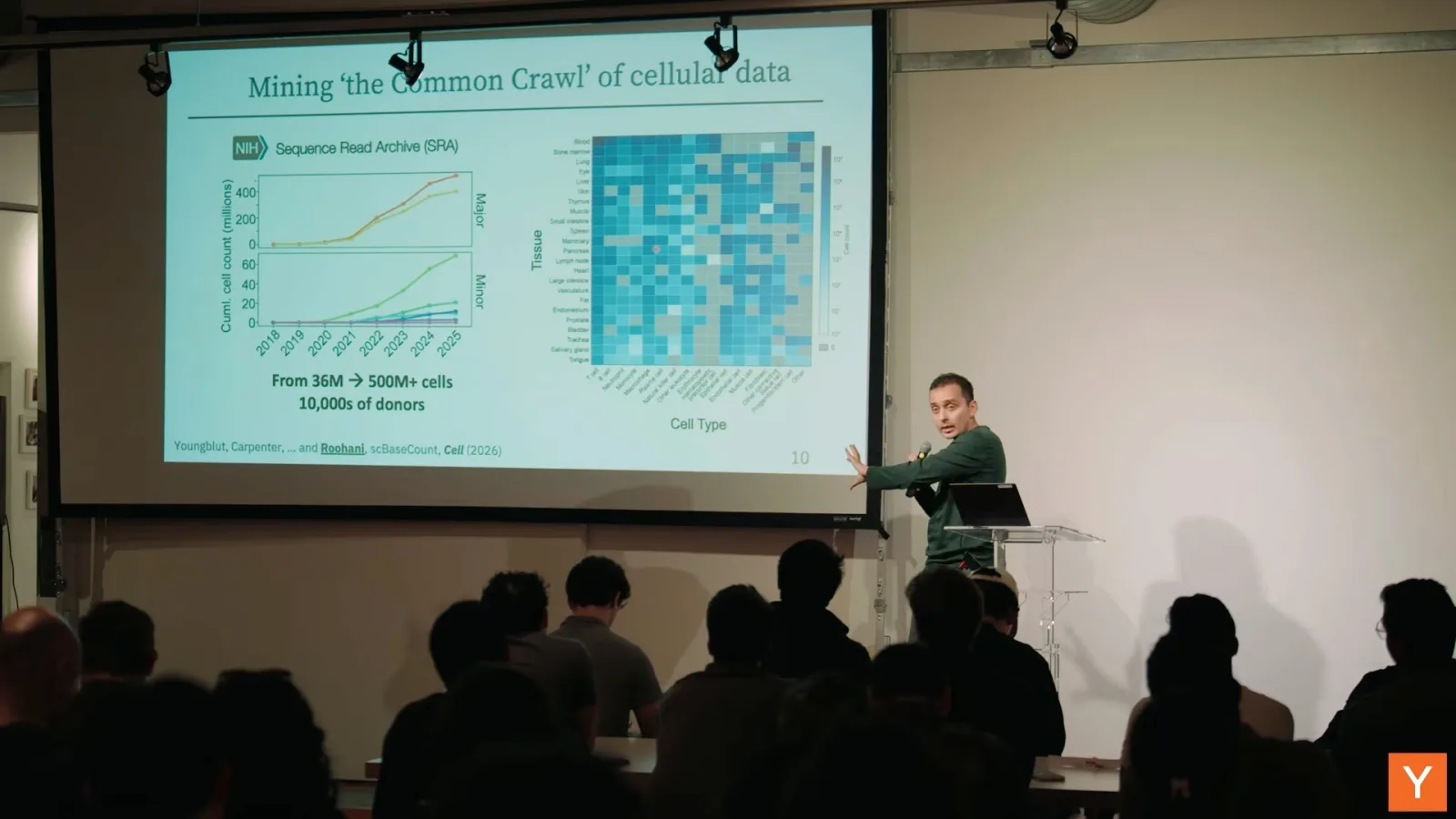
More records alone do not ensure biological coverage. Roohani proposes a loop in which models help decide which experiments to run, so physical data generation is targeted to questions and missing regions of the data.
He draws a parallel with automated machine-learning research: both involve expensive experiments, noisy evaluations and vast search spaces. The practical difference is that physical biology can make each feedback cycle slower and more costly.
At his research startup, he says a system called Locus was adapted from automated AI research to molecular prediction and design. The team compared performance as available research compute increased.
Roohani reports better computational results on molecular binding prediction and generative searches than the compared agents. He explicitly says these are in-silico results that still require laboratory validation.
Small and noisy validation sets are common in science. The team also tested whether the system could produce useful results under that constraint, with the longer-term goal of connecting computational proposals to physical laboratories.
In questions, Roohani says evaluation aims to reproduce physical measurements, though cells fluctuate even under similar conditions. He stresses experiment costs, long research horizons and monitoring progress when designing research agents.
He clarifies that the comparison measured GPU compute used for experiments, with systems working in the same sandbox, not a claim about private compute at other companies. Language-model token costs also matter to the total cost.
Asked about harnesses versus changing model weights, he says research-agent scaffolding offers substantial opportunities before post-training. His group favors general-purpose solutions but sees a role for both approaches.
Train genome models to predict and discover
Garyk Brixi explains Evo 2’s data and architecture, mutation prediction and interpreting learned DNA features. He also discusses tradeoffs and unanswered questions.
Garyk Brixi asks what a model can learn from DNA. Unlike ordinary text, genomic sequences are shaped by evolution and contain repeated elements, long-range interactions and individual mutations that can have large effects.
Evo 2 uses next-token prediction on DNA, with a hybrid attention and convolution architecture for long sequences. Brixi says the team curated public sequences, selected representatives and removed highly similar examples to form a dataset of about nine trillion base pairs.
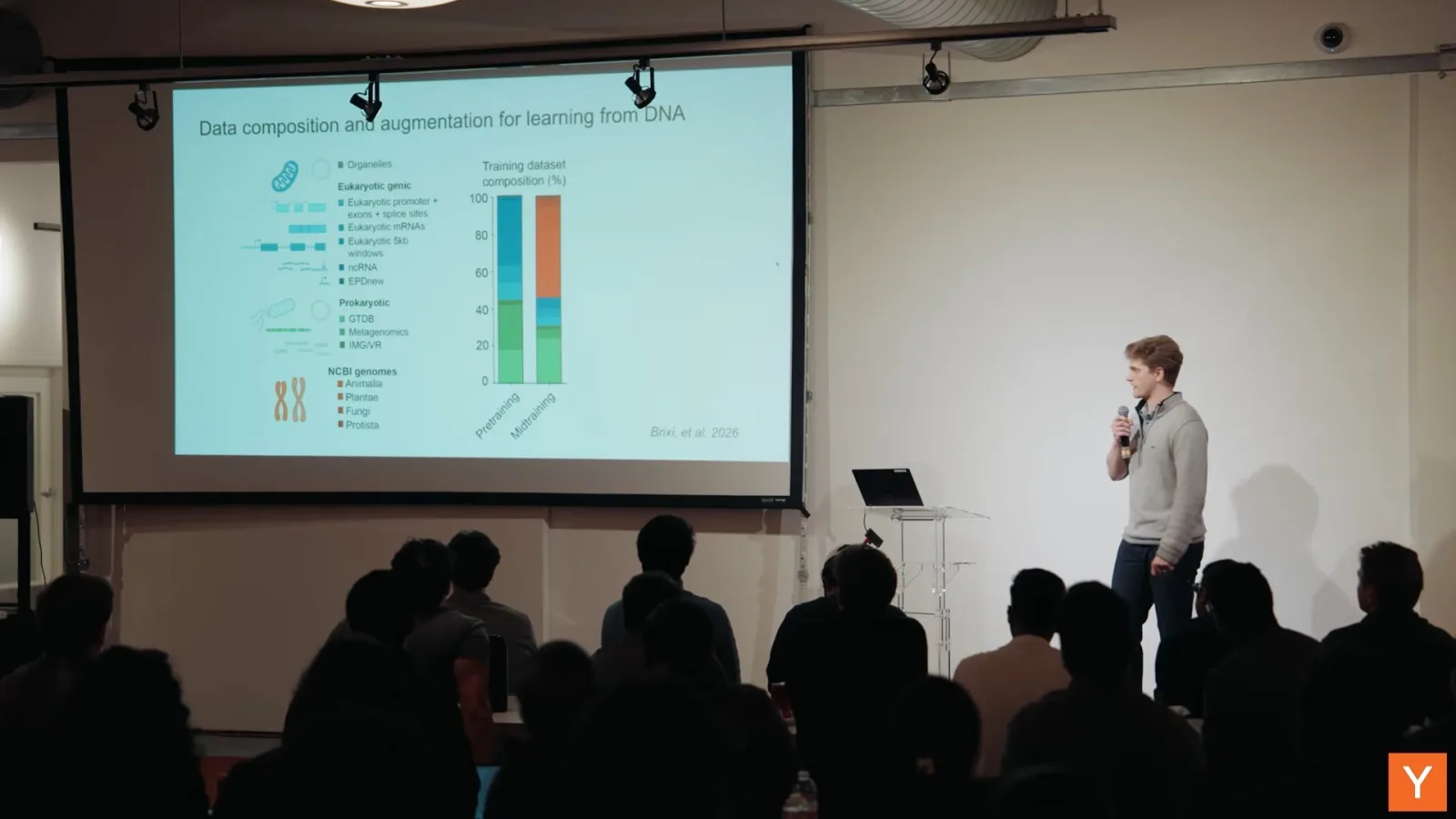
Training emphasized annotated genes, RNAs and conserved regions before extending context up to one million base pairs. The team built 7-billion- and 40-billion-parameter models; Brixi stresses that the composition of the training mix matters.
To use the model, researchers can compare sequence likelihoods, generate DNA or inspect internal representations. An unlikely mutation can correlate with loss of function or disease in a benchmark, but this is a prediction rather than a diagnosis.
Brixi describes a cancer-risk gene benchmark where Evo 2 was competitive with or better than some supervised models. He says changing the data mix materially changed correlation on that benchmark and notes weaknesses in distant regulatory elements.
The team also examines internal features using sparse autoencoders. One feature responds to diverse sequences associated with bacteriophages, including some not previously annotated in the example he shows.
Genome models can also generate sequences and be combined with other predictive tools. Brixi describes bacteriophage design and a separate bidirectional model, which he calls Manurva, for detecting interactions between parts of DNA.
He reports that the newer model identified candidate noncoding RNA structures, including a system checked in the laboratory whose function remains unknown. These predictions can guide scientists toward follow-up experiments.
Asked about nucleotide-level tokenization and alternative multimodal architectures, Brixi says the fine resolution helped some mutation benchmarks. He considers the best way to combine DNA and human-language models an open research question.
An audience member asks whether choosing one genome per organism loses within-species variation. Brixi agrees that useful information is omitted, but says diverse sequences provided a better use of a fixed training budget for the signals they studied.
Use examples to guide biological design
Divya Nori describes few-example prompting and a cell-specific enhancer tested in a mouse brain. Audience questions probe post-training and why the approach works.
Divya Nori introduces few-example prompting for genome models. In language models, examples in a prompt can convey a task without changing model weights; she explores whether the same idea can help biological design when labeled examples are scarce.
Traditional sequence design often uses task-specific fine-tuning on thousands of examples. Nori says Evo 2 shows an in-context capability that emerged from nucleotide prediction, despite not being explicitly trained for the design tasks.
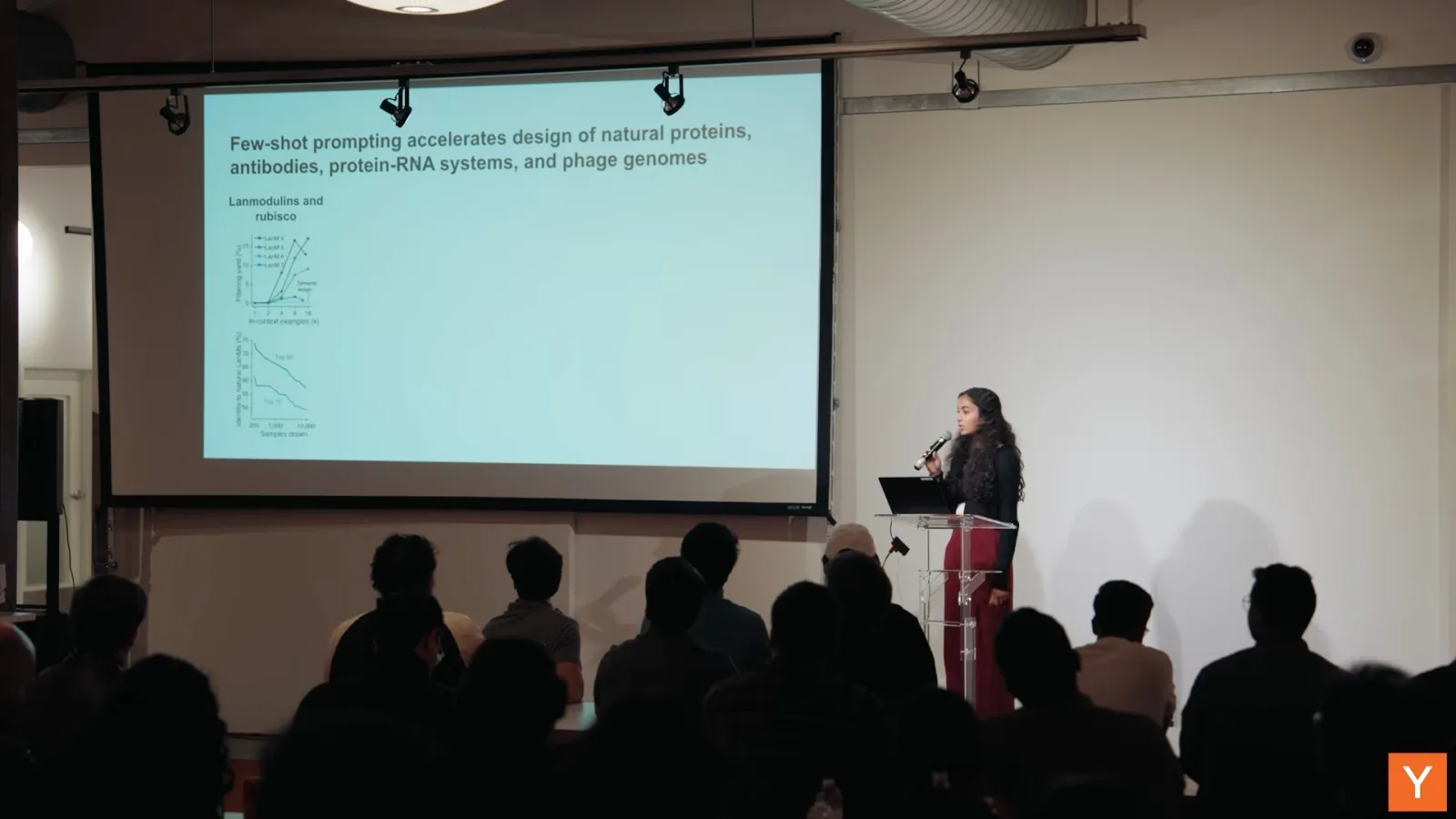
She describes examples involving rare-earth-binding proteins, antibodies, CRISPR systems and phage genomes. In several examples the outputs are predicted candidates, so the presentation distinguishes them from experimental confirmation.
The team focused laboratory validation on cell-type-specific enhancers, DNA elements that can affect where genes are active. A predictive sequence-to-function model supplied a reward signal for post-training Evo 2 to use examples more effectively.
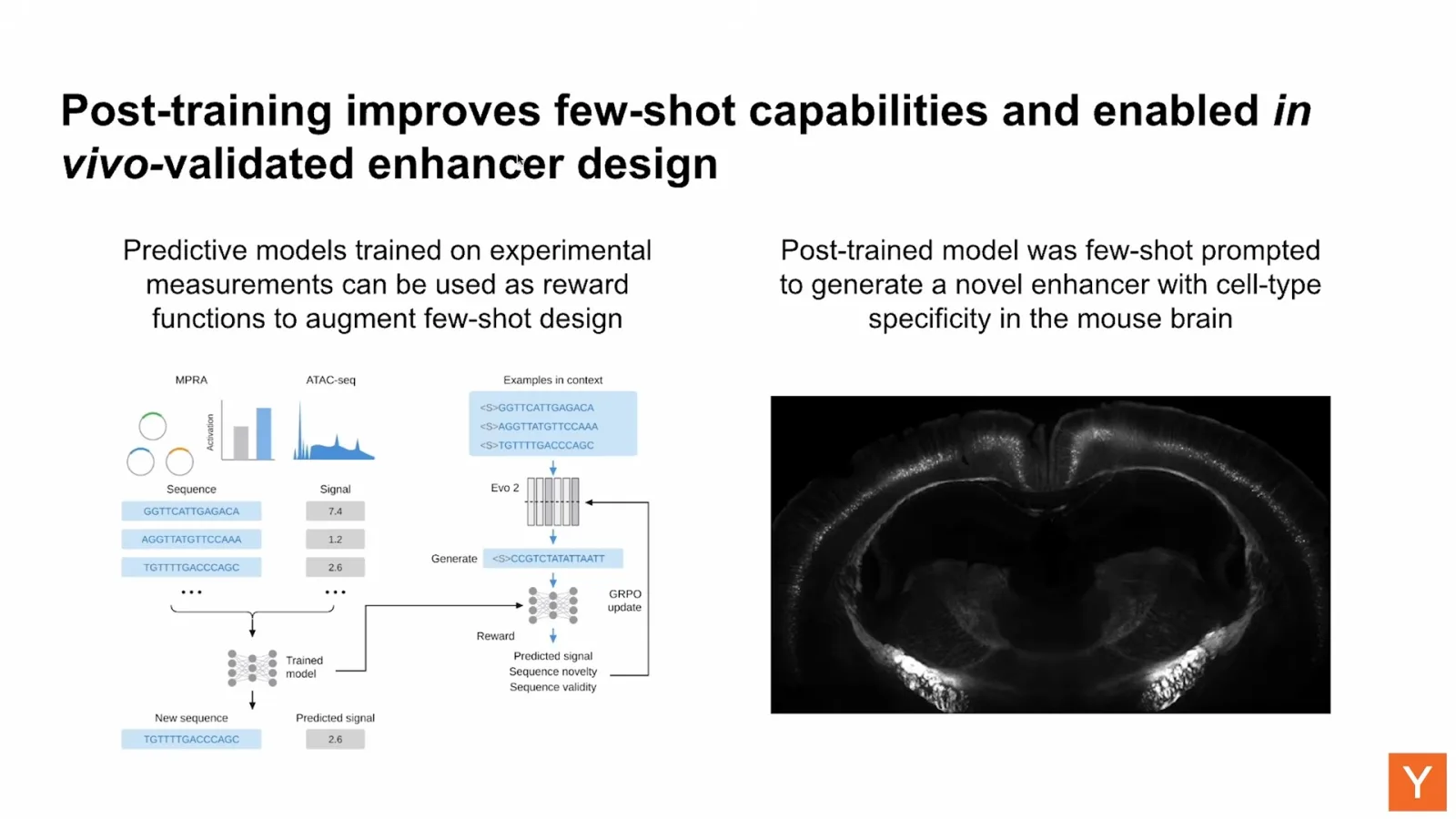
Nori says a generated enhancer was tested in a mouse brain and showed activity and specificity in the illustrated experiment. That result is an animal experiment on a regulatory element, not a demonstrated human treatment.
She proposes a laboratory feedback loop: start with natural sequences or model-generated examples, produce new candidates, test promising ones and update the prompt with the results. She also sees room to investigate inference-time methods and harnesses.
In questions, Nori explains the reinforcement-learning setup: the model generates sequences from examples, a predictor scores expected activity, and additional constraints encourage reasonable sequence properties and reduce reward hacking.
Asked why in-context learning appears in DNA models, she discusses hypotheses about the distribution and recurring structures in genomic data. She says the mechanism is under study, with some evidence of a mechanism resembling induction heads in language models.
An audience member asks whether the enhancer approach combines known patterns or produces entirely new specificity. Nori says it likely uses both prior knowledge in the weights and motifs in the examples, preserving and recombining relevant patterns.
同じチャンネルの記事
 44:15EN
 Y Combinator· 2026年11月7日Amjad Masad and Paul Graham on Replit’s Path to AI CodingPaul Graham, Amjad Masad · Y CombinatorThe Replit co-founder traces agentic coding from user observations and cloud infrastructure to his vision for enterprise work.
 47:14ENY Combinator· 2026年11月6日Blake Scholl on Supersonic Flight and the Turbines That Could Fund ItJessica Livingston, Carolynn Levy, Blake SchollThe Boom founder explains an engine partnership setback, boomless flight physics, and a proposed power-generation business.
 48:45ENY Combinator· 2026年10月30日Paul Copplestone on Databases for AI Builders and AgentsPaul Copplestone · SupabaseThe Supabase cofounder discusses the company’s growth, personal databases, agent-friendly tools and adapting to new kinds of builders.
 1:05:44ENY Combinator· 2026年10月26日Marvin Schwaibold on AI-Powered Design, Interactive Prototypes and Better WebsitesAaron Epstein, Marvin Schwaibold · Y CombinatorShopify’s product design studio lead shows how he uses AI to build and refine interactions, then reviews six websites with Aaron Epstein.
 1:50:48ENY Combinator· 2026年10月24日Why Inference Matters 12× More Than TrainingFrançois Chaubard, Dan Fu, Jeff Morgan, Joe Fioti, Liangsheng Yin · Y CombinatorYC Paper Club walks the inference stack from an API request down to GPU kernels. Four talks from Together AI, Ollama, Luminal, and SGLang argue that serving quality, not just training FLOPs, is where most of the compute and the money now sit.
 47:08ENY Combinator· 2026年10月23日How Farza Majeed Makes Product Demo VideosAaron Epstein, Farza Majeed · Y CombinatorA founder’s approach to frequent launches, storytelling and measuring the audience that converts.