









絞り込み結果
152 件並び順
 12:43EN
 Jane Street· 2024年12月20日How OCaml Represents Values in MemoryA practical tour of immediate integers, heap blocks, runtime tags and variant constructors, illustrated with OCaml's Obj module.
 1:03:21ENJane Street· 2024年12月9日Horace He on Building ML Systems for Trillion-Trillion OperationsHorace He · MetaHow GPU bottlenecks, compiler design and distributed parallelism shape the systems behind large-scale model training.
 27:16ENJane Street· 2024年11月15日Tudor Brindus on Finding and Reducing System JitterTudor Brindus · Jane StreetA memory ping-pong benchmark reveals how virtualization, interrupts, CPU frequency changes and speculation can disrupt low-latency systems.
 40:33ENJane Street· 2024年10月23日Charlie Marsh on uv: Python Dependency Resolution and PerformanceCharlie Marsh · AstralThe Astral founder explains universal lockfiles, Python packaging constraints, and the data structures and cache design behind uv.
 2:50ENJane Street· 2024年10月16日Inside Jane Street’s 2024 Internship ProgramSanemi, Brian, Xavier, Abby, Marcus, In Young Cho · Jane StreetInterns and staff describe an 11-week program built around learning, collaboration and hands-on projects across several disciplines.
 1:06:23ENJane Street· 2024年10月14日Sylvain Gugger on Accelerating ML Models and Reproducing ResultsYaron Minsky, Sylvain Gugger · Jane StreetFrom learning-rate schedules to GPU bottlenecks and noisy market data, Sylvain Gugger explains how he approaches practical machine-learning performance.
 53:51ENJane Street· 2024年10月7日Liora Friedberg on Solving Puzzles in ProductionYaron Minsky, Liora Friedberg · Jane StreetProduction engineering combines live incident response with software, process improvements and a culture that helps people learn from mistakes. Liora Friedberg and Ron Minsky explore the work at Jane Street.
 9:25ENJane Street· 2024年10月1日Richard Eisenberg: Using OCaml’s Coercion OperatorRichard Eisenberg · Jane StreetA practical tour of subtyping, polymorphic variants and private type abbreviations, with no runtime conversion cost.
 7:17ENJane Street· 2024年8月13日Erik and Martin Demaine on the Mathematics of Curved-Crease SculptureErik Demaine, Martin Demaine · MITThe MIT father-and-son collaborators turn paper folding into art and research, embedding puzzles and mathematical fonts in their sculpture Solve Me.
 8:06ENJane Street· 2024年8月7日How OCaml's Proposed Include Functor Syntax Reduces RepetitionRichard Eisenberg · Jane StreetA reverse-array example shows how to derive common module functions from a minimal implementation without an extra wrapper module.
 4:51ENJane Street· 2024年8月2日How Jane Street’s Creative Engagement Team Shapes Company CultureTala, Lana · Jane StreetTeam members describe how events, design and digital projects bring colleagues together and introduce the firm to new people.
 3:18ENJane Street· 2024年8月1日Rory on Production Engineering and Incident Support at Jane StreetRory · Jane StreetA production engineer describes monitoring order engines, responding to outages and building a supportive team.
 3:16ENJane Street· 2024年7月18日JP on Machine Learning and Trading at Jane StreetJP · Jane StreetA Hong Kong equities trader describes his changing workday, the growth of research infrastructure, and the distinctive challenges of machine learning in finance.
 2:46ENJane Street· 2024年7月18日Matt on Machine Learning and Trading at Jane StreetMatt · Jane StreetA Hong Kong equities trader describes the challenges of financial data, the firm’s ML roles and its collaborative culture.
 1:03:36ENJane Street· 2024年7月12日Erin Murphy on Designing Tools for Expert UsersYaron Minsky, Erin Murphy · Jane StreetFrom NASA scientists to Jane Street engineers, a UX designer explains how observation, drawing and collaboration reveal what complex tools need to do.
 14:36ENJane Street· 2024年6月24日Programming with OCaml's Local ModeRichard Eisenberg · Jane StreetAn example shows how a local list can contain global values, why a non-escaping annotation alone does not ensure stack allocation, and where the experimental feature remains awkward.
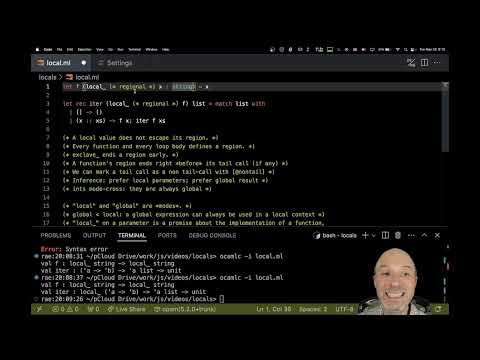 11:28ENJane Street· 2024年6月13日OCaml Local Types: Regional Parameters and Loop RegionsRichard Eisenberg · Jane StreetA demonstration explains why some local parameters can cross a function boundary and how loop regions reclaim allocations.
 3:11ENJane Street· 2024年5月31日Alok on Quantitative Research at Jane StreetAlok Puranik · Jane StreetA researcher describes projects, useful mathematical background and how candidates can prepare for interviews.
 9:14ENJane Street· 2024年5月29日OCaml Local Function Types: Why Partial Application Can EscapeRichard Eisenberg · Jane StreetRichard Eisenberg uses a list-append example to show how a local argument changes the mode of a partially applied function in Jane Street’s OCaml compiler branch.
 15:59ENJane Street· 2024年5月7日Tail Calls and Local Regions in OCamlRichard Eisenberg · Jane StreetA list-counting example reveals why a local closure can escape at a tail call, and how regional mode and [@nontail] affect the result.
 3:30ENJane Street· 2024年3月13日Richard Eisenberg on Jane Street's OCaml ExperimentsRichard Eisenberg · Jane StreetJane Street's compiler team is exploring unboxed types, locality modes, and data-race-free parallelism to make OCaml's performance and memory management better suited to its needs.
 11:07ENJane Street· 2024年2月29日How OCaml Locals Use a Separate StackRichard Eisenberg · Jane StreetA list example shows how region-scoped local values can avoid repeated garbage-collected allocations.
 23:25ENJane Street· 2024年2月20日Richard Eisenberg: How OCaml Locals Reduce Garbage-Collected AllocationRichard Eisenberg · Jane StreetAn annotated list-processing example shows why locality must be preserved both when values are created and when functions consume them.
 22:27ENJane Street· 2024年2月7日How OCaml Infers LocalityRichard Eisenberg · Jane StreetA look at local and global mode inference, module signatures, mode crossing for integers, and conversions between function types.
もっと見る152 件中 24 件を表示