En 30 secondes
Cameron Wolfe explains why subjective agent evaluations are noisy and presents a framework combining calibrated human review, offline judges and production A/B tests. He discusses power analysis, resampling and a Netflix example linking judge results to viewer behavior.
- 1A spectrum of verifiabilityCreative work introduces judgment where a deterministic pass–fail check may not exist.
- 2Human evaluationExperts define criteria and reviewers calibrate by examining disagreements.
- 3Judges and rubricsA broad judge applies quality guidelines; a rubric checks task-specific criteria.
- 4Meta-evaluationCompare automatic judgments with reliable human-labeled examples.
- 5Make uncertainty visiblePlan sample sizes and report error bars while accounting for variability.
- 6Test in productionUse controlled A/B tests and monitoring before and after wider rollout.
À retenir
- Define quality with domain experts and calibrate human reviewers against shared examples.
- Use model judges and task-specific rubrics as imperfect proxies, then validate them against human-labeled data.
- Plan sample size and report uncertainty while recognizing that statistics do not remove systematic bias.
- Use A/B tests and production monitoring to check whether offline improvements matter in real use.
- Feed new production failures back into datasets and guidelines.
Lire le texte remanié, chapitre par chapitre
Why subjective evaluation is noisy
Wolfe explains evaluation trials and the spectrum of verifiability.
I’m Cameron Wolfe, a staff research scientist at Netflix. This talk is an overview of how to evaluate highly subjective tasks, such as creative writing, where there may be no single verifiable right answer.
A primary difficulty in evaluation is noise. Agents have nondeterministic behavior, so repeated runs can produce different trajectories and answers. When the benchmark contains only a limited number of tasks, that variability makes performance differences harder to interpret.
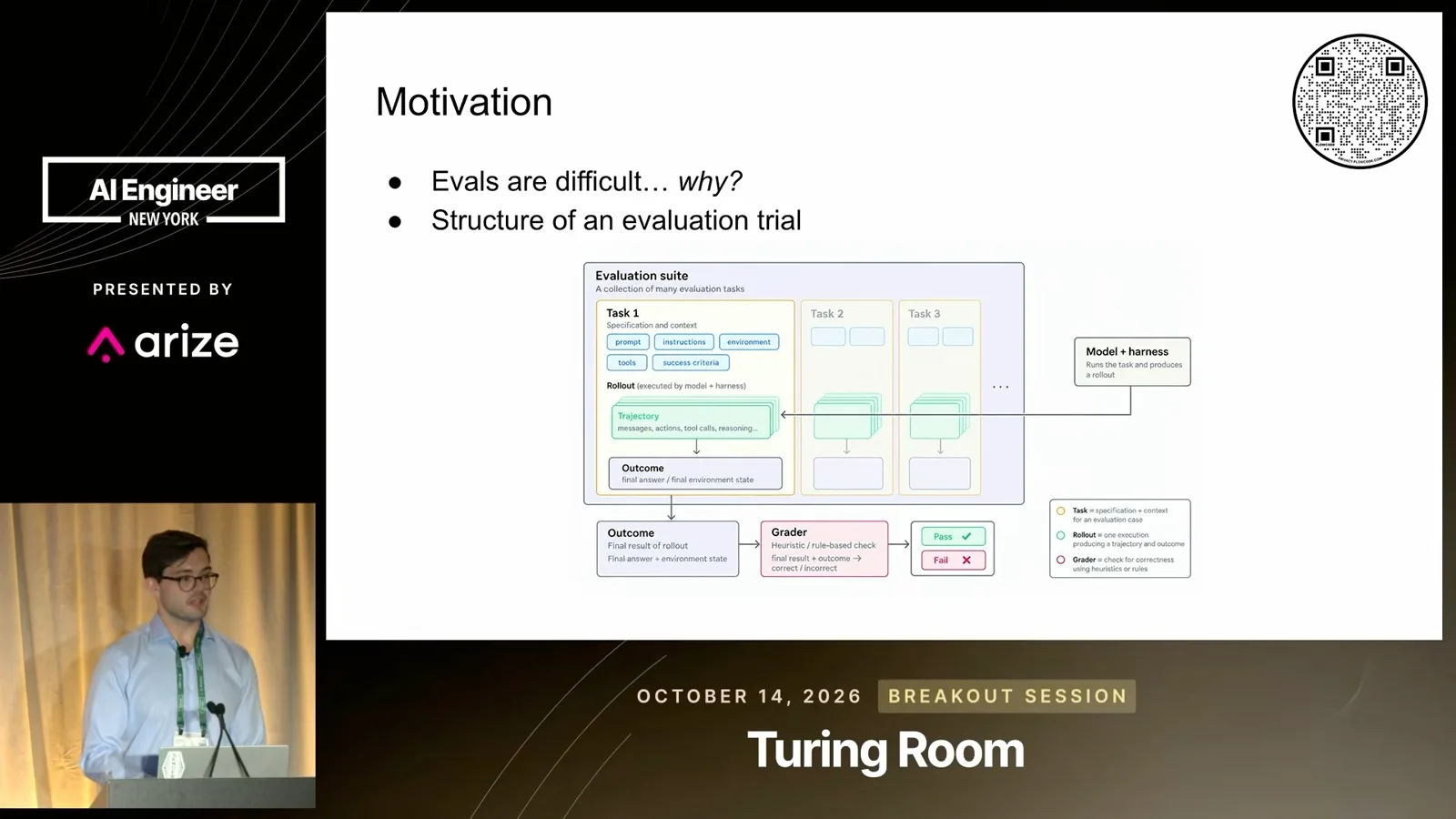
In a simple evaluation trial, a suite supplies tasks, an agent produces a rollout and an outcome, and a grader assigns a result. Some benchmarks are expensive to run, limiting the number of tasks or repeated runs a team can afford.
Tasks lie on a spectrum of verifiability. A math answer may permit a deterministic check, while creative writing requires judgment about open-ended qualities. Replacing a deterministic grader with a model judge adds another potential source of variability.
My framework combines human evaluation, offline automatic evaluation and production monitoring. These components inform one another: humans define quality, automated proxies enable faster iteration, and production provides evidence about real use.
Human evaluation and sampling
He describes guidelines, reviewer calibration and power analysis.
Start with human evaluation as the reference for a subjective task. Work with subject-matter experts to define a small set of criteria, rating scales and detailed examples, so reviewers have a shared understanding of what they are evaluating.
Good guidelines alone do not guarantee agreement. Ask multiple reviewers to assess the same examples, study where they disagree, discuss ambiguity and revise the guidelines. Repeat this calibration until agreement is appropriate for the task.
Sampling matters too. Power analysis can estimate the number of examples needed to detect an effect of a chosen size, given assumptions about variability, significance level and desired statistical power. It is a planning tool, not a guarantee that every conclusion will be correct.
The evaluation set should reflect real production tasks, include diverse cases and be difficult enough to distinguish models. Profiling rollouts can reveal what a model solves or misses, while human and model-based review can improve data quality over time.
Offline judges and rubrics
He explains automatic proxies and how to check them against human judgments.
Human review of every model change quickly becomes a bottleneck. Offline automatic evaluation uses an imperfect proxy—often a language-model judge or a rubric—to make a larger number of experiments practical.
In the distinction I use here, an LLM judge applies high-level quality guidelines across tasks. A rubric breaks a particular task into a checklist of criteria that can be assessed separately. Both approaches still require validation against the intended quality standard.
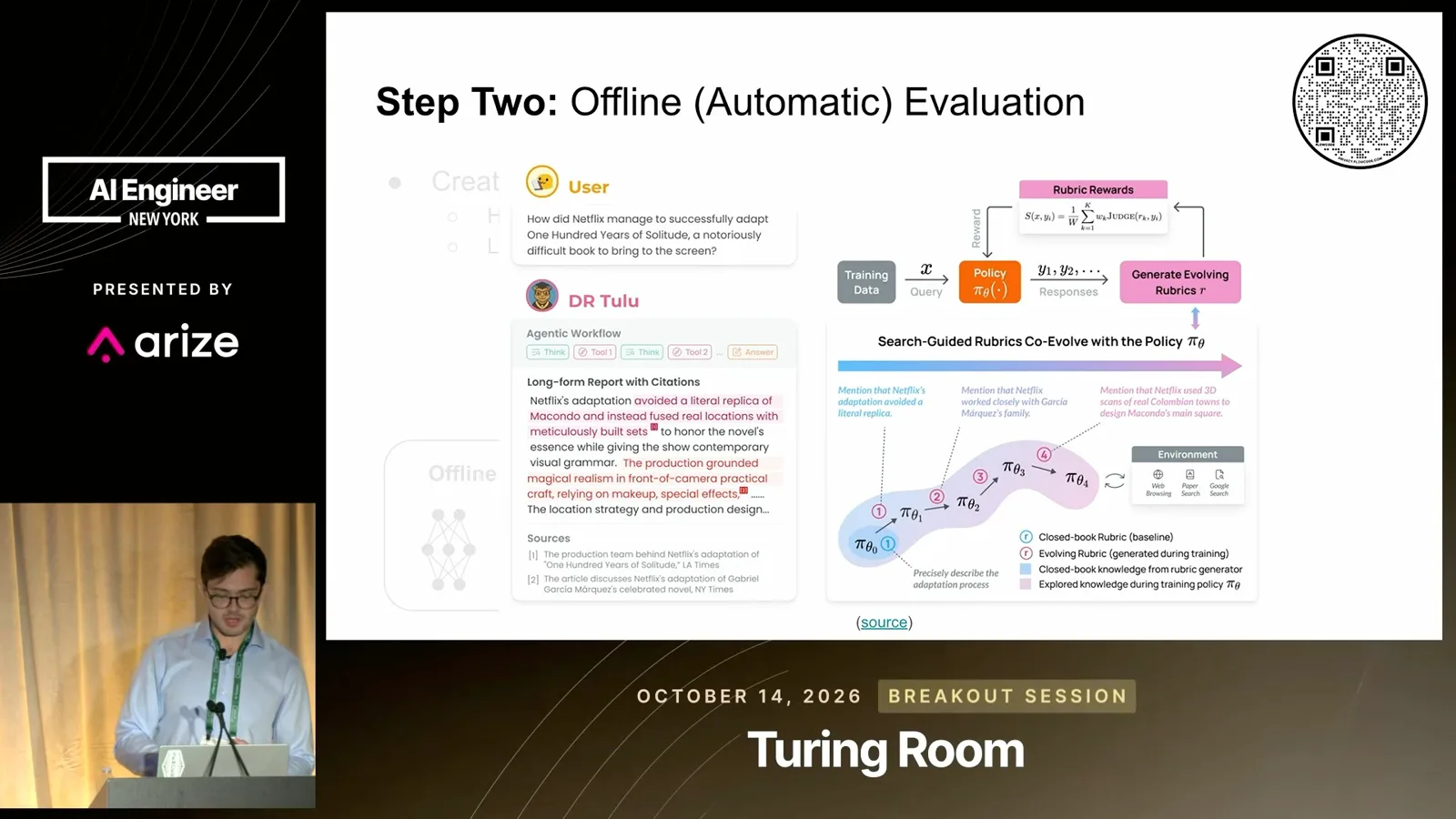
I show a Dr. Tulu example involving an adaptation of a book for Netflix. Rather than relying on one general impression, the rubric lists specific features to check. Making criteria explicit can improve consistency, though it does not eliminate judgment or bias.
Meta-evaluation checks whether the automatic judge agrees with trustworthy human-labeled “golden” examples. Depending on the task, teams can examine correlation, classification accuracy and particular patterns of disagreement rather than relying on a single headline number.
In a Netflix project I worked on, we linked an LLM judge’s outputs to streaming outcomes such as abandonment. I describe this as evidence relevant to that project; the talk does not provide enough detail to generalize its causal claim to all judges or viewing contexts.
How much agreement is enough depends on the task. One practical reference is agreement among human reviewers: compare the judge’s agreement with people against the level people achieve with one another, while still examining important errors.
Statistics and production
The talk covers uncertainty, A/B tests and monitoring.
With both a stochastic model and a stochastic judge, uncertainty needs explicit treatment. I recommend planning sample size, reporting error bars and using repeated samples or resampling where appropriate. The design must account for the sources of dependence and variability in the experiment.
Use automatic evaluation to explore many changes, then bring promising candidates back to human reviewers. Statistical intervals help quantify sampling uncertainty, but they do not remove systematic bias or prove that one model is better in every setting.
Before a full deployment, monitor production signals. These can be explicit ratings, such as thumbs up or down, or implicit measures, such as session length and abandonment. Each is a proxy whose meaning depends on the product and user context.
An A/B test compares a candidate with the existing experience and can serve as a controlled, limited rollout. Power analysis can help plan duration and sample size; guardrails and ongoing monitoring remain important after a full release.
Improving the loop
Production failures feed back into guidelines and offline evaluation.
Production can reveal new failure cases and use patterns missing from the offline set. Feed those examples back into the evaluation data, improve guidelines and recalibrate reviewers or judges as the product evolves.
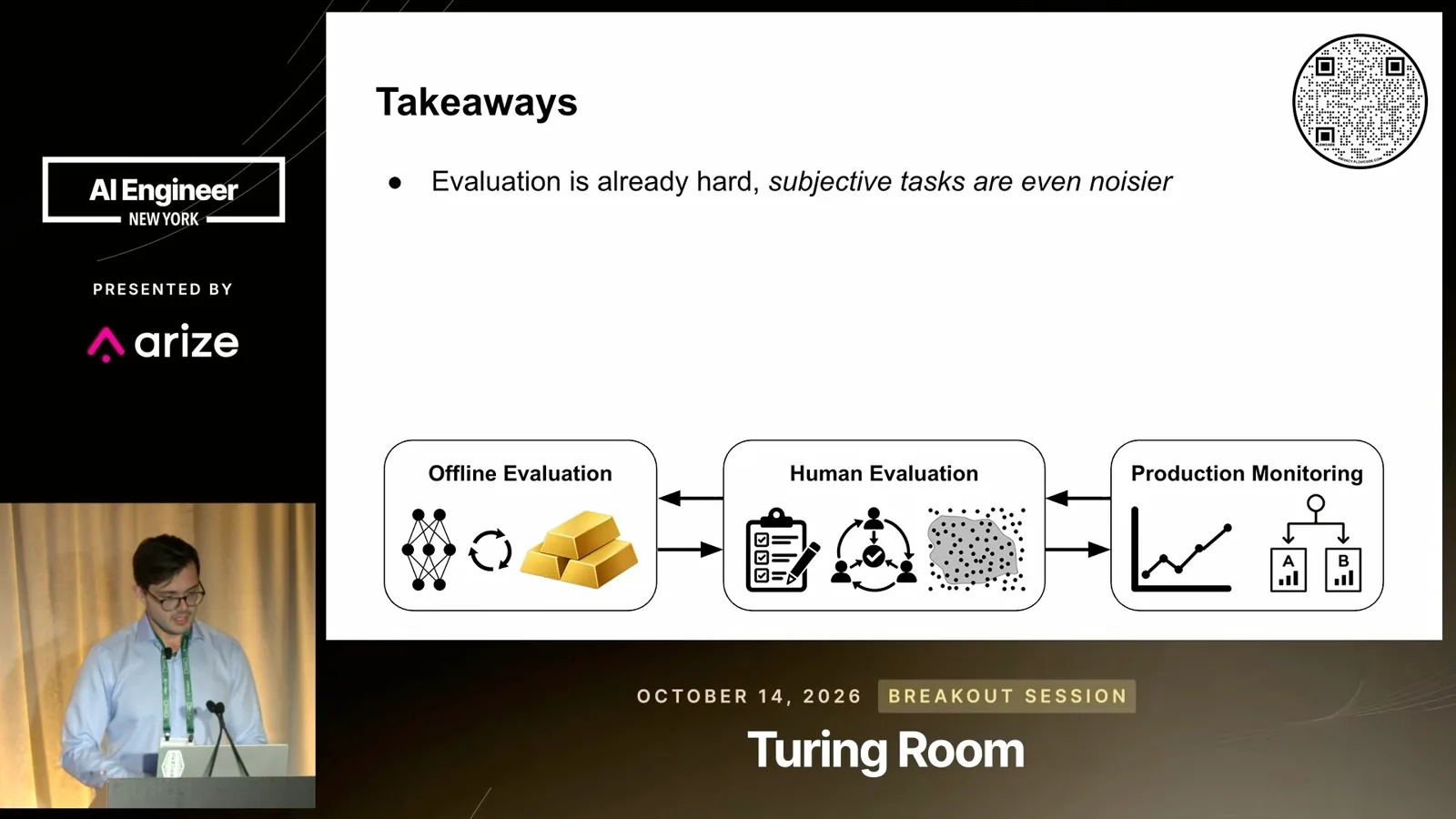
The complete loop is to use offline evaluation for breadth, human evaluation for a higher-fidelity view, and A/B tests plus monitoring to check real-world behavior. At each stage, be skeptical of noisy results and communicate the uncertainty alongside the score.
Sur la même chaîne
 23:05ZH
 AI Engineer· 6 nov. 2026Ryo Lu:当我们什么都能做,还知道自己想做什么吗?Ryo Lu从 AI 生成的日记工具到爵士乐团,Ryo Lu 讨论如何在更强大的工具旁保有判断、生活和与他人合作的空间。
 14:58ENAI Engineer· 6 nov. 2026Sparsh Jain on Building Experiential Memory for AI AgentsSparsh Jain · CentralAgent AIAn agent-memory lifecycle forms, updates and retrieves lessons while evaluation loops manage changing context.
 17:27ENAI Engineer· 6 nov. 2026Philipp Schmid: Seven Things an AI Coworker NeedsPhilipp Schmid · Google DeepMindA walkthrough of managed agents, skills, credentials and controls, culminating in a scheduled portfolio-audit demo.
 18:13ENAI Engineer· 6 nov. 2026Sid Pednekar: Judgment Is the Scarce Resource in AI AdoptionSid PednekarA framework for choosing valuable problems, building shared capabilities and turning experience into organizational learning.
 14:04ENAI Engineer· 6 nov. 2026Frank Long on Building AI Investment Workflows Around QualityFrank Long · CoatueCoatue’s Frank Long breaks investing into information, analysis and decision steps, and argues for choosing the right combination of code, models and people.
 20:45ENAI Engineer· 5 nov. 2026John Stecher and Scott Worland on Building AI Systems That Can ChangeScott Worland, John Stecher · Norm AIThe Blackstone and Norm AI CTOs discuss data strategy, evaluations, production controls and when to wait for a better model.