En 30 secondes
Marina Mogilko interviews Harvard Business School professor Karim R. Lakhani about research on AI-assisted work, education, leadership and organizational change. Lakhani distinguishes study observations from his own forecasts and argues that people must continue learning and exercising judgment as tools improve.
- 1Three ways of workingLakhani contrasts close collaboration, supervised division of work and uncritical self-automation.
- 2The jagged frontierTasks that look similar can fall on different sides of an AI model’s capability boundary.
- 3Ask for counterargumentsHe suggests challenging a model’s first answer, exploring alternatives and checking weak claims.
- 4Learning the foundationsLakhani uses an integration example to argue for initial practice followed by learning from many machine-generated examples.
- 5Building in the MBA courseHe says students build projects and study the business implications alongside technical exercises.
- 6Uneven adoptionHe reports large differences in AI usage across workers but distinguishes those observations from productivity evidence.
- 7Who is at risk?Lakhani questions whether junior roles are uniquely vulnerable and offers a tentative view about middle management.
À retenir
- Lakhani describes collaborative, divided and fully delegated patterns of working with AI, with different implications for learning.
- AI performance can be uneven across similar-looking tasks, so users should test and challenge its outputs.
- He argues that foundational knowledge and taste remain important when AI expands a person’s role.
- His MBA course combines hands-on AI projects with economics, strategy and change management.
- Usage varies widely within organizations, but he says his usage data does not yet establish performance correlations.
- He recommends business outcome targets rather than AI usage targets and says leaders should use the tools themselves.
- His views on junior work, middle management and future firms are hypotheses, not settled results.
Lire le texte remanié, chapitre par chapitre
Working with AI without switching off
Mogilko asks about research on different patterns of AI use. Lakhani discusses learning, uneven task performance and the need to challenge persuasive answers.
Marina Mogilko introduces Harvard Business School professor Karim R. Lakhani and asks how people can use AI without losing the ability to learn. Their conversation draws on his research with organizations including BCG, Procter & Gamble and H&M, as well as his experience teaching managers.
Lakhani says he still expects humans working with AI to be important in the foreseeable future. In his view, models need direction, curation and judgment even as they perform more execution. He expects both organizations and occupations to be reconfigured, but says complete replacement of people is not yet what he sees.
Mogilko asks about three patterns described in research involving BCG consultants: close collaboration with AI, dividing tasks between human and machine, and delegating almost everything. She cites approximate shares for a subset of consultants; Lakhani situates the work within a larger experiment involving about 800 consultants.
Lakhani calls the first pattern “cyborg” work: people and AI solve problems together. “Centaurs” divide tasks according to their respective strengths and supervise what comes back. “Self-automators,” in his description, press play and disengage; he says this group learned least in the work he discusses.
He sees learning opportunities in close collaboration, but says people who divide work must revisit the boundary as model capabilities change. The categories describe observed ways of working in the study, not permanent labels for people or a guarantee that one approach fits every task.
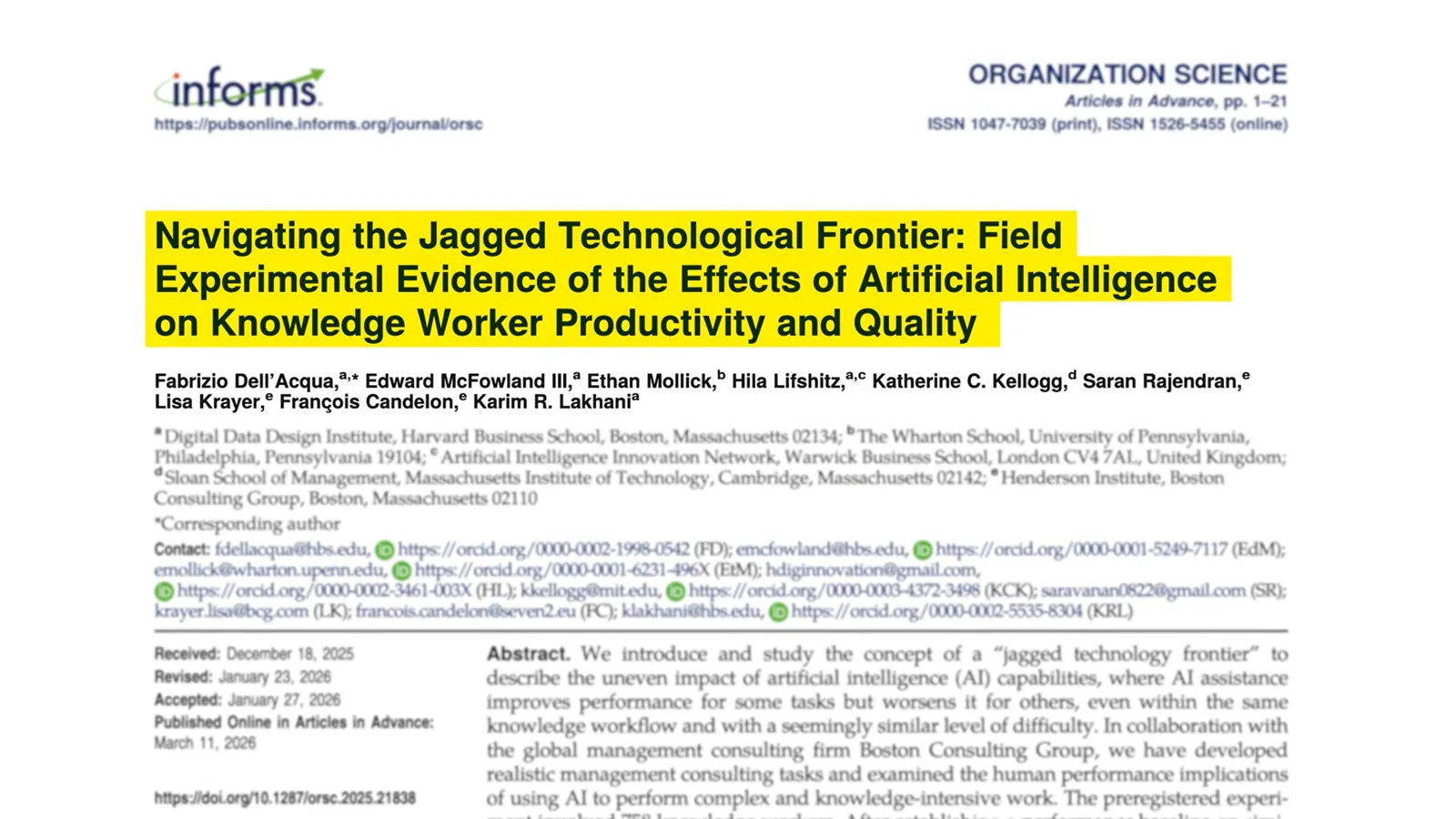
Mogilko raises the “jagged frontier”: AI can succeed at one task and fail at a similar-looking one. Lakhani says a model’s persuasive language can make imperfect answers easy to accept. He recommends testing the tools against demanding tasks, applying skeptical standards and updating one’s assessment as models change.
The conversation turns to cases where a model argues more forcefully after being challenged. Lakhani suggests asking for counterarguments first, identifying weak points and examining how confident a claim is. Such prompts are aids to critical review, not proof that the model’s stated confidence or reasoning is accurate.
He compares working with AI to mentoring assistants: the human must push back as well as ask the system to challenge assumptions. He says his research practice involves trying to disprove his own conclusions and that people in marketing, research or finance need a similar habit of review.
For practical use, Lakhani suggests requesting several arguments against a proposal, further research and possible red flags. He says he rarely accepts the first answer and asks for alternatives or follows up himself. The purpose is to widen the search and inspect it, not to outsource responsibility for the final decision.
After a sponsor segment, Mogilko asks about models that choose how to use a dataset without a detailed workflow. Lakhani welcomes the capability but worries that, without scrutiny, a model may settle on a generic approach that does not fit the user’s particular problem.
Taste, foundations and learning to learn
The discussion turns to delegated decisions, design judgment and early-career learning. Lakhani argues for mastering foundations while using AI to expand practice.
He uses a one-person product team as an example. AI may help an engineer with design, interviews and testing, but the person still needs enough design knowledge and taste to evaluate the result. Asking for a design in a famous person’s style is not, in his view, a substitute for understanding the work.
For research, Lakhani says a model might propose several kinds of regression but still choose an unsuitable method. He recommends learning the underlying principles, requesting alternatives and asking the system to examine the pros and cons. Human expertise remains necessary to judge those comparisons.
Asked how a solo worker can recognize excellent output, he stresses accountability: the person’s name goes on the work. He says he has dismissed people who blamed a poor result on AI. His broader point is that copying an answer is not the same as reviewing it or developing judgment.
Mogilko asks how junior workers can develop taste if basic tasks are automated. Lakhani says he has more questions than answers and considers two possibilities: AI could remove the early rungs of a career ladder or act as a springboard. In either case, he argues, people need to take responsibility for foundational learning.
He recounts an example attributed to Stephen Wolfram about learning integration. A student may need to solve some integrals by hand to understand the method, then learn from observing many examples generated by a machine. Lakhani presents this as a way to combine initial practice with wider exposure, not as a tested rule for every subject.
As people take on a wider range of work, he says, they must keep learning the foundations needed to supervise and challenge tools. Mogilko notes the tension between jumping to a machine too quickly and having more material to learn. Lakhani emphasizes learning how to learn and using AI explanations or quizzes thoughtfully.
Teaching and leading through practice
Lakhani describes changes to the Harvard MBA curriculum and hands-on work with executives. He discusses unequal adoption and the importance of business outcome targets.
Asked about Harvard MBA students, Lakhani says the required AI course changes rapidly as capabilities change. The teaching team concluded that students should not merely discuss AI: they should build with it and confront actual business problems.
He says the course includes retrieval-augmented generation, evaluations and multi-agent systems, and that students built projects in place of a conventional final exam. He reports that about 900 MBA students created solutions with AI assistance. These are his descriptions of the course and its results.
Technical projects are paired with economics, strategy, organizational change and case discussions. Lakhani says hands-on work helps students understand both the tools’ capabilities and the implications for companies and careers. He describes the shift as challenging for faculty as well as students.
Mogilko asks about access outside the campus course. Lakhani says some online offerings exist, though he does not describe them as equivalent in depth. The discussion then turns to executive workshops, where he asks senior leaders to build applications for problems in their own businesses.
Lakhani says some executives initially resist, but hands-on exercises can expose what the tools can and cannot do. He argues that a leader who never uses AI has a weaker basis for guiding teams. His examples reflect his workshop experience rather than a measured result across all companies.
On adoption, he says technology centers and many companies are living with different levels of experience. His team has examined prompt and usage data across large organizations, and he describes a wide gap between heavy users and the median.
Lakhani reports differences of roughly 10 to 20 times in usage at the high end compared with the median in the data he discusses. He explicitly says those usage observations do not yet establish correlations with performance; he separately mentions productivity differences seen in other software and company data.
He advises individuals to build their own experience with prompting, model limitations and review rather than assume that access alone is enough. For organizations, he says, leadership must also set direction and rethink the operating model.
Instead of targets for AI usage itself, Lakhani recommends ambitious targets for outcomes such as customer service, research productivity, product launches or operations, then asking how AI might help. Mogilko notes the difficulty of attributing a business result to AI when other factors also change.
Lakhani describes targets as acts of imagination and argues that ambitious goals can change what a team attempts. His example contrasts aiming for a tenfold improvement and achieving sevenfold with settling for a smaller target. It is a leadership heuristic, not evidence that such gains are typical.
Mogilko refers to an H&M study and asks whether a strategy produced by AI is harder for people to advocate. Lakhani responds that people should develop and own the ambition, using AI to strengthen it. They then discuss fear of failure and how educators encourage students to pursue larger goals.
Expertise and meaningful work
He connects AI to his research on open-source collaboration and explains his view of human expertise with AI. The guests consider creative work, consumption and the meaning of managing agents.
The discussion shifts to the cost of expertise. Lakhani recalls his research on open-source software, where contributors have motivations beyond money and many participants can try different approaches. He uses that history to think about how widely available AI assistance might affect knowledge work.
He argues that open collaboration can surface strong results from a distribution of attempts, and that AI may shift the capabilities of a human-plus-tool combination. He treats this as a framework informed by studies at several organizations, not a claim that every person automatically becomes an expert.
Lakhani compares the change to moving from hand drafting to CAD: tools can let people attempt more complex work, provided they learn how to use and evaluate them. Asked how to choose a field in which to develop expertise, he emphasizes sustained work and learning alongside AI.
He wonders whether AI represents a difference of degree or a difference in kind from earlier technology waves and says he leans toward the latter. He draws an analogy with technologies used in music, arguing that tools can change an art form while still requiring people to master or collaborate around them.
Mogilko asks whether people can consume all the output that more efficient organizations may produce. Lakhani says he does not know. In software, more generated pull requests may exceed human review capacity, raising questions about what people do and where they find meaning if agents perform more of the work.
He speculates that personal agents may mediate discovery of videos or other content, perhaps by reading a text version and directing a person to selected sections. Mogilko notes that human views still matter. Both are discussing possible future behavior, not a demonstrated replacement for audiences.
Jobs, firms and leadership
Lakhani offers a cautious view of which organizational layers may be vulnerable. He closes by urging leaders to experiment and evaluate how new models affect their business.
Mogilko asks about work in 2030 and refers to a Procter & Gamble study comparing individuals using AI with teams. Lakhani says he does not consider the automation of junior work settled. In his view, some middle-management roles could face greater pressure if their occupants resist changing how they work.
He acknowledges that the early-career labor market has multiple causes and that other researchers are concerned about junior workers. His assessment of organizational layers is a hypothesis based on observations he describes, not proof that an age group or job category will be displaced.
Lakhani argues that simply copying model output is not a durable role, and asks firms how they will redefine work. He expects some startups and established organizations to invest in learning new practices while others move more slowly; he says customer and organizational inertia may delay change.
He uses Amazon, Kmart and Walmart as contrasting stories about responding to online retail, then asks incumbents whether they are rethinking their business or merely adding AI to an old model. This is an analogy for strategic choices, not a forecast about any particular company.
Mogilko asks how a company can tell whether it is merely a wrapper around a frontier model. She relays a question attributed to Greg Brockman: does a new model make the business more valuable or absorb what it does? Lakhani says leaders cannot outsource that strategic judgment.
He returns to hands-on use: leaders who rely on expertise should experiment with systems that affect that expertise. He compares executives avoiding email in an earlier era with leaders delegating AI entirely to others, and says some CEOs he has spoken with now devote substantial meeting time to AI’s business implications.
Lakhani closes by connecting experimentation with imagination. Leaders, in his view, must consider not only their competitors but also how AI changes their own value. Mogilko thanks him and encourages listeners to keep asking what role people and companies will play.