En 30 secondes
Theo Browne examines a change in Codex subscription usage accounting and compares his own Codex and Claude workflows. He argues that a lower API-equivalent allowance can still support substantial work with a cheaper model, while Astra Ultrafast can consume the allowance quickly. His margin and pricing-motivation explanations are hypotheses. The usage and benchmark figures are specific to his tests and should not be read as guaranteed plan limits.
- 1Different meanings of costSubscription price, API-equivalent value and the provider’s actual marginal cost are different quantities.
- 2One observed usage runTheo’s report estimates $573.86 in API value before the account displayed 100%; its model mix and remaining allowed requests limit the conclusion.
- 3Cost per completed taskA 63-task benchmark comparison shows a large price difference for similar scores, within that particular test setup.
- 4Ultrafast can consume allowance quicklyThe video shows much higher Astra Ultrafast rates and a projection for the $500 plan based on a small sample.
- 5A choice based on the workflowTheo prefers Claude for his own coding and uses Codex and Sol for review and other tasks.
À retenir
- API-equivalent token value is an estimate, not a cash allowance or the provider’s actual cost.
- The number of useful tasks a plan supports depends on model choice, token mix and success rate.
- Theo’s mixed-model test reached a displayed 100% with $573.86 of priced API-equivalent usage, but did not capture a hard rejection.
- His Ultrafast estimate projects a full weekly allowance from a small sample; it is not a measured full-week drain.
- Theo prefers Opus for much of his coding work and uses Sol as an economical review partner.
Lire le texte remanié, chapitre par chapitre
What changed in the subscription
Theo compares earlier API-equivalent estimates with one recent usage run. He explains why agents make subscription usage more intensive.
A few weeks ago, I estimated that a $200 Codex subscription could yield up to roughly $12,000 per month in API-equivalent inference, with Claude's plan around $8,000 in my comparison. Those are estimates of token usage valued at API rates, not cash the subscriber receives or a guaranteed allowance.
These plans were designed when heavy users sent far fewer prompts and the tools felt nearly unlimited. As agents became more capable and ran for longer, users consumed more inference. I think the companies subsidized the plans heavily to keep the experience attractive as models became more expensive.
OpenAI announced a change to how usage is calculated for the $200 plan. In one of my recent tests, I measured about $574 of API-equivalent usage before the account displayed its weekly allowance as exhausted, which would suggest roughly $2,500 per month if repeated. This is one mixed-model observation, not a fixed dollar allocation.
API value and provider costs
Theo distinguishes API rates from subscription price and speculates about margins and competition. Those assumptions are not audited company figures.
The first thing to understand is that a subscription price and API-equivalent usage are different quantities. My dashboard shows almost $20,000 of API-priced usage across several machines over seven days. That is an estimate based on published rates, not a bill I actually paid and not the providers' own cost to run the models.
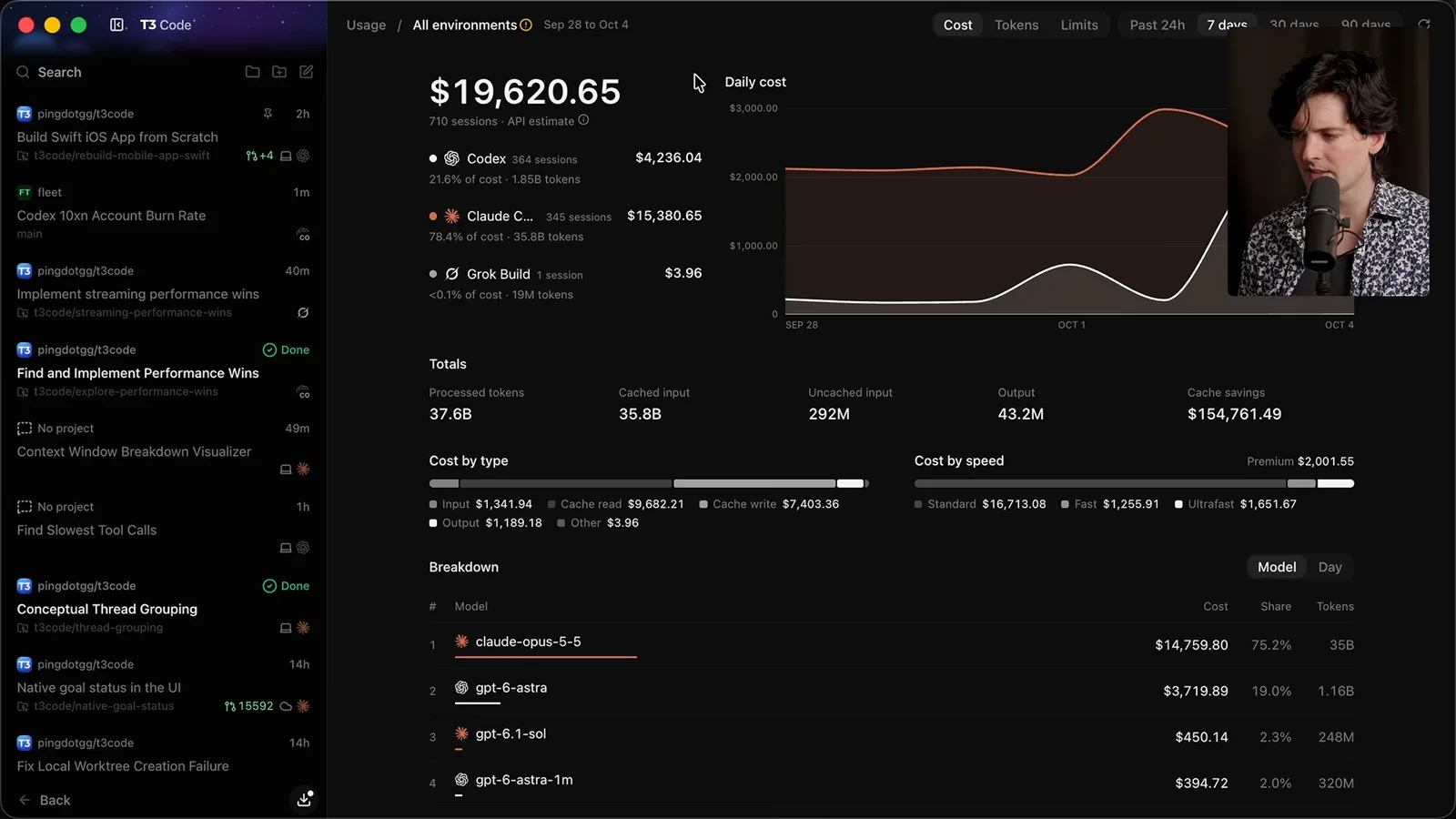
I believe API prices have historically been much higher than the marginal hardware and energy cost, but the specific margin figures I discuss are assumptions. They exclude substantial costs such as training, staff and infrastructure, and I do not have the companies' internal unit economics. Use them as an illustration, not an audited profit statement.
The products also differ in how their subscriptions can be used. I describe Claude access through Claude Code and its agent SDK, including T3 Code's integration, and contrast that with my understanding of permitted Codex uses. Rules and entitlements can change, so those remarks describe my interpretation at the time rather than a substitute for current terms.
I also describe a separate restriction on Fable usage within Claude's overall allowance, whereas I say Astra could use the Codex weekly allowance. These plan details shape the comparison, but my estimates from personal usage should not be mistaken for an official or permanent quota formula.
To explain my theory about competition, I compare a proposed Mythos output price of $125 per million tokens with the later Fable price of $50. I assume a $6.25 marginal cost in both cases to illustrate how the margin would fall from 95% to 87.5%. The cost and the companies' pricing intentions are speculative; the arithmetic does not establish either one.
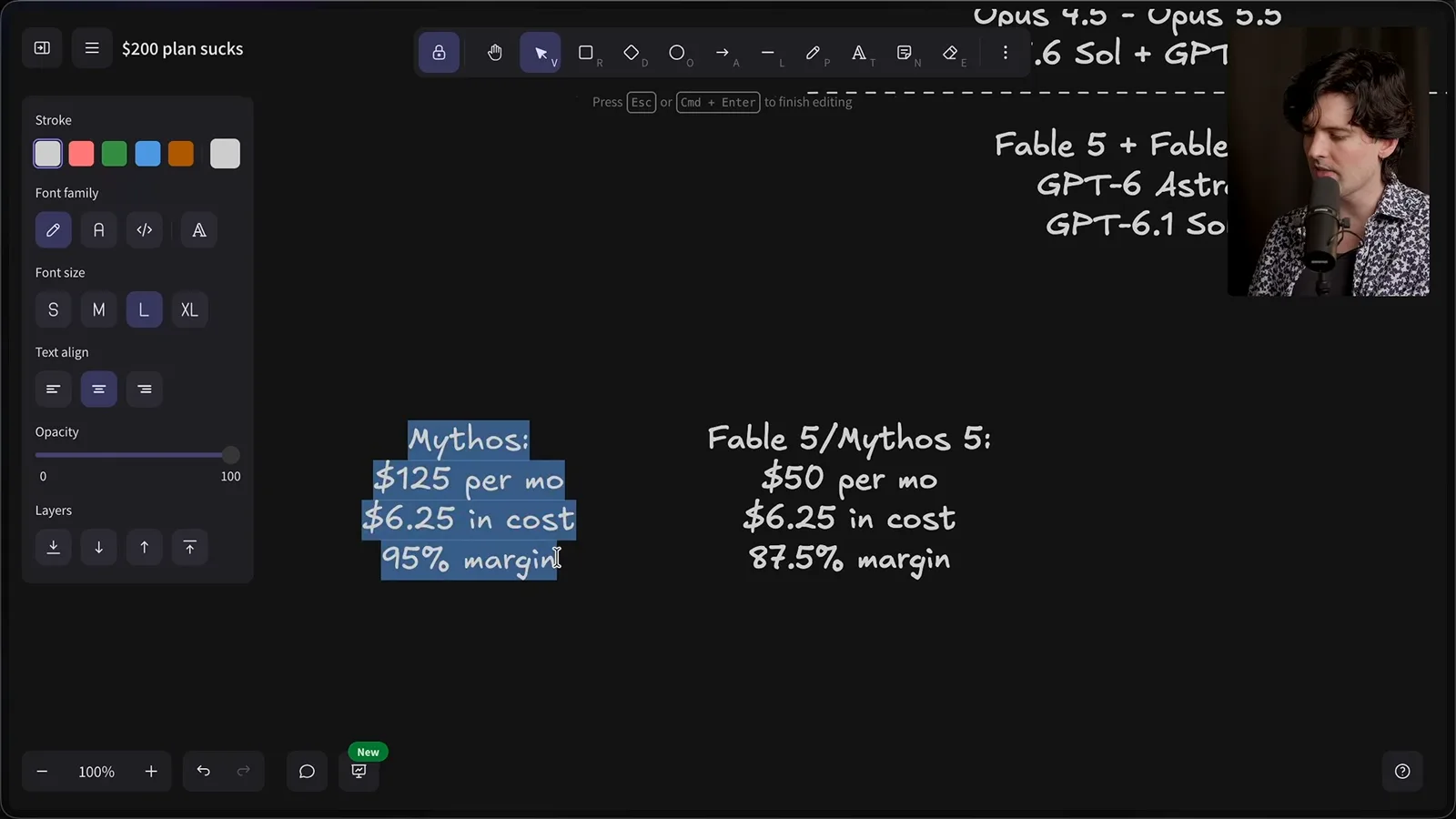
My argument is that competitive pressure can lower API prices and narrow the apparent gap between subscription value and API pricing. I speculate that Anthropic's Fable pricing influenced OpenAI's Astra pricing. Similar prices do not by themselves prove a competitor caused the decision.
I make a similar hypothetical comparison for GPT-6.1 Sol: perhaps OpenAI once considered pricing closer to Opus, but the release price I discuss is $2 per million input tokens and $10 per million output tokens, with $0.10 cached reads. The earlier intended price and resulting margin are my guesses, not disclosed company figures.
A cache-read discount can change the economics of agent work substantially because cached tokens may represent a large share of use. How much a user saves depends on the actual mix of fresh inputs, cache reads and outputs. It is not enough to compare list prices without knowing the workload.
Usage measurements and task efficiency
His mixed-model log shows different API-equivalent values for Astra and Sol. A benchmark comparison illustrates why task cost matters.
My hypothesis is that OpenAI changed subscription accounting partly to reduce the gap between subsidized usage and cheaper API pricing, rather than placing a separate limit on Sol. I cannot verify its internal motivation. I also think the announcement was poorly timed for people still relying heavily on Astra.
Here are my own numbers: the test shows $573.86 of priced API-equivalent usage, plus unpriced review activity. The display reached 100% during a roughly 29-hour run. The report also notes that requests were still allowed at the displayed 100%, so this is a displayed empty state, not a captured hard rejection.
Astra accounted for 1,815 responses, about 766,000 output tokens and $534.21 of estimated API value. Sol produced 1,490 responses, about 629,000 output tokens and $38.27 of estimated value. The input and cache mixes differed substantially, and I mention a possible setup issue, so this is not a controlled comparison of identical tasks.
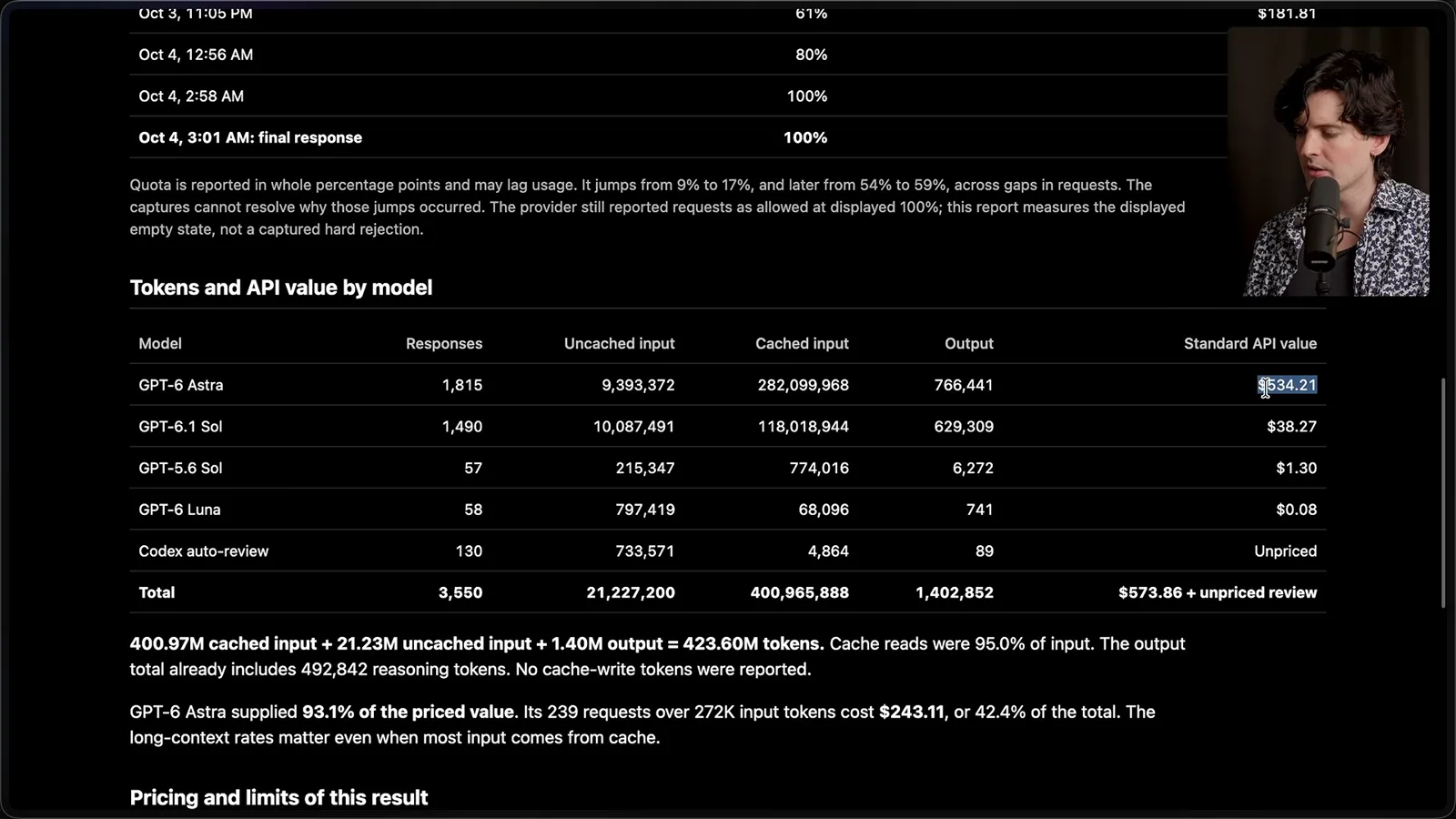
My interpretation is that the cheaper Sol model can make the subscription go much further for many workloads, even if its API-equivalent dollar value is lower. I say it may feel practically unlimited for ordinary usage, but that is my opinion and usage limits depend on workload and account conditions.
For shipping serious code, I personally prefer the value of my Claude subscriptions and use Opus heavily. I also regard Sol as exceptionally good value at API prices. Those can both be true: a subscription's apparent discount and the cost of completing useful work are separate comparisons.
I built a visualization to compare benchmark scores with task costs. In my Terminal-Bench 4.0 run using the models' native coding harnesses, Sol at xhigh scored 58.7% on 63 tasks at $0.96 per task; I compare it with an Opus result costing $13.11 per task and a similar score. One benchmark and one harness configuration do not settle which model is best for every job.
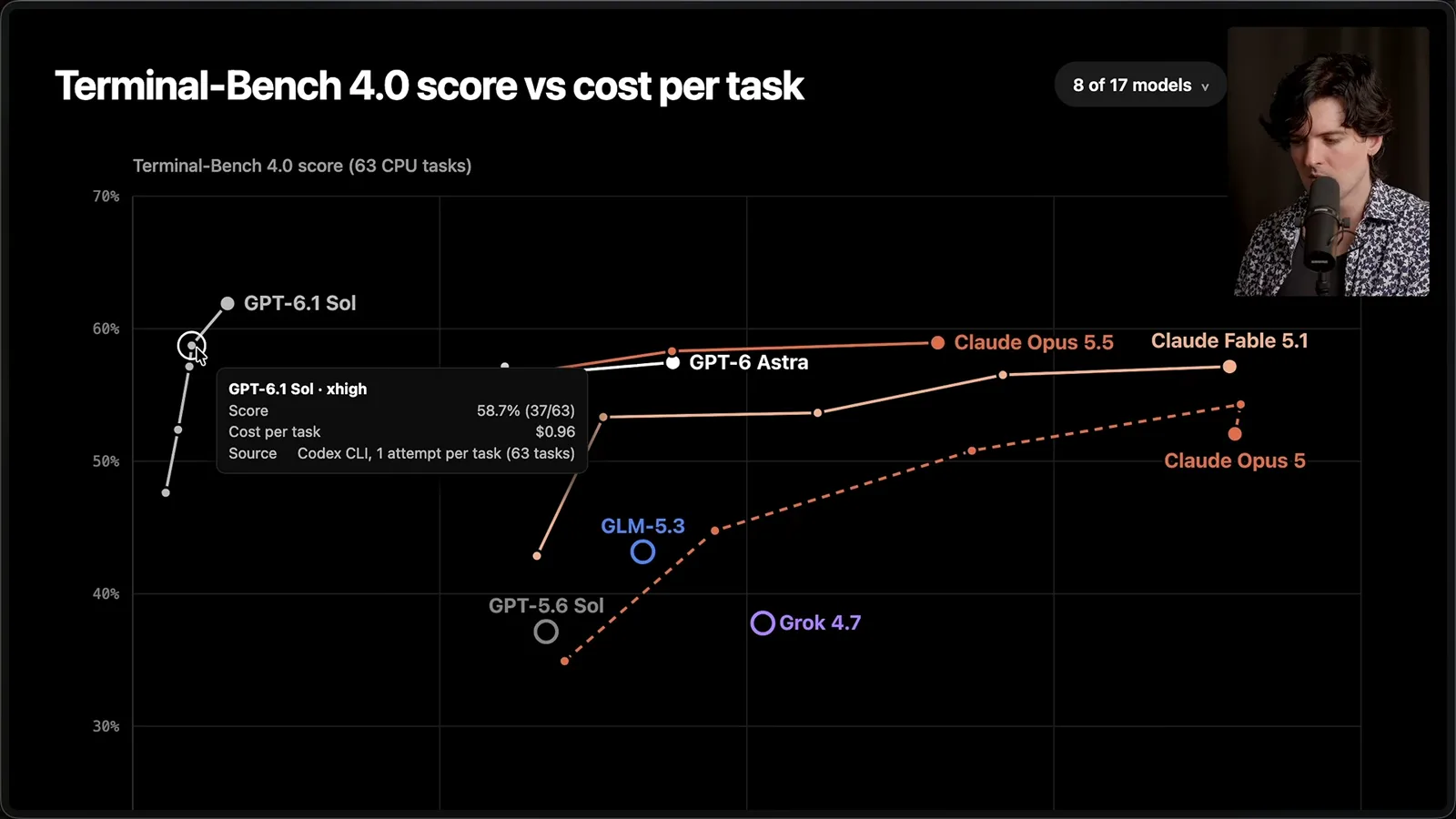
That illustrates why a lower dollar-equivalent allowance can still buy more completed benchmark tasks when the model is much cheaper and efficient. The exact ratio depends on success rates and the tasks being attempted. I still do not think Sol is automatically the better model for everything I do.
The $500 plan and Ultrafast
Theo criticizes the timing and presentation of the premium tier. He reviews higher speed-mode prices and a projected allowance based on a small test.
My criticism of the $500 plan is about timing and presentation. Announcing a reduction in the value users perceive from the $200 plan alongside a much more expensive tier makes people feel pressured to upgrade. Even if a higher tier has a place, I think introducing both changes together damaged trust.
Ultrafast adds another problem. The API price table shown for Astra Ultrafast lists $60 per million input tokens and $300 per million output tokens for short context, with still higher long-context rates. I report two PR reviews worth about $600 at API rates. This is API-equivalent accounting from my use, not a claim that every two reviews cost that amount.
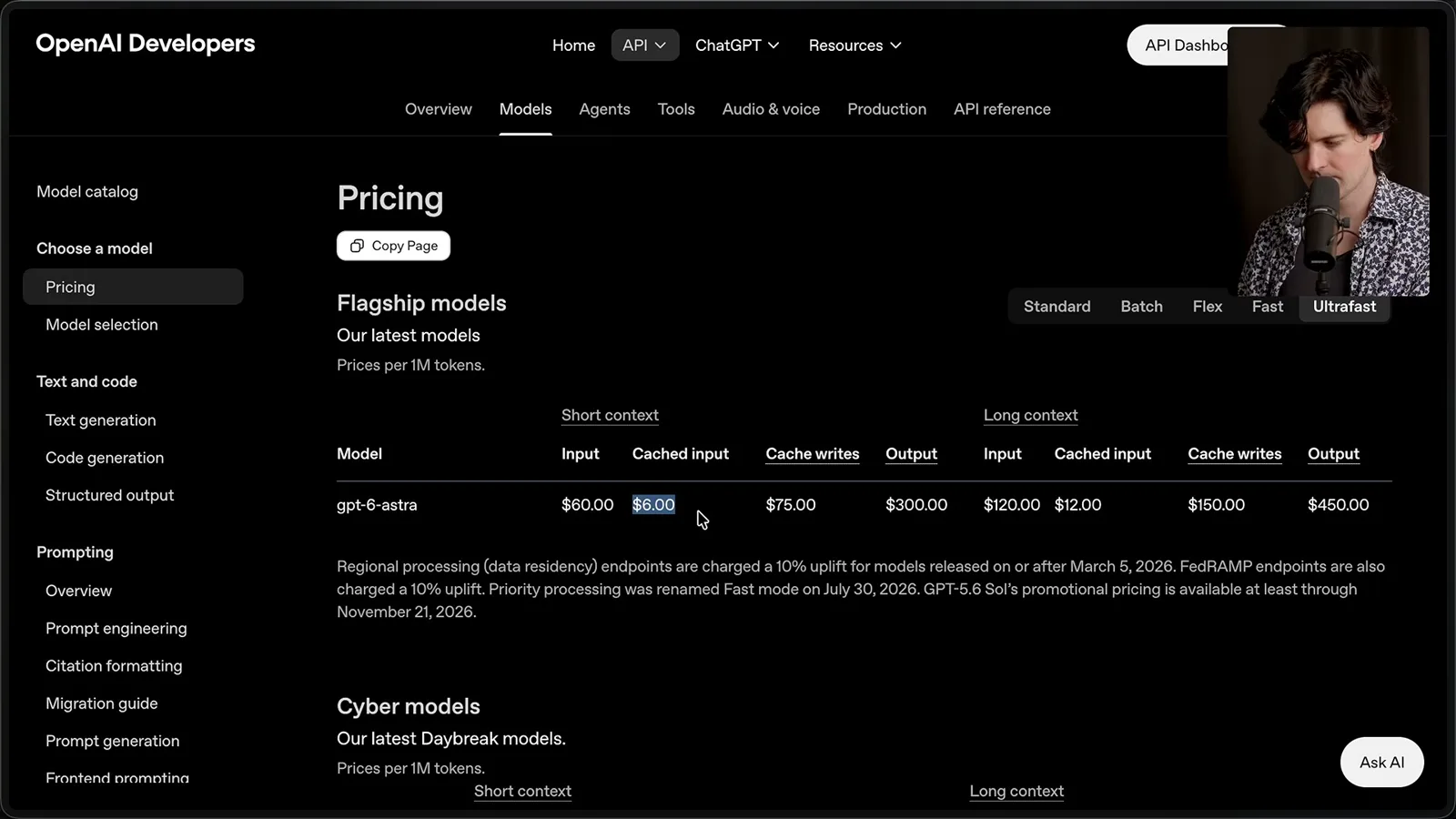
I initially speculate about the specialized infrastructure behind the speed, then correct myself during the video after learning Astra Ultrafast was using Nvidia rather than the Cerebras arrangement I had assumed. The infrastructure and margin explanations remain speculative rather than verified cost disclosures.
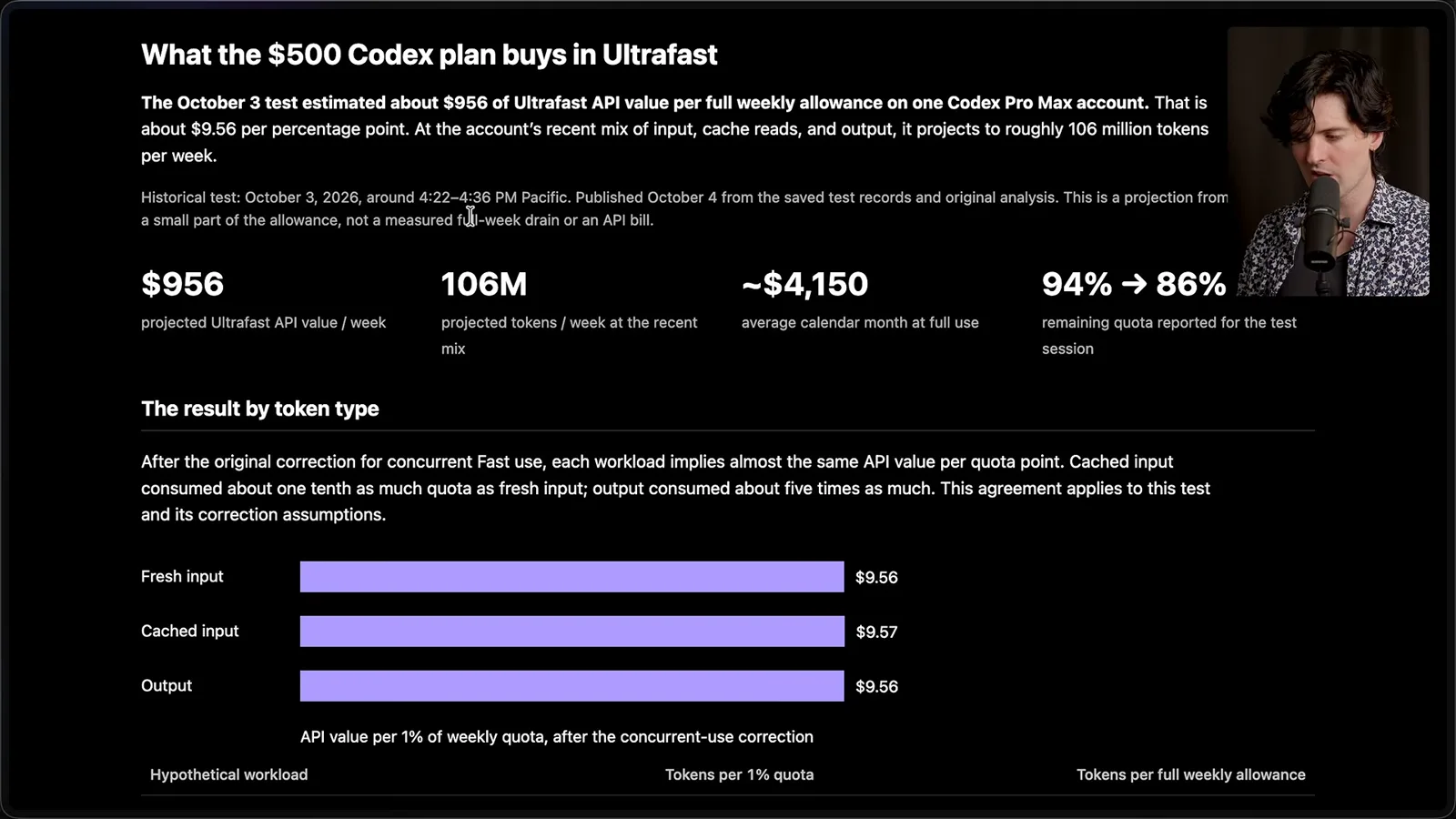
My estimate for a $500 plan is about $956 of Ultrafast API-equivalent value per full weekly allowance, projected from a small sample and an assumed token mix. I estimate that could correspond to about 2.1 hours of generation in my workload. The screenshot explicitly describes a projection, not a measured full-week drain or an API bill.
My complaint is the combination: a change in limits, a new premium tier and a very expensive speed mode arrived before users had a clear way to understand the tradeoffs. Someone upgrading primarily for Ultrafast could be surprised by how quickly their allowance disappears. The model mix matters as much as the subscription price.
For my own use, comparing $4,000 of projected monthly Ultrafast API value on the $500 plan with an earlier $12,000 estimate on the $200 plan feels like a step backward. But these figures reflect different modes, workloads and estimates; they are not a controlled comparison of identical work.
Choosing a plan for the work
Theo discusses his own Claude and Codex combination. He concludes that value depends on the model and work rather than the apparent discount alone.
If you buy the $200 plan mainly to use expensive Astra, I think the reduction hurts and I prefer Claude for my own coding work. If you can use Sol, the account can still provide substantial value. I use both: Claude often writes, while Codex reviews its work or handles email and computer-use tasks.
My prediction is that competition will continue to lower API prices and make subscription subsidy less visually dramatic. I hope models will complete more work for the same plan over time, but that is a forecast, not a promise. For now, judge the plan by the quality, speed and quantity of the work it helps you finish.
Sur la même chaîne
 36:07EN
 Theo - t3․gg· 27 oct. 2026Theo on Token Costs, Coding Agents, and the Price of AI CapabilityTheo Browne · Ping LabsA viral estimate of Lauren's AI spending prompts a closer look at cache pricing, benchmarks, and the changing work of coding agents.
 30:37ENTheo - t3․gg· 26 oct. 2026Theo’s Three Skills for Reviewing and Shipping with Coding AgentsTheo Browne · Ping LabsHow sol-loop, full-send and full-stop encode review, verification and different levels of merge authority.
 0:43ENTheo - t3․gg· 23 oct. 2026Theo Distinguishes Security Vulnerabilities from Active AttacksTheo Browne · Ping LabsA short explanation of why disclosed software flaws and reported attacks are different kinds of security news.
 29:22ENTheo - t3․gg· 22 oct. 2026Theo on Security Vulnerabilities, Stolen API Keys and AITheo Browne · Ping LabsA look at the gap between vulnerability disclosure and patching, and a speculative account of why stolen inference keys may be valuable.
 31:13ENTheo - t3․gg· 20 oct. 2026Theo on Why Smarter Models Help More Than DevelopersTheo Browne · Ping LabsFrom game modifications to compiler experiments, Theo revisits his assumptions about who benefits from more capable AI.
 31:47ENTheo - t3․gg· 18 oct. 2026Theo on Asking Agents for Outcomes and Building the Tools They NeedTheo Browne · Ping LabsA tool-call report, a troubleshooting playbook and connected data show how prompting can reshape product engineering.