En 30 secondes
Start with one agent, a clear task and a way to check its work; add agents only when the task can benefit from them, OpenAI’s Eric advises. He and Raj explain how Codex combines tool use, compaction and persistence, then describe parallel investigations and a compact work log to prevent goals drifting. Raj also reports on a much larger mathematics effort using teams with different approaches and a shared objective.
- 1The harness manages tools, execution and contextRaj describes the Responses API loop and the interaction between model training and harness design.
- 2Goals and compaction preserve work across turnsThe harness can keep an objective outside the context window and carry useful history forward.
- 3One agent is the default; parallelism has a costEric recommends delegation for work that can benefit from independent investigations.
- 4A compact work log helps prevent goal driftRecord the objective, active work and decisions as the user adds new instructions.
- 5Large teams need diverse approaches and communicationRaj reports on a mathematics effort that coordinated many teams toward one objective.
À retenir
- Start with one agent and add parallel help when the work justifies the extra cost.
- Give agents a clear objective and a way to check their results.
- Keep a compact log of goals, active work and decisions when steering a long task.
- Avoid elaborate coordination hierarchies that add delay without value.
Lire le texte remanié, chapitre par chapitre
From generated code to an acting agent
Raj describes tool use and the model-harness loop.
Raj from OpenAI’s Applied AI engineering team says agent design changes as models improve. He and developer experience engineer Eric trace the move from single loops to longer-running and multi-agent work.
Raj remembers asking early ChatGPT to write FizzBuzz, then copying the code into an editor and running it himself. The next shift was allowing a model to act on its reasoning through tools.
In an image-analysis example, a model could zoom in, inspect details and decide what to do next. Raj calls the sequence of action, feedback and planning an agentic loop.
Codex extends this idea with computer access. Its model and surrounding harness are designed together: the harness supplies tools and feedback, while training helps the model work with them.
The harness manages instructions, tools, execution and context. Raj says Codex favors a small set of general-purpose tools such as a shell, filesystem and computer use, so the model can work out how to approach a task.
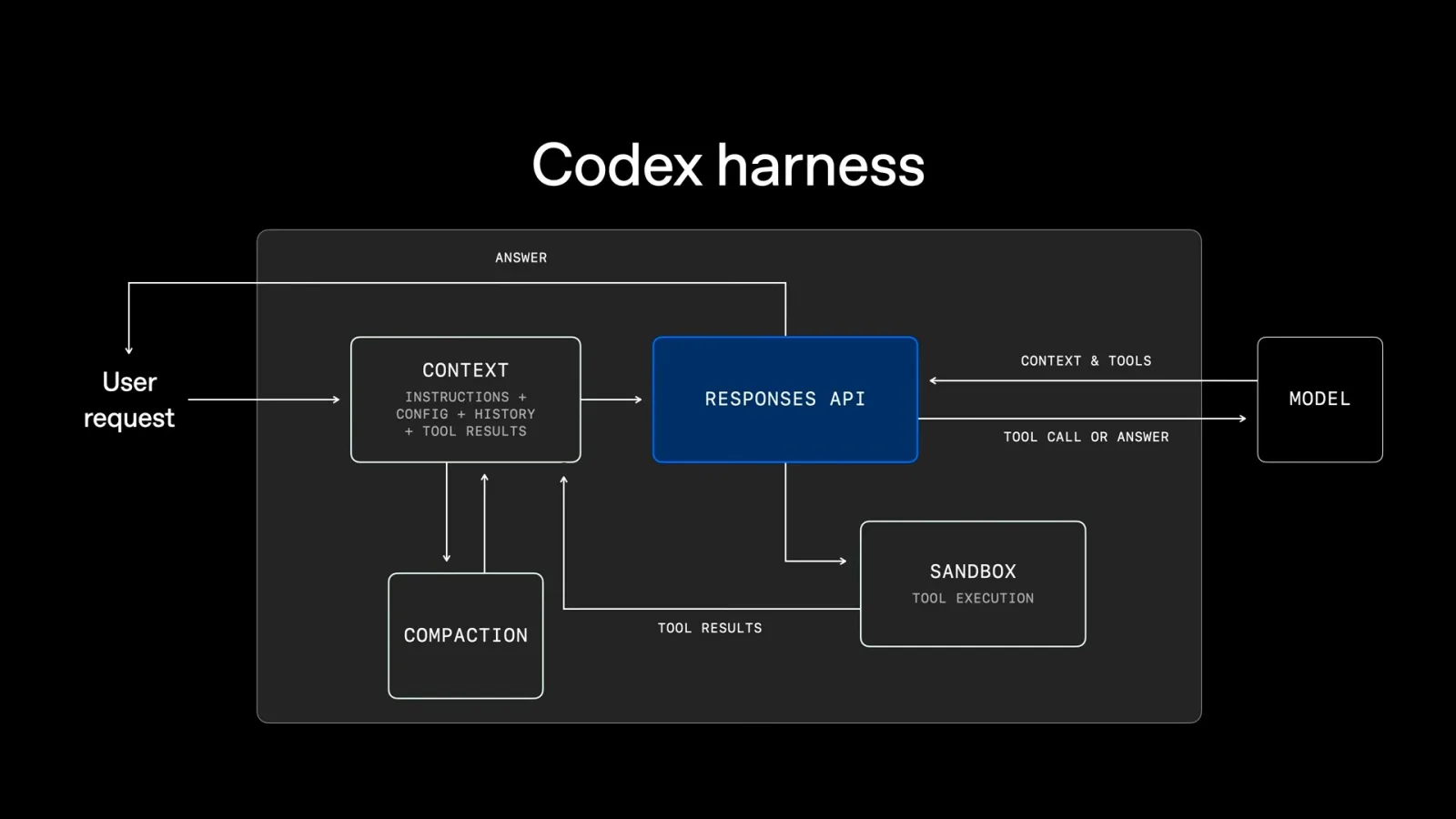
The Responses API carries context and tool definitions to the model; the harness executes requested tools in a sandbox and adds results to the conversation. Harness design and model training influence one another.
Keeping long tasks moving
Compaction, external goals and model training help work continue across context windows.
Long tasks fill the context window with instructions, files, tool calls and results. Compaction condenses the history so the agent can continue while retaining useful information.
Raj says Codex trains the model to understand compaction and resume from a compacted state. This allows work to continue across multiple context windows and compaction events.
Earlier models could make progress but stop before completing a task, so users repeatedly sent continue messages. Outer loops and Ralph-style loops automated repeated attempts, with files carrying state between runs.
Codex later added goals stored outside the conversation context. The harness tracks the objective and can continue after a turn ends, while stopping for a real blocker.
Raj says later training built more persistence into the model itself: it could identify useful steps and check its work without repeated continue prompts. Better coordination then made parallel work possible.
When multiple agents are useful
Eric advises starting with one agent and delegating where independent work warrants it.
Eric recommends starting most work with one agent, a clear task and a way to check the result. Add agents only when the task supplies a reason, because extra agents consume tokens without necessarily improving speed or quality.
Independent reviews or parallel investigations can justify delegation. Each subagent gets its own working context, but complex agent structures can also create coordination work without adding value.
Eric describes effort scaling: a primary model can ask a stronger model for help on a difficult failure and delegate simpler support work to smaller agents. He cautions that this does not guarantee lower cost.
For an old game port, he paired one agent capturing the running original with another unpacking and visualizing its scene in Blender. They needed to exchange findings because the output format affected the capture approach.
Coordinate chats without losing the goal
Separate work streams and a compact log can help, but elaborate hierarchies impose costs.
He distinguishes user-visible chats from subagents: a coordinating chat can manage other chats, each of which may use its own subagents. Users can open and steer individual chats.
For a long game project, separate chats could own art, programming and testing. Eric warns that elaborate approval hierarchies can slow agents down and create what he calls a middle-management tax.
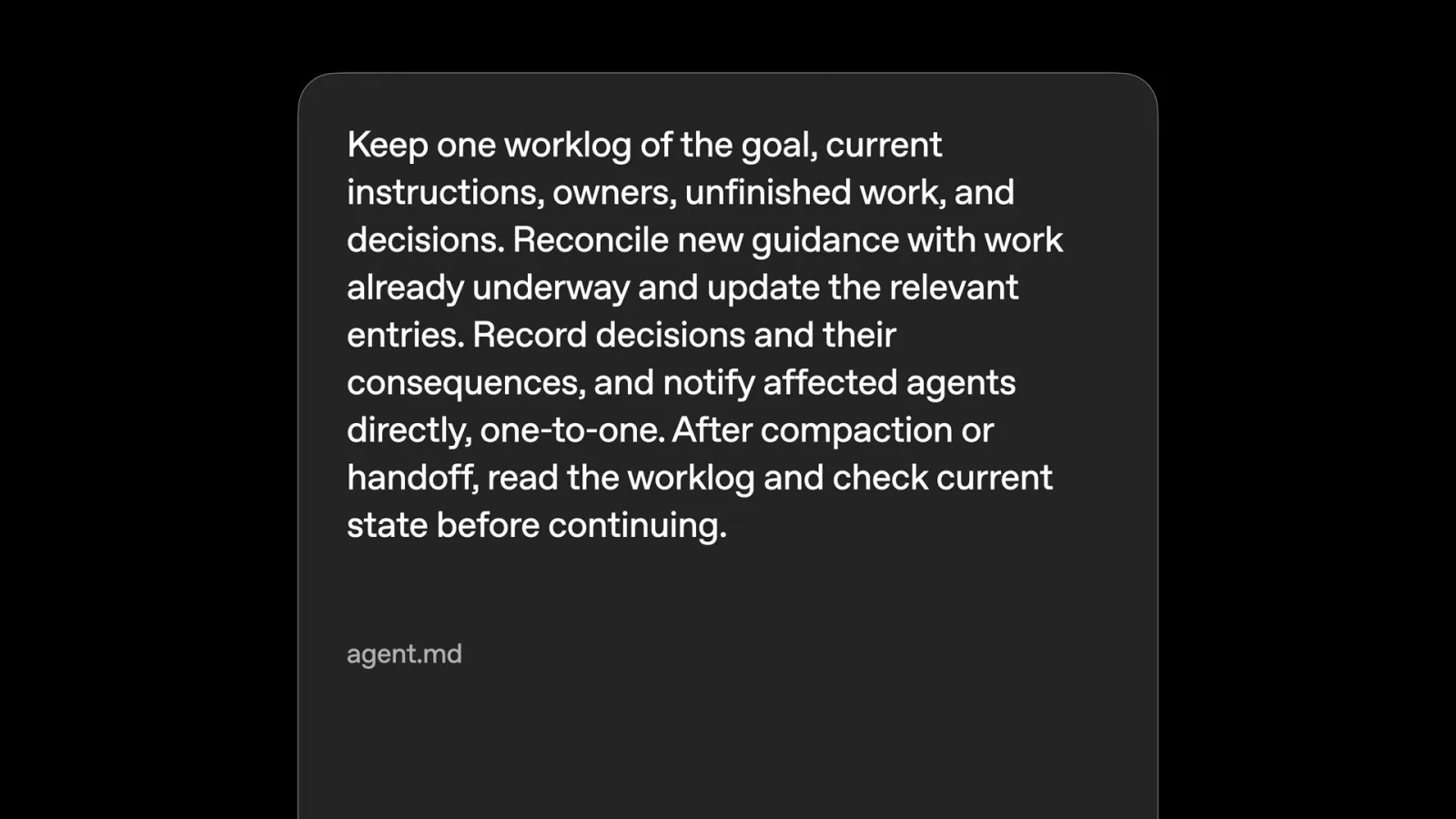
Frequent user steering can cause the original objective to drift after several compactions. Eric recommends a compact work log recording the goal, current work, ownership and decisions, rather than a diary of every failed test.
Coordinating larger agent teams
Raj describes teams exploring distinct mathematical approaches under a shared objective.
He cautions that best practices have a shelf life. Raj then discusses the challenges of coordinating agents at far larger scale.
Raj says an OpenAI mathematics effort used 10,000 agents, 2.7 million messages and about 130 billion output tokens. He describes teams pursuing different approaches to a shared objective and communicating findings across team boundaries.
Teams explored hypotheses, challenged assumptions and ran experiments. New teams were created or redirected as the work exposed promising questions, while the overall objective stayed fixed.
Raj reports that an internal model contributed to mathematical results and says more powerful models may allow more ambitious work. He encourages developers to revisit problems earlier models could not complete.
Sur la même chaîne
 27:44EN
 OpenAI· 11 nov. 2026Plugin extensions bring interactive tools into ChatGPTCorey, Max Neuber · OpenAIOpenAI describes discovery, sidebar and file entry points, event-driven automation and revised submissions.
 22:37ENOpenAI· 11 nov. 2026How GPT Live keeps speaking while an agent worksAlex, Erika · OpenAIOpenAI demonstrates simultaneous voice, background delegation and three ways to return updates.
 21:10ENOpenAI· 11 nov. 2026How OpenAI turned security findings into verified fixesIan, Kyle · OpenAIOpenAI engineers describe the scan, deduplication and patch verification loop behind Codex Security.
 19:44ENOpenAI· 11 nov. 2026What a managed agent harness has to do to keep workingCharlie, Steve · OpenAIOpenAI engineers explain remote sandboxes, long-running state and a human-approved flight rebooking demo.
 27:09ENOpenAI· 11 nov. 2026A six-week coding agent run and what it took to superviseOpenAI engineers describe a CI maintenance agent, long-running context and the cost of keeping it working.
 20:48ENOpenAI· 11 nov. 2026Sites adds personalized connectors and agent-friendly web appsKatia, John · OpenAIOpenAI demonstrates scheduled updates, per-user plugins and WebMCP in two Sites applications.