En 30 secondes
Matthew Berman reacts live to Anthropic’s announcement that it will use SpaceX’s Colossus 1 compute capacity and increase certain Claude Code and API limits. He discusses infrastructure demand, Elon Musk’s previous criticism of Anthropic, SpaceX’s Cursor partnership and new managed-agent features, then responds to audience questions. The broadcast is a contemporaneous analysis rather than a verified account of the parties’ private motives. The capacity was to become available within the month, not necessarily all on the announcement day. Berman discloses that he is an investor in Factory when comparing its Missions feature.
- 1The compute announcementAnthropic announced a SpaceX partnership and higher limits. The Colossus capacity was planned to ramp within the month.
- 2Usage limits versus capacityFive-hour Claude Code limits were doubled for specified plans and Opus API limits increased; these are distinct from a fixed token allotment.
- 3Orbital computing remains prospectiveThe companies expressed interest in exploring orbital AI compute; the stream presents no operational orbital deployment.
- 4Changing public rhetoricBerman contrasts Musk’s praise after meeting Anthropic staff with earlier criticism. His explanation of Musk’s motivations is speculation.
- 5Cursor’s separate dealCursor announced use of Colossus for training; SpaceX said it had an acquisition option or could pay for joint work.
- 6Managed agents and memoryThe stream examines orchestration, dreaming and outcomes, including company-reported benchmark improvements and Berman’s Factory investment disclosure.
À retenir
- Anthropic announced access to all Colossus 1 compute capacity, more than 300 MW and over 220,000 NVIDIA GPUs, to be deployed within the month.
- The announcement increased selected Claude Code five-hour limits and Opus API rate limits, while subscription and API terms remained distinct.
- Berman attributes his recent frustration with usage limits to compute constraints, but the deal’s effect on future service quality is a prediction.
- SpaceX and Cursor had announced a training partnership and an acquisition option; a $10 billion alternative was for joint work, not a confirmed breakup fee.
- Managed agents, dreaming and outcomes describe orchestration, memory refinement and rubric-based evaluation, not guaranteed autonomous model retraining.
- Berman discloses an investment in Factory while comparing its Missions feature with goal-oriented agent workflows.
Lire le texte remanié, chapitre par chapitre
Waiting screen and livestream introduction
The stream begins with a silent waiting screen before Berman greets viewers. He prepares to cover the Anthropic and SpaceX announcement.
The stream opens after a roughly five-minute waiting screen. Berman greets viewers, adjusts the audio and says he will record a video about a new Anthropic and SpaceX deal before continuing with other topics.
Anthropic’s compute agreement and limits
Berman reads the deal announcement and discusses subscription and API limits. He questions how and when the new capacity changes service.
Anthropic has announced a partnership with SpaceX for additional computing capacity. I think the agreement could ease a serious capacity constraint for Claude, although how much it changes the user experience over time remains to be seen. The two companies have also publicly disagreed in the past, which makes the partnership striking.
Berman contrasts Anthropic’s comparatively cautious investment in compute with OpenAI’s more aggressive commitments. He interprets the demand surge as a reason to expand capacity. Those descriptions are his assessment of corporate strategy, not a complete accounting of either company’s commitments.
I have been frustrated by changing Claude usage limits and what I consider insufficient transparency about the available quota. Anthropic says it is now increasing certain limits. My criticism is based on my experience as a subscriber; it should not be read as a precise account of every user’s allocation.
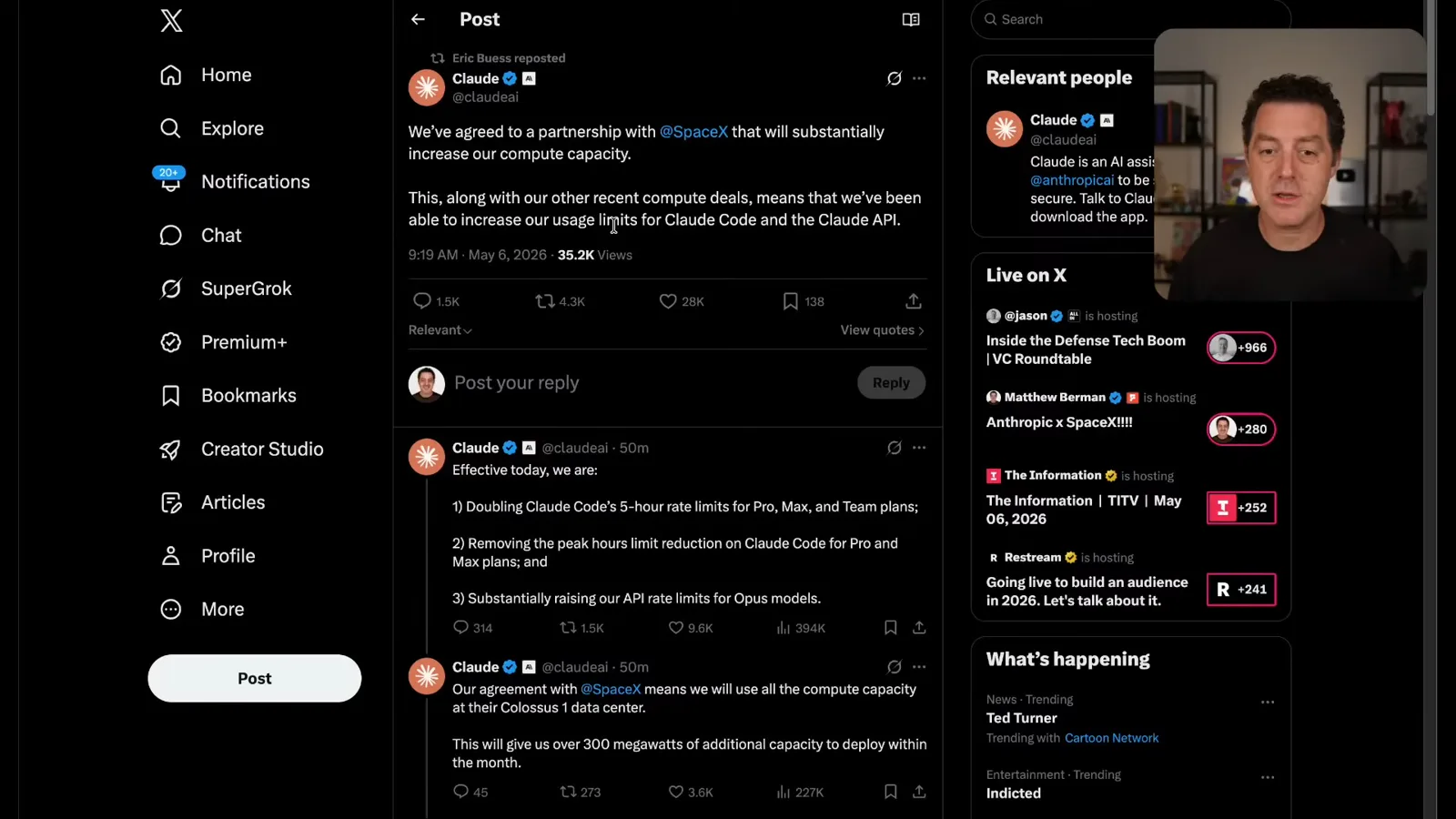
Anthropic says it agreed to use all the compute capacity at Colossus 1, providing over 300 megawatts and more than 220,000 NVIDIA GPUs. Its announcement says the new capacity is available within the month; Berman initially infers that all capacity must already be live, which the announcement does not establish.
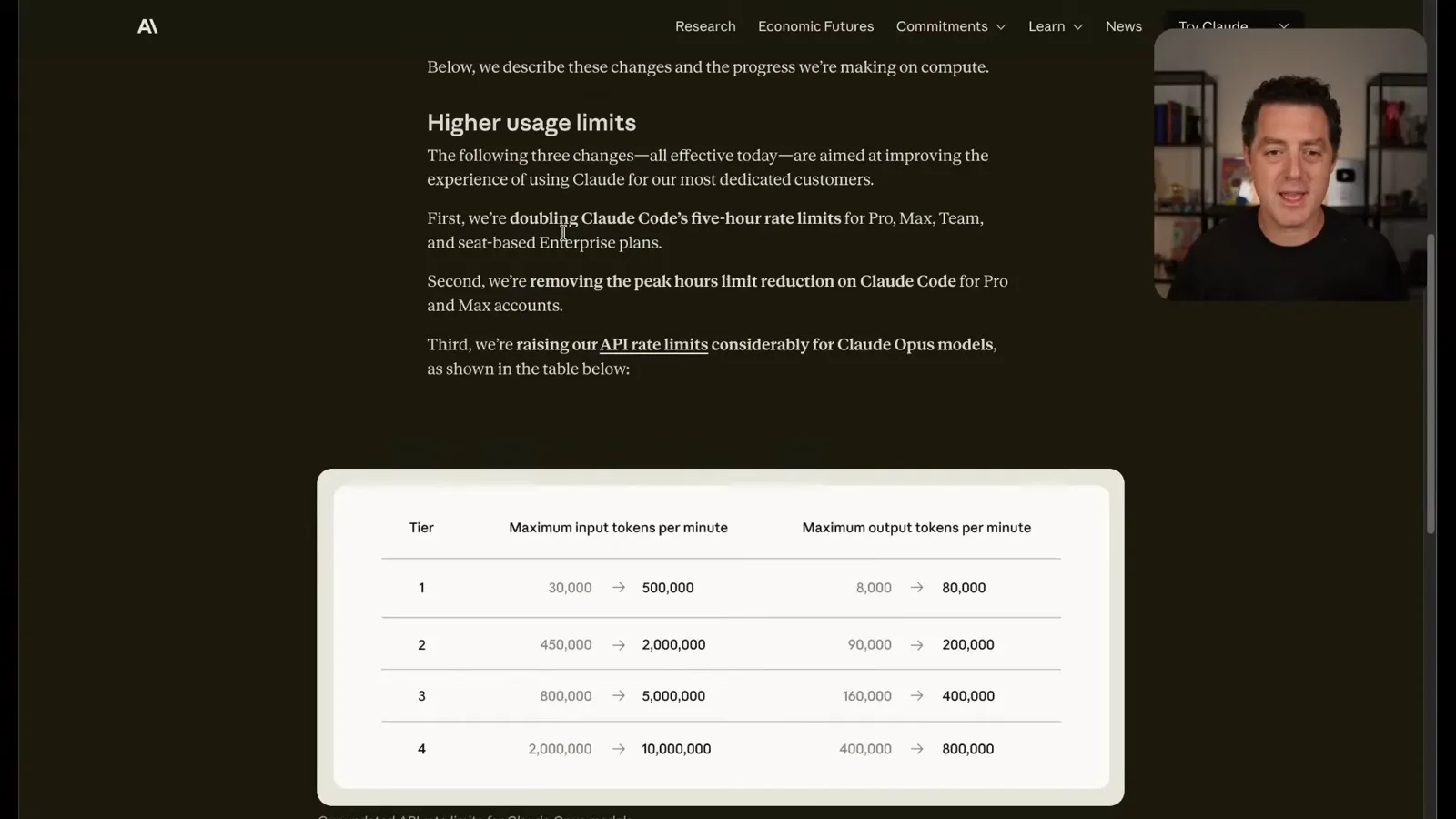
Effective May 6, Anthropic says it is doubling Claude Code’s five-hour rate limits for Pro, Max, Team and seat-based Enterprise plans, and removing the peak-hours reduction for Pro and Max. Berman welcomes the change but says the original allowance was not transparent enough to him. A doubled rate limit does not by itself define every other usage constraint.
Berman wonders how exclusive use of Colossus 1 fits with a separate SpaceX deal involving Cursor. He also questions the extent of previously idle capacity. The announcement gives an agreement and deployment timeline; the amount of unused compute before the deal is not independently established in the stream.
Anthropic also raised Opus API token-per-minute limits. The displayed table changes tier-one input from 30,000 to 500,000 per minute and tier four from 2 million to 10 million; API limits are distinct from subscription access and API usage is separately billed. Berman wants similar clarity on what subscription customers can use.
Asked about third-party tools, Berman distinguishes using Claude through an API key from using a Claude subscription through OpenClaw. His complaint concerns the latter restriction and the different economics of API use; the specific terms and product rules can change.
Berman believes demand for AI compute could exceed supply for years and sees chip suppliers as major beneficiaries. This is a prediction about a changing market, not a measured guarantee of future demand or company performance.
The broader compute market and orbital proposal
He examines other infrastructure deals, chip suppliers and regional capacity. He treats the stated orbital-compute interest as a prospective idea.
Anthropic lists other compute arrangements: up to 5 GW with Amazon, nearly 1 GW intended by the end of 2026, and a 5 GW Google and Broadcom agreement beginning to come online in 2027. These are announced plans and capacity commitments, not proof all of that infrastructure was already operating.
Berman recalls an interview with Google Cloud CEO Thomas Kurian about TPU capacity and contrasts it with public comments by Sundar Pichai about compute constraints. His interpretation is that providers are trying to serve both their own models and outside customers as demand grows.
Other commitments cited include Azure capacity under a Microsoft and NVIDIA partnership and an investment in infrastructure with Fluidstack. Berman asks whether the principal winners may be the companies making the underlying chips rather than the model providers.
Anthropic says it trains and runs Claude on AWS Trainium, Google TPUs and NVIDIA GPUs. Berman recalls discussing hardware portability with OpenAI’s Greg Brockman and wonders whether chips will become commoditized. Porting and optimizing large models can involve substantial software and systems work; interchangeability is not established by the anecdote.
The stream reads a SpaceXAI statement about supplying Colossus 1 capacity to Anthropic. It also says the parties expressed interest in developing multiple gigawatts of orbital AI compute. Interest is an exploratory statement, not an announcement that such an orbital system exists or is financed.
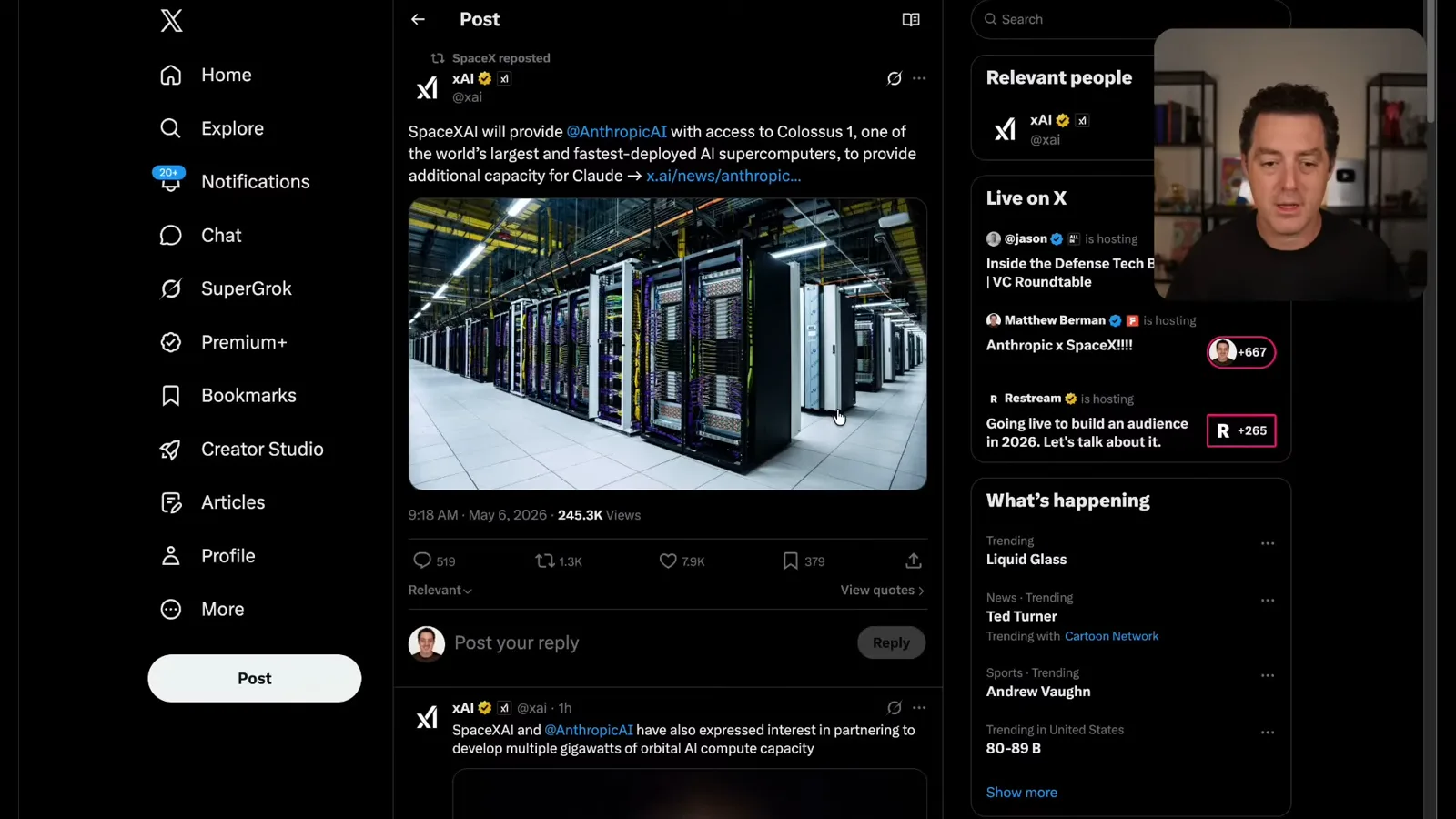
Berman notes disagreement in the industry about orbital data centers and seeks earlier posts by Elon Musk criticizing Anthropic and Dario Amodei. His interpretation is that the companies’ commercial deal sits alongside a history of public rivalry.
A viewer asks about Claude and OpenClaw. Berman clarifies that the API can be used with an API key in the viewer’s setup; he objects to not being able to use his subscription in the same way and prefers not to pay separate API rates. Availability and terms should be checked for the relevant product and date.
Musk, Anthropic and xAI’s strategy
Berman contrasts earlier public criticisms with Musk’s later positive comments. He speculates about the business relationship and xAI’s model development.
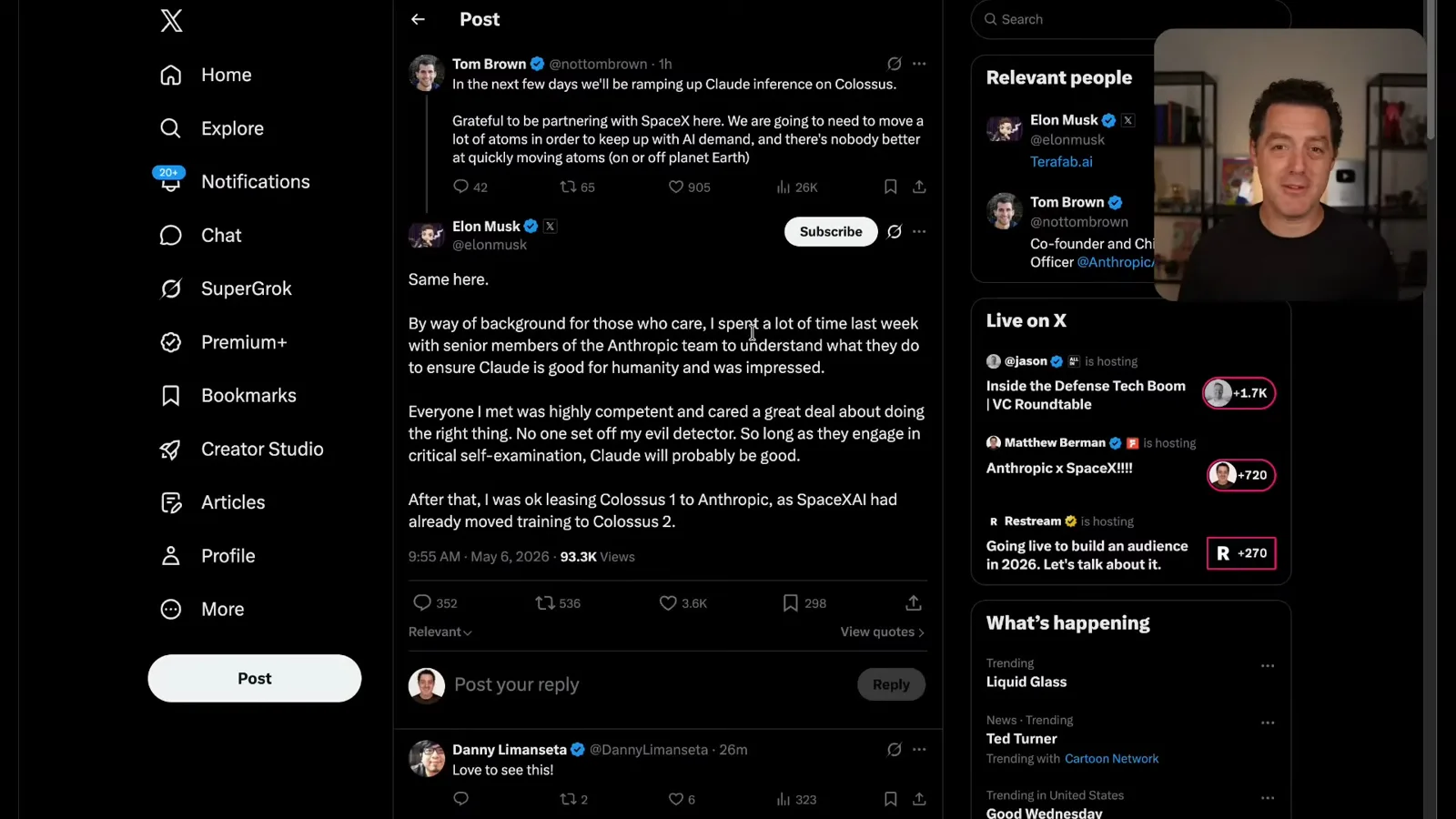
Anthropic co-founder Tom Brown says Claude inference will ramp on Colossus over the following days. Musk replies that he met senior Anthropic staff, found them competent and was comfortable leasing Colossus 1 after SpaceXAI moved training to Colossus 2. Berman views the change in tone skeptically.
Berman says he believes Anthropic staff genuinely intend to do the right thing, even while he criticizes the company’s policies. He reads Musk’s positive comments against earlier posts critical of Anthropic. Claims about the parties’ internal feelings or motivations remain Berman’s interpretation, not verified facts.
The stream reviews older Musk posts about Anthropic, including comments made during the company’s dispute with the US defense department. Berman finds the contrast with the new partnership notable. The existence of critical posts does not establish why a later commercial agreement was made.
Berman also displays a post alleging misuse of training data and referring to settlements. These are Musk’s allegations and comments, not a judicial finding established by the stream; copyright disputes and settlement terms require their own careful sourcing.
After revisiting the positive statement, Berman speculates that leasing the compute reflects an economic need to use capacity. He considers the deal beneficial to both sides: Anthropic gets more infrastructure and SpaceX receives a customer. The actual negotiating considerations and precise utilization are not established.
Berman reads Musk’s statement that xAI is being rebuilt from its foundations and relates it to his interpretation of Tesla’s transition toward neural-network driving systems. He reports an impressive personal drive using Tesla’s system. That anecdote does not establish comparative safety or autonomy; the driver remains responsible for supervised systems.
Commodities, energy and Cursor
Berman debates where value may accrue in the AI stack, then reviews Cursor’s separate SpaceX training agreement. He distinguishes the acquisition option from a completed acquisition.
I wonder whether a company with infrastructure necessarily needs its own frontier model if models become more interchangeable. I then ask the same question about chips and conclude that electricity may be a fundamental constraint. This is a thought experiment about where value could accumulate, not a conclusion that models or hardware are already commodities.
Berman speculates that Musk’s dispute with OpenAI might have influenced the Anthropic deal. He frames this as a possible motive, but does not have evidence of the private decision-making. A viewer argues that xAI still needs its own frontier model for physical systems and general intelligence.
Cursor’s April 21 announcement says it partnered with SpaceX to scale model training using Colossus infrastructure. Cursor describes successive Composer models and its compute bottleneck. Berman connects that agreement with the new Anthropic deal and asks how the available infrastructure will be divided.
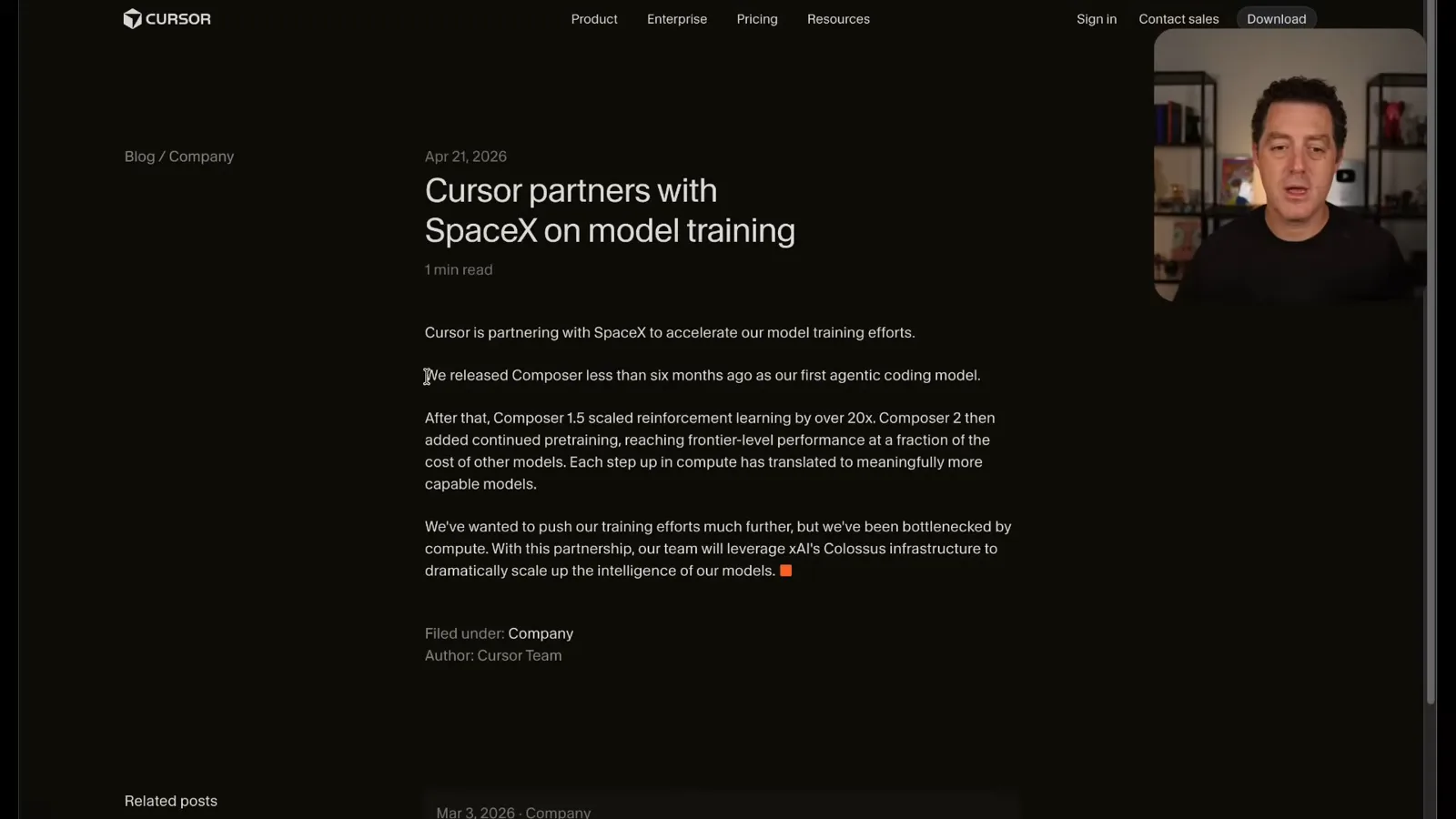
Berman speculates that Cursor may use Colossus 2 alongside xAI, while Anthropic takes Colossus 1; the Cursor announcement does not specify that allocation. SpaceX had said it held an option to acquire Cursor for $60 billion later in 2026 or pay $10 billion for work together. The alternative payment should not be assumed to be a conventional breakup fee.
A viewer suggests that Cursor’s coding data could benefit future models, and Berman agrees. The stream does not establish what private customer data could be used or shared; such use depends on applicable agreements, settings and permissions. Berman also debates whether physical AI and more general model capabilities are both needed.
Managed agents, dreaming and outcomes
He reviews Claude Managed Agents announcements on parallel orchestration, memory and rubric-based evaluation. He discloses an investment in Factory.
After wrapping up the main deal discussion, Berman turns to Code with Claude announcements. Managed-agent orchestration lets a lead agent delegate work to specialists in parallel. He sees potential benefits in quality and cost when a stronger model plans and other agents perform subtasks, although savings depend on the workload.
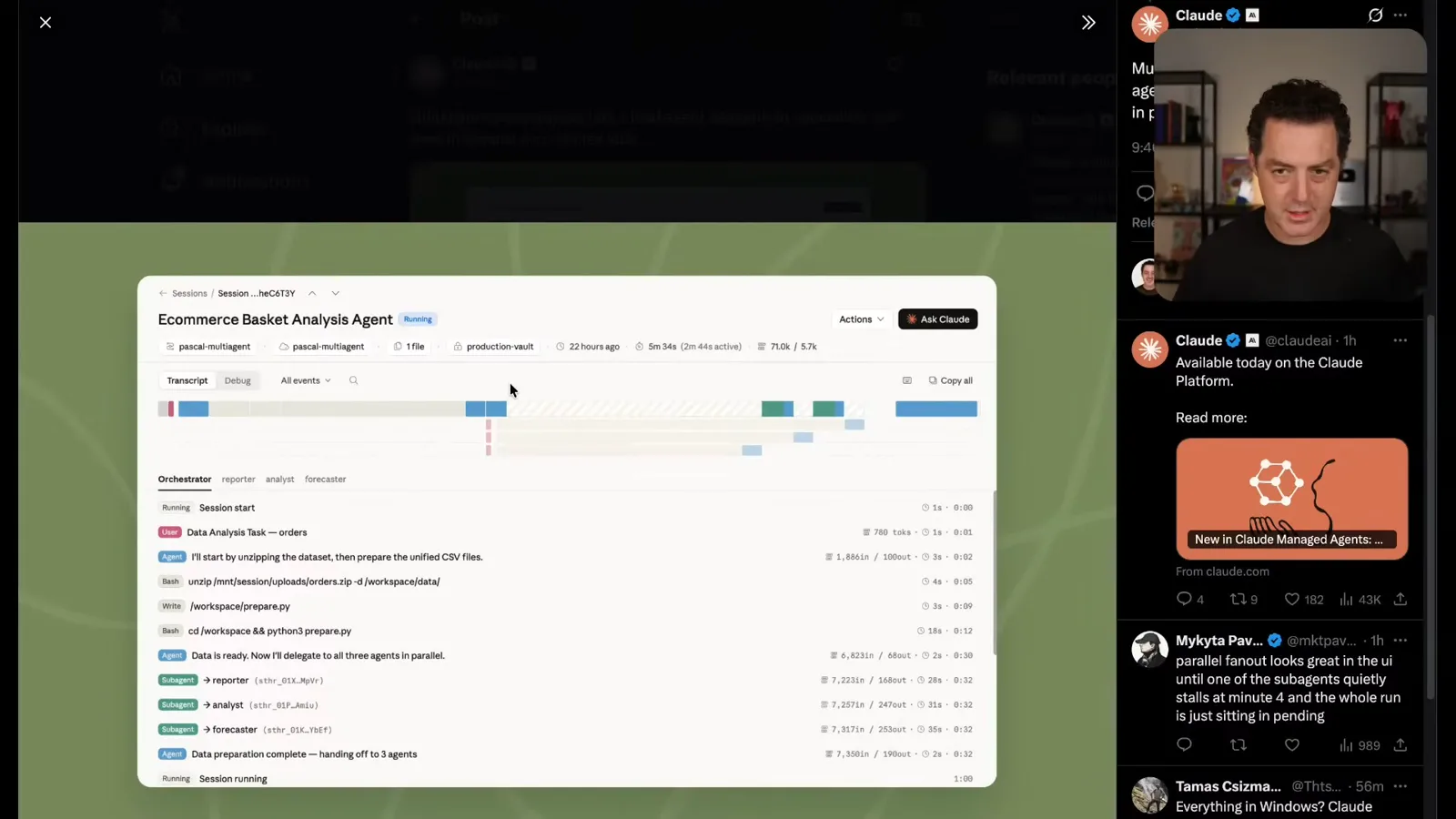
The announced dreaming feature reviews prior sessions to surface patterns and refine memory. Berman relates it to sleep-time compute and recalls discussing a similar idea with Peter Steinberger. Refining an agent’s stored memory or workflow is not the same as independently retraining the underlying model weights.
Berman speculates that shifting work to periods of lower demand might reduce cost. Actual GPU utilization and electricity prices depend on the location, time and provider; the stream does not demonstrate those savings. He credits the Letta team and its earlier sleep-time-compute work as an influence on the discussion.
According to the product description, dreaming can identify recurring mistakes, shared preferences and convergent workflows, then restructure memory for longer-running and multi-agent work. Berman notices the example requires a user to start the process and wonders whether it could run automatically.
Asked about open source, Berman says he remains supportive and hopes for a stronger US open-source strategy. He distinguishes that position from his past criticism of DeepSeek.
The outcomes feature asks users to describe success in a rubric. A separate evaluator checks the output against those criteria and the agent can revise it. Berman compares this with OpenAI goals and Factory Missions and discloses that he is an investor in Factory; he later acknowledges earlier loop approaches may also be relevant.
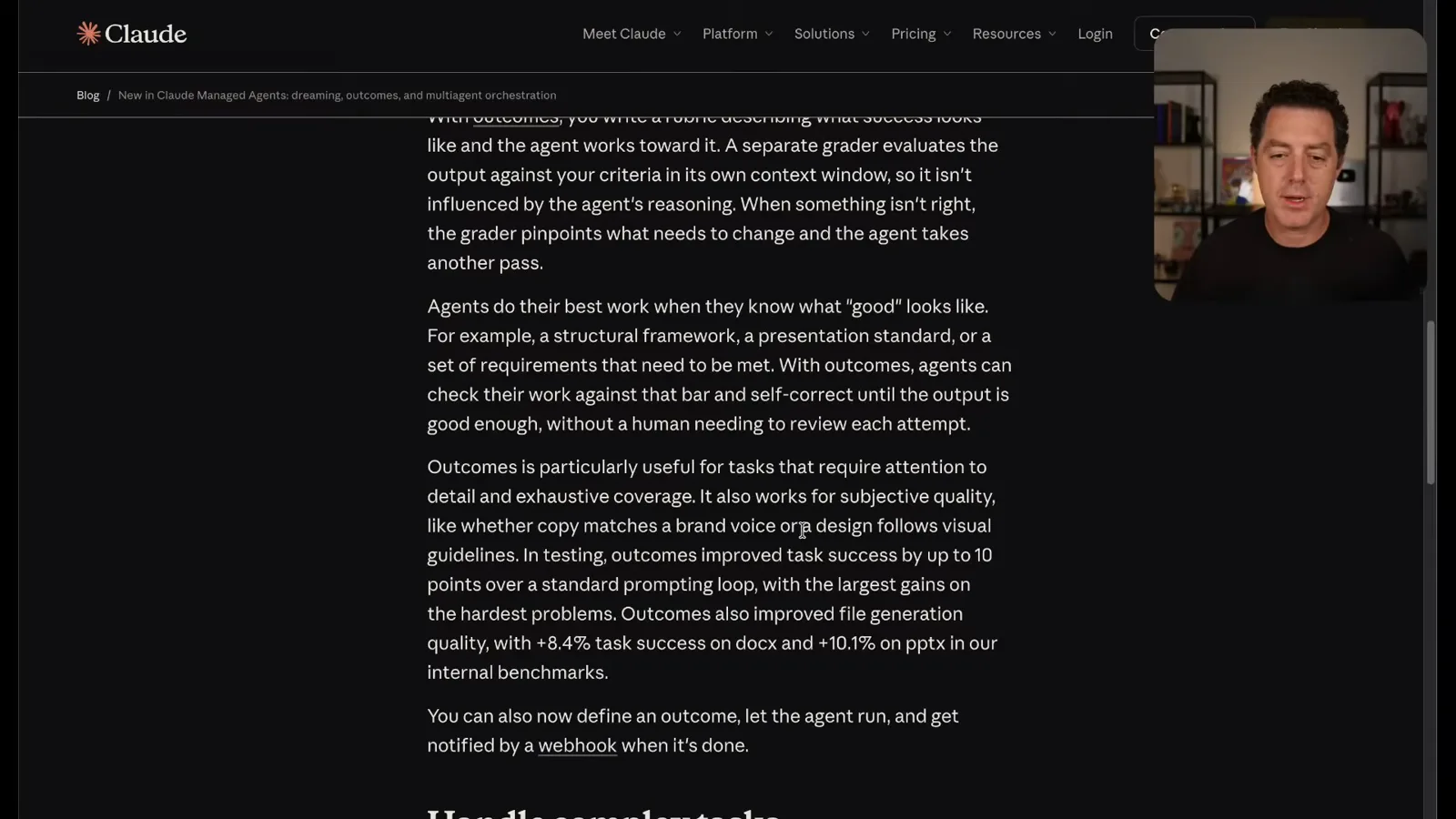
Anthropic reports that outcomes improved success by up to ten points over a standard prompting loop in its testing, with reported gains for document and slide generation in internal benchmarks. Those are company-reported results for particular tests, not a guaranteed improvement for every task.
Audience questions and closing
Berman discusses audiences, open models, other AI companies and a viewer’s question about the Titans paper. He closes the livestream.
Berman compares audience engagement across platforms, speculating that Anthropic’s audience is concentrated among industry insiders while ChatGPT is better known to the general public. Viewer counts and engagement can vary, so the observation is not a controlled audience study.
In audience questions, Berman points to his previously shared OpenClaw instruction files and says he does not have much verified information about the private work of Ilya Sutskever’s and Mira Murati’s companies. He declines to invent details about their products or plans.
A viewer raises the Titans paper and describes a memory mechanism involving learned parameters rather than simply stacking context in a key-value cache. Berman finds the idea interesting but does not develop a technical evaluation. He closes by inviting feedback and directing viewers to the community and a newly released video.
Sur la même chaîne
 34:21EN
 Matthew Berman· 27 oct. 2026Matthew Berman Examines Anthropic’s IPO Filing, AI Growth and GovernanceMatthew Berman, Sam Altman · Forward FutureThe presenter reviews the S-1’s financial metrics, compute strategy and voting structure while questioning the tension between rapid AI development and safety.
 0:26ENMatthew Berman· 25 oct. 2026Sam Altman on Human Values and Problem-Solving in an AI WorldSam Altman · OpenAIIn a short interview excerpt, Altman considers the enjoyment of solving hard problems and the human role in interpreting results.
 0:36ENMatthew Berman· 25 oct. 2026Kimi K3.1 and a Rubik’s Cube Solver DemonstrationMatthew Berman · Forward FutureMatthew Berman shows a scrambled virtual cube being solved and gives the Kimi K3.1 test a favorable assessment.
 0:21ENMatthew Berman· 24 oct. 2026An AI-Generated Kimi Benchmark Chart Used Invented ScoresMatthew Berman · Forward FutureMatthew Berman asks for a graph of Kimi K3.1 Pro benchmarks, then discovers that the displayed figures are illustrative placeholders.
 25:50ENMatthew Berman· 24 oct. 2026Kimi K3.1 Pro Tested: Strong 3D Demos, Uneven Results and Competitive PricingMatthew Berman · Forward FutureMatthew Berman tests the open-weight model on coding, 3D rendering and visual explanations, then compares benchmark results and prices.
 32:20ENMatthew Berman· 23 oct. 2026Who Is Local AI For? The Costs, Trade-offs and a Hybrid FutureMatthew Berman · Forward FutureMatthew Berman weighs data control and independence against hardware cost, setup complexity and inference speed.