En 30 secondes
Matthew Berman argues that AI can make code cheaper while companies still need engineers, because lower costs may open up new uses for software. He points to Indeed data as evidence of rising software jobs. Job postings are not hires, and the available data depends on the period and market measured; the proposed causal link remains a hypothesis.
- 1More code, cheaper productionBerman says more code is being written and contrasts forecasts of AI replacing engineers with his view that engineers remain needed. His record-output assertion and the forecast are not established by the short.
- 2A rebound argumentHe suggests lower costs can increase demand and prompt companies to pursue new uses for software. The video illustrates this idea with a Jevons paradox diagram.
- 3What postings can showBerman invokes Indeed data for rising software jobs, but the short does not identify the series or timeframe. Postings measure advertised demand, not completed hires or total employment.
À retenir
- Berman argues that cheaper software development can make previously uneconomic projects worthwhile.
- An increase in demand for software does not automatically imply an increase in employment for every type of engineer.
- Indeed's US software development postings were 0.8% higher year over year through January 23, 2026, but 31.8% below February 2020.
- Later Indeed research reported a rebound concentrated in senior and AI-related roles, while cautioning that correlation does not prove AI caused it.
Lire le texte remanié, chapitre par chapitre
Cheaper software and demand for engineers
Berman argues that lower coding costs may expand demand for software and points to Indeed job data. The economic mechanism and the observed labor-market trend require separate evidence.
We are writing more lines of code than ever, I argue, even as people predict that software engineering jobs will disappear and AI will write almost every line by the end of the year. I think engineers are still needed, and point to a reported uptick in hiring as code becomes cheaper. Neither the record-output claim nor the forecast is substantiated in this short.
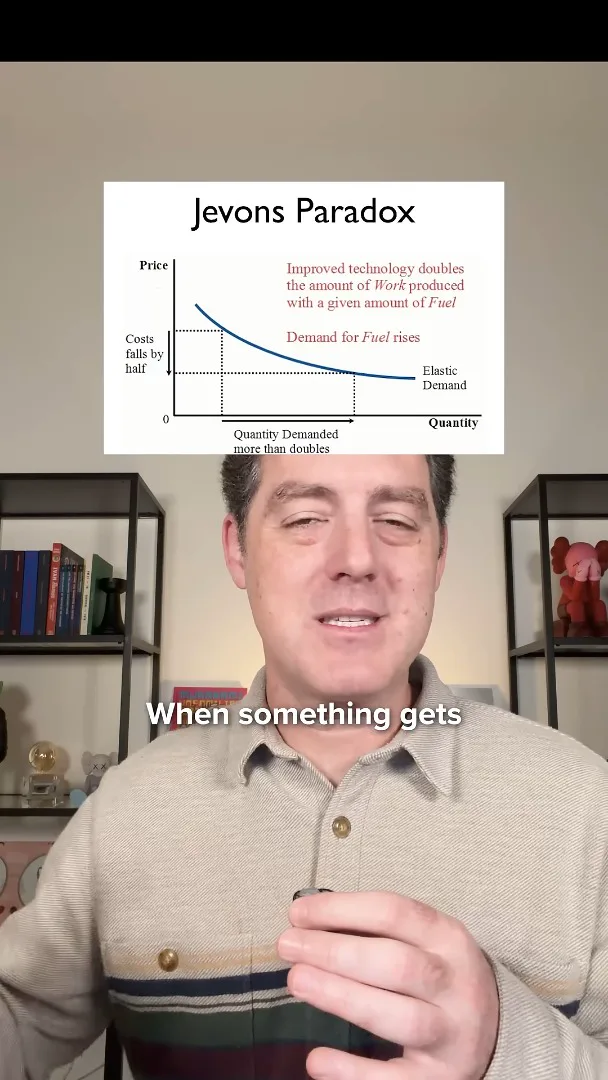
When something that was previously constrained becomes cheaper, demand for it can rise. My argument is that cheaper, more efficient software creation encourages companies to consider new applications they would not have pursued before. The displayed Jevons paradox diagram illustrates a rebound in resource demand; whether software demand translates into more engineering jobs is an empirical question.
I say Indeed data shows software engineering jobs increasing, but the short does not specify a series, location or comparison period. For context, [Indeed's US tech update](https://d341ezm4iqaae0.cloudfront.net/hiringlaborg/2026/02/20105029/HiringLab-Tech_Q4_1.pdf) reported software development postings up 0.8% year over year through January 23, 2026, but down 31.8% from February 2020. A [later July report](https://hiringlab.indeed.com/2026/07/08/ai-and-job-postings-from-destruction-to-creation/) found a rebound concentrated in senior and AI-related roles and cautioned that correlation is not causation. Postings do not directly measure hires or total employment.
Sur la même chaîne
 34:21EN
 Matthew Berman· 27 oct. 2026Matthew Berman Examines Anthropic’s IPO Filing, AI Growth and GovernanceMatthew Berman, Sam Altman · Forward FutureThe presenter reviews the S-1’s financial metrics, compute strategy and voting structure while questioning the tension between rapid AI development and safety.
 0:26ENMatthew Berman· 25 oct. 2026Sam Altman on Human Values and Problem-Solving in an AI WorldSam Altman · OpenAIIn a short interview excerpt, Altman considers the enjoyment of solving hard problems and the human role in interpreting results.
 0:36ENMatthew Berman· 25 oct. 2026Kimi K3.1 and a Rubik’s Cube Solver DemonstrationMatthew Berman · Forward FutureMatthew Berman shows a scrambled virtual cube being solved and gives the Kimi K3.1 test a favorable assessment.
 0:21ENMatthew Berman· 24 oct. 2026An AI-Generated Kimi Benchmark Chart Used Invented ScoresMatthew Berman · Forward FutureMatthew Berman asks for a graph of Kimi K3.1 Pro benchmarks, then discovers that the displayed figures are illustrative placeholders.
 25:50ENMatthew Berman· 24 oct. 2026Kimi K3.1 Pro Tested: Strong 3D Demos, Uneven Results and Competitive PricingMatthew Berman · Forward FutureMatthew Berman tests the open-weight model on coding, 3D rendering and visual explanations, then compares benchmark results and prices.
 32:20ENMatthew Berman· 23 oct. 2026Who Is Local AI For? The Costs, Trade-offs and a Hybrid FutureMatthew Berman · Forward FutureMatthew Berman weighs data control and independence against hardware cost, setup complexity and inference speed.