En 30 secondes
Matthew Berman explains how decompilation, asset swaps, bridges between games and recreated mechanics can produce game mashups. He describes his own unfinished Super Mario World project and draws broader conclusions about software, mathematical research and recursive improvement. He argues that human taste and audience connection will matter more as digital creation becomes easier; his sweeping predictions are presented as opinions rather than established results.
- 1Working backward from machine codeCompilation can remove names and comments, so a reconstruction may behave similarly without matching the original source.
- 2A game project in progressBerman describes an AI-assisted Super Mario World recreation that had been running for over four days.
- 3Bridging two gamesA pass-through mod can keep both engines running and synchronize cameras and events.
- 4Goals and verificationHe sees iterative checks as a common pattern across coding and mathematical exploration.
- 5Human tasteHe argues that knowing what resonates with an audience remains important as creation gets easier.
À retenir
- Decompilation works backward from machine code and does not necessarily recover the original source.
- Game mashups can use visual swaps, bridges between running games, recreated mechanics or a rebuilt implementation.
- AI coding loops rely on goals and verification, but a working demo does not establish complete equivalence.
- Berman argues that services, creativity and audience connection become more valuable as code becomes easier to produce.
Lire le texte remanié, chapitre par chapitre
Decompilation and AI coding
Berman explains compilation and the limits of recovering original source. He describes AI-assisted iteration and his own game project.
AI coding is getting good enough, in my view, to change how people recreate and combine software. Game mashups put characters or mechanics into different worlds, while a Photoshop-like application has been recreated and released for free. I will explain several approaches and show a game project of my own.
Source code is written for people to read and edit; a compiler translates it into machine code for a computer to execute. Decompilation works backward from the executable toward a readable implementation. Historically, teams of fans have spent years on projects such as Super Smash Bros. Melee.
The work involves inferring what a piece of machine code does, writing a candidate implementation and checking its behavior. For example, one might recreate the code that makes Mario jump, compare the result with the original and revise it when it differs.
Working backward does not necessarily recover the original source. Compilation can discard comments and names and rearrange operations. A source expression such as 2 + 3 may become a simple return value of 5. A reconstruction can reproduce behavior without restoring the exact original text.
I see this as a natural fit for AI because it combines code with a repeatable verification loop. A model can propose an implementation, check it and iterate. Splitting work across multiple agents can also shorten elapsed time, although the quality of the result still depends on the checks and the task.
I discuss Chris Lewis’s Snowboard Kids work as an example of the changing timelines: a long-running human effort followed by an AI-assisted attempt completed in 84 days. The reconstructed code need not be identical for the game to look and feel the same; that observation is about the examples discussed, not proof of equivalence for every reconstruction.
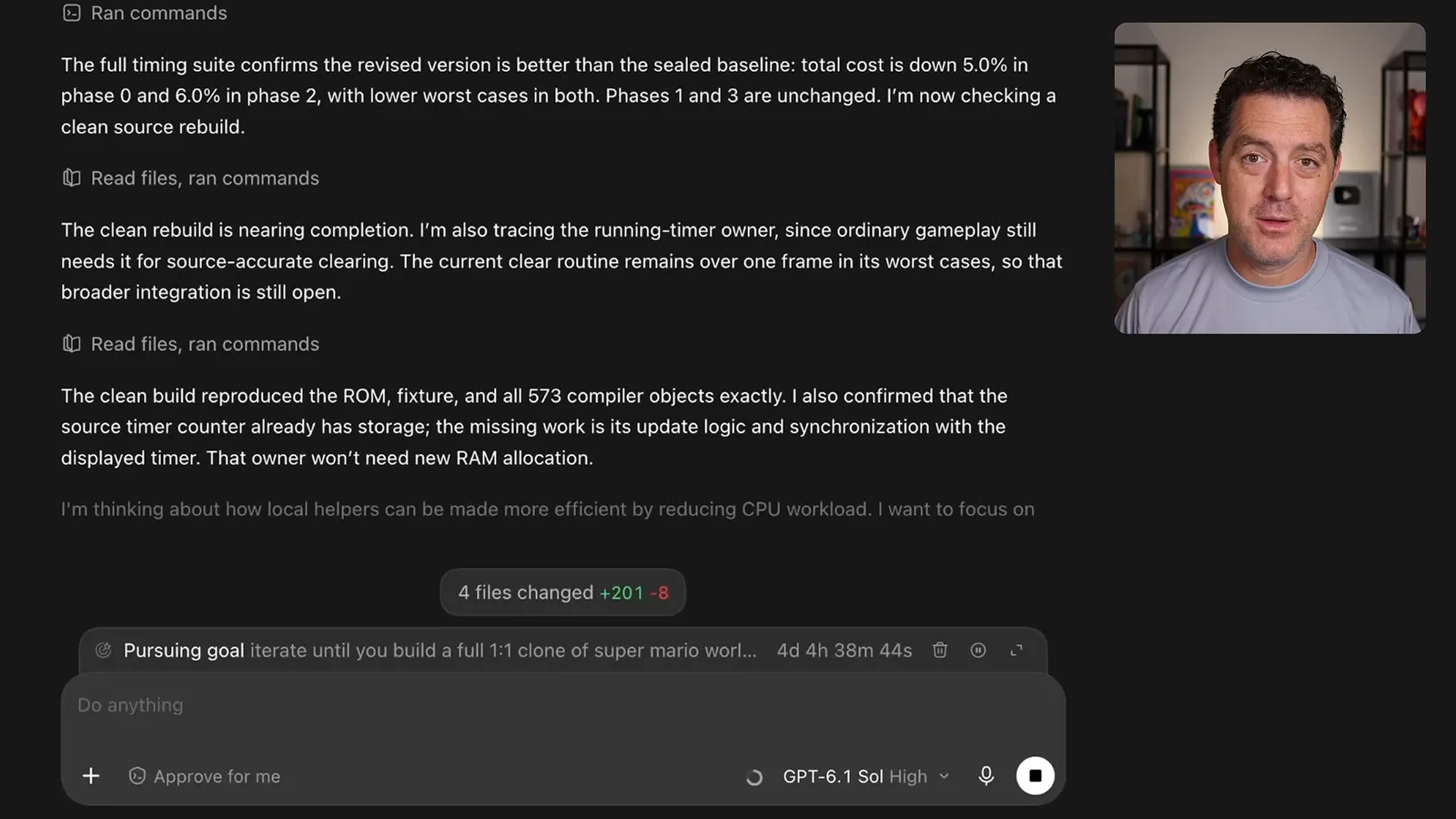
My own project is recreating Super Mario World for a ModRetro handheld. I asked GPT-6.1 Sol to build it from scratch, using online documentation and repeated checks against the original. It had been running for more than four days at the time of the video. I describe this as close to, but not necessarily the same as, decompilation.
How game mashups work
He compares asset swaps, bridges, transferred mechanics and rebuilding game behavior. Each approach offers a different level of control.
There are several ways to make a game mashup. The simplest swaps visual assets: a character may look like Spider-Man while retaining the original character’s behavior. It is similar to changing a skin, rather than bringing a whole new set of mechanics into the game.
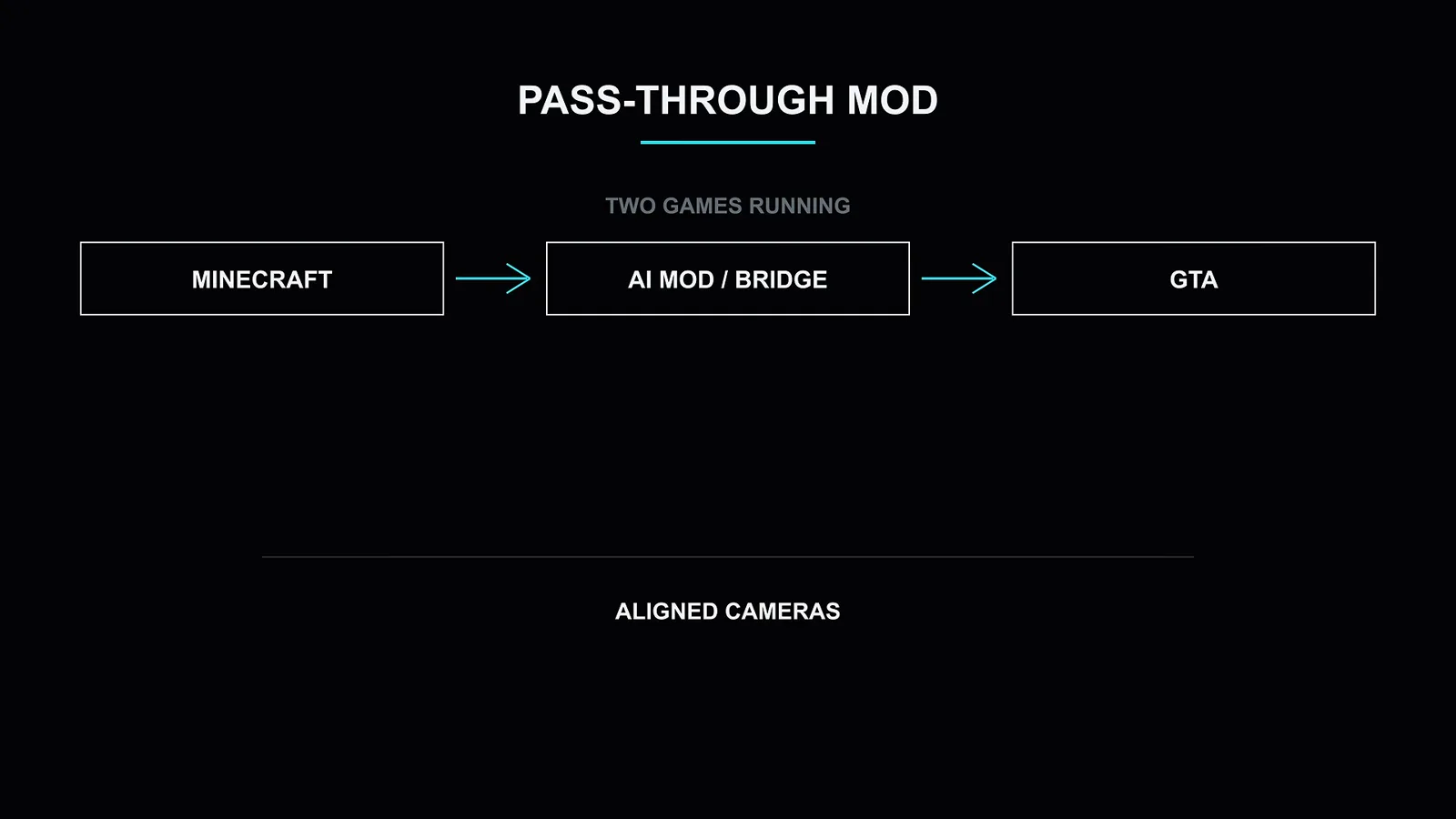
A pass-through mod keeps two games running and connects them. In the Minecraft and GTA example, one engine handles blocks and creatures while a bridge aligns cameras, combines the output and passes events between games. An explosion in one world can trigger an explosion at the corresponding location in the other.
Another approach transfers a mechanic, such as parkour or skateboarding, to a different game. The developer must make acceleration, jumping and collisions work in the destination engine. Sometimes code can be adapted; other times the behavior is observed and recreated without access to its source.
The most intensive approach rebuilds the rules and software needed to run a game. Studying the original and implementing the needed behavior gives the creator more control over a mashup, but takes more work. I expect AI tools to make more of these experiments possible.
Software, mathematics and feedback loops
Berman considers software recreation and AI-assisted research. His broad predictions go beyond what a single demo establishes.
I extend the idea to other software. Berman describes a project called PhotoCraft that recreated a Photoshop-like application, and recalls asking AI to inspect Excel and recreate some behavior. In such a process the model observes actions and outcomes instead of reading the original source. A demonstration of selected behavior does not establish complete feature parity.
My view is that software alone will become a weaker business moat as recreation gets cheaper. Companies can still offer training, enterprise features, support, maintenance and updates. These services and relationships may matter more when producing code is less difficult.
The common thread is an iterative loop: give an agent a goal and a way to check progress, then let it continue. I see a parallel with mathematical research, where a system can explore candidate paths and test arguments. A verifiable goal is useful, although determining the right checks and establishing a correct result remain important.
I point to OpenAI’s recent mathematical research and a third-party list categorizing recent discoveries. I interpret the examples as a sign of rapid change in AI-assisted mathematics. My broader claim that math or software is ‘solved’ is a prediction about this trajectory, not proof that every open problem or software task has been solved.
Recursive improvement and creativity
He discusses potential feedback in AI development and argues that human taste matters in an abundance of generated work.
I extend the loop idea to recursive self-improvement: an AI might help find ways to make its own operation faster, cheaper or more capable, and then use the improvements in later work. I see the possibility of rapid compounding but acknowledge uncertainty about its implications and the need to keep systems aligned.
I mention Google’s AlphaEvolve as an example of AI helping optimize underlying systems. The larger point is that improvements to tools and infrastructure can feed back into future work; the scale and impact of any specific claimed savings would need its own evidence.
As digital creation becomes easier, I think taste and creativity matter more. Producing many images or games does not by itself reveal which will resonate with people. A compelling new character, story or game still requires choices about what is meaningful and fun.
Someone can copy a successful idea and make many variants, but remixing has long been part of art and music. In a world with far more derivatives, I expect work that connects with an audience to become more valuable as a signal amid the noise.
Sur la même chaîne
 25:50EN
 32:20EN
 45:08EN
 12:14EN
 10:36EN
 21:29EN