En 30 secondes
In unstable conditions, the useful planning horizon can shrink: DJ Patil illustrates that with a double pendulum and weather forecasts. Upwork’s Hayden Brown advocates setting a direction and adapting rather than following a fixed route, while Watch Duty’s John Mills says speed must not outrun accuracy in public safety. Dara and William Treseder protect their essential “glass balls” and deliberately let less essential commitments wait.
- 1The useful forecasting horizon changes with the situationPatil compares a double pendulum with weather forecasts that can be reliable weeks ahead in one situation and only hours ahead in another.
- 2Keep judgment even when you cannot keep up with every toolKumra manages AI agents but says their outputs still require human clarity and responsibility.
- 3Set a direction and revise the route as conditions changeBrown says Upwork is trying to restore startup-like agility while measuring progress and adapting its plans.
- 4In public safety, fast enough must still be accurateMills says his team uses AI to assist people interpreting signals, not to broadcast unverified information.
- 5Protect the glass balls and let some rubber balls dropThe Treseders distinguish essential family commitments from activities that can wait and revisit priorities together.
- 6Not everything demanding attention deserves your energyDara Treseder describes using values and a longer time horizon to decide where to focus.
À retenir
- Adjust planning to how far ahead the situation can actually be forecast.
- Separate speed from haste when accuracy is essential.
- Identify the commitments you cannot afford to drop and revisit them as circumstances change.
- Use AI to assist judgment, while keeping responsibility for the output.
- Ask whether technology strengthens or weakens your relationships, Thurston suggests.
Lire le texte remanié, chapitre par chapitre
Chaos and the limits of forecasting
Patil uses a double pendulum and weather to explain changing forecast horizons and the value of multiple plans.
Bob Safian gathers leaders to discuss how to work and live amid rapid change. He revisits his idea of “Generation Flux,” asking about planning, skill building, speed, attention and priorities.
DJ Patil demonstrates a double pendulum: one pendulum attached to another. The device follows mathematical rules, but small differences in starting conditions can lead to very different later movements, illustrating sensitive dependence in chaos theory.
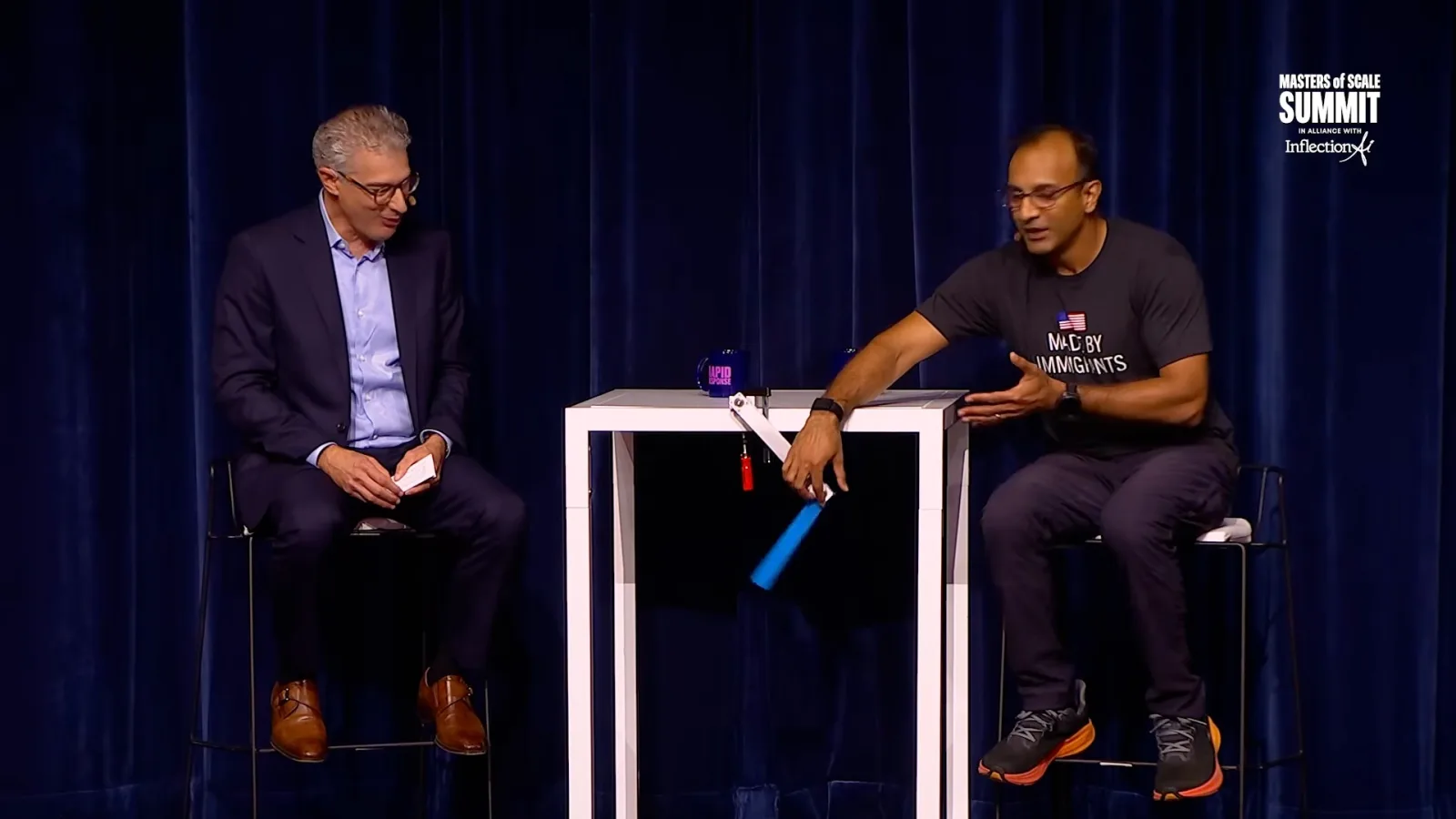
Patil compares forecasting to weather: sometimes useful predictions extend weeks ahead, while at other times the reliable horizon is only hours. He suggests asking how far ahead a situation can be forecast, rather than simply calling it chaotic.
A former military colleague told Patil that opportunity can emerge from chaos. His response is to prepare multiple plans and use available tools, including AI, to help process information and consider alternatives.
AI agents, judgment and adaptable planning
Kumra describes managing agents; Brown says leaders need a direction and the agility to revise the route.
Raina Kumra says she is tired of carrying an ever-growing personal toolkit as technology changes. She now manages a team of 12 AI agents with different roles, although she finds that some have poor judgment despite their technical abilities.
Kumra tells people worried about falling behind that there is no way to keep up with everything. She suggests staying calm, learning what is needed and retaining responsibility for judgment and the quality of what is published.
Upwork CEO Hayden Brown says detailed fixed roadmaps have become harder to sustain. She advocates acting like a pioneer: choose a direction, learn and iterate daily, measure progress and revisit the horizon as conditions change.
Brown says Upwork has tried to recover some of its early startup agility while remaining a public company. Its internal “crystal ball” tool lets employees query governed business data; she says work that once took analyst teams weeks can now take a person hours.
Technology, attention and public safety
Thurston evaluates tools by their effect on relationships. Mills distinguishes useful speed from dangerous haste.
Writer Baratunde Thurston leads the audience in a breath and reflects on speed. He wants to use technology without adopting a pace that disconnects him from life, even though he enjoys technology and does not want to opt out entirely.
Thurston asks whether a tool helps or hinders his relationship with himself, other people and the living world. If it substitutes for those relationships, he tries to pause, look up and reconnect.
Watch Duty CEO John Mills distinguishes speed from haste in public safety. He compares his work to surgery: accuracy matters more than setting a speed record, and updates within minutes can meet a need without sacrificing precision for seconds.
Mills says his team uses AI to help people sift through signals and reduce fatigue, while humans interpret the results. Broadcasting every signal without context, he warns, could confuse training exercises with real emergencies and put people at risk.
Patil returns to the pendulum and says chaotic periods can also contain intervals of calm. He urges the audience to resist cynicism, find room for composure and take action.
Protecting family priorities
Dara and William Treseder describe essential commitments, shared communication and measures of family trust.
Safian asks Dara Treseder and William Treseder how they balance demanding careers, two children and their marriage. Dara says they do not keep every obligation aloft: they distinguish “glass balls” they cannot afford to drop from “rubber balls” they can temporarily let go.
For the couple, marriage, their children’s well-being, health and family finances are glass balls. Other valued activities may be delayed; William says they keep talking about whether a priority has changed and decide who takes the lead on each essential task.
They also share a journal. Dara says they read one another’s entries without immediate criticism, then can discuss what they have read later.
William describes a family whiteboard with goals that help their children see progress, such as a pull-up challenge and typing speed. He says the purpose is to build confidence and show that practice can move a person toward a goal.
Dara describes a family version of a satisfaction measure: whether the couple still choose each other and whether their children feel safe, loved and able to call their parents when something goes wrong. She sees trust and respect as things parents continue to earn.
William says the family discusses a hierarchy of commitments including faith, family, service and work. His possible re-enlistment in the Marines is a live family conversation, including with the children.
Dara says her faith anchors decisions even when acting on her values is inconvenient. She also asks what deserves her energy over a meaningful period, since not everything that demands attention deserves equal effort.
William says Dara makes explicit promises to their children and works to keep them despite travel and a demanding job. He describes that reliability as a source of safety for the family.
Safian closes by noting that the panel began using the double pendulum as a kind of timer. He encourages the audience to turn uncertain conditions into something they can work with rather than expecting change to slow down.
Sur la même chaîne
 25:32EN
 Masters of Scale· 5 nov. 2026Podcast · 2 voixDemis Hassabis warns against AI self-improvement without human reviewInvité : Demis Hassabis · Anime : Reid HoffmanThe Google DeepMind co-founder calls for stronger engineering, shared safety standards and broader debate about AI consciousness.
 18:26ENMasters of Scale· 4 nov. 2026Podcast · 3 voixRana el Kaliouby leaves her dating spreadsheet behindInvité : Rana el Kaliouby, Francesca Hogi · Anime : Jeff BermanAn AI scientist and a matchmaker discuss how to seek connection intentionally without reducing people to a checklist.