En 30 secondes
In January 2025, Matthew Berman discusses Mark Zuckerberg’s prediction that Meta would develop AI capable of work resembling a mid-level software engineer. Zuckerberg also expects AI to augment people and says the effects on employment are uncertain. Berman is optimistic about productivity and entrepreneurship but acknowledges a difficult transition. He contrasts that outlook with a contemporaneous report quoting Salesforce CEO Marc Benioff on plans for engineering and sales hiring; the productivity figure and future employment outcomes remain claims and predictions.
- 1A forecast for AI engineeringZuckerberg says Meta may have AI capable of mid-level engineering work in 2025. Berman extrapolates toward software increasingly written on demand by agents.
- 2Augmentation and reviewZuckerberg suggests AI engineers will augment people; Berman asks how generated code will be reviewed when human reviewers could become a bottleneck.
- 3Jobs and historical analogyZuckerberg says employment effects are uncertain but predicts more creative work and fewer required hours, citing the long decline in agricultural employment.
- 4Salesforce’s reported hiring planBerman cites a December 2024 report quoting Marc Benioff’s 2025 plans and his claim of a greater-than-30% engineering productivity increase.
- 5Preparing for a changing fieldBerman encourages developers to experiment with AI tools and predicts that smaller teams could tackle more problems.
À retenir
- Zuckerberg predicted in early 2025 that Meta might develop AI capable of mid-level engineering work; this was a prediction, not evidence the capability had already arrived.
- Zuckerberg expected AI to augment human creativity but acknowledged it was too early to know the employment outcome.
- Berman expects greater productivity and new opportunities, while recognizing potential layoffs and a difficult transition.
- Benioff said Salesforce planned not to add software engineers in 2025 and claimed over 30% engineering productivity improvement from AI; the measure is a company claim.
- A hiring plan, an executive forecast and the long-term effect on jobs are different kinds of evidence.
Lire le texte remanié, chapitre par chapitre
AI engineers and software on demand
Berman introduces Zuckerberg’s 2025 prediction and offers his own speculation about agent-generated code and interfaces. Zuckerberg says AI engineers may initially be expensive and later augment human workers.
In a January 2025 interview with Joe Rogan, Meta CEO Mark Zuckerberg predicts that Meta will probably have AI capable of performing work like a mid-level engineer during 2025. This is a forecast, not a demonstration that such a system already exists. I see it as part of a larger shift in both what software is and how it gets built.
Meta has considerable resources to invest in AI, and I think the workforce could change rapidly. Looking beyond 2025, I speculate that AI will eventually write much of the software we use. The timing, scale and employment consequences are uncertain, even if the technology improves quickly.
I wonder whether code will remain in familiar forms or be generated when needed. My tentative picture is that databases still provide a source of truth, while agents create tools, interact with those databases and generate interfaces for a particular request. That would change what we mean by an application; it is a possible future, not an established deployment.
In the interview clip, Zuckerberg says AI engineering may initially be expensive, become more efficient and eventually produce much of the code in Meta’s apps and AI systems. He expects this to augment people and free them to pursue more creative work. His statements express an anticipated trajectory, not a measured present-day outcome.
That raises a review problem. If AI writes increasing volumes of code, will people be able to understand and review all of it, or will AI systems review some of it too? Human reviewers could become a bottleneck, and teams may need new systems for testing and oversight.
I share Zuckerberg’s optimistic view that AI can complement people and make them more productive. More output does not automatically tell us how many workers a company will employ, however, and the effect can vary across roles and organizations.
Employment, creativity and productivity
In the interview clip Zuckerberg says the employment effects remain uncertain and offers an optimistic historical analogy. Berman agrees with the productivity outlook while warning that the transition could be disruptive.
Rogan raises the concern that AI could eliminate jobs. Zuckerberg says it is too early to know exactly how things will play out, but guesses that the technology may create more opportunities for creative work. He compares the potential transition with the long decline in the share of people working in agriculture.
Zuckerberg suggests that agricultural productivity allowed more people to pursue cultural, creative and other work or leisure. He predicts that the share of people doing work strictly required for survival could continue to shrink, while people who are deeply engaged in their work could accomplish more with technology.
I agree with the broad optimism and ask what happens if a software engineer can produce far more software. My expectation is that much of the additional capacity will be used to build more. Lower costs can make previously uneconomic uses worthwhile and increase demand, although the actual response differs across markets.
The transition will not necessarily be smooth. I expect layoffs and a period of friction as companies and workers adjust. Productivity gains alone do not settle whether particular people will retain their jobs or whether new opportunities will appear quickly enough for everyone affected.
Salesforce hiring plans and the transition
Berman reviews a contemporaneous report about Salesforce’s plans and Benioff’s productivity claim. He notes that companies can increase productivity while changing staffing plans.
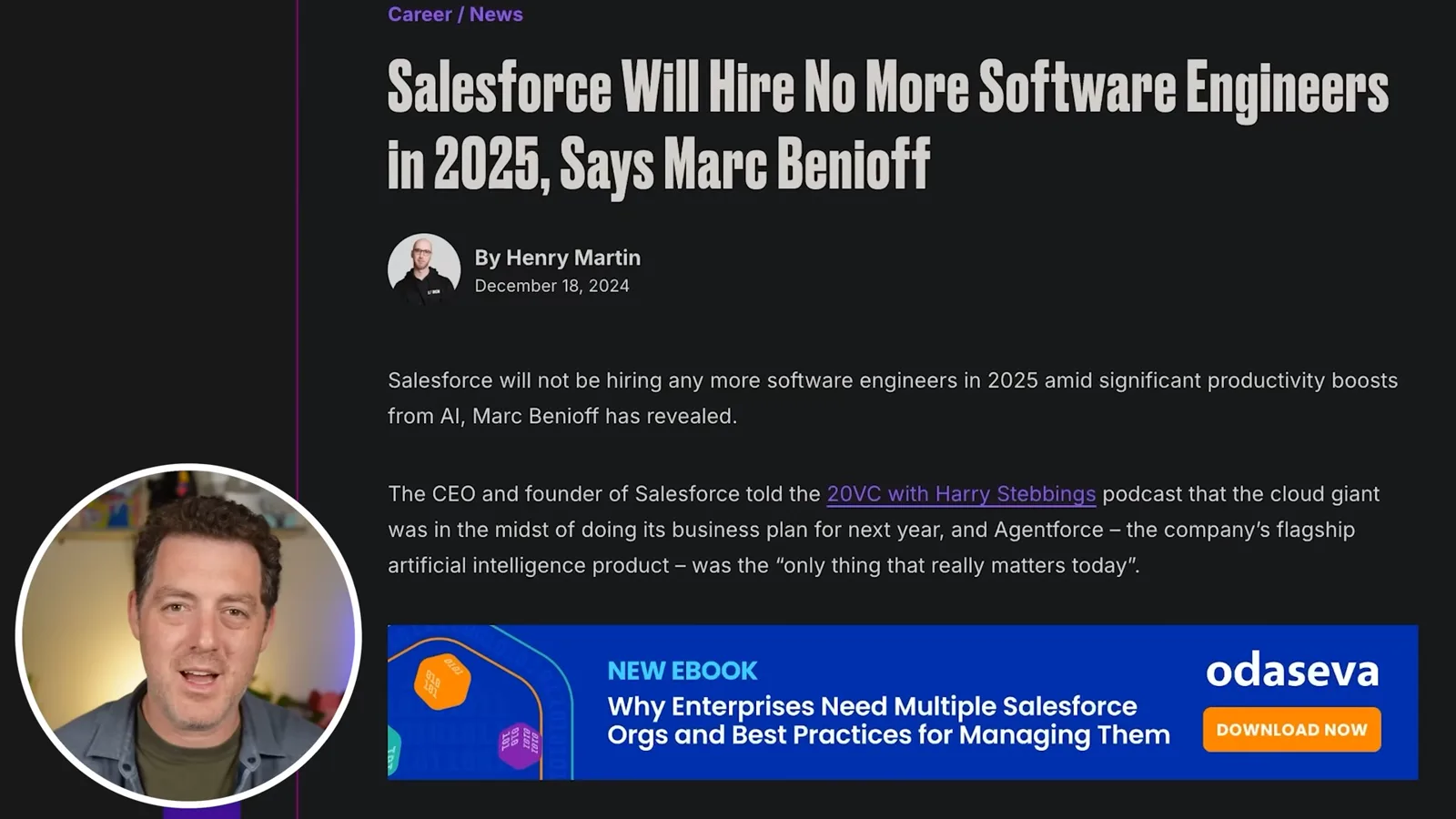
As a counterpoint, I cite a December 2024 report quoting Salesforce CEO Marc Benioff on the company’s 2025 plans. He said Salesforce was not adding more software engineers the following year and attributed an engineering productivity increase of more than 30% to Agentforce and other AI technology. That percentage is his company’s claim, and a hiring plan is not the same as a verified outcome.
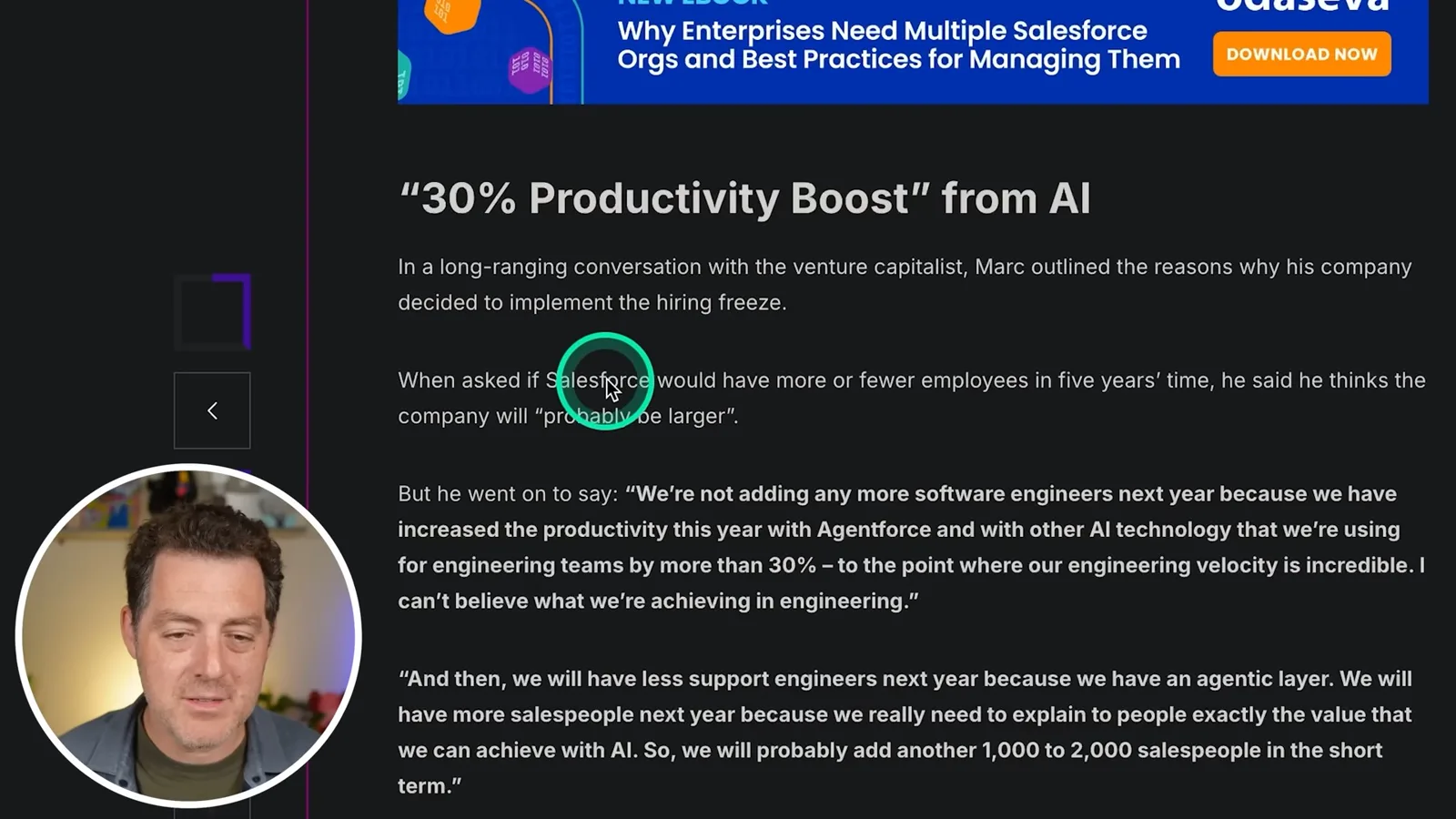
The same account says Benioff expected fewer support engineers while potentially adding 1,000 to 2,000 salespeople to explain and sell AI services. I am skeptical of the marketing incentives around the claims, but the contrast is revealing: the company was discussing reduced demand in some roles alongside expansion in others.
Experimenting with AI tools
Berman urges software engineers to try AI tools. He closes with predictions about small teams and entrepreneurship.
Software is changing, and I encourage engineers to experiment with tools such as Cursor and Pythagora. I expect smaller teams to solve more long-tail problems, although that is a prediction rather than a guarantee. I also mention Sam Altman’s prediction of a billion-dollar one-person company enabled by AI.
The possibility that AI gives small teams more leverage is particularly exciting to me as someone interested in entrepreneurship. I hope it helps people start companies and solve useful problems. That optimistic scenario does not remove the uncertainty and disruption for workers during the transition.
Sur la même chaîne
 14:45EN
 Matthew Berman· 29 oct. 2026Matthew Berman Examines Google’s Gemini 4 Carbon AnnouncementMatthew Berman · Forward FutureMatthew Berman reviews Google’s reported benchmark results, staged rollout and pricing for Gemini 4 Carbon, while noting he has not yet used the model.
 21:11ENMatthew Berman· 28 oct. 2026Matthew Berman tests DeepSeek V4.1 Flash: coding, vision and local appsMatthew Berman · Forward FutureA hands-on tour of visual coding, image reasoning, local applications and provider economics reveals both impressive results and visible flaws.
 34:21ENMatthew Berman· 27 oct. 2026Matthew Berman Examines Anthropic’s IPO Filing, AI Growth and GovernanceMatthew Berman, Sam Altman · Forward FutureThe presenter reviews the S-1’s financial metrics, compute strategy and voting structure while questioning the tension between rapid AI development and safety.
 0:26ENMatthew Berman· 25 oct. 2026Sam Altman on Human Values and Problem-Solving in an AI WorldSam Altman · OpenAIIn a short interview excerpt, Altman considers the enjoyment of solving hard problems and the human role in interpreting results.
 0:36ENMatthew Berman· 25 oct. 2026Kimi K3.1 and a Rubik’s Cube Solver DemonstrationMatthew Berman · Forward FutureMatthew Berman shows a scrambled virtual cube being solved and gives the Kimi K3.1 test a favorable assessment.
 0:21ENMatthew Berman· 24 oct. 2026An AI-Generated Kimi Benchmark Chart Used Invented ScoresMatthew Berman · Forward FutureMatthew Berman asks for a graph of Kimi K3.1 Pro benchmarks, then discovers that the displayed figures are illustrative placeholders.