En 30 secondes
Vinoo Ganesh, CEO and co-founder of Kepler, explains three ways an AI system can produce a wrong number: selecting the wrong document, extracting the wrong value and making an arithmetic error. He describes a pipeline that preprocesses facts, assigns pointers, retrieves and calculates with code, and checks the resulting citations. Ganesh also discusses broad retrieval, tenant-scoped security and the need to refuse unsupported facts. His account includes a caveat that model outputs can still contain unsupported numbers and need further checking.
- 1Three ways numbers go wrongGanesh separates wrong-source retrieval, wrong-value extraction and arithmetic mistakes.
- 2Facts become pointersThe described pipeline structures facts ahead of time and has code resolve identifiers and perform calculations.
- 3Search broadly, then narrowThe system combines semantic and keyword retrieval, rank fusion and a cross-encoder to narrow candidates.
- 4Security is part of retrievalTenant filtering, identity checks and consistent access rules matter across search and direct reads.
- 5Final checking remains necessaryGanesh says unsupported outputs decreased but did not disappear, so a further post-processing step is used.
À retenir
- Wrong numbers can arise from source selection, extraction or arithmetic, and each needs a different control.
- Preprocessed facts and resolvable pointers can make the path from an answer to its source inspectable.
- Deterministic calculation avoids asking a language model to perform arithmetic in generated text.
- A valid pointer does not establish that the underlying source or its selection is correct.
- Document retrieval must enforce tenant and user access rules throughout the system.
- Unsupported claims should be corrected or refused, with checks on the final output.
Lire le texte remanié, chapitre par chapitre
Why finance needs verifiable answers
Ganesh argues that a model can omit a firm’s internal context as well as invent facts. He connects trust to accountability and inspectable work.
Vinoo Ganesh, CEO and co-founder of Kepler, returns to a theme from an earlier talk: financial institutions need ways to verify AI-generated work. He argues that adding a verification layer only after an answer has been generated misses important design choices earlier in the pipeline.
Ganesh says Wall Street's trust problem is not just that a model occasionally invents a number. A firm's own research and internal data may never have been retrieved or represented in the answer. At the same time, he values the creative analysis that can give an investor an edge, which he calls alpha.
Financial firms are buying retrieval systems, building their own and running agent pilots, but a convincing demonstration does not necessarily produce an answer a professional will rely on. Ganesh frames trust partly as an accountability problem: someone must be able to understand and take responsibility for the work.
Three sources of wrong numbers
Wrong documents, incorrect extraction and arithmetic mistakes require different interventions. Ganesh advocates deterministic tools for calculations.
He identifies three routes to a wrong numerical answer. First, retrieval may return the wrong document; even defining the right source can depend on whether the firm prefers its own analysis or a particular external analyst.
Second, a system can retrieve the right document but extract the wrong figure. A later annual report might contain figures for several years, for example, so a 2023 revenue question must not be answered with the 2025 value. Citation checks can help, but an after-the-fact filter alone does not change how the answer was produced.
Third, a model may make an arithmetic error. Ganesh advocates letting deterministic code perform arithmetic rather than relying on generated text to calculate the result. His broader aim is to reserve the model for planning and interpretation while using conventional tools for operations they handle well.
Pointers, structured facts and lookup
Kepler preprocesses facts and assigns identifiers, while a model plans which material to consult. Code resolves stored facts and a later pass checks output.
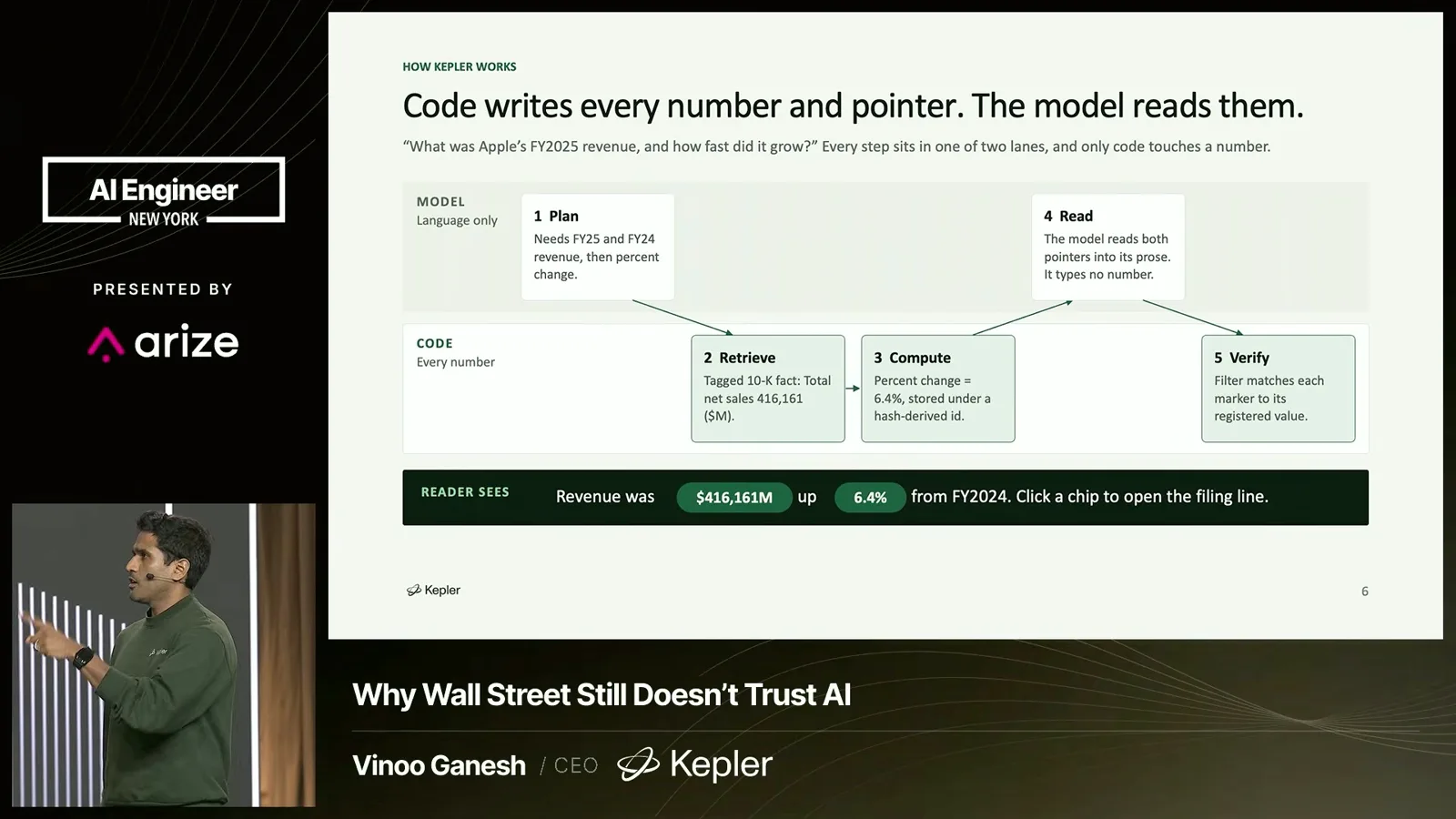
In Kepler's design, he says, preprocessing extracts facts from documents into structured storage and assigns identifiers or pointers to them. The model plans which sources and entities to consult; code then retrieves the referenced facts and performs calculations. This moves work from repeated model reading at query time into a preprocessing stage.
Ganesh says the output path is designed to resolve a pointer before a number can appear, followed by a separate verification pass. Readers can click a citation to see the source. Later in the talk he acknowledges that models can still generate unsupported numbers during inference, which is why additional post-processing is needed.
Drawing on his former work in business engineering at Citadel, Ganesh compares the model to a skilled analyst paired with deterministic tools. Investors need reliable data, but they also need judgment about incomplete information. The goal is to look up known facts and reason carefully about what remains unknown.
He describes storing information that can be represented deterministically and preprocessing less structured information into a hybrid system. Search and reranking identify candidate material; pointer dereferencing then retrieves a particular stored value. A lookup can return the stored value reliably, but choosing the wrong pointer or storing a wrong value remains a separate risk.
Broad search and access control
The retrieval pipeline combines semantic and keyword search with reranking. Security rules must constrain both search and direct document access.
For broad retrieval, the system combines approximate nearest-neighbor search and BM25, using reciprocal rank fusion and a cross-encoder to narrow the candidates. His slide shows a funnel from up to 200 candidates to 100, then 20 documents and finally 10 results; the displayed RRF parameter k is 60.
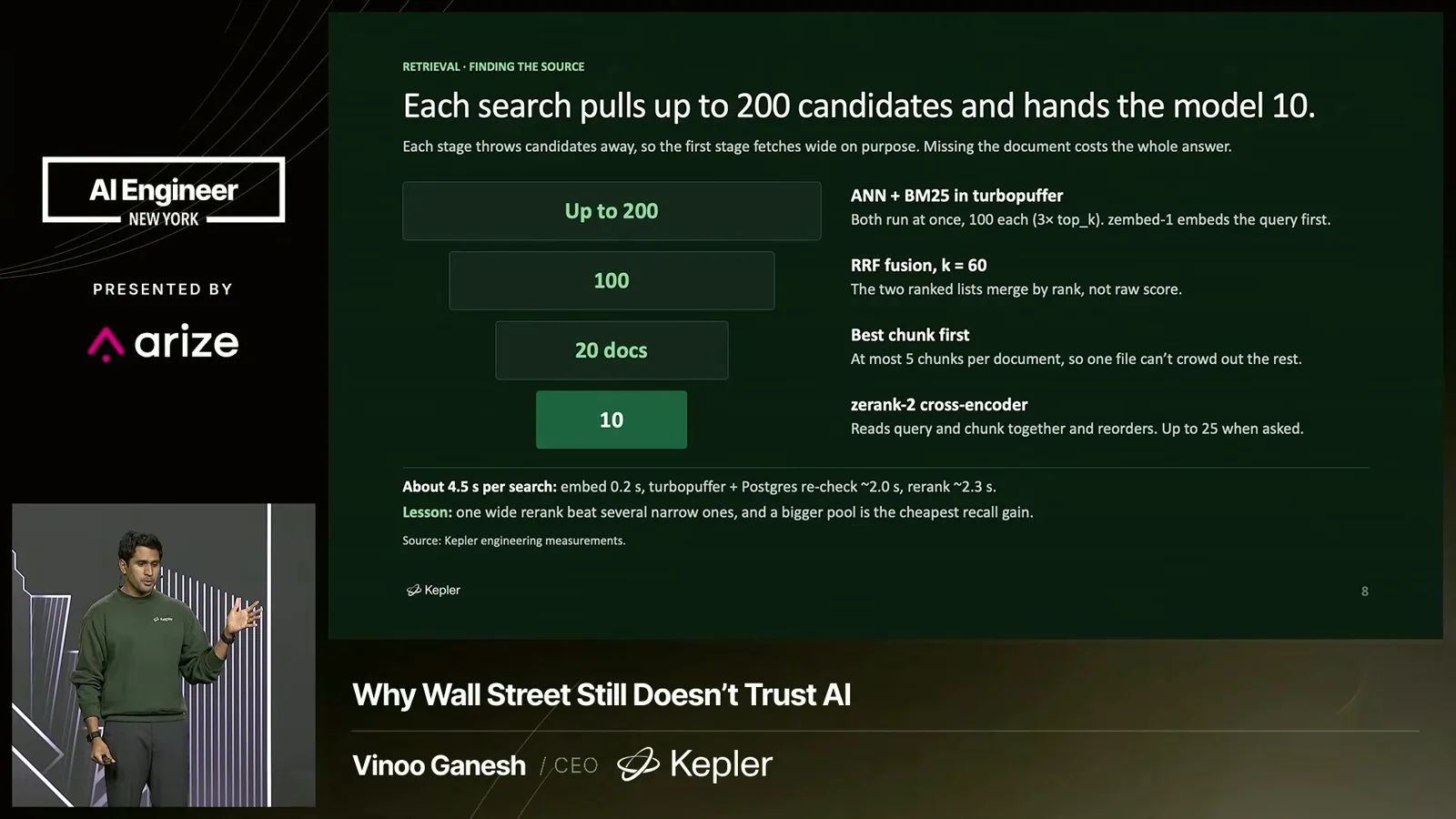
Ganesh favors searching broadly before narrowing. In his experience, an agent can be tempted to accept an early result instead of exploring a wide set of sources, partly because examining more material is costly. The design tries to make that breadth a property of the retrieval system rather than relying only on the model's search plan.
He then turns to security in document retrieval. Examples of failures include omitting tenant filters, accepting a caller's claimed identity without proper checks, returning stale results, allowing direct reads to bypass search rules and querying an unpopulated index.
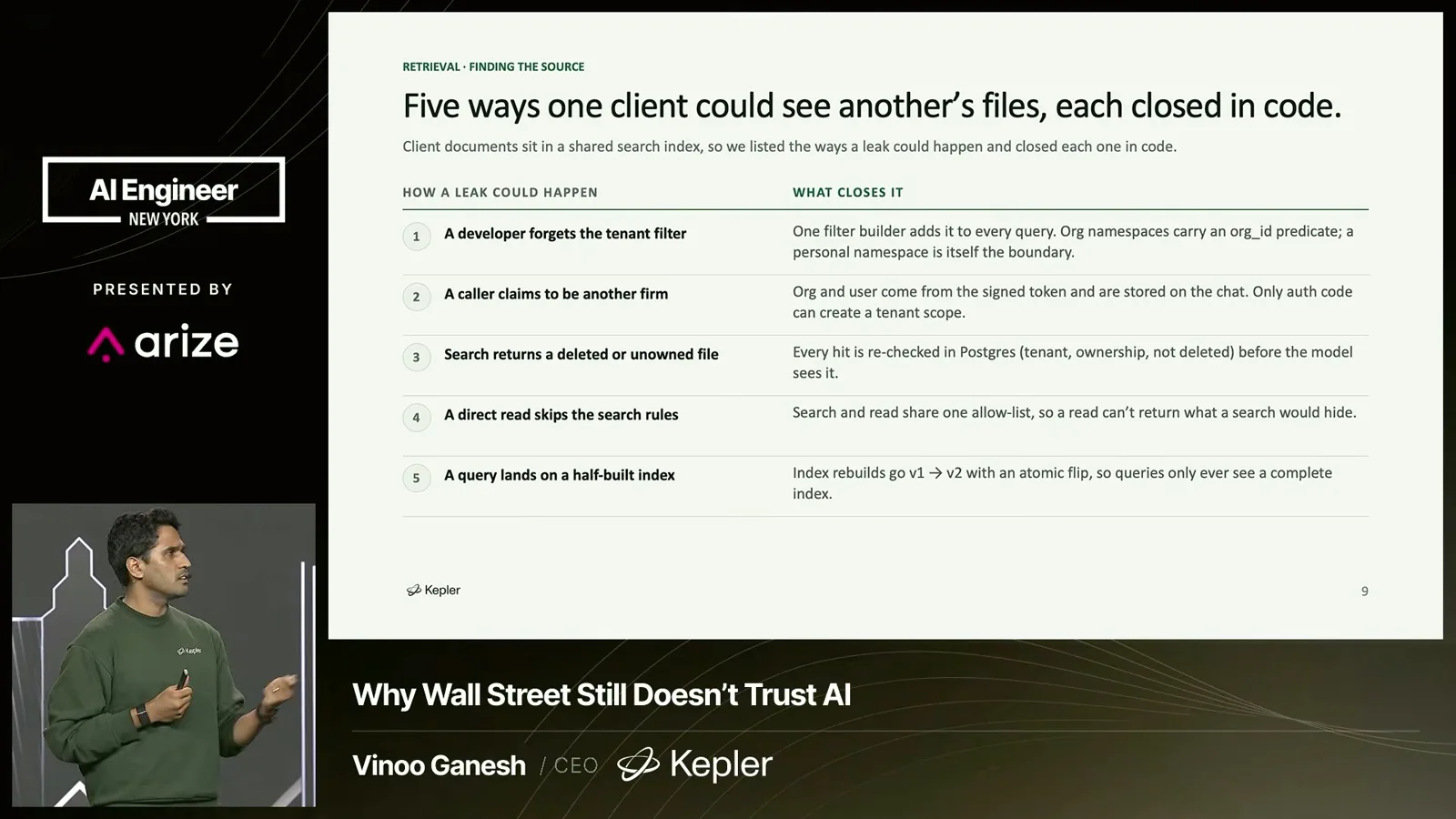
His recommendation is to build authorization into the scope of every query and document access path. A financial firm's research can be highly sensitive, so retrieving useful context is not enough: the system must also prevent a user or tenant from receiving material they are not entitled to access.
Verification and production behavior
Ganesh describes a verified, corrected or refused citation contract. He acknowledges that model-generated unsupported numbers still require post-processing.
For verification, Ganesh describes identifiers and hashes that connect stored facts back to source material. If a requested pointer cannot be resolved, it should not yield a fact. This provides a way to check provenance, though it does not by itself prove the underlying source or the choice of source is correct.
He presents the intended contract as citations that are verified, corrected at search time or refused. The same pattern could apply outside finance, such as checking whether a cited legal precedent actually exists. The broader objective is to make the provenance of a fact visible rather than merely attaching a plausible citation afterward.
Ganesh worries that unreliable outputs could make institutions reject useful AI tools. He argues that wider adoption requires systems whose numbers and sources can be inspected, not just systems that produce fluent presentations. His remarks about industry adoption are his own assessment.
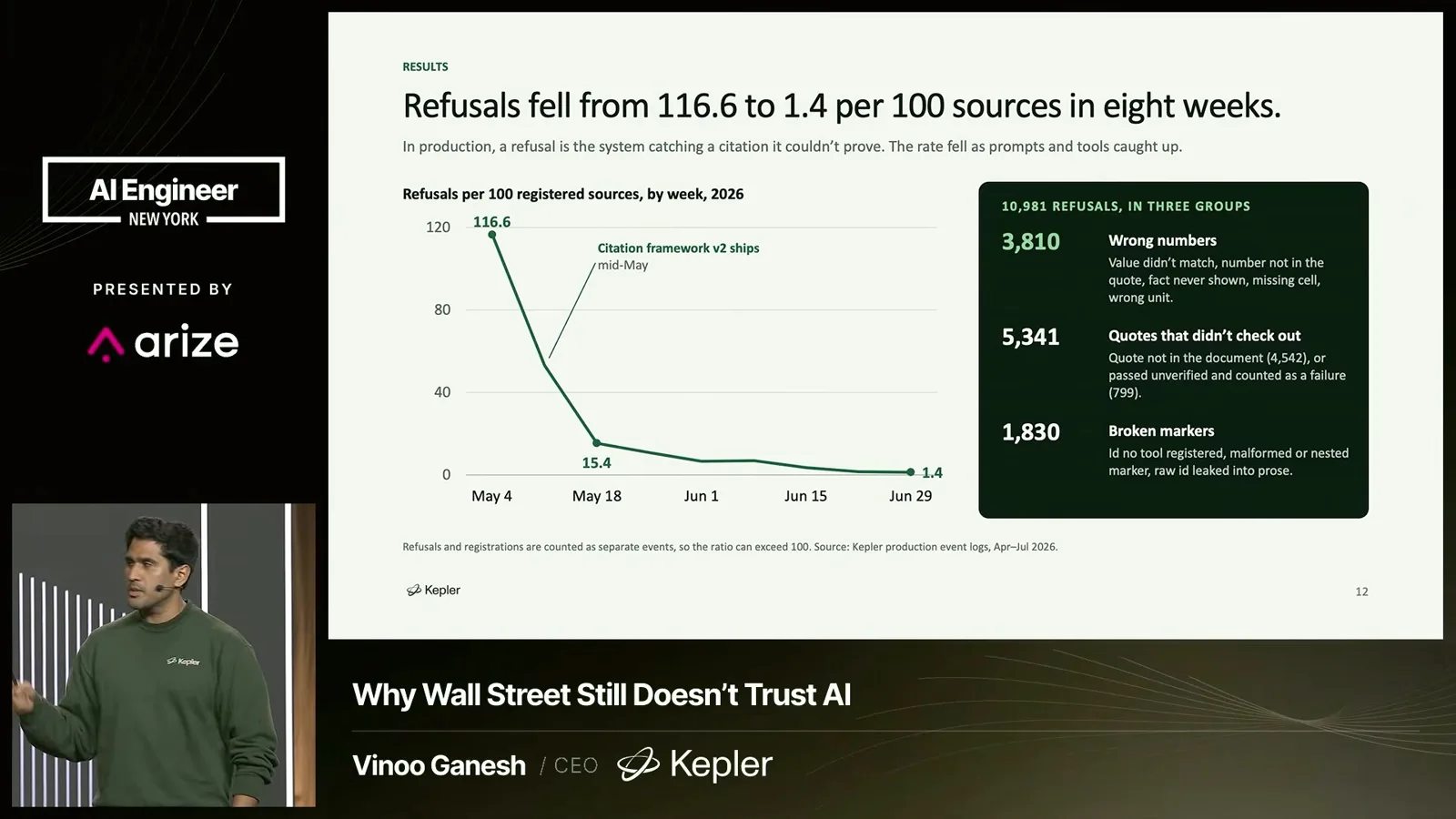
Showing production results, he says unsupported-number refusals dropped after the team introduced pointer-based handling. They did not fall to zero: he acknowledges that a probabilistic model can still generate a number during inference, so the implementation also uses a subsequent checking step. He does not provide enough context here to treat the result as a general benchmark.
Questions for builders and vendors
He asks teams to check sources, calculations, authorization and missing facts. The talk closes with a call for reliable infrastructure around models.
His practical challenge to builders is to make a number inspectable, whether it was extracted, calculated or both. He asks vendors whether every citation and arithmetic step is checked, whether access controls prevent unauthorized documents reaching clients, and what happens when a fact has no source.
Ganesh closes by arguing that better models still need reliable data infrastructure and carefully designed software around them. A missing database value should not quietly become an invented fact; trustworthy applications need retrieval, controls and verification to work together.
Sur la même chaîne
 31:22EN
 AI Engineer· 7 nov. 2026Nouha Dziri on Making Coding-Agent Teams More Cost-EfficientNouha Dziri · CohereExperiments on ProgramBench and Commit0 show why the task bottleneck, lead model and coordination design matter more than simply adding agents.
 19:34ENAI Engineer· 7 nov. 2026How Cloud Agents Help Review Changes to a Security MasterAmol Kapoor, Clifford Ressel · Nori AgenticAmol Kapoor and Clifford Ressel explain why private-asset data is difficult to reconcile and how an agent assists human reviewers.
 1:04:02ENAI Engineer· 6 nov. 2026Lance Martin: Audit Prompts, Build Better Evals and Optimize Agent CostLance Martin · AnthropicAn Anthropic engineer explains prompt caching, evaluation design, hill climbing and the architecture of reliable long-running agents.
 23:05ZHAI Engineer· 6 nov. 2026Ryo Lu:当我们什么都能做,还知道自己想做什么吗?Ryo Lu从 AI 生成的日记工具到爵士乐团,Ryo Lu 讨论如何在更强大的工具旁保有判断、生活和与他人合作的空间。
 19:19ENAI Engineer· 6 nov. 2026Ben Holmes: Use Agent Traces to Improve Agent SkillsBen Holmes · WarpThe Warp engineer explains how scoring conversations can uncover hidden friction and produce reviewable configuration improvements.
 19:43ENAI Engineer· 6 nov. 2026How a Knowledge Graph Helped Map a 35-Million-Line MainframeStephen Chin, Neeraj Deshmukh · Neo4jStephen Chin and Neeraj Deshmukh explain context, agent orchestration and behavior-parity tests for legacy-system modernization.