En 30 secondes
Matthew Berman examines Sam Altman’s 2023 remarks on the limits of relying on ever-larger models and Greg Brockman’s comments on GPT-4 safety. He discusses data quality, human feedback, architecture and compute constraints as possible paths and trade-offs. Some claims are historical or speculative. OpenAI did not disclose GPT-4’s parameter count in its technical report, so Berman’s comparison with GPT-3.5 cannot be verified from that report; OpenAI later introduced GPT-5 in 2025.
- 1Looking beyond sizeAltman’s remarks suggested that larger parameter counts alone would not be the only route to better models. The statement did not prove that scaling had ceased to help.
- 2A parameter comparison without public figuresBerman claims GPT-4 had only a small parameter increase over GPT-3.5, but OpenAI did not publish GPT-4’s size in its technical report.
- 3Other research directionsNew architectures and tuning based on human feedback were presented as possibilities, not as an announced OpenAI roadmap.
- 4Testing GPT-4Brockman said the company spent more than six months testing GPT-4 and making it safer.
- 5Reporting powerful training runsBrockman advocated reporting powerful training runs to governments and evaluating potentially dangerous capabilities.
À retenir
- Altman suggested in 2023 that improvements would increasingly come from approaches beyond simply making models larger.
- The size difference between GPT-3.5 and GPT-4 is not established by OpenAI’s GPT-4 report, which does not disclose model size.
- New architectures, data and human-feedback-based tuning were discussed as possible avenues rather than a confirmed roadmap.
- Brockman described GPT-4 safety testing and advocated reporting powerful training runs to governments.
- The discussion reflects a 2023 snapshot; OpenAI introduced GPT-5 in 2025.
Lire le texte remanié, chapitre par chapitre
What Altman said about giant models
Berman discusses the 2023 claim that future improvements may require more than parameter scaling. His comparison of model sizes cannot be verified from OpenAI’s public GPT-4 report.
In April 2023, I wanted to discuss Sam Altman's comments on the race to build ever-larger AI models. At an MIT event, the OpenAI CEO suggested that progress would increasingly have to come from other approaches, rather than simply making models bigger. That was a view about the direction of research, not a demonstration that scaling had stopped working.
Transformers helped power the new wave of large language models. My reading is that adding parameters alone can bring diminishing returns, and that the next major performance improvement may require new ideas, better data or different techniques. Those are possibilities, not a detailed roadmap that OpenAI announced at the event.
I compare GPT-3.5 with GPT-4 and say the latter achieved better performance with only a small increase in parameters. That numerical comparison is not established: OpenAI's [GPT-4 technical report](https://arxiv.org/abs/2303.08774) explicitly withholds model size and architecture details. The size increase cannot be verified from the report.
Alternatives and limits to scaling
Berman reviews reporting on scaling, compute constraints and research ideas such as new architectures and human-feedback-based tuning.
I turn to a [Wired article](https://www.wired.com/story/openai-ceo-sam-altman-the-age-of-giant-ai-models-is-already-over/) quoting Altman on the end of an era of giant models and the possibility of improving them in other ways. The article also describes competitors including Anthropic, AI21, Cohere and Character.AI investing heavily in their own systems.
The article interprets Altman's remarks as suggesting that GPT-4 could mark a shift away from relying on ever-larger models and datasets. It does not identify a specific replacement research strategy. It also notes diminishing returns and the physical constraints on building data centers; neither establishes that further scaling is impossible.
Cohere co-founder Nick Frosst makes a similar distinction: progress on transformers need not depend solely on adding parameters. The article points to new architectures and additional tuning based on human feedback as promising directions. I think those could make systems more useful even without assuming a particular increase in model size.
GPT-4 safety and future plans
He reviews Greg Brockman’s statement on safety testing and reporting powerful training runs, then offers his own expectations for GPT-4.
I connect that discussion to a post from OpenAI co-founder Greg Brockman. At the time, OpenAI had said it was not training GPT-5, and Brockman's post stresses work on GPT-4 and safety rather than specifying when a successor would arrive. The idea that particular architecture changes were planned is my interpretation, not a confirmed announcement.
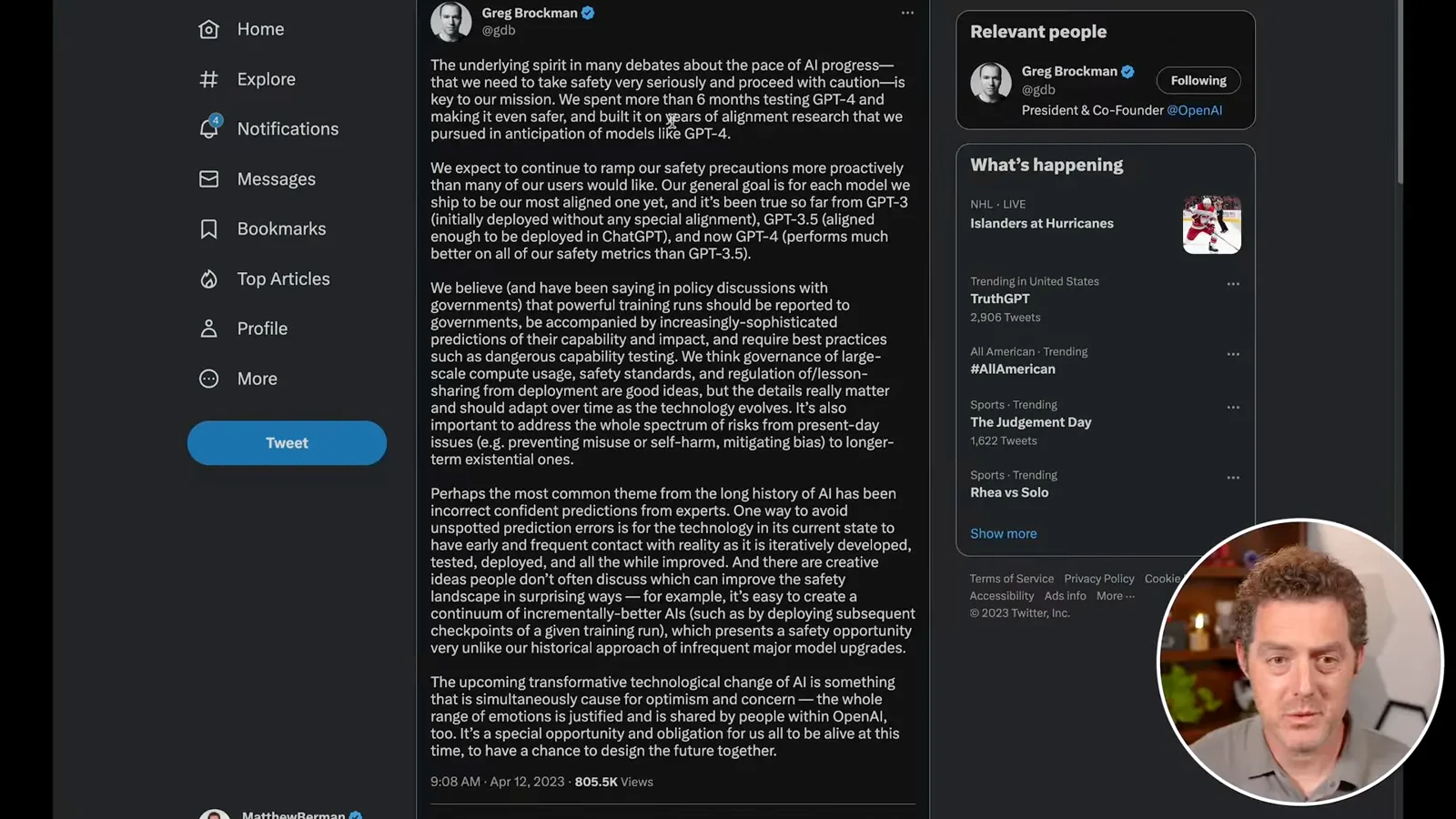
Brockman writes that OpenAI spent more than six months testing GPT-4 and making it safer, building on earlier alignment research. He says the company expected to increase precautions, even more proactively than some users might prefer. I see this as a signal that OpenAI intended to keep investing in the model it had just released.
Another part of Brockman's post calls for powerful training runs to be reported to governments, accompanied by increasingly sophisticated predictions of capabilities and impact, and subject to practices such as dangerous-capability testing. I welcome innovation, but I also think it is important to consider possible harms and safeguards.
My expectation at the time is that OpenAI will work on deploying and improving GPT-4, safety, data and human-feedback-based tuning while investigating new techniques. I also want higher ChatGPT message limits. This is a 2023 forecast, not a permanent statement about the company's plans: OpenAI later [introduced GPT-5 in August 2025](https://openai.com/gpt-5/).
Sur la même chaîne
 34:21EN
 Matthew Berman· 27 oct. 2026Matthew Berman Examines Anthropic’s IPO Filing, AI Growth and GovernanceMatthew Berman, Sam Altman · Forward FutureThe presenter reviews the S-1’s financial metrics, compute strategy and voting structure while questioning the tension between rapid AI development and safety.
 0:36ENMatthew Berman· 25 oct. 2026Kimi K3.1 and a Rubik’s Cube Solver DemonstrationMatthew Berman · Forward FutureMatthew Berman shows a scrambled virtual cube being solved and gives the Kimi K3.1 test a favorable assessment.
 0:21ENMatthew Berman· 24 oct. 2026An AI-Generated Kimi Benchmark Chart Used Invented ScoresMatthew Berman · Forward FutureMatthew Berman asks for a graph of Kimi K3.1 Pro benchmarks, then discovers that the displayed figures are illustrative placeholders.
 25:50ENMatthew Berman· 24 oct. 2026Kimi K3.1 Pro Tested: Strong 3D Demos, Uneven Results and Competitive PricingMatthew Berman · Forward FutureMatthew Berman tests the open-weight model on coding, 3D rendering and visual explanations, then compares benchmark results and prices.
 32:20ENMatthew Berman· 23 oct. 2026Who Is Local AI For? The Costs, Trade-offs and a Hybrid FutureMatthew Berman · Forward FutureMatthew Berman weighs data control and independence against hardware cost, setup complexity and inference speed.
 1:03:37ENMatthew Berman· 23 oct. 2026Matthew Berman’s Team Tests Kimi K3.1 on Animation, Games, and ChartsMatthew Berman, Alex, Brian · Forward FutureA live team AMA turns into an informal test of Kimi K3.1, from personal-agent workflows to motion graphics, a browser game, and a benchmark chart.