En 30 secondes
Matthew Berman discusses DeepSeek V3.2 and the higher-compute V3.2-Speciale, drawing on the developer’s published results and technical report. He examines benchmark scores, sparse attention, reinforcement learning and synthetic agent tasks, while noting that tool-use performance remains below the leading proprietary models.
- 1Two model variantsDeepSeek announced V3.2 and the higher-compute V3.2-Speciale; its release material described Speciale as API-only at launch.
- 2Reasoning benchmarksDeepSeek’s table reports 96.0 on AIME 2025 for Speciale, compared with 93.1 for V3.2 Thinking, with higher token use.
- 3Sparse attentionDeepSeek says its attention mechanism reduces computational complexity while preserving long-context performance.
- 4Post-training and agent tasksThe technical report describes a large post-training budget and synthetic environments for reinforcement learning.
- 5Model sizeBerman cites 671 billion total parameters and 37 billion active parameters in the mixture-of-experts model.
À retenir
- DeepSeek reported strong reasoning results for V3.2-Speciale, with greater reasoning-token usage than the standard thinking model.
- DeepSeek Sparse Attention aims to reduce attention complexity for long contexts.
- The team reports spending more than 10% of the pre-training compute budget on post-training.
- Synthetic environments and prompts were used to train agentic tool use.
- The 671-billion-parameter mixture-of-experts model activates 37 billion parameters per token, while its full weights still demand substantial memory.
Lire le texte remanié, chapitre par chapitre
The V3.2 release and benchmarks
Berman introduces the two variants and compares reported reasoning, coding and science benchmark scores. The results come from DeepSeek’s own published table.
DeepSeek V3.2 has arrived, and I think it marks another important moment for open models. DeepSeek reports that its higher-compute model achieved gold-medal-level performance on the 2025 International Mathematical Olympiad and International Olympiad in Informatics. These are developer-reported evaluation results; they do not establish that the model leads every closed model on every task.
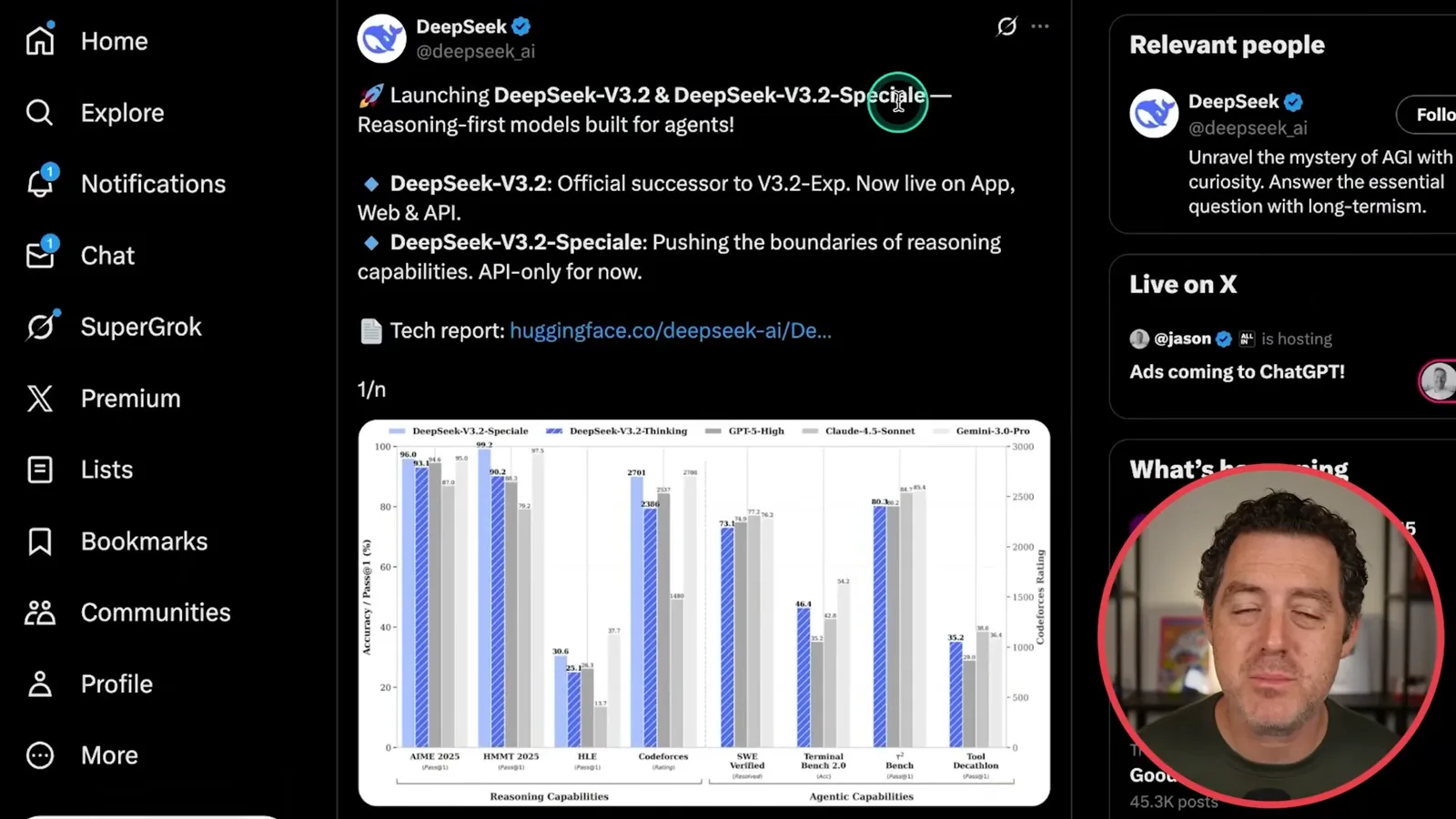
DeepSeek announced V3.2 and V3.2-Speciale as reasoning-first models. Its launch post presents V3.2 as the successor to V3.2-Exp, available through the app, web and API, and describes Speciale as a higher-compute variant available through the API at launch. The post also says Speciale did not support tool use at that point.
The company’s benchmark table compares the models with GPT-5 High, Gemini 3.0 Pro and Kimi K2 Thinking; I note that Claude Opus 4.5 is absent. On AIME 2025, the table reports 94.6 for GPT-5 High, 95.0 for Gemini 3.0 Pro, 93.1 for V3.2 Thinking and 96.0 for Speciale.
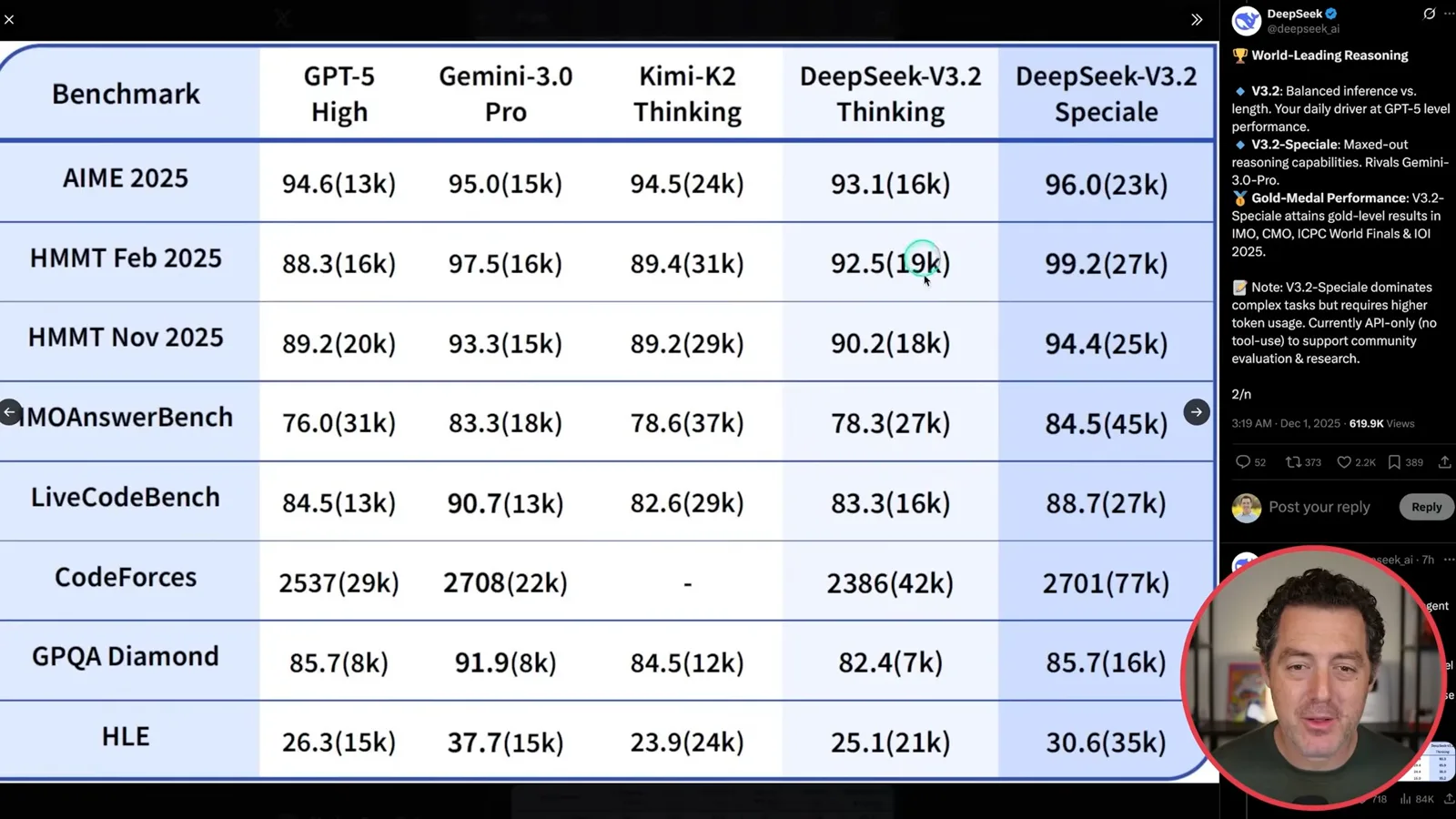
The numbers in parentheses are the reasoning tokens used. DeepSeek’s standard thinking model uses fewer tokens than Speciale on the examples shown, while Speciale spends substantially more to achieve higher scores. That extra inference compute matters when comparing both performance and cost.
On LiveCodeBench, the displayed results are 84.5 for GPT-5 High, 83.3 for V3.2 Thinking and 88.7 for Speciale. On GPQA Diamond, the table shows 85.7 for both GPT-5 High and Speciale, and 91.9 for Gemini 3.0 Pro. These are selected benchmarks, not a guarantee of the same ordering in every real task.
Attention, reinforcement learning and agent data
The technical report describes sparse attention, scaled post-training and synthetic agentic tasks. Berman explains the intended benefits.
DeepSeek’s report describes several technical changes. The first is DeepSeek Sparse Attention, or DSA, which the authors say substantially reduces attention’s computational complexity while preserving performance in long-context scenarios. More efficient attention can make longer contexts less expensive to process.
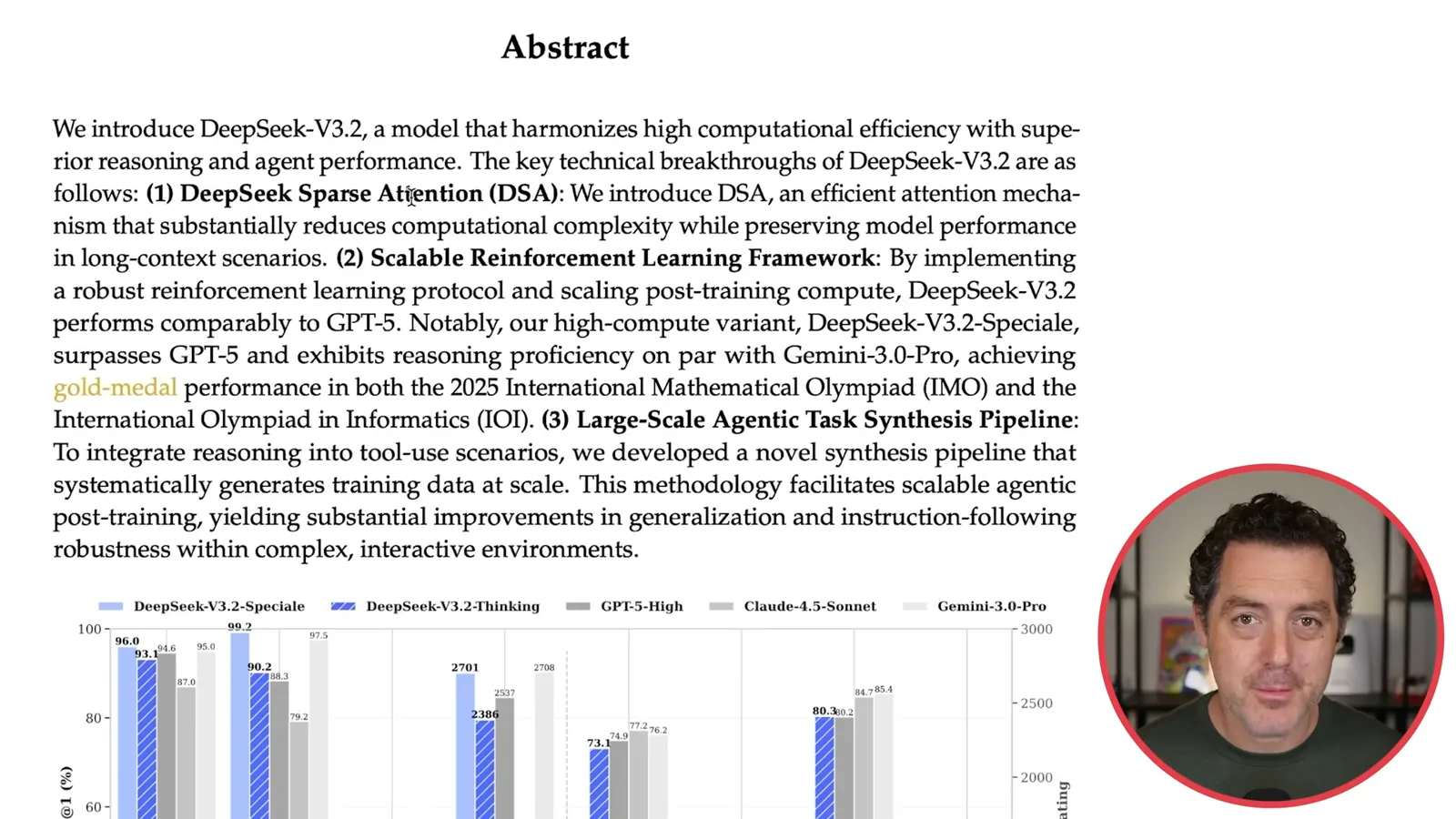
Conventional full attention becomes costly as the sequence length grows because its attention computation scales quadratically. DeepSeek describes reducing the core attention complexity from O(L²) to O(L × K), where L is sequence length and K is the number of selected tokens. The savings depend on the value of K and do not imply that every part of model inference becomes linear.
The second component is a scalable reinforcement-learning framework and more post-training compute. DeepSeek says V3.2 performs comparably to GPT-5 on its evaluated reasoning tasks and reports that Speciale reaches gold-medal-level results on the 2025 IMO and IOI. Those comparisons reflect the developer’s evaluation conditions.
Third, DeepSeek built a large-scale pipeline to synthesize agentic tasks. It generated training scenarios intended to combine reasoning with tool use, producing data for reinforcement learning rather than relying entirely on manually created examples. The aim is better generalization and instruction following in interactive environments.
Training details and practical deployment
Berman returns to the compute budget and synthetic environments, then discusses tool-use limits and the memory required to run the model.
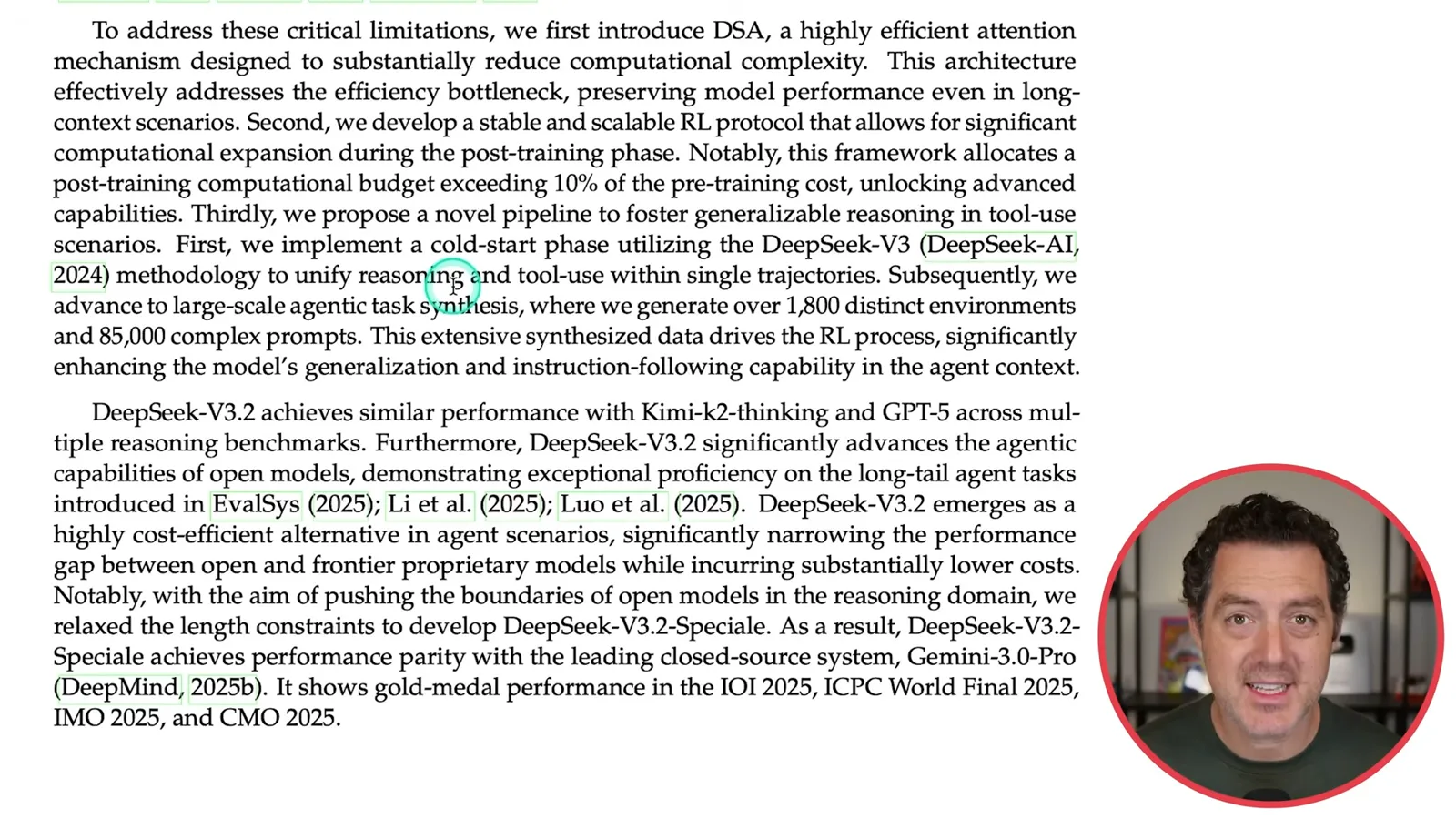
DeepSeek’s report says its post-training compute budget exceeded 10% of the pre-training cost. That is a comparison with pre-training compute, not a statement that reinforcement learning used 10% of the entire project budget. The company also reports generating more than 1,800 distinct environments and 85,000 complex prompts for agentic tasks.
The advantage of sparse attention is the difference between quadratic growth in the main attention operation and growth proportional to L × K. Berman describes the practical goal as controlling the cost of longer sequences, while the actual runtime and expense depend on implementation, hardware and other model operations.
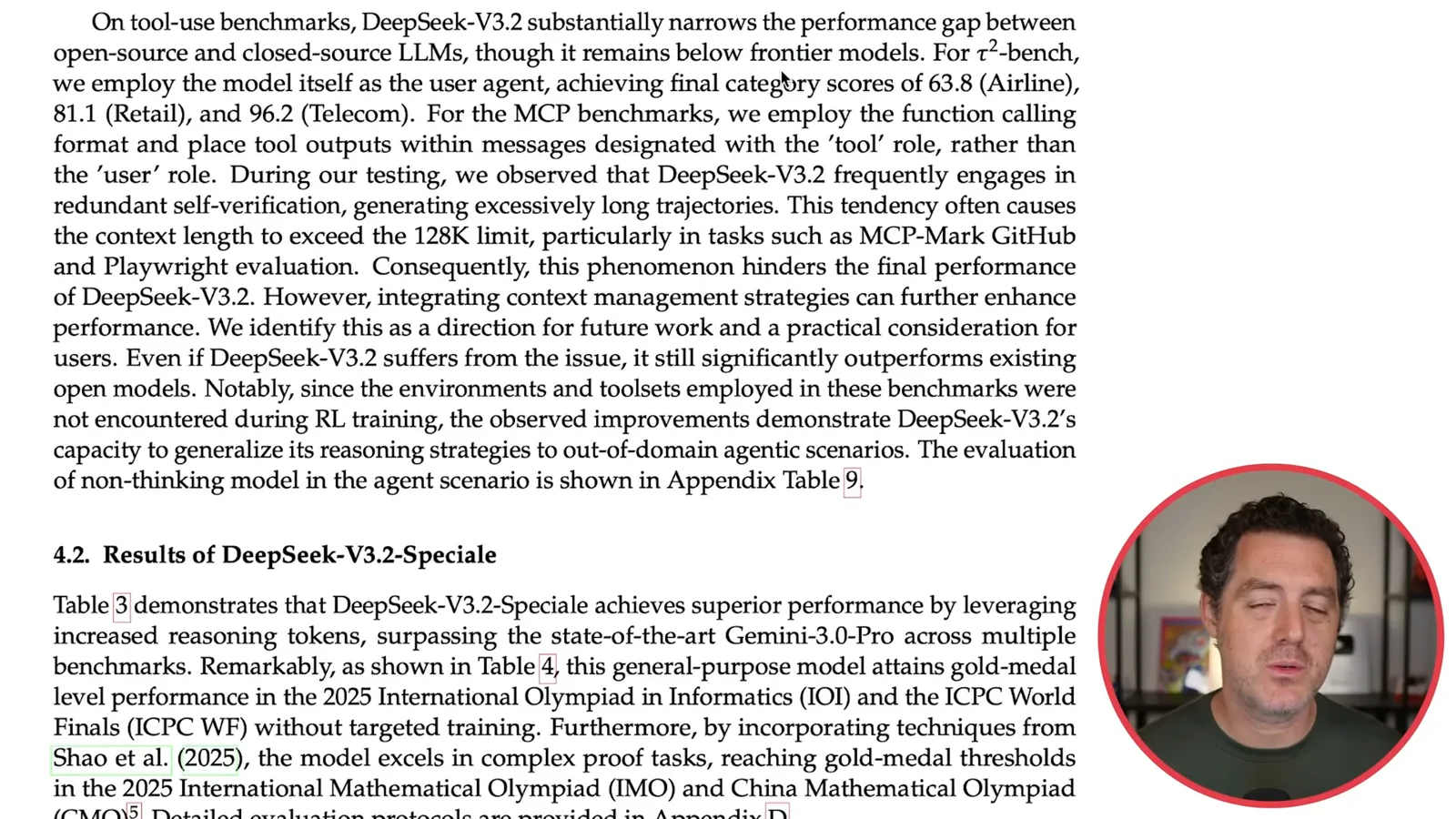
DeepSeek reports that V3.2 narrows the gap between open and closed models on tool-use benchmarks, while still trailing frontier systems in that evaluation. The displayed paper also notes that redundant self-verification can generate long trajectories and exceed the 128K context limit in some tasks.
The model has 671 billion total parameters and activates 37 billion at inference in its mixture-of-experts architecture. I estimate roughly 700 GB of VRAM for FP8 weights and 1.3 TB for BF16, illustrating that a relatively small active parameter count does not eliminate the memory needed to hold the full model. The release includes open weights under an MIT license; the Speciale variant’s availability at launch was more limited.
Sur la même chaîne
 34:21EN
 Matthew Berman· 27 oct. 2026Matthew Berman Examines Anthropic’s IPO Filing, AI Growth and GovernanceMatthew Berman, Sam Altman · Forward FutureThe presenter reviews the S-1’s financial metrics, compute strategy and voting structure while questioning the tension between rapid AI development and safety.
 25:50ENMatthew Berman· 24 oct. 2026Kimi K3.1 Pro Tested: Strong 3D Demos, Uneven Results and Competitive PricingMatthew Berman · Forward FutureMatthew Berman tests the open-weight model on coding, 3D rendering and visual explanations, then compares benchmark results and prices.
 32:20ENMatthew Berman· 23 oct. 2026Who Is Local AI For? The Costs, Trade-offs and a Hybrid FutureMatthew Berman · Forward FutureMatthew Berman weighs data control and independence against hardware cost, setup complexity and inference speed.
 1:03:37ENMatthew Berman· 23 oct. 2026Matthew Berman’s Team Tests Kimi K3.1 on Animation, Games, and ChartsMatthew Berman, Alex, Brian · Forward FutureA live team AMA turns into an informal test of Kimi K3.1, from personal-agent workflows to motion graphics, a browser game, and a benchmark chart.
 0:53ENMatthew Berman· 22 oct. 2026Sam Altman on AI and the Discovery of New KnowledgeSam Altman · OpenAIAltman expects progress in mathematical discovery to extend to biology, materials and energy.
 0:22ENMatthew Berman· 21 oct. 2026A Robot Bodyguard Video Shows Dramatic Rescue ScenariosMatthew Berman · Forward FutureMatthew Berman reacts to a short robot demonstration depicting fighting and vehicle-rescue scenarios.