En 30 secondes
In a September 2024 livestream, Matthew Berman and his colleagues Alex and Melissa browse TIME’s AI 100 list, discussing company leaders, researchers, chipmakers, creators and policymakers. Berman praises open models and infrastructure innovation, questions several omissions, discloses an investment in Groq and shares views on creator compensation. The list is not formally ranked, and their speculation about editorial choices, corporate motives and future products is distinguished from established facts.
- 1Debating the listBerman and Alex question omissions, including Elon Musk, and discuss how TIME features different figures.
- 2AI and energySasha Luccioni’s profile introduces the environmental cost of AI and the need for better measurement.
- 3Chips and computingBerman discusses NVIDIA’s move from graphics into AI and later examines TSMC’s manufacturing role.
- 4Meta and open modelsHe credits Zuckerberg and Meta for releasing Llama models and open development tools.
- 5Groq disclosureBerman says he is an investor while praising Jonathan Ross and fast inference.
- 6Creators and dataThe hosts discuss Reddit’s AI partnerships and Berman argues creators should have choice and compensation.
- 7Audience questionsThey discuss a reported possible subscription tier, tools, agents and uncertain paths to AGI.
À retenir
- TIME’s list includes researchers, executives, policymakers and creators; Berman disputes some selections and omissions.
- Berman acknowledges that the list is not formally ranked, despite discussing which figures are prominently featured.
- The hosts examine the roles of NVIDIA, TSMC, AMD and Groq in AI hardware and inference.
- Berman discloses that he is an investor in Groq while discussing its CEO and products.
- The discussion includes environmental costs, model safety, healthcare research and creators’ control over training data.
- A rumored high-priced ChatGPT tier and predictions about AGI are presented as speculation at the time.
Lire le texte remanié, chapitre par chapitre
Introducing the list and Google
Berman and Alex begin an impromptu review of TIME’s 2024 list. They debate its presentation and discuss Google’s position in AI.
Matthew Berman introduces an impromptu September 2024 livestream reviewing TIME’s 100 most influential people in AI. His editor and channel manager Alex joins him, and they plan to mix a recorded-style discussion with audience comments.
Berman and Alex question the omission of Elon Musk and xAI, and Berman suspects bias in the selections. That is his speculation, not evidence that inclusion was paid for. He later acknowledges that the list is not formally ranked, even as he discusses its featured placement.
Berman notices Sundar Pichai prominently featured and questions that choice. He agrees Google is influential but, in his assessment at the time, has been catching up in generative AI. TIME’s profile itself discusses ChatGPT’s launch and the competitive challenge to Google.
Berman says his own Google searches have fallen substantially as he uses ChatGPT and Perplexity more. He sees Google’s AI Overviews as broad distribution, but personally prefers alternatives. His experience is one user’s impression, not a market-wide measurement.
Berman speculates that Google’s caution about security and safety slowed its releases relative to OpenAI. He notes that Google had applied AI to products such as photo search years earlier, even if the newer generative AI wave changed public expectations.
The TIME interview asks Pichai about hallucinations in search. Berman describes Google’s explanation that AI Overviews use search ranking and grounding; he says he still prefers Perplexity. Alex notes Google had shipped a voice experience, while Berman says he had not yet tried that voice feature.
A viewer questions whether Musk can compete by spending money. Berman says he would not bet against Musk given his previous ventures and the compute cluster xAI had assembled, although these are expectations about future performance.
Microsoft, OpenAI and NVIDIA
They consider Nadella, Luccioni, Altman and Huang, and discuss energy, safety and AI chips. Melissa joins the stream.
Berman turns to Satya Nadella and credits his leadership with Microsoft’s cloud transformation and AI investments. He would feature Nadella or Sam Altman more prominently than Pichai, while clarifying that he is talking about prominence on an unranked list.
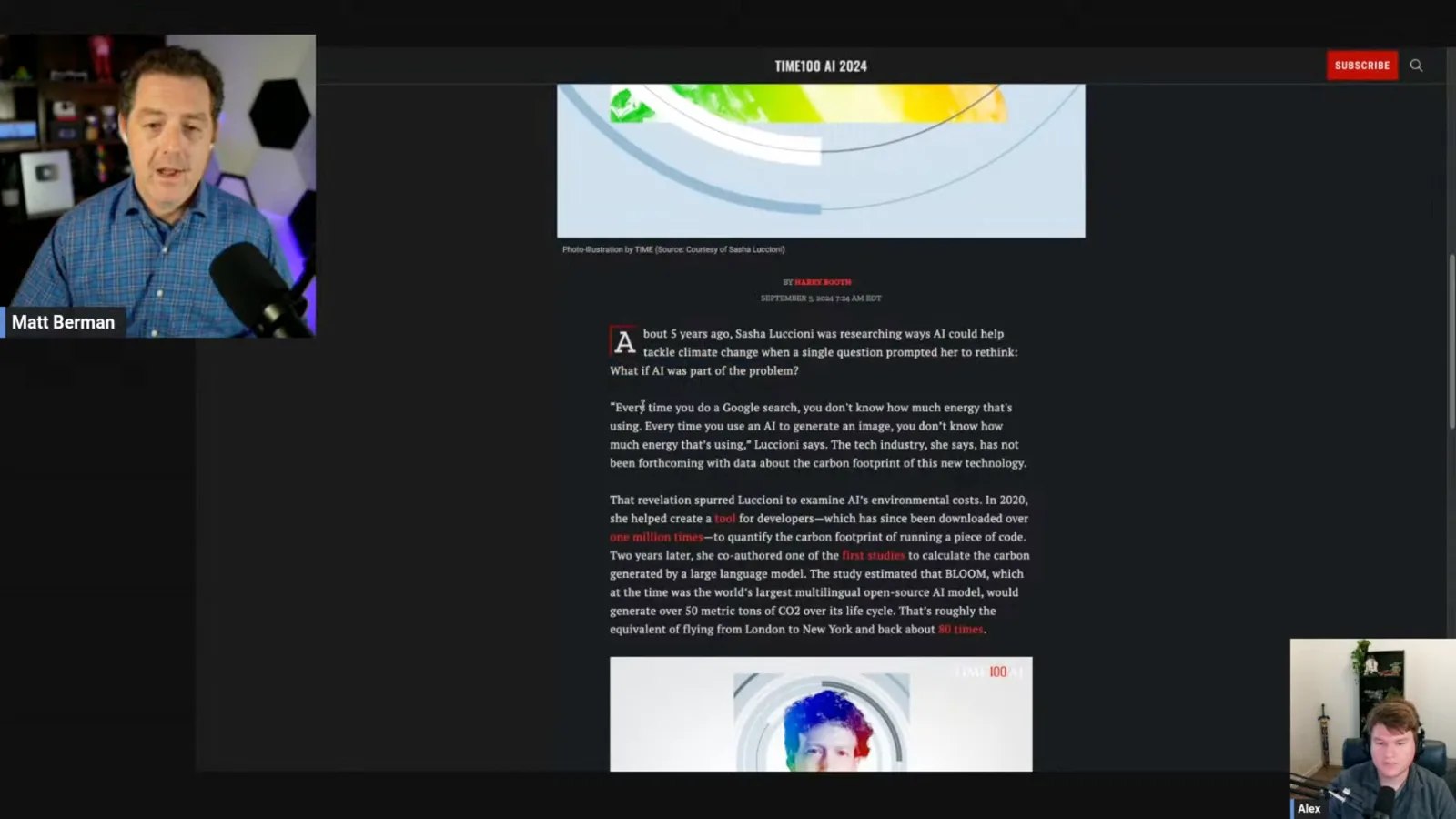
TIME’s profile introduces Sasha Luccioni, whom Berman did not previously know. He reads about her work at Hugging Face on AI’s environmental cost and the lack of transparent energy data. He expects efficiency to improve over time, but treats the cost discussion as a useful addition to the list.
Berman considers Altman an obvious inclusion because of OpenAI’s role in the generative AI wave. In response to a viewer asking about Tesla and NVIDIA stocks, he declines to give investment advice and discusses possible innovation instead.
The hosts check market-cap rankings after a viewer corrects Berman’s impression that NVIDIA was currently first. He then reads TIME’s Altman profile and discusses OpenAI’s nonprofit and for-profit structure, noting Altman’s prior statement that he held no OpenAI equity. His conjecture about the source of Altman’s wealth is not established by the discussion.
Berman describes the voice, video and search products mentioned in the profile as having different availability at the time, and recalls reporting on a proposed chip investment. Melissa, who manages business matters for the channel, joins the stream.
The profile discusses Altman’s views on democratic AI development and departures of OpenAI safety researchers. Berman connects the latter to concerns about safety and product priorities, while recognizing that the discussion does not establish every individual’s reasons for leaving.
Turning to Jensen Huang, Berman looks at NVIDIA’s five-year stock chart and the rise in demand for AI chips. He considers Huang a deserving selection because NVIDIA anticipated the use of GPU computing for AI. Market values and share prices he displays reflect September 2024.
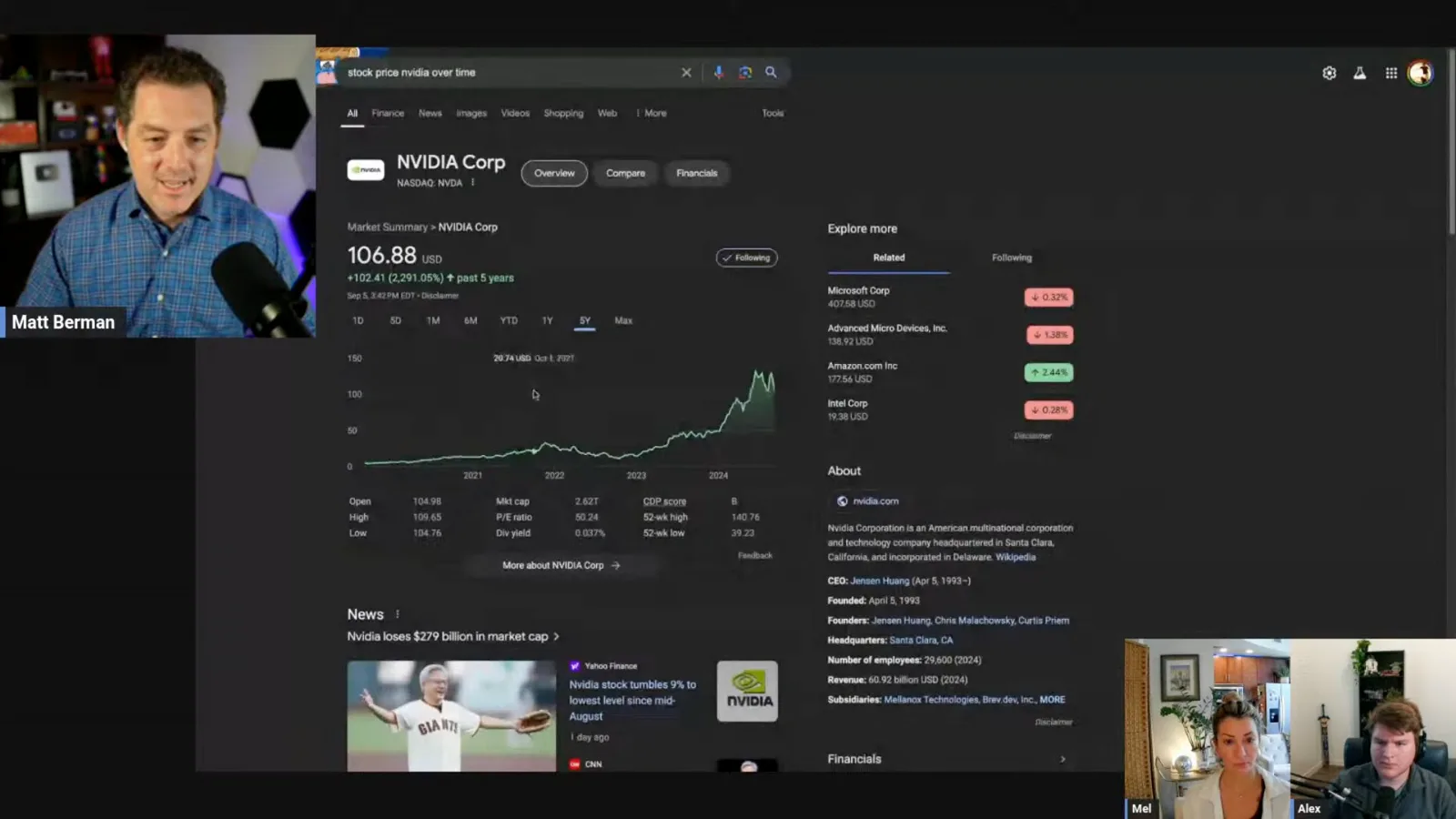
Berman explains the contrast between sequential CPU workloads and the parallel calculations for which GPUs were developed, then describes NVIDIA’s shift from gaming graphics toward AI chips and relationships with research labs. He points to an early NVIDIA machine delivered to OpenAI as a sign of Huang’s foresight.
A viewer raises neuromorphic and photonic chips. Berman uses Perplexity to look up neuromorphic computing and a separate physics-based hardware company, then says the technical details are beyond his current knowledge and he needs to read more.
Amazon, Meta and DeepMind
The group discusses enterprise AI, corporate arrangements, open models and research. They also consider safety, regulation and manufacturing.
The hosts return to the list and discuss Amazon AI leader Rohit Prasad. They note AWS infrastructure, Amazon Q and warehouse automation, although they are unsure about the precise role of AI in every warehouse system. Berman reads about Amazon’s effort to develop language models and its arrangement with Adept.
Berman compares the Adept deal with Microsoft hiring Inflection staff and licensing technology. He speculates that these structures may reduce regulatory scrutiny; he explicitly frames this as conjecture rather than a confirmed motive.
Berman encounters Open Philanthropy president Cari Tuna and reads about earlier donations addressing advanced AI risk. He also considers China’s cyberspace regulator Zhuang Rongwen and the difficulty of applying censorship rules to unpredictable generative systems.
Berman and Alex discuss jailbreaks as examples of the difficulty of controlling model responses. Berman then turns to Mark Zuckerberg, praising Meta’s Llama releases and its reorientation toward generative AI after major investment in AR and VR.
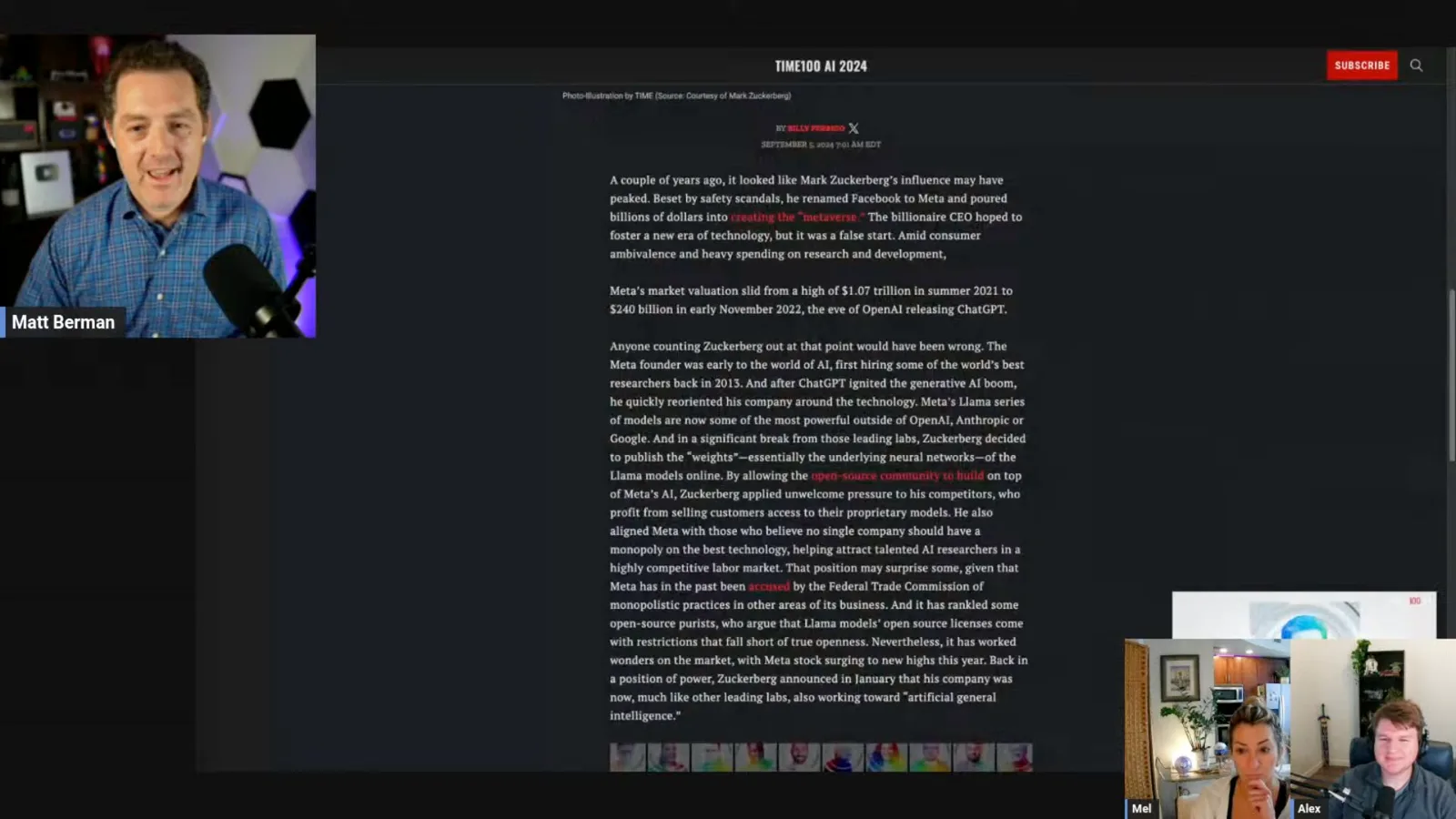
Berman recalls Meta’s earlier AI research and its release of open tools such as PyTorch and React. He says he has come to appreciate the company’s contributions despite his own misgivings about Facebook and data collection.
The hosts react to a viewer’s claim that Yann LeCun is missing from the list, questioning the selection criteria. Their assessment of omissions is opinion, and prominence on the list does not constitute a numbered ranking.
Berman praises DeepMind co-founder Demis Hassabis and discusses AlphaGo and protein-structure prediction. He recalls the Folding@home distributed-computing project; his enthusiastic suggestion that AI can resolve every protein should be understood as an overstatement of the achievement.
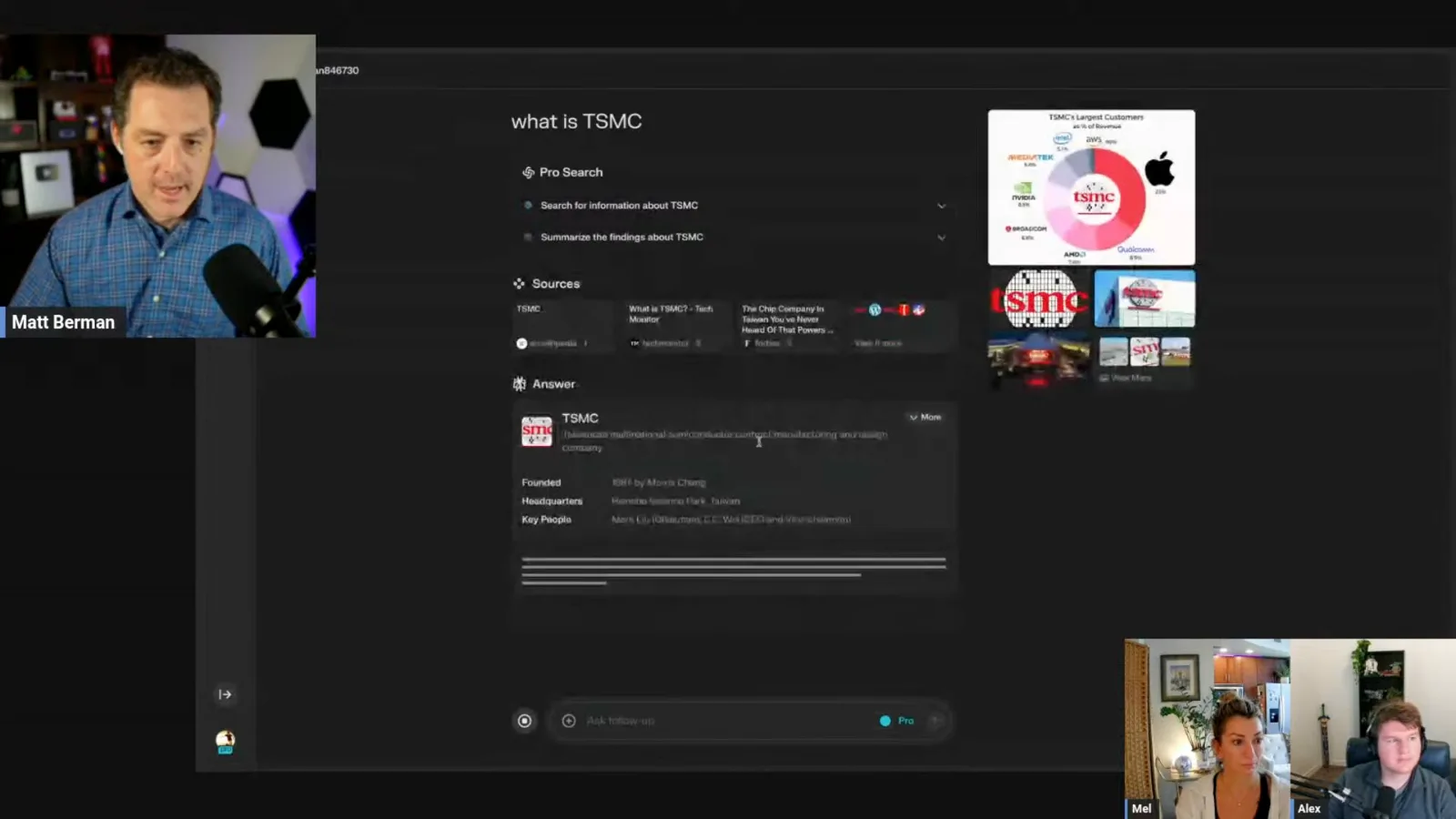
Next is TSMC leader C. C. Wei. Berman checks what TSMC does and discusses the concentration of advanced semiconductor manufacturing and its geopolitical importance. He notes that customers design chips while TSMC manufactures them, and argues for expanding manufacturing capacity.
Global models and chip leaders
The hosts encounter Baichuan, discuss language and tokens, and review AMD and Groq. Berman discloses his investment in Groq.
The list moves to ByteDance’s Liang Rubo and Baichuan founder Wang Xiaochuan. Berman looks up Baichuan’s language models and its reported long context window, admitting that he had not previously followed the company.
Alex asks whether Chinese characters make context more efficient. The hosts discuss possible differences in characters and tokens but acknowledge they do not know the answer; the exchange does not establish a general comparison of language efficiency.
The hosts discuss AMD CEO Lisa Su and the reported family connection to Jensen Huang. Berman remembers choosing AMD chips for their price and performance, then plays an awkward racing-grid interview in which a presenter did not recognize Su.
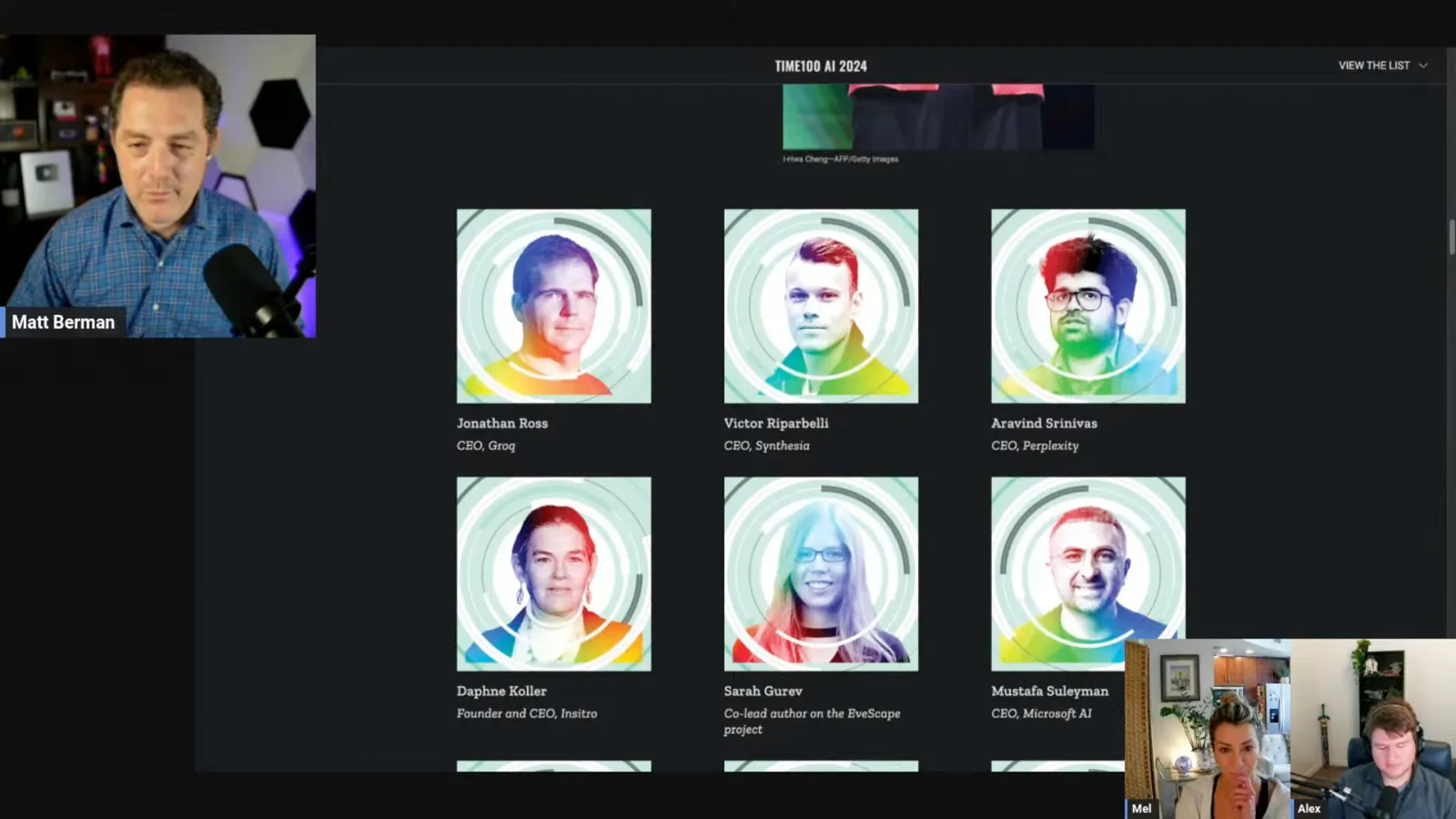
Berman introduces Groq CEO Jonathan Ross and discloses that he is an investor in Groq. He sees high-speed inference as valuable for future agents and notes Ross’s work on Google’s TPU. His enthusiasm should be read alongside that financial interest.
A viewer asks for bias testing of models. Berman says he has started including moral questions and invites suggestions for political or ideological tests and grading. Alex observes that moral questions do not necessarily have a single correct answer.
After a brief pause, Berman reads more about Ross and describes Groq’s move from selling chips toward offering inference. He treats a comment about who approached Ross as speculation. He then notes Synthesia’s Victor Riparbelli and Perplexity’s Aravind Srinivas, praising the search tool he uses.
Healthcare, robotics and AI researchers
They browse healthcare projects, Microsoft AI, Figure, ElevenLabs, Mistral and other names. The discussion expands to safety and creative work.
Berman briefly reviews Daphne Koller’s Insitro and Sarah Gurev’s work on predicting viral evolution. He welcomes applications of AI to disease research, while acknowledging he does not know the projects in depth.
He discusses Mustafa Suleyman and recommends his book The Coming Wave, which covers AI and biotechnology. Berman recaps Suleyman’s move from Inflection to Microsoft AI, including the licensing agreement, and offers his interpretation of the unusual arrangement rather than asserting its purpose as fact.
Berman notes healthcare-focused companies on the list and then Mira Murati, OpenAI’s CTO at the time. He recalls an interview about video training data, but his speculation about what she knew or intended is not evidence of the underlying training sources.
The group moves through Cerebras CEO Andrew Feldman, ASML’s Christophe Fouquet and Figure founder Brett Adcock. They compare reported inference speeds and admire Figure’s humanoid robots. Melissa says she would welcome a robot that could fold laundry, while Alex is more cautious.
They mention AlphaFold researcher John Jumper and ElevenLabs co-founder Piotr Dąbkowski. Alex describes voice and noise-processing demonstrations; Berman recalls cloning his own voice to narrate a video when he had lost it, and reflects on what such tools could mean for creators.
The hosts look up a film in artist Lawrence Lek’s profile and wonder whether a title was misstated. Berman then praises Mistral CEO Arthur Mensch and its models, while questioning whether proprietary model businesses will remain sustainable as open models improve. That is his forecast, not a settled market outcome.
Berman reacts to FTC chair Lina Khan’s inclusion: even policies he dislikes can be influential. The group speeds through additional names, including Palmer Luckey and Waymo’s co-CEO, and moves to the thinkers category.
Berman highlights Ray Kurzweil’s long-running predictions and interest in technological change. He then discusses Ilya Sutskever’s departure from OpenAI and funding for Safe Superintelligence, expressing skepticism about valuations at such an early stage.
He praises Andrew Karpathy’s contributions at OpenAI and Tesla and his move into education through Eureka Labs. He also discusses former OpenAI board member Helen Toner’s role in the leadership upheaval and her work on AI safety, giving his own sharply expressed interpretation of those events.
Among other researchers, Berman notices Anthropic staff and Ben Zhao’s Nightshade. TIME describes Nightshade as a way for artists to alter images so training systems associate them incorrectly; Berman says the idea is new to him.
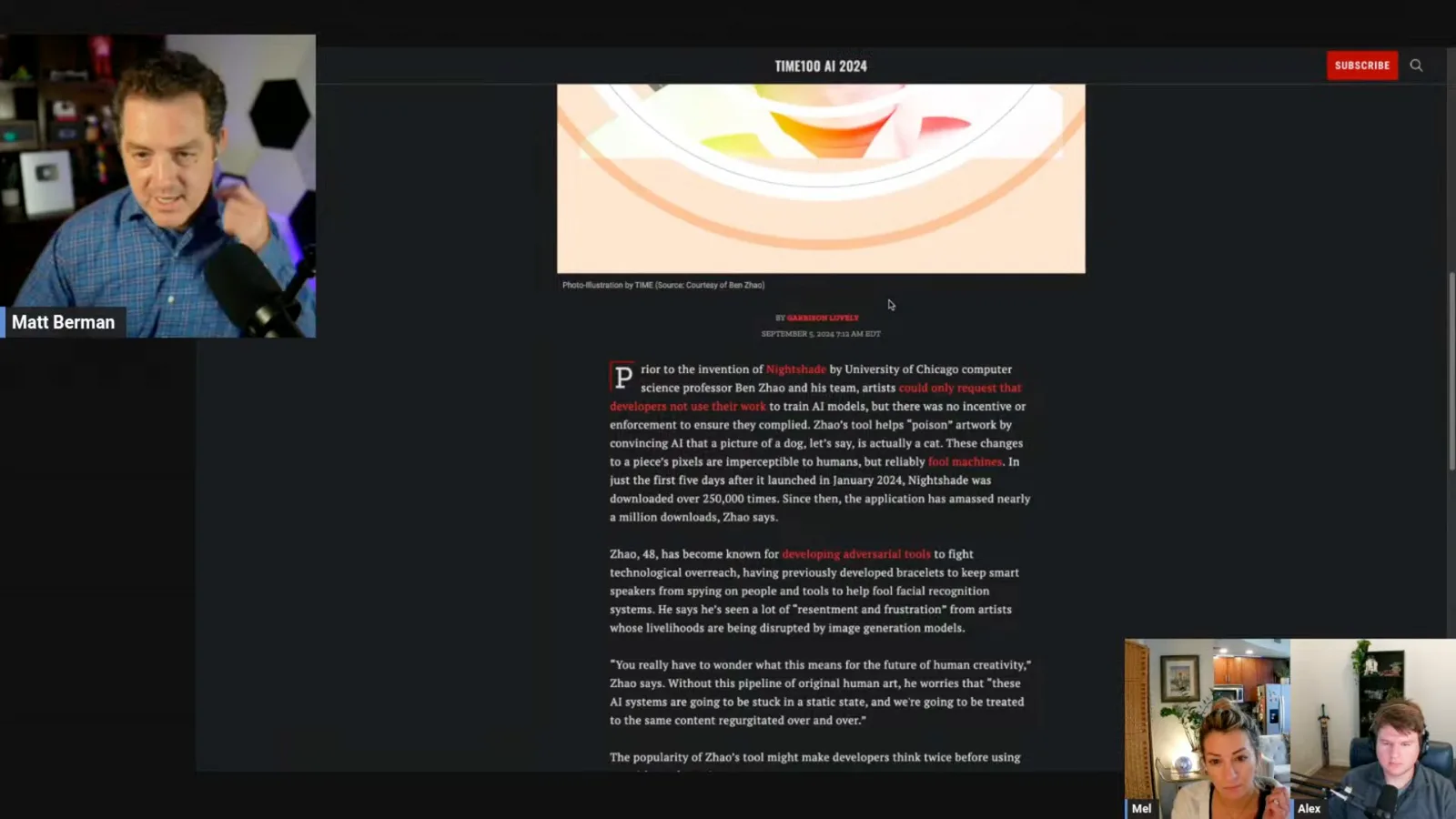
Berman introduces Ethan Mollick’s work on practical AI adoption and his book Co-Intelligence. He agrees that people should experiment with AI in everyday life to discover where it can help, which is also a motivation for his channel.
Creators, policy and data
The hosts debate the influence of reviewers and public figures, then discuss policy and Reddit’s data partnerships. Berman argues for creator choice and compensation.
The list turns to creators and public figures. Berman questions Marques Brownlee’s inclusion for reviewing AI devices; Alex points out that those reviews had substantial impact, a point Berman accepts. They discuss additional shapers from policy, investment and the public sector.
Berman notes California senator Scott Wiener’s AI legislation and Dario Amodei of Anthropic. The hosts debate Scarlett Johansson’s influence in connection with a voice controversy and again question omissions such as Yann LeCun and Lex Fridman. These are opinions about TIME’s editorial choices.
Berman praises Khan Academy’s educational work and notes investor Eric Schmidt and Vinod Khosla. On Reddit CEO Steve Huffman, the hosts read about data partnerships with Google and OpenAI, correcting their initial uncertainty that only one company was involved.
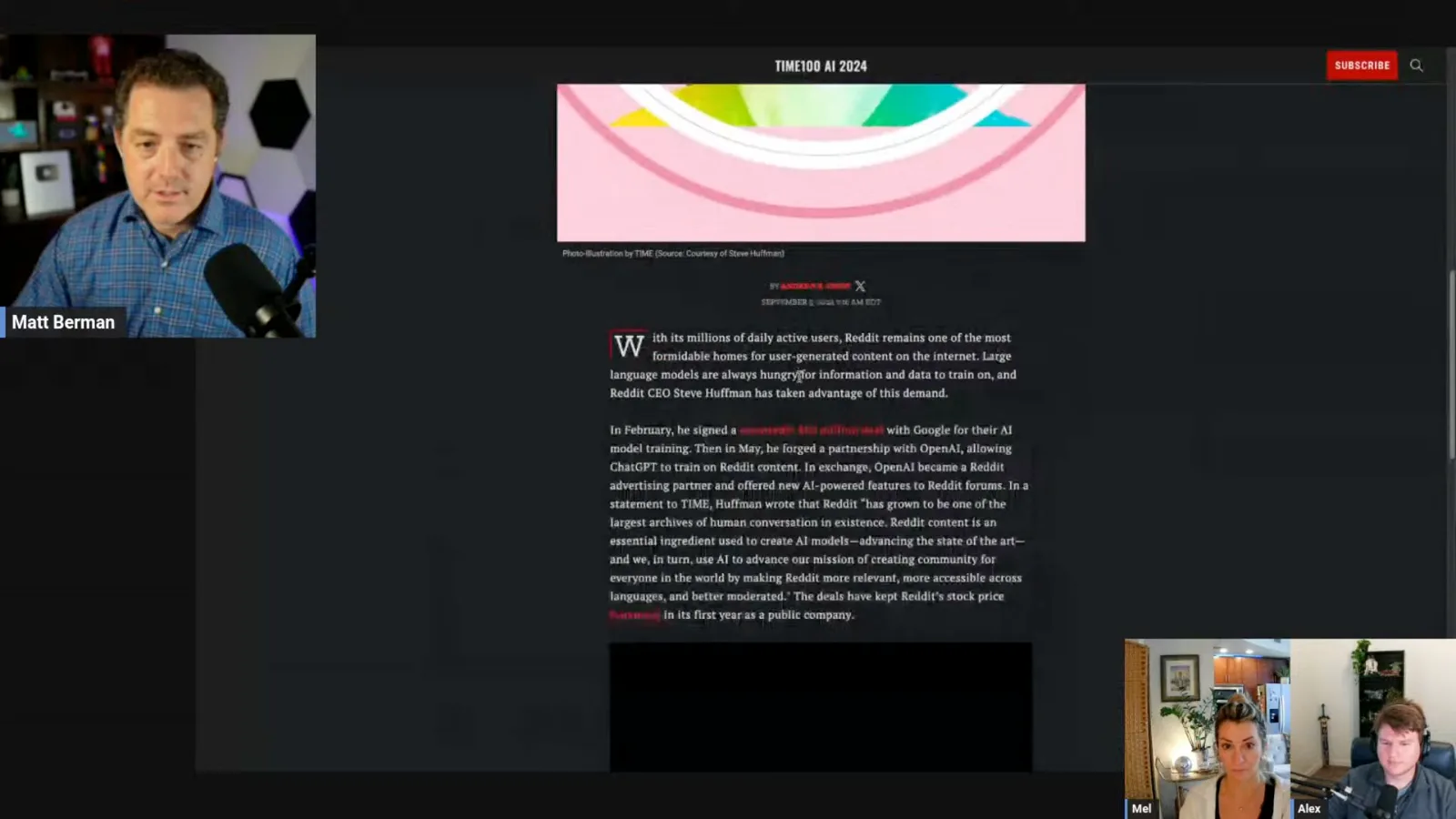
Berman argues that Reddit’s user-generated material is valuable and that people who create content should share in its value. He extends that preference to creators generally and says he would like a choice over whether his videos are used for model training.
Audience questions
They discuss a reported pricing proposal, image tools, news sources, Agent Zero and uncertain AGI development. Berman closes with a local-model thought experiment.
In the Q&A, Alex raises reporting about a possible ChatGPT tier costing up to $2,000 a month. The hosts speculate that a sufficiently capable system might justify such a cost for a business; Berman says he would try it for a month under those conditions. The figure is a reported possibility at the time, not an announced product price.
Berman says he currently uses DALL·E through ChatGPT and Grok 2 with Flux for image generation, and may revisit Midjourney’s website. For podcasts, he mentions the All-In Podcast; for news, he says he relies heavily on X and newsletters.
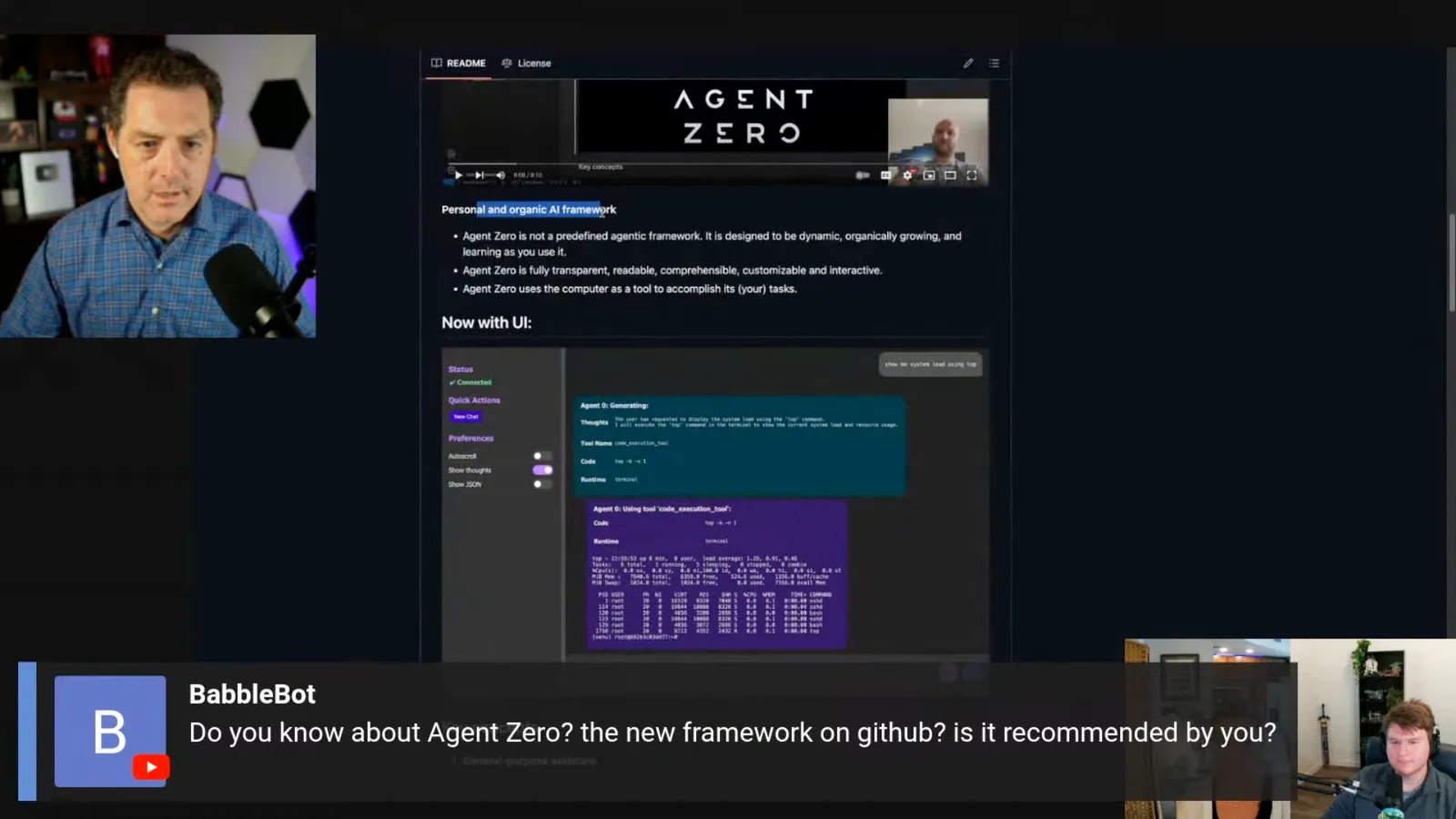
A viewer asks about the Agent Zero framework. Berman looks at its GitHub description but says he has not tried it and therefore does not recommend it from experience. He considers a future tutorial.
Asked whether AGI is more likely to come from startups or large companies, Berman says he does not know. He expects substantial compute and funding to matter, and speculates that the first stages of AGI may emerge gradually before a faster takeoff.
For a doomsday-bunker question, Berman describes saving an open-weight model on a USB drive as an experiment. He notes the practical issue of supplying power and does not claim that a downloaded model literally contains all reliable knowledge. The hosts then wrap up the impromptu livestream.
Sur la même chaîne
 34:21EN
 Matthew Berman· 27 oct. 2026Matthew Berman Examines Anthropic’s IPO Filing, AI Growth and GovernanceMatthew Berman, Sam Altman · Forward FutureThe presenter reviews the S-1’s financial metrics, compute strategy and voting structure while questioning the tension between rapid AI development and safety.
 0:36ENMatthew Berman· 25 oct. 2026Kimi K3.1 and a Rubik’s Cube Solver DemonstrationMatthew Berman · Forward FutureMatthew Berman shows a scrambled virtual cube being solved and gives the Kimi K3.1 test a favorable assessment.
 25:50ENMatthew Berman· 24 oct. 2026Kimi K3.1 Pro Tested: Strong 3D Demos, Uneven Results and Competitive PricingMatthew Berman · Forward FutureMatthew Berman tests the open-weight model on coding, 3D rendering and visual explanations, then compares benchmark results and prices.
 32:20ENMatthew Berman· 23 oct. 2026Who Is Local AI For? The Costs, Trade-offs and a Hybrid FutureMatthew Berman · Forward FutureMatthew Berman weighs data control and independence against hardware cost, setup complexity and inference speed.
 1:03:37ENMatthew Berman· 23 oct. 2026Matthew Berman’s Team Tests Kimi K3.1 on Animation, Games, and ChartsMatthew Berman, Alex, Brian · Forward FutureA live team AMA turns into an informal test of Kimi K3.1, from personal-agent workflows to motion graphics, a browser game, and a benchmark chart.
 0:53ENMatthew Berman· 22 oct. 2026Sam Altman on AI and the Discovery of New KnowledgeSam Altman · OpenAIAltman expects progress in mathematical discovery to extend to biology, materials and energy.