En 30 secondes
Nathan Lambert answers course questions about how industrial post-training stages fit together, when KL regularization is useful, how data needs scale, and why RL is not interchangeable with supervised fine-tuning. He also discusses in-context learning versus training and the risks of poor synthetic data.
- 1Combining specialistsMulti-teacher on-policy distillation can consolidate specialist models; sequential RL is another option.
- 2KL depends on the taskVerifiable math and code rewards can reduce the need for a penalty, while complex tool use may bring regularization back.
- 3RL is not just SFTSimilar-looking losses do not eliminate the role of generated on-policy experience and negative gradients.
- 4Train or provide contextMeasure the task and compare the value of improvement with training and serving costs.
- 5Synthetic data can hurtTeacher choice and pipeline quality determine whether distilled data helps the student.
À retenir
- Industrial recipes combine multiple stages and may consolidate domain specialists through distillation.
- Simple verifiable tasks can work without a KL penalty, while more complex agentic tasks can need regularization.
- Larger models may learn efficiently from fewer examples, but prompt counts are an imperfect and changing rule of thumb.
- RL differs from supervised learning in its generated experience and its ability to discourage poor samples.
- Evaluate business value and cost before training, and do not assume synthetic data is automatically beneficial.
Lire le texte remanié, chapitre par chapitre
Stages and specialists
Lambert explains multi-stage recipes and ways to combine domain capabilities.
Post-training recipes in industry are more complicated than a single public paper can usually show. A common abstraction is supervised fine-tuning to establish reasoning behavior followed by reinforcement learning to improve capability and agency. In practice, labs use many intermediate models, specialists and training stages.
The OLMo 3 diagram illustrates a relatively simple recipe: pretraining, mid-training and long-context work, followed by supervised fine-tuning and reinforcement learning, perhaps with preference tuning between them. Even this straightforward open recipe contains multiple stages.
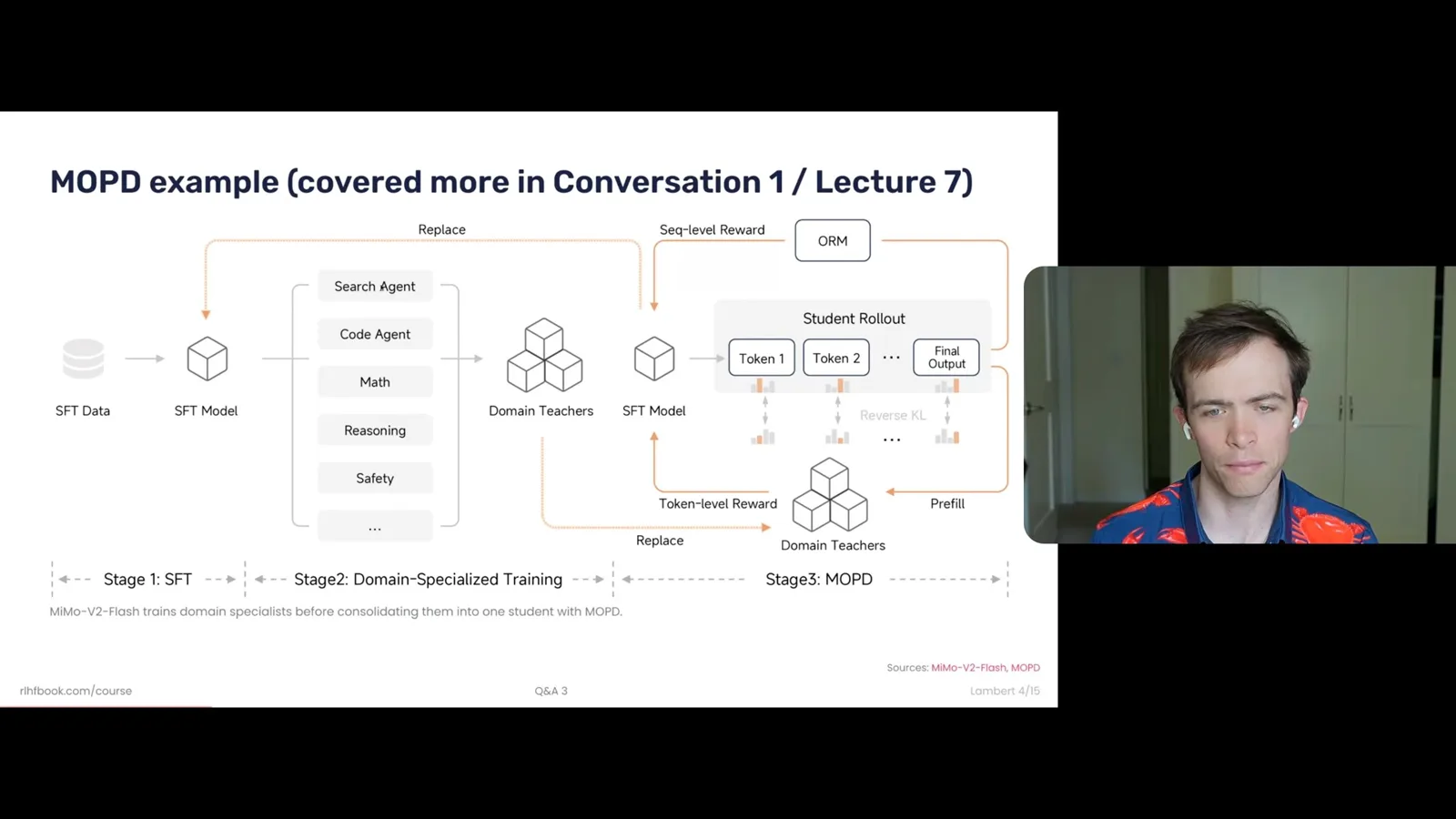
One emerging way to combine specialist capabilities is multi-teacher on-policy distillation: train domain specialists and consolidate their directions into a student. There is also research on sequential reinforcement learning by capability, including work from NVIDIA. I would not assume that training every capability sequentially is the industry norm.
KL and data budgets
He discusses regularization in RLVR and why a fixed supervised prompt count is only a rough guide.
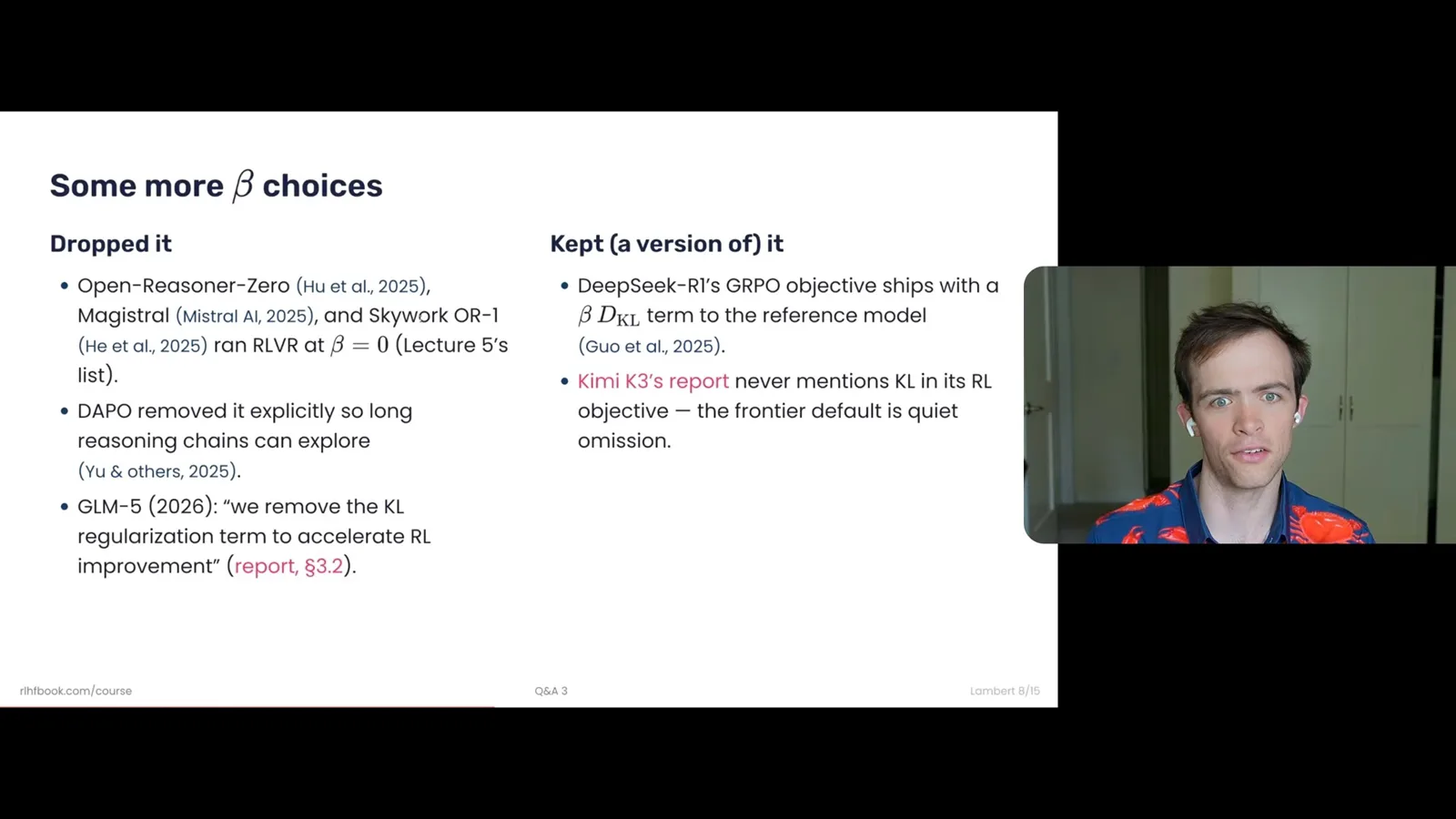
Why do reasoning recipes often omit a KL penalty? With verifiable rewards in relatively clean math and code tasks, the ground truth can reduce some of the over-optimization concern. In Tülu 3, we found that math RL could be learned in a fairly specific mode without necessarily disrupting other domains.
As tool use and agentic tasks grow more complex, over-optimization can take more forms and regularization is returning. Reports differ: Open-Reasoner-Zero, Magistral, Skywork and DAPO discuss dropping KL, and GLM-5 removes it to accelerate improvement. Some reports do not make the choice clear, so the frontier picture is messy.
How does a rough budget of a million supervised prompts scale with model size? Larger models often need fewer examples: they may gain more from mid-training and learn more efficiently from both instruction data and RL. Test whether each data source actually improves performance; otherwise it wastes compute.
There are important confounders. Mid-training and supervised fine-tuning increasingly overlap in laying the foundation for reasoning, and agentic completions contain more tokens. The million-prompt rule comes from an earlier era; we need better public figures for total prompt-completion tokens and should not assume the count transfers unchanged.
RL versus supervised learning
Similar loss functions do not remove differences in experience and gradients.
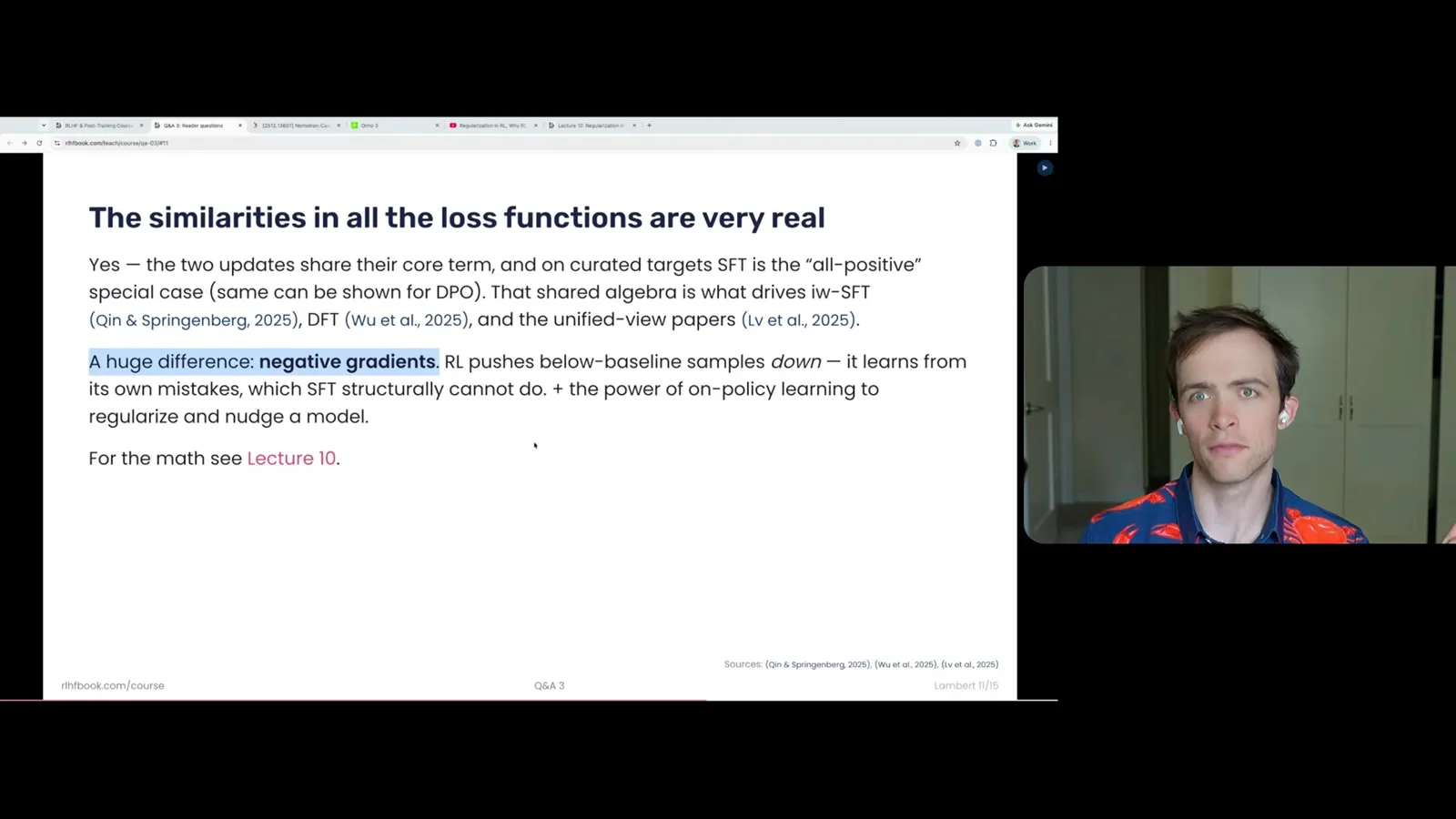
Is RL merely supervised fine-tuning with a regularization term? Their losses can have closely related mathematical forms, but RL also generates experience from the current model and updates it from that experience. One cannot necessarily prepare all of that data in advance and obtain the same result with supervised learning alone.
Supervised learning can be enough for more applications, particularly small models, than people assume. But RL can help models adapt to harder problems. Its updates can also include negative gradients that push down below-baseline behavior, whereas ordinary supervised fine-tuning primarily reinforces demonstrated targets.
Practical data decisions
Task evaluation, business value and data quality determine whether training is worthwhile.
When should an organization train its internal knowledge into weights instead of providing context at inference time? Start by building an evaluation for the actual task and deciding how much an improvement is worth. Compare that benefit with the cost of training; a meaningful frontier-scale training job can be very expensive.
Costs may fall, especially for smaller models. If a task is sufficiently narrow, a small model trained on internal data might beat a frontier model on that task or save substantial serving cost. The decision depends on the business case and on the gap between the current in-context approach and the desired performance.
Can continued pretraining on distilled data make a model worse? Yes. Synthetic or distilled data is not automatically good or bad: the teacher may be poorly matched to the student, or the data pipeline may be flawed. A well-designed pipeline can help, but there is no free improvement simply from labeling data synthetic.
Sur la même chaîne
 16:48EN
 Nathan Lambert· 2 nov. 2026Nathan Lambert on How Open Models Can Compete With Frontier LabsNathan Lambert · Allen Institute for AIOpen models are gaining use and closing capability gaps, but their builders need a sustainable economy and advantages beyond price.
 48:04ENNathan Lambert· 26 oct. 2026Nathan Lambert on Open Language Models: History, Competition and RiskNathan Lambert · Allen Institute for AIA tour of open weights, research infrastructure, distillation, adoption and the choices facing model developers.
 46:42ENNathan Lambert· 25 oct. 2026Nathan Lambert and Florian Brand on Kimi K3.1, Cyber Risk and AI AgentsNathan Lambert, Florian Brand · Allen Institute for AIThe Interconnects hosts discuss mixed model evaluations, a wave of security disclosures, and what a personal agent can do in everyday life.
 5:42ENNathan Lambert· 12 août 2026Why the Shoggoth Became a Mascot for AI Post-TrainingNathan Lambert · Allen Institute for AINathan Lambert traces a creature from Lovecraft to a visual metaphor for language models, fine-tuning, and RLHF.
 32:56ENNathan Lambert· 6 août 2026Nathan Lambert: An Introduction to AI Character TrainingNathan Lambert · Allen Institute for AIHow post-training shapes a model’s behavior, from constitutions and model specs to experiments with personality and activation steering.
 32:11ENNathan Lambert· 5 août 2026Nathan Lambert on How Language Model Evaluation Has EvolvedNathan Lambert · Allen Institute for AIFrom few-shot prompts and pass@k to agent sandboxes, noisy scores and benchmark contamination.