En 30 secondes
IBM physicist Olivia Lanes shows the small superconducting chip inside a large dilution refrigerator and explains how microwave signals control and measure qubits. The video explores why quantum systems may be useful for selected molecular simulations and why error correction remains a barrier to scaling. It also describes hybrid research that combines quantum processors with conventional supercomputers; one 12,635-atom demonstration used both and has not yet beaten the best classical approaches.
- 1The quantum chip sits at the bottom of the cooling apparatusThe video identifies a 156-qubit IBM Heron chip inside a dilution refrigerator; most of the visible structure supports cooling, wiring and shielding.
- 2Quantum simulation is a potential specialized useThe host explains why tracking interacting quantum systems becomes difficult for classical machines and discusses materials and molecular research as possible applications.
- 3A measurement yields an outcome; repeated runs reveal a patternLanes describes how the readout signal changes with the measured qubit state. Researchers repeat the experiment to estimate useful properties.
- 4The large molecule example used a hybrid calculationIBM’s reported 12,635-atom research combined quantum processors with classical supercomputers and did not yet outperform the best classical approaches.
- 5IBM’s data-center design combines modular cooling with classical machinesSystem Two is presented as a modular way to scale quantum hardware and integrate it with supercomputing.
À retenir
- A quantum processor is a different computational tool, not a universally faster replacement for a classical computer.
- IBM’s superconducting qubits need a dilution refrigerator and shielding to operate at very low temperatures.
- Repeated measurements provide estimates; adding qubits and operations also makes error control important.
- Hybrid workflows divide a calculation between classical and quantum machines; current research demonstrations do not establish a general speed advantage.
Lire le texte remanié, chapitre par chapitre
A quantum computer is not just a faster laptop
The host visits IBM to examine a specialized machine. Lanes distinguishes the small processor from the cooling system around it.
The host visits an IBM quantum-computing lab to examine a common misconception: a quantum computer is not simply a much faster version of a laptop. It is a different kind of machine whose potential lies in particular classes of problems, including modeling quantum systems.
The team arrives at IBM’s laboratory, where physicist Olivia Lanes shows them a dilution refrigerator. The suspended, chandelier-like structure holds the electronics and cooling system; the quantum processor itself is a small chip at the bottom, protected from external interference.
A classical computer represents information in bits that take values of zero or one. IBM’s device instead uses superconducting circuits as quantum bits, or qubits. The host describes superposition: before a measurement, a qubit can be in a quantum state combining the possible measurement outcomes.
Why superconducting qubits need extreme cold
The processor uses superconducting circuits controlled by microwave signals. A dilution refrigerator and shielding help maintain the conditions they need.
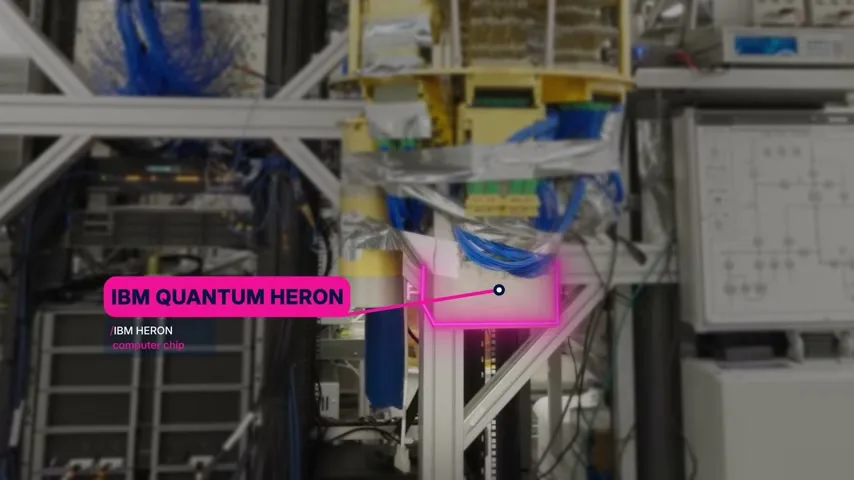
The video identifies the chip as IBM Heron, with 156 qubits. Its superconducting circuits include a thin insulating layer between aluminum layers. Microwave signals sent through the wiring control the qubits, while the refrigerator keeps them at temperatures far below those of deep space.
Lanes says the lowest stage is around ten millikelvin. Even placing the machine in Antarctica or on the Moon would not eliminate the need for cooling: the required temperature is much lower than the surrounding environment there.
Modeling molecules with quantum and classical computers
The speakers describe potential molecular and materials applications. Measuring the processor requires repeated runs to estimate results.
The host contrasts predicting a falling apple with modeling interacting molecules. Classical computers are effective for many physical calculations, but representing the full quantum behavior of a sufficiently complex system becomes difficult. Quantum processors may eventually help with selected molecular and materials problems.
As an example, the speakers discuss studying materials for better batteries. A researcher encodes a model of the system’s energy and interactions into operations on the qubits. Lanes describes how microwave signals carry those instructions to the processor.
Measurement gives a definite outcome rather than exposing the entire quantum state directly. Lanes explains that the qubit state changes the frequency of a readout signal. Researchers repeat measurements to estimate properties of the system they are studying.
Errors and scale remain challenges
A hybrid quantum-classical research demonstration is discussed. Larger fault-tolerant machines remain a future goal.
The video presents a 12,635-atom simulation as an example of current research. The cited IBM, Cleveland Clinic and RIKEN work combined quantum processors with classical supercomputers; IBM says the method did not yet outperform the best classical approaches. It is a research demonstration, not a general-purpose simulation of an entire body.
Errors remain a major scaling challenge. As operations and qubits accumulate, errors can obscure results, so a useful large machine needs reliable error correction. The video presents IBM’s target for a fault-tolerant machine by 2029 as a goal, rather than an accomplished result.
A modular quantum data center
Lanes explains how multiple cryogenic units could be combined with classical computers. Hybrid workloads aim to give each processor the work it does best.
Lanes introduces IBM Quantum System Two as a modular approach to scaling. Multiple cryogenic systems can be assembled in a larger installation, allowing a data center to combine quantum hardware with conventional supercomputers.
The host describes a research workflow for a cancer-related protein in which classical computing and generative AI handled much of the work and a quantum processor contributed to part of the calculation. Lanes says a hybrid system aims to send each part of an algorithm to the processor best suited to it and combine the results.
The visit ends with the idea of quantum-centric supercomputing: pairing different machines rather than replacing classical computers outright. The host sees possible applications in materials and drug research, while emphasizing that scaling the hardware is still work ahead.