En 30 secondes
Will Brown argues that organizations hold implicit knowledge that agents repeatedly rediscover. He proposes combining context, retrieval, evaluations, human feedback and targeted model training to make organizational workflows improve over time, and describes examples and prototypes from Prime Intellect.
- 1Implicit knowledgeBrown says important organizational context is distributed across documents, relationships and habits.
- 2Context or weightsHe distinguishes explicit rules and retrieved information from repeated patterns that may merit training.
- 3A long feedback chainHe describes how domain expertise can pass through several intermediaries before reaching a model training run.
- 4Evaluations as testsTraces and feedback can become test cases for an organization’s models and workflows.
- 5Interfaces for decisionsTask-specific widgets can ask people for judgment and create explicit feedback for later learning.
- 6A continual-learning prototypeBrown describes reviewing flagged issues and proposed experiments before an overnight training run.
À retenir
- Organizational knowledge lives in both explicit documents and implicit patterns of work.
- Skills, retrieval and model weights are complementary places to store different kinds of knowledge.
- Production traces and feedback can be curated into evaluations before they are used for training.
- Routing and decision models offer concrete, labelable starting points for learning from feedback.
- Human-friendly decision interfaces can improve interaction and provide explicit signals for evaluation or training.
Lire le texte remanié, chapitre par chapitre
The AI-native organization
Brown introduces the opportunity to combine enterprise workflows with models that improve over time.
I lead applied research at Prime Intellect. At this conference, people compare what works, what does not and what comes next. I want to look at that question at the organizational level: what would it mean for an established enterprise to become truly AI-native?
We have moved from chatbots through reasoning systems toward agents and tools that can carry out more of a workflow. The next question is how agents can be integrated throughout an organization, not just used by a small startup building quickly.
Prime Intellect builds infrastructure for training, deploying and improving models, particularly open models and tools. Our premise is that an organization can develop models around its own workflows, data and harnesses, alongside the frontier models it already uses.
Knowledge, context and weights
He describes implicit institutional knowledge and asks which information belongs in prompts, retrieval or model training.
An organization contains more knowledge than its formal documentation. Some lives in code, email and written processes; some is implicit in meeting notes, relationships, local preferences and an informal understanding of who actually makes a decision.
Individual employees may see only part of an inefficient process. An agent that examines unstructured material across teams could help surface repeated friction or reveal that one group has already solved a problem another group is still facing.
I do not want this to be a one-time analysis. The goal is a continuing loop in which agents receive the context they need and both the agents and the organization improve. Human coworkers learn on the job; current agents mostly do so through comparatively limited in-context methods.
An agent can read a skill file or inspect a codebase, but it may repeatedly rediscover institutional knowledge. Each run can require processing substantial context again. Some recurring patterns, especially preferences that are difficult to state as rigid rules, may be candidates for model training.
I think of a spectrum from rules to patterns and from code to data. A skill or explicit rule belongs toward one end; preferences, friction, heuristics and trends are often distributed across data that employees learn from experience.
That raises a practical question: what belongs in context and what deserves to be learned in the weights? Not everything should be trained in immediately. But training is already a major reason new model generations improve, and organizations can consider it for repeated, valuable workflows.
Shortening the feedback chain
Brown contrasts a multi-stage training-data pipeline with more direct feedback from people doing the work.
Consider how a frontier model might learn a specialized enterprise workflow today. An expert shares knowledge with an expert network, an environment vendor turns it into a training environment, and a lab researcher incorporates that environment into a later training run.
That long chain can resemble a game of telephone: the person who knows the work is not necessarily supervising how the model learns it. I see an opportunity to shorten the loop between a domain expert’s feedback and durable model improvement.
With coding agents, we already correct repeated mistakes and express preferences in context. Some guidance belongs in an agent instruction file, but those files can accumulate and need maintenance. A training pipeline could also learn from examples of what a user preferred in a specific situation.
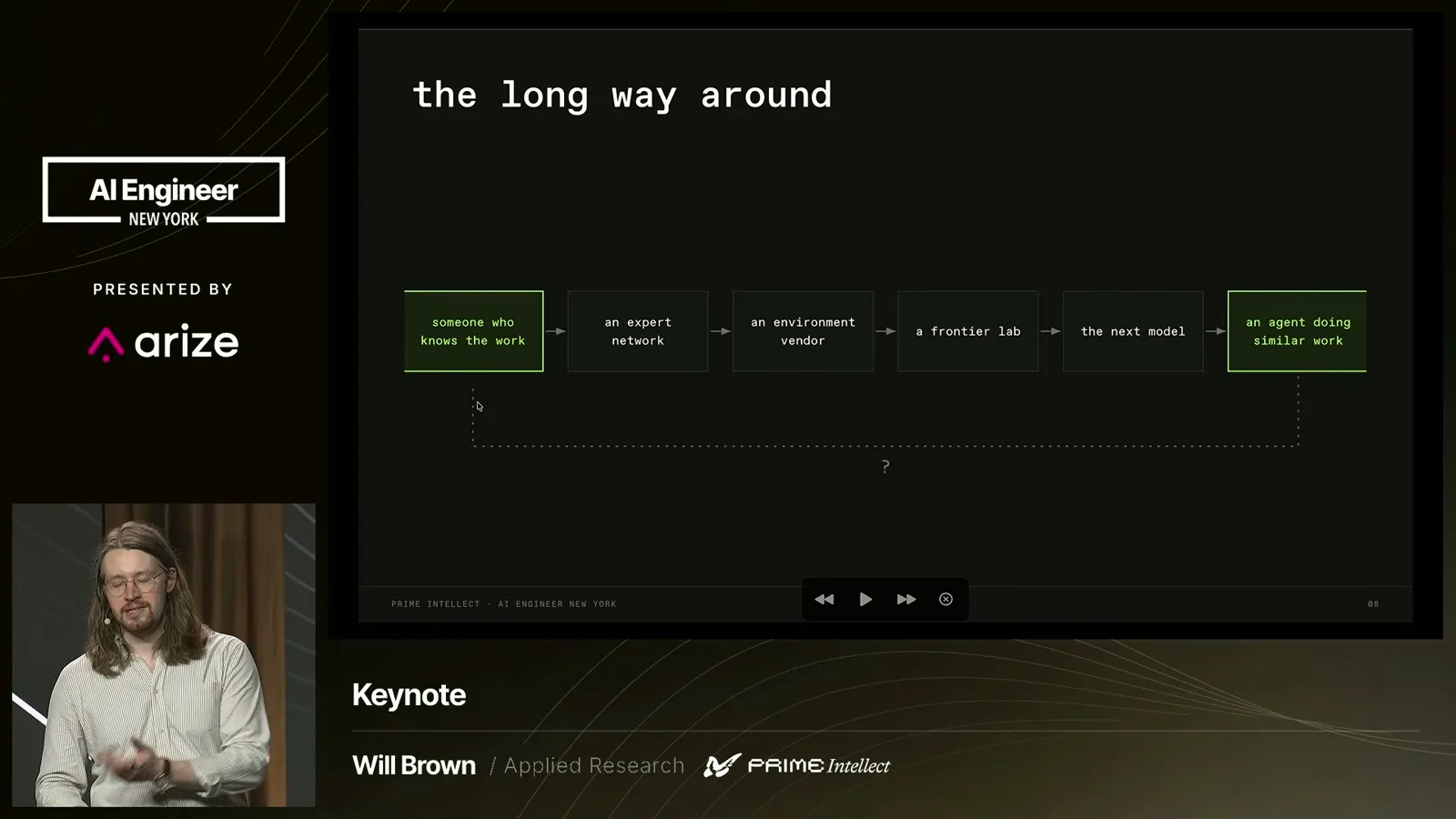
There are several complementary places for knowledge: skills and memory in the harness, documents and databases retrieved with tools, and the model’s own weights. Each has different properties; a model’s training cutoff, for example, can force it to reconstruct recent context repeatedly.
Evaluations and routing
Production traces can become tests, while comparisons and approvals can inform routing and decision models.
For organizations that want to train on their own work, evaluations are a useful starting point. Think of them as test cases: a model can have a lifecycle in which an organization adds examples, checks behavior and improves the system over time.
Using agents produces traces containing prompts, actions and feedback. Those traces can become evaluation assets, although curating good evaluations has historically taken work. Agents may help prepare examples, with attention to robustness and whether the results can support learning.
Decision models and routing provide a concrete example. A large and small model can attempt the same task, and feedback can identify cases where the smaller model performs well enough. Those comparisons can inform future routing decisions and cost trade-offs.
A decision model could also learn from an organization’s approvals and preferences. The relevant decisions are not limited to tool security: each organization has its own rules about its work. Feedback must be meaningful in that specific context.
Human decisions and continual learning
He discusses rich training environments, decision interfaces, an example model and a prototype for overnight improvement.
For more ambitious training, production traces from a high-volume workflow can help build richer environments combining real and synthetic material. With suitable orchestration, tools and human involvement, agents can help turn those traces into environments for longer-running tasks.
I am also interested in interfaces that make human decisions easier to give. Instead of searching through long agent threads for a question, an agent might generate a small, task-specific card or widget and return when it needs a person’s judgment.
We keep moving between a single agent stream and many parallel agents. The underlying need is to give agents ideas, let them work and receive decisions at useful moments. A clear interface can make that interaction more manageable.
Those decisions can also provide explicit feedback for training a decision or orchestration model. This is not a complete solution to reward hacking or other problems, but it offers a concrete place to begin collecting labels aligned with what a person chose.
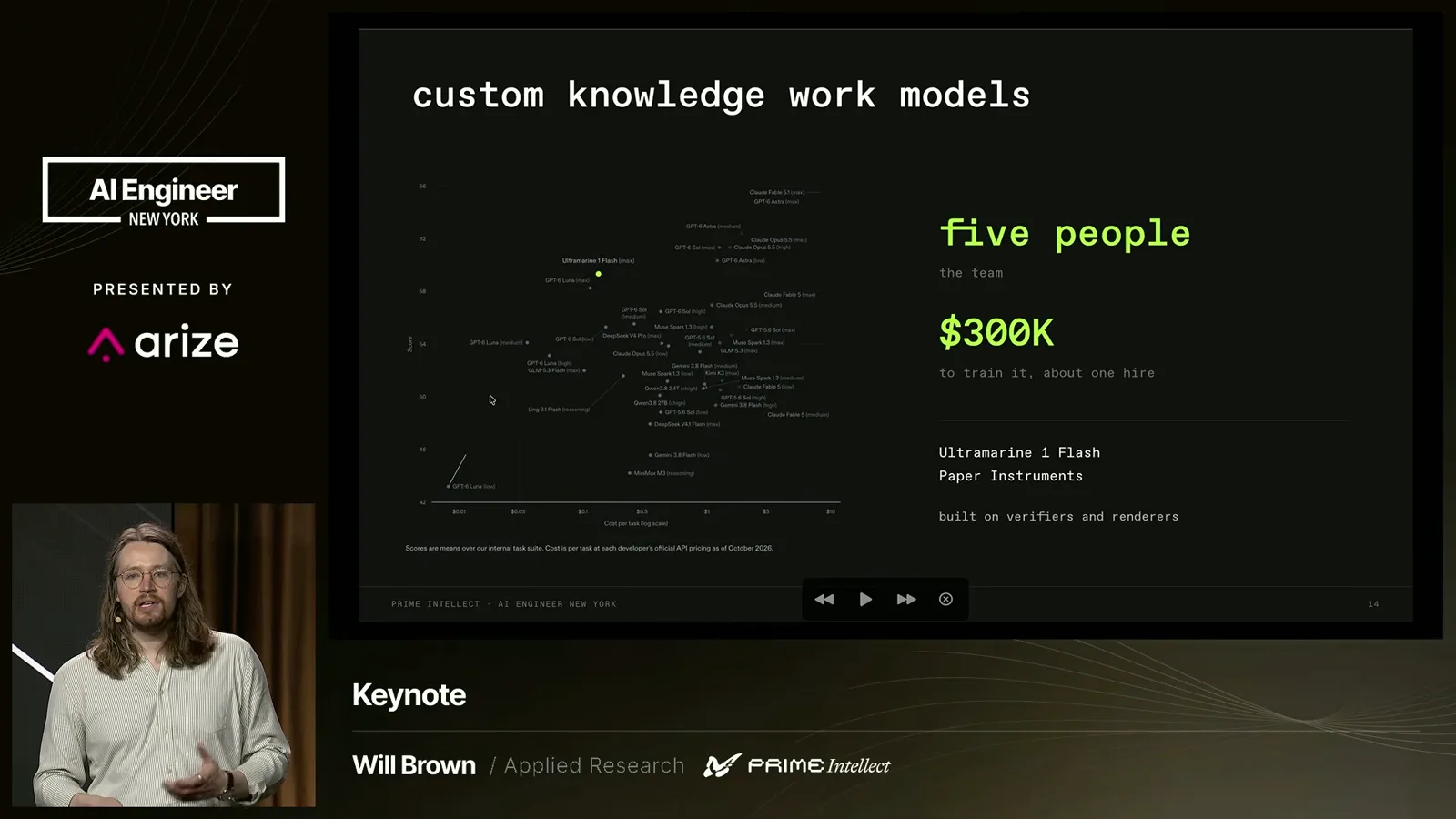
I mention Paper Instruments, a company that used some of our tooling and reported training a knowledge-work model for about $300,000. The example suggests an investment on the scale of a hire, though the right economics depend on the organization and task.
Our prototype for continual learning starts by collecting traces, flagging issues and proposing experiments. A team could review an experiment and start an overnight training run, potentially using capacity that is less busy serving employees at night.
The sequence I envision is to understand the workflow, create skills, build evaluations and routing, and then train where there is enough repeated data and value. The aim is for institutional knowledge to compound into better agents over time. That is the direction we are working toward, not a claim that every organization already has it.
Sur la même chaîne
 16:51EN
 AI Engineer· 3 nov. 2026Cristóbal Valenzuela on Interactive Video Models and Runway’s ContinuumCristóbal Valenzuela · RunwayRunway’s co-founder traces next-frame prediction from early generated film to research prototypes for interactive visual interfaces.
 15:51ENAI Engineer· 2 nov. 2026Adam Nahari: Six Moves to Turn AI Pilots Into Financial ImpactAdam Nahari · ApolloAn airline crew-scheduling example shows why financial outcomes depend on workflow redesign, adoption and disciplined measurement.
 20:39ENAI Engineer· 2 nov. 2026Sagar Batchu: Authorizing AI Agent Actions Before They Reach an APISagar Batchu · SpeakeasyA proposed governance path combines agent identity, permission ceilings, policy decisions and audit records.
 18:33ENAI Engineer· 2 nov. 2026Zack Proser: Build a Factory to Help Others Tell Their StoriesZack Proser · WorkOSA WorkOS blog assistant and a bedtime-story app show how AI tools can share expertise while humans retain responsibility.
 18:57ENAI Engineer· 2 nov. 2026Andrew Norrish: Code Context for AI-Era Incident ResponseAndrew Norrish · SourcegraphA Sourcegraph engineer describes review pressure and bounded workflows for investigating, preventing and fixing incidents.
 15:44ENAI Engineer· 1 nov. 2026Yijia Liang on Building Office-Compatible Engines for Finance AgentsYijia Liang · Compound AICompound’s approach combines shared agent inboxes, document engines and cited access to large data rooms.