En 30 secondes
After NVIDIA announced Jensen Huang’s resignation and named Colette Kress interim CEO, SemiAnalysis and ChinaTalk discuss two questions: how the United States should restrict China’s access to AI chips, and how NVIDIA will operate without its founder. Dylan Patel favors tighter controls on chipmaking equipment but argues that some supervised overseas cloud access could preserve US leverage and limit retaliation. Others question that trade-off. The speakers also see retaining engineers and executing existing chip plans as tests for NVIDIA, while differing on how much its lead could erode.
- 1The group distinguishes equipment restrictions from a cloud-access banThe participants discuss the MATCH Act as a proposal targeting chipmaking tools and RASA as a proposal addressing access to restricted computing through the cloud. They disagree more strongly about the latter.
- 2Patel favors controlled cloud access as leverageHe argues that a total ban could trigger retaliation against supply chains and accelerate domestic alternatives. He prefers permitting some overseas access through providers subject to US control.
- 3A counterargument questions whether China would escalateAnother participant suggests Chinese policymakers could use tighter restrictions to press companies to invest in domestic hardware rather than disrupt global manufacturing.
- 4Chinese accelerator adoption is already progressingThe speakers cite support for several domestic accelerators and reported training on Huawei hardware as examples. They argue about what additional restrictions would change.
- 5The debate turns to controlling how chips are madePatel says removing one input is unlikely to be decisive by itself, but restrictions on chipmaking equipment could raise the economic cost of domestic production.
- 6The near-term test is execution; the longer-term test is retentionA speaker says NVIDIA has a roadmap and strong supply-chain relationships, but retaining executives and engineers after the leadership change will matter.
- 7Patel worries decisions and product ramps could slowHe points to Huang’s involvement in problem solving and suggests delays in manufacturing or future designs could accumulate. Another speaker notes that competition was already intensifying.
À retenir
- Patel argues that restricting chipmaking equipment while allowing some supervised cloud access would give the US leverage over China’s AI compute.
- A speaker counters that China could respond to tighter cloud controls by accelerating investment in domestic chips rather than disrupting the global supply chain.
- The participants say advances in Chinese accelerators and open models complicate the assumption that restrictions alone will determine the competitive outcome.
- The speakers identify retention of NVIDIA executives and engineers, and delivery of its existing chip roadmap, as indicators to watch after the CEO transition.
Lire le texte remanié, chapitre par chapitre
NVIDIA announces a change in leadership
The speakers react to Huang’s departure and turn to the consequences for AI and US–China policy.
NVIDIA has announced that Jensen Huang resigned as CEO and that CFO Colette Kress will serve as interim CEO. The hosts react to the news and discuss how the leadership change might affect the company, US–China technology policy and AI development.
Dylan Patel says he has long supported tough controls on China but worries the moment could lead to poorly designed laws. He sees NVIDIA as weaker without Huang and asks whether the company’s interests necessarily align with US national interests.
Why equipment and cloud access draw different responses
The panel contrasts proposed restrictions on chipmaking equipment with limits on remote access to advanced computing.
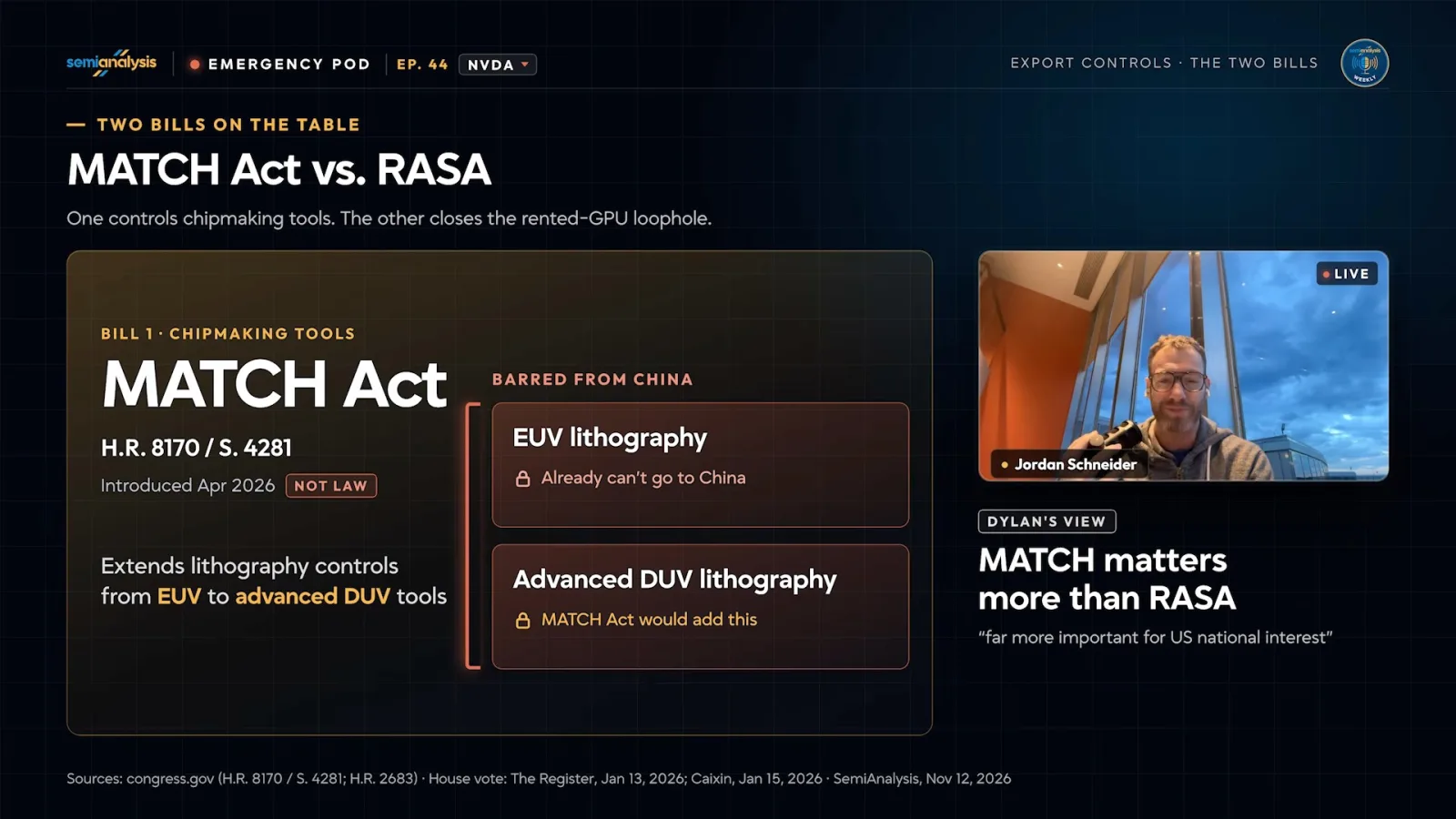
The participants contrast two proposals. They describe the MATCH Act as targeting advanced lithography equipment used to make chips, including certain deep-ultraviolet tools, and RASA as addressing remote access to restricted chips through overseas cloud providers.
Patel favors tighter equipment restrictions and says he opposes a blanket remote-access ban. He argues that advanced AI hardware depends on international components, including Chinese suppliers, so restrictions need to account for possible retaliation.
Could a total compute ban backfire?
Patel argues some supervised cloud access preserves leverage and reduces incentives for retaliation. Another participant questions how far China would escalate.
He defines his preferred policy as maintaining a US AI lead while limiting China’s access to compute. In his view, denying all access could provoke economic retaliation that also harms American companies, so the US should consider what limited access might preserve leverage.
Patel points to previous trade disputes and restrictions involving critical materials as reasons to take retaliation seriously. He argues that the US has not shown a willingness to disentangle the electronics supply chain completely.
His proposed compromise is to allow Chinese customers some computing through overseas providers subject to US oversight. He says this would let the US monitor or cut off access, while making customers pay for a service instead of owning the underlying chips.
A broad remote-access ban, Patel argues, would increase incentives to develop domestic alternatives or obtain chips through unauthorized channels. He says the US should consider how its policy choices affect the incentives on both sides.
A participant pushes back: some Chinese policymakers may prefer domestic chips and could treat cloud restrictions as a reason to accelerate local investment, rather than responding by disrupting global production. The speakers disagree about how much economic pain either side would accept.
Cloud margins and the value of open models
The group debates who benefits economically from cloud rentals and Chinese open models, and whether restrictions would free computing for US firms.
Patel argues that overseas rentals could generate substantial profit for US chip and cloud companies. He estimates margins at several million dollars per megawatt and says Chinese firms paying those margins could face higher costs than US competitors with their own infrastructure.
A counterargument asks whether keeping that computing capacity for US AI labs would produce a larger advantage. The speaker also questions whether collecting revenue from a competitor necessarily outweighs the benefits of denying that competitor access.
Patel argues that US companies also earn revenue serving open models developed in China. In his view, those models can make AI applications available more broadly and help American infrastructure companies invest further.
Smuggling allegations and enforcement uncertainty
Speakers discuss criminal cases and speculate about what executives may have known. They also debate the status and enforcement of prior diffusion controls.
The speakers turn to chip-diversion cases and discuss public allegations involving suppliers. They speculate about who may have known what, while one participant says evidence of personal knowledge and involvement would be needed to establish responsibility. Criminal charges are allegations, and the discussion does not establish that NVIDIA executives committed offenses.
The participants debate the state of earlier US AI diffusion controls. Their recollections differ about whether prior guidance was withdrawn or left in place without enforcement; they describe uncertainty and inconsistency in how policy has been administered.
The cost of severing research ties
A participant values oversight of rented compute and warns that escalating tensions could damage engineering and research relationships.
Asked about remote compute access, one participant says oversight and the option to cut off access could be valuable during a crisis. He also argues that US companies benefit from working with Chinese engineers, researchers and software, and that rising tensions could damage relationships that are difficult to rebuild.
Domestic chips make the choice more complicated
The speakers describe Chinese accelerator adoption and weigh whether manufacturing equipment or cloud capacity is the more effective target.
The speakers say Chinese developers are already supporting domestic accelerators. They point to GLM support for several local chip suppliers, work involving Huawei Ascend and a company claim that a model was trained on Ascend hardware.
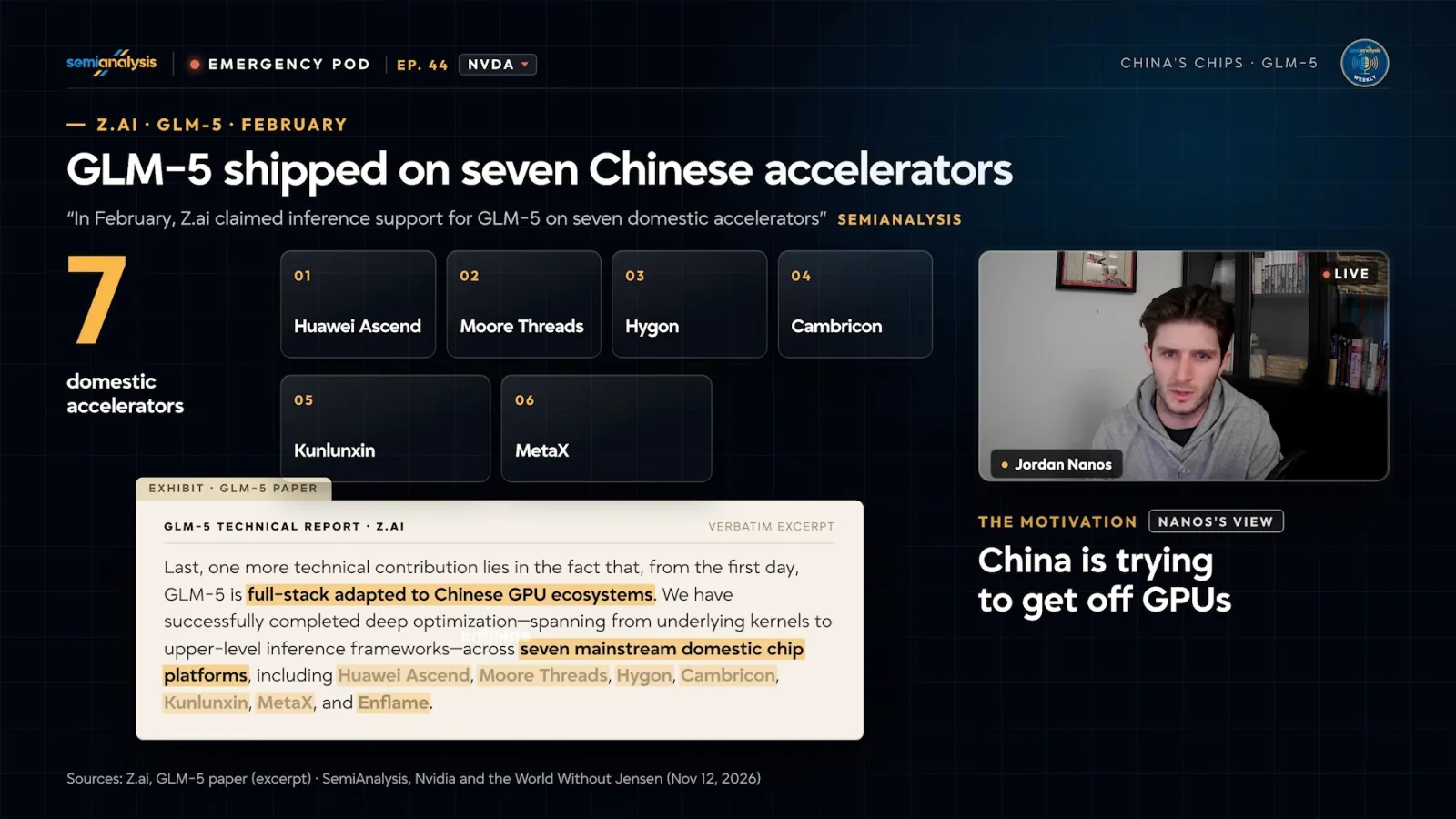
A participant says the policy choice also affects where Chinese companies can run inference—the computation needed to serve AI models—and how they compete internationally. He describes collaboration with Chinese engineers as valuable to US labs and difficult to replace if severed.
Patel compares the supply chain to a jigsaw puzzle: removing a single piece may prompt an alternative, while disrupting several connected inputs is harder to work around. He argues for focusing restrictions on the equipment used to produce chips, while allowing access further up the value chain under controlled terms.
Another participant considers the time dimension and argues that Chinese chip capabilities have narrowed the gap in some areas, even if frontier AI models differ. These are the speaker’s assessments of relative capability, not measurements established by the discussion.
The competition depends on production scale
They debate whether chip capability or the ability to manufacture at scale matters most, and acknowledge the costs to collaboration.
A participant responds that production scale matters as well as whether a chip can be made at all. In his view, access to Dutch, Japanese and other manufacturing equipment affects whether an ecosystem can produce enough advanced chips to support large data centers.
The group acknowledges the human cost of restrictions that separate researchers. They also differ over the weight to give international collaboration versus national-security concerns in setting policy.
Open models depend on talent as well as money
The group argues that hiring, engineering skill, data and access to compute all shape model development.
Asked why a US company could not simply spend billions to build a better open model, Patel says money alone is insufficient. He points to limited talent, engineering skill, computing capacity and data, and says Chinese labs have strong research teams despite constraints.
Another speaker notes that NVIDIA itself has invested in open models without necessarily outperforming competitors. The group agrees that funding and compute do not automatically produce a leading model; recruiting and execution matter too.
NVIDIA must execute its roadmap and retain leaders
The participants discuss existing commitments, talent retention and the possibility of losing long-term technical bets after its founder’s departure.
The discussion turns to NVIDIA without its founder. One participant argues that the immediate task is delivering on existing customer commitments and the Rubin roadmap, for which teams already have plans. He does not assume that the company will fail simply because Huang has left.
The longer-term test, he says, is whether NVIDIA retains experienced executives and engineers. Competitors and investors may try to recruit them, so compensation, direction and a sense of mission will matter during the transition.
He says he would be more concerned if many leaders departed within a year, and more confident if the team stayed together under Kress or another leader. NVIDIA still has strong supplier relationships, customer support, investments and a large balance sheet, in his assessment.
Another question is whether talent leaving to create new chip companies could benefit the wider ecosystem even if it weakens NVIDIA. The speakers also consider whether a successor would make the same unconventional long-term bets as a founder.
The group compares the transition with Apple after Steve Jobs, while noting that analogies have limits. Patel believes Huang has been unusually involved in supply contracts and day-to-day decisions, although he acknowledges that he knows Apple less well.
How a slowdown might show up
Patel describes potential delays in decisions and manufacturing ramps. Others ask how competitors and alternative chip teams could change the outcome.
Patel says a potential failure mode is slower resolution of manufacturing problems, with decisions passing through committees rather than being escalated quickly. He cites his experience contacting Huang to resolve a software issue as an example of the founder’s direct involvement.
Another participant says competitive pressure from custom chips was already present. Patel responds that even small delays could accumulate: manufacturing yields, future chip designs and software optimization might all suffer if decisions take longer.
The speakers disagree about the wider effect. One notes that several capable competing teams now exist; Patel argues that if the industry leader slows, competitors maintaining their existing pace do not fully offset lost progress.
The participants describe sadness and disappointment at the news, and reflect on the difficulty of separating admiration for a founder’s work from concerns about personal conduct.
Choosing a successor and assessing uncertainty
The group considers potential leaders and the tension between finance, sales and technical direction. Some speculate about the circumstances of the transition.
Asked to imagine a successor, the participants mention Lisa Su, Charlie Kawwas and Hock Tan as speculative possibilities, while also discussing interim CEO Colette Kress. These are preferences and guesses, not announced candidates.
The speakers speculate about potential scrutiny of company leadership and disagree on what inferences to draw. They return to the risks of a prolonged search and the importance of delivering future chips.
One participant worries about tension among finance, technology and sales as the company chooses a permanent direction. The group returns to its preference for discussing manufacturing-equipment restrictions separately from the more contentious cloud-access proposal.
A disputed analogy to nationalization
In an exchange the speakers characterize as speculative, one likens the leadership change to nationalization and the others reject that comparison.
The closing conversation turns briefly to a hypothetical government takeover, then to one participant’s analogy between the CEO transition and nationalization. The others reject that interpretation; the participant later calls it his own speculative theory. No government takeover is established in the exchange.
Sur la même chaîne
 42:39EN
 SemiAnalysis· 4 nov. 2026Podcast · 4 voixHow the Midterms Could Reshape the 2028 Data Center BuildoutInvité : Maya Barkin, Wayne Ma, Jeremie Eliahou Ontiveros · Anime : Jordan NanosSemiAnalysis examines permitting, grid costs and the local backlash behind a more uncertain US data center pipeline.
 51:52ENSemiAnalysis· 3 nov. 2026Podcast · 3 voixHow GDPx Tests Frontier AI: Inside SemiAnalysis’s New BenchmarkInvité : Max Kan, Andrew Megalaa · Anime : Jordan NanosThe team behind GDPx explains task quality, domain selection, grading and the trade-off between public scrutiny and private evaluations.
 55:06ENSemiAnalysis· 27 oct. 2026Podcast · 4 voixAnthropic's S-1: Revenue, Compute Costs and the Race to ScaleThe SemiAnalysis panel examines Anthropic’s filing, from improving compute economics to customer concentration and competition.
 34:35ENSemiAnalysis· 23 oct. 2026Podcast · 3 voixSemiAnalysis on ASML's Hybrid-Bonding Patents, HBM Economics and the Next Tool EcosystemInvité : Sherry Zhang, Howie · Anime : Jordan NanosJordan Nanos, Sherry Zhang and Howie examine a track-based bonding design that brings the wafer to the die, then explain why adoption depends on precision, cleanliness, economics and a changing supply chain.
 34:47ENSemiAnalysis· 20 oct. 2026Podcast · 3 voixWhy SemiAnalysis Raised Its 2027 Data Center ForecastInvité : Jeremie Ontiveros, Reyk Knuhtsen · Anime : Jordan NanosJeremie Ontiveros and Reyk Knuhtsen explain their project-level model, construction risks and the possibility of a future capacity imbalance.
 44:12ENSemiAnalysis· 14 oct. 2026Podcast · 3 voixGLM 5.3, Sparse Attention and the Cost of InferenceInvité : Kimbo Chen, Wenyao Gao · Anime : Jordan NanosSemiAnalysis examines memory bottlenecks, AMD and NVIDIA serving results, post-training and support for Chinese chips.