En 30 secondes
Jordan Nanos, Doug O’Laughlin, Jeremie Eliahou Ontiveros and Joey Brookhart discuss Anthropic’s S-1 and its implications for AI infrastructure and competing labs. They disagree on some interpretations and distinguish the reported numbers from forecasts.
- 1Operating economicsThe panel sees improving operating margins, while the filing also records a substantial net loss.
- 2Compute commitmentsThe scale of future infrastructure purchases is large, but their duration and conditions matter.
- 3Customer concentrationThe panel disagrees on how direct customers and marketplace revenue relate.
- 4Revenue per compute dollarA filing chart shows revenue growing more quickly than compute and infrastructure expense.
- 5CompetitionParticipants differ over OpenAI’s prospects and the durability of Anthropic’s lead.
À retenir
- Revenue has grown faster than compute and infrastructure expense, but operating and net profitability are different measures.
- Future compute commitments must be understood in the context of their timing and contractual terms.
- Customer concentration figures depend on whether revenue is direct or routed through a marketplace.
- Competition depends on model quality, distribution, capacity and customer switching costs.
Lire le texte remanié, chapitre par chapitre
Profitability and infrastructure
The panel examines reported operating economics and the perspective of data-center suppliers. It distinguishes current revenue from long-term compute commitments.
The panel opens with a striking shift in the economics of AI: Anthropic's S-1 suggests that customer spending is growing much faster than the cost of serving it. The participants examine how far that change can go and what it means for compute providers and competitors.
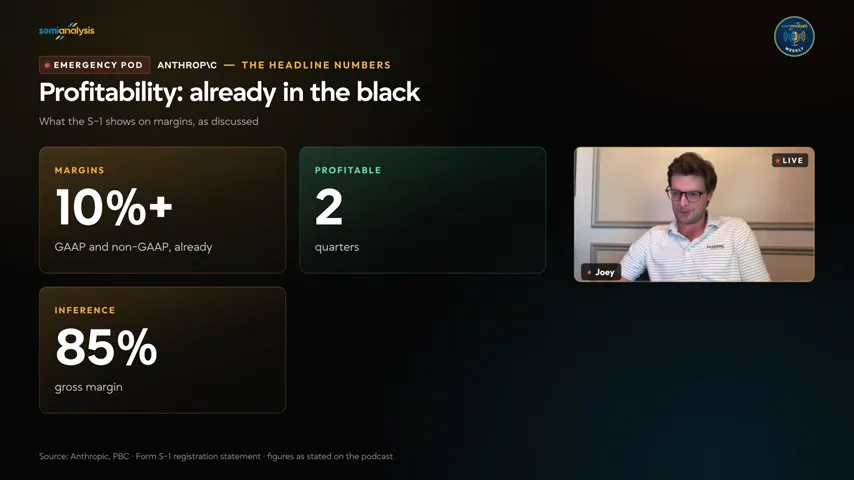
The discussion starts with profitability. The panel emphasizes operating margins and inference economics, and argues that the filing challenges the assumption that every additional dollar of AI revenue must bring a proportionate increase in compute costs. The [filing](https://www.sec.gov/Archives/edgar/data/2130357/000162828026067168/anthropicpbc-sx1.htm) also reports an $80.7 billion net loss in the first half of 2026, largely due to noncash changes in the fair value of financial instruments; operating profitability is not the same as net profitability.
The panel highlights the growth in spending by existing customers: customers who spent a dollar in the prior year are now spending several dollars. They see usage expansion as an important part of the business, although that pace should not automatically be extrapolated indefinitely.
For data-center suppliers, the numbers make the financial capacity of a major buyer tangible. The panel describes infrastructure operators' excitement at the prospect of selling additional power and capacity to a company growing this quickly.
A data center contract is only part of the picture. The participants distinguish the cost of buildings and power from the much larger cost of chips, and discuss why different suppliers can have very different exposures to an AI company's growth.
The scale of Anthropic's compute commitments draws particular attention. The panel discusses several hundred billion dollars of announced capacity and commitments, while stressing that the timing and terms of individual agreements matter when comparing the figures.
The apparent mismatch between today's annualized revenue and future infrastructure commitments is less straightforward than a single ratio suggests. The panel argues that commitments extend over time, and that future revenue and the cost of future capacity both remain uncertain.
On incremental margins, one participant estimates roughly 90% gross margin and 40% operating margin on additional revenue. These are the panel's interpretations of the reported changes, rather than a guarantee of the margins on future business.
The panel disputes the view that greater usage must inevitably make the company lose more money. Better utilization, inference optimization, pricing and a changing mix of services can all affect the relationship between revenue and infrastructure expense.
Customer concentration
The panel discusses large customers and the ambiguity of marketplace channels. It speculates about unnamed accounts without establishing their identities.
Customer concentration leads to a disagreement about how to read the filing. The panel discusses the largest direct customers and revenue routed through cloud marketplaces, and whether those categories should be treated as mutually exclusive.
One participant urges the others to distinguish a customer from the channel through which that customer purchases. If the same underlying organization can appear through a marketplace and a direct relationship, adding the percentages mechanically would exaggerate concentration.
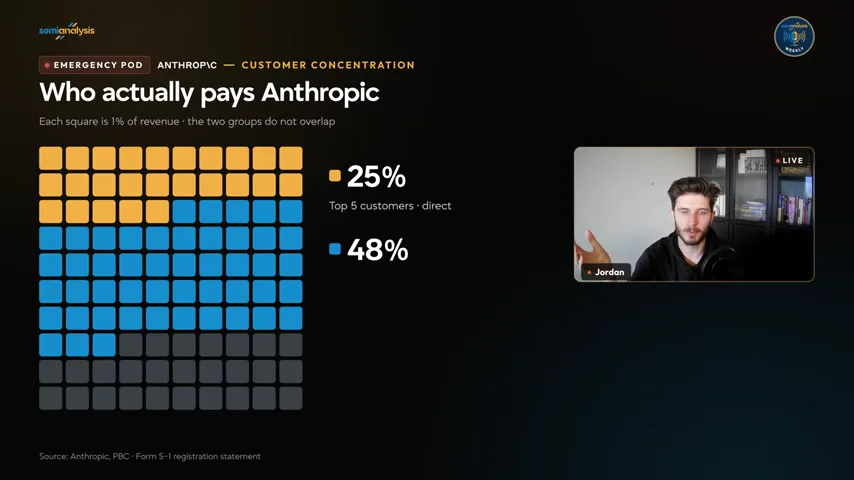
The panel continues to debate what the customer definitions mean. The filing reports that the five largest customers represented about 25% of revenue for the nine months ended September 30; the video does not settle how that figure relates to every marketplace sale.
Large enterprise accounts are growing rapidly. The panel also discusses the number of customers spending millions of dollars, and treats concentrated demand as both evidence of product adoption and a risk if important accounts change direction.
The filing anonymizes major customers as letters, prompting the participants to guess at their identities. They consider technology companies and financial firms, but acknowledge that these are inferences rather than disclosed names.
The speakers consider whether access to Claude, customer buying patterns and cloud partnerships could help identify individual accounts. They also point out that timing and the distinction between direct and indirect purchases complicate that exercise.
The group weighs the possibility that a large customer could move usage between models or providers. A customer's contractual commitments, product integration and access through cloud partners all affect how quickly that movement can occur.
The latest model's share of revenue illustrates how quickly users migrate toward newer offerings. The panel contrasts nimble startups with larger enterprises, where procurement and certification processes may delay a switch to a new model.
Funding and capacity
Potential funding, supply deals and future compute plans raise questions about timing and contractual obligations.
Funding and compute agreements are linked but are not interchangeable. The discussion turns to the conditions attached to potential financing and supply deals, including arrangements involving Google and Broadcom.
The participants discuss how additional capital could support a much larger compute roadmap. They frame future deployment and revenue as conditional on the timing of capacity, demand and execution, not as amounts already earned.
The panel asks whether Anthropic has tended to set conservative expectations and then exceed them. They treat that pattern as a management and communication strategy, while recognizing that past surprises cannot establish future results.
A particularly ambitious forecast would require both enormous infrastructure and customers willing to use it. The discussion separates confidence in demand from the practical challenge of bringing power, hardware and data centers online.
The conversation shifts to Elon Musk, SpaceX and the prospects of so-called neocloud providers. The panel discusses competing narratives about whether new sources of capacity could undermine existing infrastructure companies.
The speakers caution that public announcements can obscure very different commercial structures. They speculate about the financing incentives of infrastructure suppliers and the consequences for companies that must fund equipment before customers consume it.
A crucial comparison is the duration of a contract. An annualized price based on a month-to-month arrangement with a cancellation right is not the same thing as a binding multiyear purchase obligation, even if the headline figures look similar.
The group compares large data-center deals and stresses that a quoted price per year does not reveal all of the risk. Cancellation rights, construction schedules, financing and the split between chips and buildings determine who actually bears it.
Compute efficiency and competition
The speakers discuss revenue per compute dollar, optimization and the challenge of catching up. They consider enterprise adoption and long-term runway.
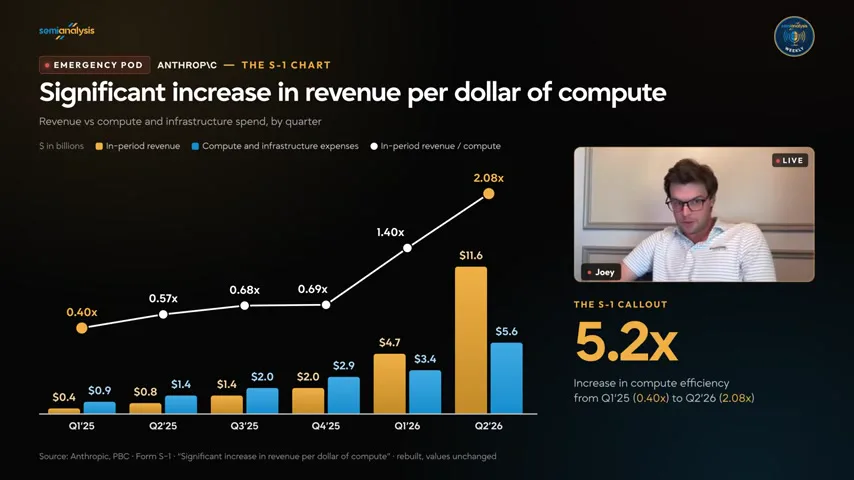
A chart in the filing shows a sharp increase in revenue per dollar of compute and infrastructure expense. The video highlights a rise from 0.40 times in the first quarter of 2025 to 2.08 times in the second quarter of 2026.
The panel attributes the improvement to a combination of factors, including model quality, higher utilization and engineering work that makes inference more efficient. Revenue and infrastructure costs are not identical measures of product gross margin.
They discuss the practical work of optimizing inference across different chips and clouds. Better kernels and software can increase the amount of useful work delivered by existing hardware, while access to several suppliers can alter costs and capacity constraints.
The conversation turns to AI's ability to help with technical work itself. The participants offer examples and predictions about increasingly capable models, but their most ambitious claims about future scientific breakthroughs are forecasts rather than established results.
Can another lab catch up? The panel argues that compute alone is not enough: model quality, research and engineering execution also matter. Some participants are skeptical that a new entrant can readily match the incumbent's pace and scale.
A lead can reinforce itself if a better model attracts more use and revenue, which in turn supports more compute and research. The speakers still recognize that customers can use competing models and that today's lead does not settle the market permanently.
They consider the way Claude can be applied to improve engineering inside the company. Their argument is that a strong coding model may help the team execute faster, though the size and durability of such a feedback loop are uncertain.
The panel revisits what surprised them in the filing: not simply growth, but the combination of revenue growth and improving operating economics. They discuss how those figures fit their earlier expectations about the company's trajectory.
There is disagreement about the remaining runway. One view is that most enterprise employees still use very little AI, leaving substantial room for spending to grow; another warns against assuming current power-user behavior becomes the median.
The speakers broaden the question beyond software engineers. Claude's current use is heavily associated with coding, but the potential market depends on whether other kinds of white-collar work become frequent, valuable users as well.
Large estimates of enterprise spending are sensitive to adoption, price and productivity. The panel treats them as a way to think about the opportunity rather than as a forecast guaranteed by the current customer base.
Markets and rivals
The group debates market reactions, seasonal usage and OpenAI’s competitive position.
Turning to market reaction, the panel asks how public investors might value other AI and infrastructure companies once more financial information about Anthropic is available. Their discussion is about possible reactions, not investment advice or a settled valuation.
Usage seasonality is another complication. The filing describes a decline around the start of January relative to the preceding weeks; the participants debate what holidays and changes in the mix of users could mean for future spending.
A slowdown during a holiday is not necessarily evidence that the underlying market has stopped growing. Equally, the panel cautions against reading a single point in time as proof of a permanent growth rate.
The speakers return to forecasts and the possibility that future product releases change demand. They note that expectations depend on timing and capabilities that were not established by the figures already reported.
The panel then debates OpenAI's competitive position. One participant is more pessimistic about its current trajectory, while others point to strong products, enterprise relationships and the difficulty of declaring the contest over.
The comparison varies by use case. Participants describe preferences for particular models in coding or data analysis, but their experiences are examples of user choice rather than a comprehensive measure of either company's performance.
Even if one provider is ahead in a particular domain, rivals have customers, infrastructure and room to improve. The panel discusses how model quality and commercial distribution could change the balance over time.
Enterprise relationships may make customers slower to switch than individual developers. Prepayments, integrations, security requirements and procurement all influence how quickly a business can move spending between providers.
The panel also considers the cost of serving free users and the challenge of turning broad consumer usage into profitable revenue. Different product mixes can make two companies' economics difficult to compare directly.
Government revenue and closing
Government agencies account for a small reported share of revenue. The episode ends with audience comments and informal conversation.
The filing says U.S. and non-U.S. government agency contracts together accounted for approximately 1% of revenue in each period presented. The speakers discuss government procurement and the gap between its visibility in public debate and its reported revenue share.
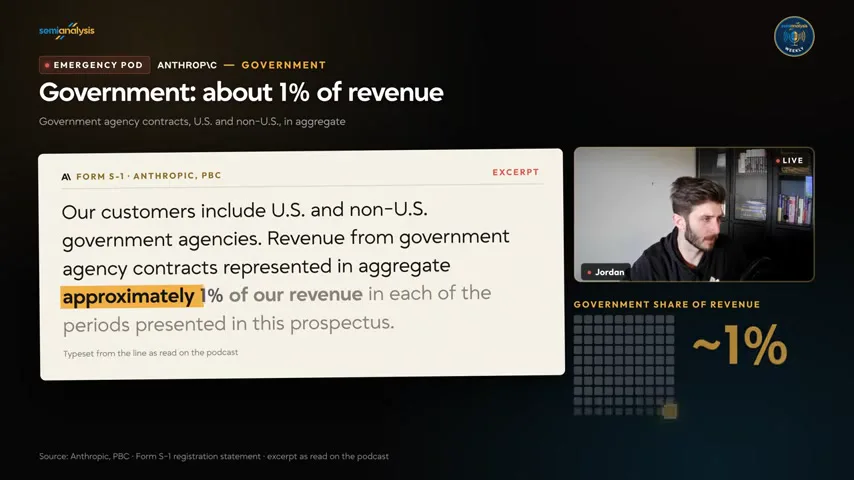
Government adoption may still matter strategically even when its current share is small. The group discusses procurement channels and the larger installed base of enterprise software, without treating future government revenue as certain.
As the discussion winds down, the participants exchange lighter remarks about their offices, online security and the culture around AI companies. The closing conversation moves away from the financial analysis.
The panel responds to comments from viewers and jokes about appearances and upcoming plans. The banter continues through the end of the episode, after the discussion of Anthropic's filing has concluded.

