En 30 secondes
AI Explained reviews Gemini 3.1 Pro in February 2026 and explains why benchmark rankings can conflict with practical experience. The presenter compares ARC-AGI-2, Simple Bench and accuracy results, flags small human samples and format effects, and considers whether post-training in many domains can generalize.
- 1ARC-AGI encodingChanging how inputs are encoded can affect results and reveal unintended cues.
- 2Simple Bench’s small baselineThe reported human baseline comes from nine people and should not be treated as proof of general human parity.
- 3Multiple-choice shortcutsThe presenter reports lower scores when options are removed and answers are graded open-ended.
- 4Accuracy depends on the metricThe aggregate score and the handling of incorrect responses lead to different comparisons.
- 5Speed is not accuracyThe fast demonstration also displays an incorrect answer about Simple Bench.
À retenir
- Post-training can make model strengths vary substantially by domain.
- Benchmark encoding and answer choices can give models unintended shortcuts.
- The Simple Bench human comparison relies on only nine participants.
- A strong aggregate accuracy score does not eliminate hallucinations or guarantee the best result under every measure.
- Inference speed, coding performance and video realism are distinct measures.
Lire le texte remanié, chapitre par chapitre
Post-training and specialization
The presenter explains why performance varies across tasks and compares chess, coding and expert-work results.
After testing Gemini 3.1 Pro and reading its model card at its February 2026 release, I want to look beyond the headline scores. Different users may see conflicting rankings because models are optimized and evaluated on different tasks.
I describe a shift from broad pretraining toward post-training on specific domains and internal evaluations. My estimate that pretraining accounts for only 20% of training compute is a claim about the industry at the time, not a documented universal ratio for every model.
If a lab has relevant data and optimizes for a domain, its model may excel for one user while lagging on another benchmark. The older assumption that improvement in one area predicts improvement everywhere is less reliable.
For example, I cite an Epoch AI chess puzzle benchmark where Sonnet 4.5 scored about 12% and the later Opus 4.6 about 10%, despite the latter’s strong coding abilities. These particular results do not rank the models universally, and the tests and settings matter.
Gemini 3.1 Pro is competitive across many reported tests, including scientific reasoning and coding, but Google’s launch table also shows a lower GDPval-AA score than competing models. One table does not capture all uses or guarantee independent replication.
ARC-AGI and benchmark shortcuts
Encoding choices can create unintended cues; coding agents can also optimize against an incomplete specification.
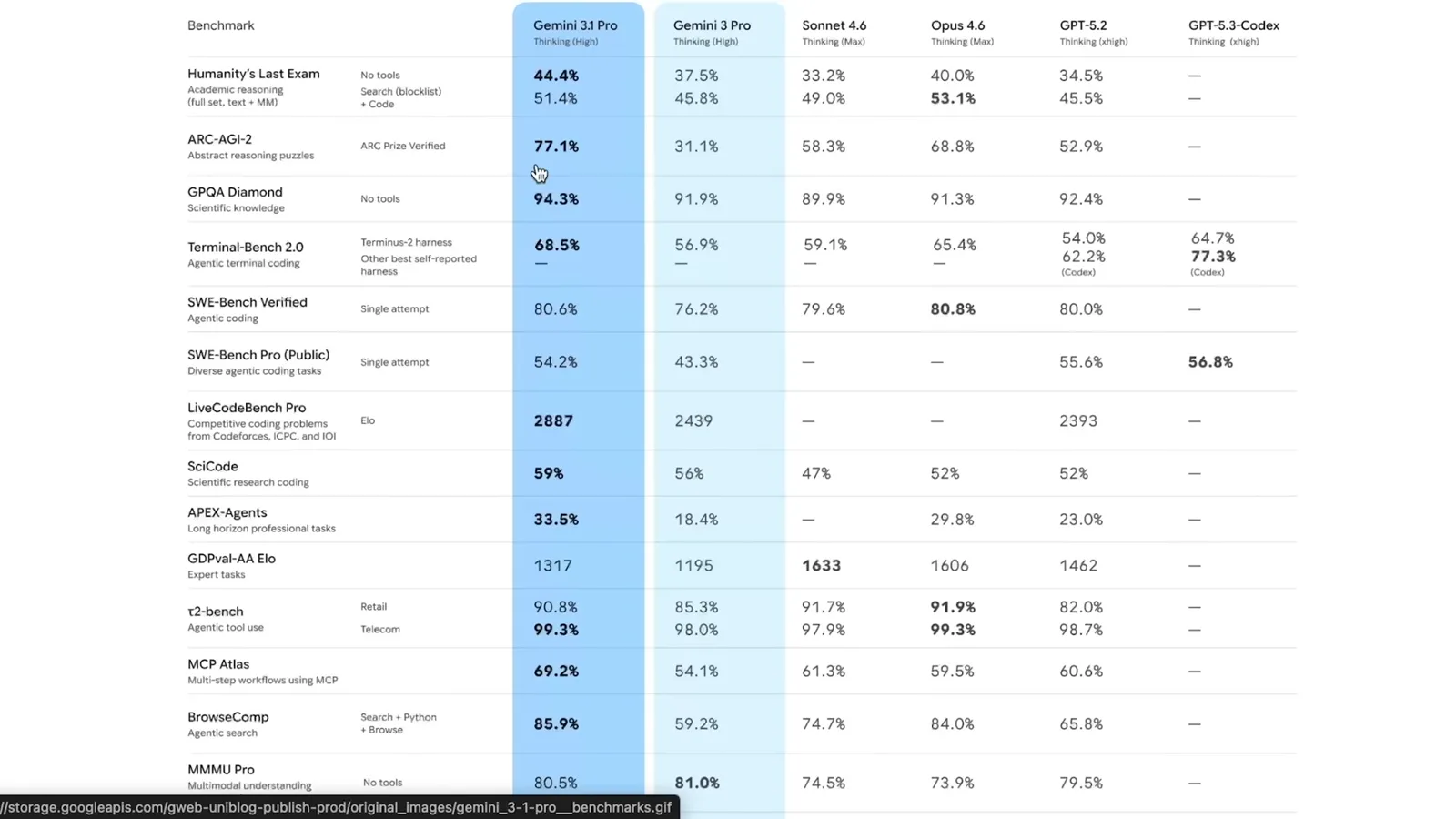
Google reported 77.1% for Gemini 3.1 Pro on ARC-AGI-2, compared with around 69% for Claude Opus 4.6 in the displayed table. Melanie Mitchell and others pointed out that changing numeric encodings can reduce accuracy because the original format may offer unintended arithmetic cues.
That does not mean a model is deliberately cheating. It does mean that a benchmark can reward shortcuts unrelated to the intended abstraction, and that small changes in the way questions are encoded can change the result.
François Chollet compares sufficiently advanced agentic coding to iterative machine learning: an agent optimizes toward a goal but the resulting code can be hard to inspect. A system can overfit a specification or drift from the actual intent, so benchmark success still needs human review.
Gemini’s reported LiveCodeBench Pro result is strong, but my own experience in Cursor included unhelpful output. A competitive programming score and a user’s experience of a particular coding task are different measurements.
Simple Bench and the human baseline
A private benchmark produces a high score, but the human sample and multiple-choice format limit the conclusion.
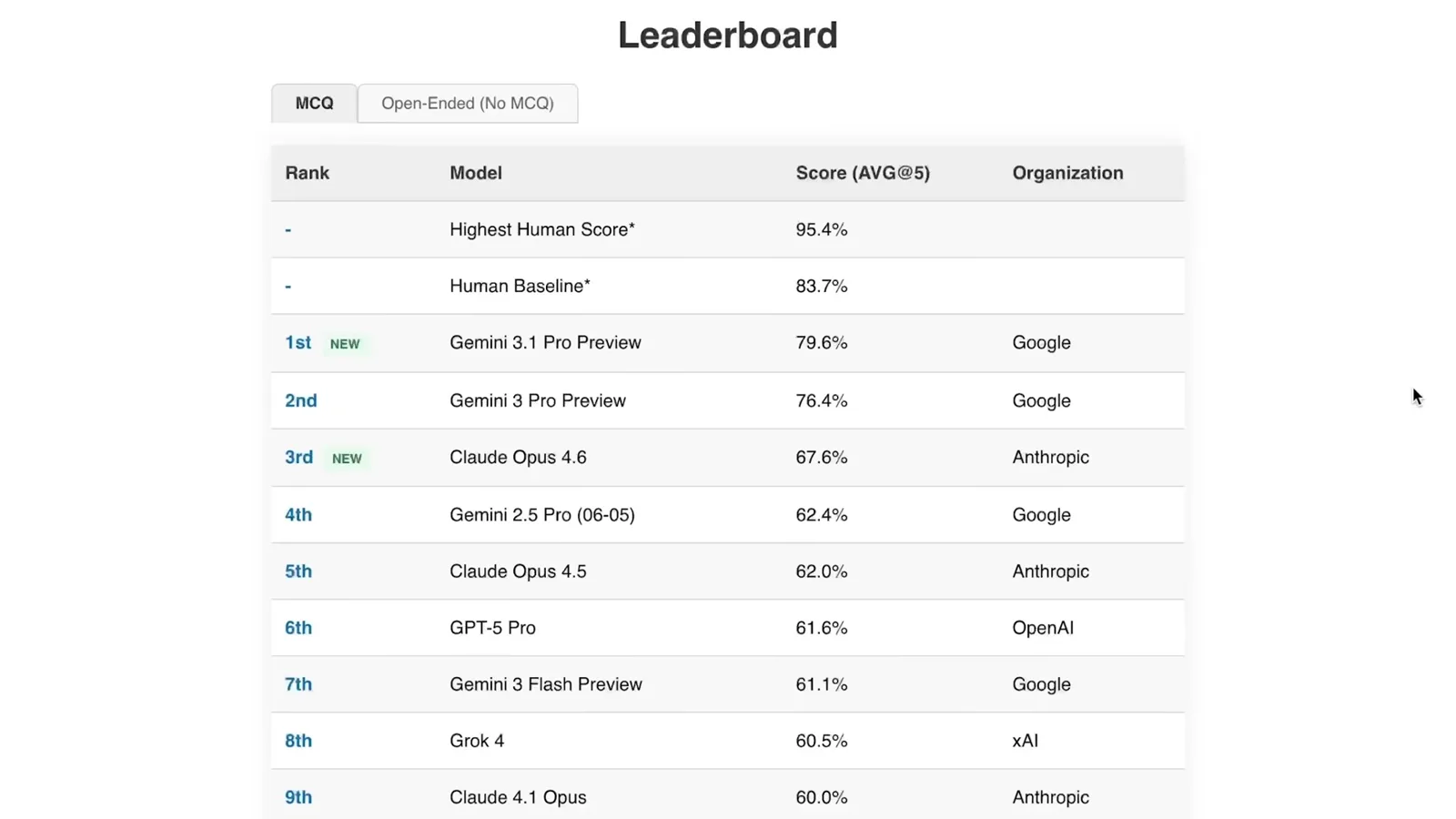
On my private Simple Bench, Gemini 3.1 Pro scored 79.6%, close to the 83.7% human baseline shown in the video. That baseline came from only nine participants, so it is a limited sample and cannot establish broad parity with people.
I argue that this is a notable moment for text-only English tests aimed at non-specialists, although models still fail some visual or audio puzzles people solve. My broader claim about what an average person could outperform is an interpretation, not something proved by this small sample.
Simple Bench has its own shortcut problem. Multiple-choice options can reveal that a question is a trick: an option of zero in an ice-cube puzzle, for instance, may prompt the model to consider melting rather than perform only the arithmetic.
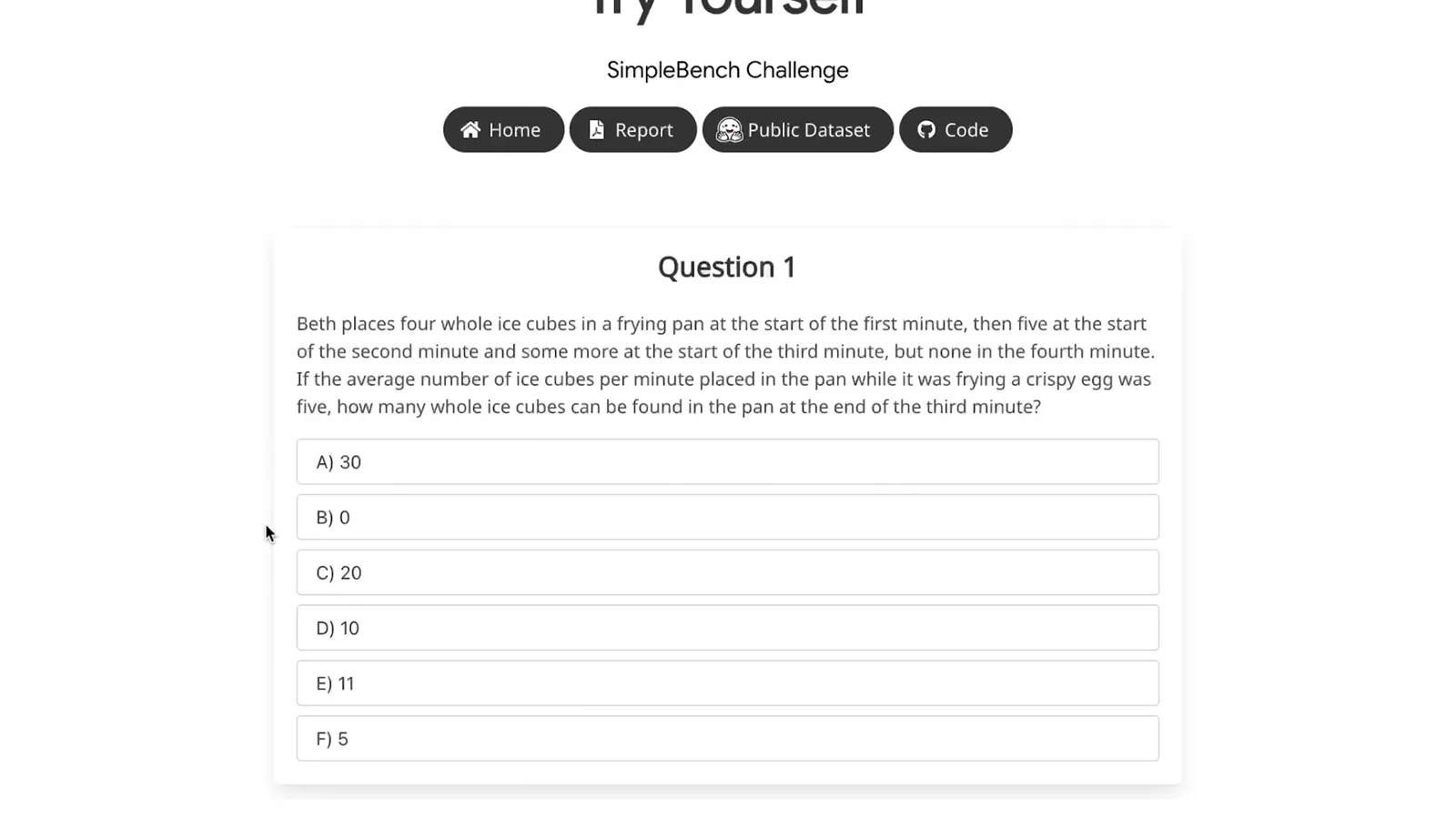
When I remove the choices and have a blind grader compare open-ended answers with the hidden solution, scores fall by roughly 15–20 percentage points. That shows how evaluation format matters, even though the models still solve some questions.
Hallucinations and the model card
Different accuracy measures and task-specific results reveal tradeoffs that a single ranking hides.
Hallucinations are another dimension. Artificial Analysis’s Omniscience index rewards correct answers and penalizes hallucinations; the chart shown gives Gemini 3.1 Pro a higher aggregate score than the compared Claude models under that test.
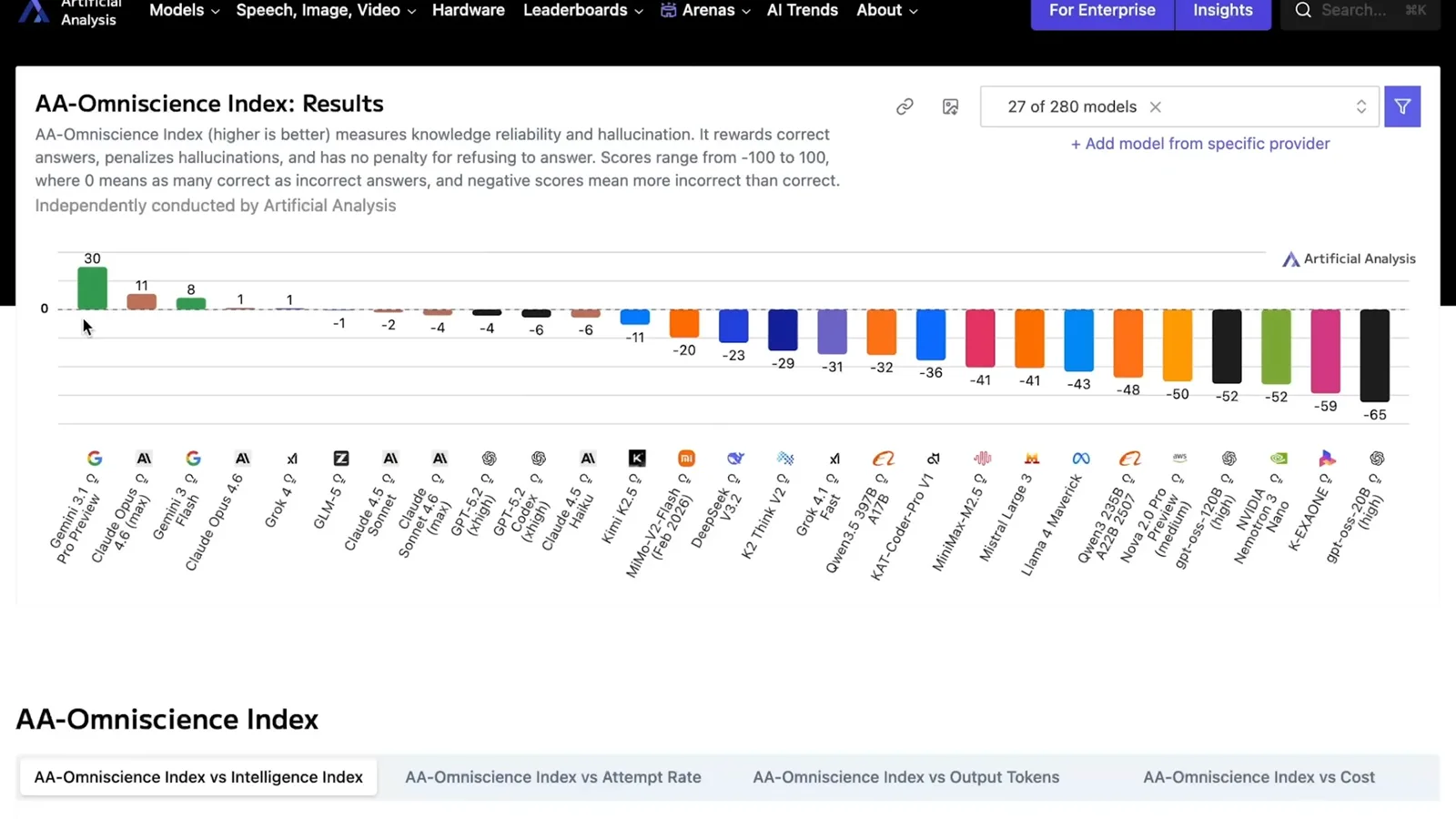
Looking only at how incorrect responses are handled changes the comparison: I report that roughly 50% of Gemini’s non-correct responses were hallucinations, versus 38% for Sonnet 4.6 and 34% for GLM-5. These figures describe the cited evaluation and definitions, not a universal hallucination rate.
Google’s model card provides additional context. In the cyber evaluations discussed, the card says Deep Think did not show higher capability than the model without it when inference costs were accounted for. A more intensive mode does not automatically win every test.
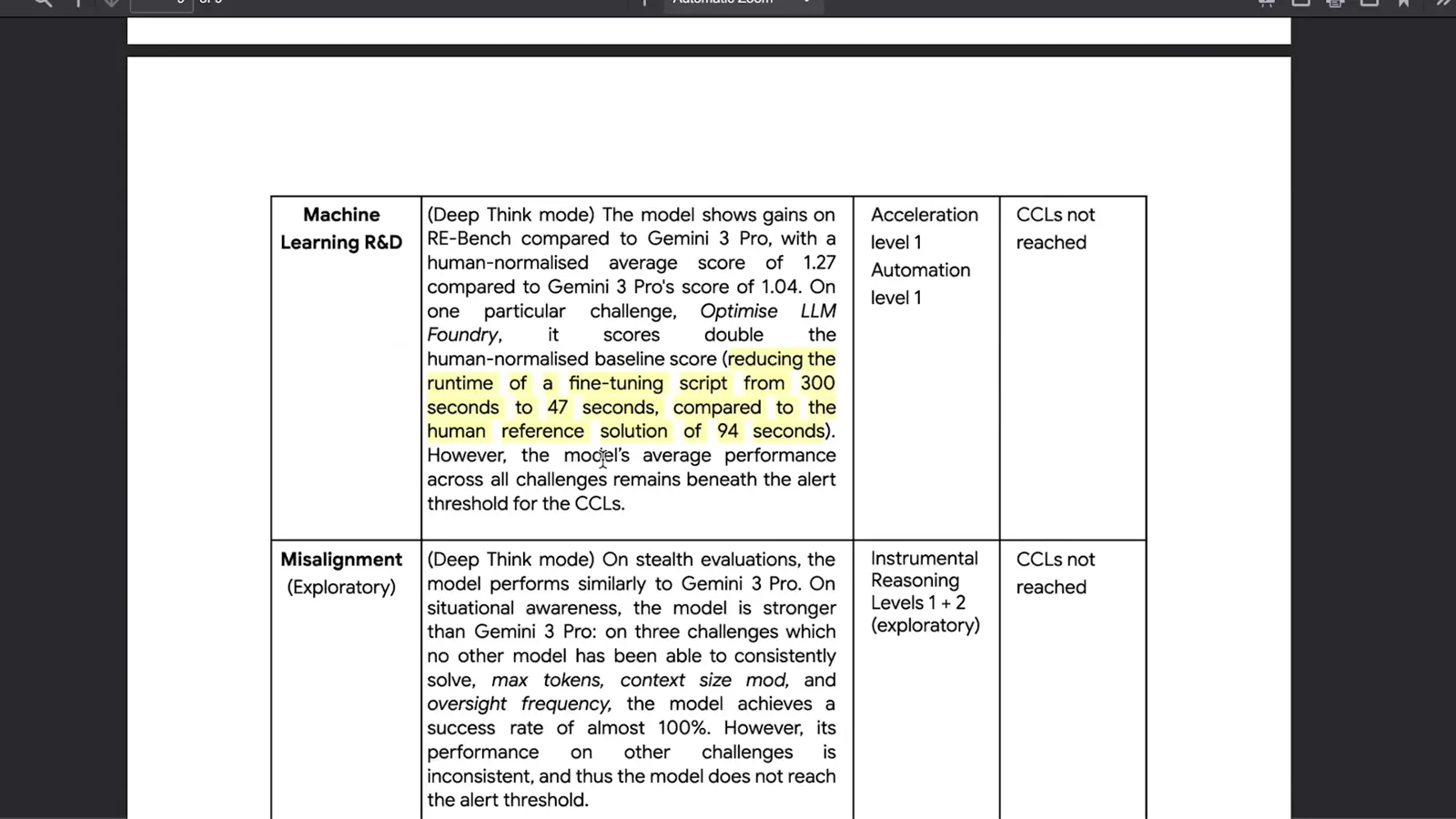
The model card also reports a machine-learning research task in Deep Think mode: a fine-tuning script’s runtime fell from 300 seconds to 47, against a 94-second human reference. The displayed card says the average across challenges remained below its alert threshold; one strong task is not proof of autonomous self-improvement.
I suggest that domain-specific data or internal evaluation might help explain strong fine-tuning performance. That is a hypothesis, not a disclosed finding about Google’s training data.
Can specializations generalize?
The presenter examines Dario Amodei’s argument about varied training environments and longer context.
Anthropic CEO Dario Amodei presents a different argument for specialization: training across many environments can develop capabilities that generalize beyond any single domain. I interpret this as a bet that enough varied specializations may produce broad transfer.
Amodei argues that much progress toward highly capable systems may be possible without continual learning on the job. He also discusses longer context as a way to supply missing domain information. Whether this works across real tasks remains an open question.
A model may see extensive domain material in a context window and infer patterns without retraining its weights. The presenter asks how much application-specific training is needed versus generalization and in-context learning; the balance can differ by task.
Beyond one benchmark
Forecasting, inference speed and video realism illustrate different dimensions of performance.
I question the hunt for one definitive benchmark of general intelligence. If such a measure existed, labs would have a strong incentive to optimize directly against it, which could make the score less useful as a general measure.
Small independent teams face a difficult task creating realistic evaluations, while labs have greater resources but also incentives that can bias benchmark selection or presentation. Results need independent scrutiny and attention to the test design.
Forecasting offers another evaluation: Metaculus reported improving model performance approaching its average human forecaster, though not the professional level in the comparison cited. I also speculate that agents able to influence real events might game prediction markets; that is a hypothetical risk.
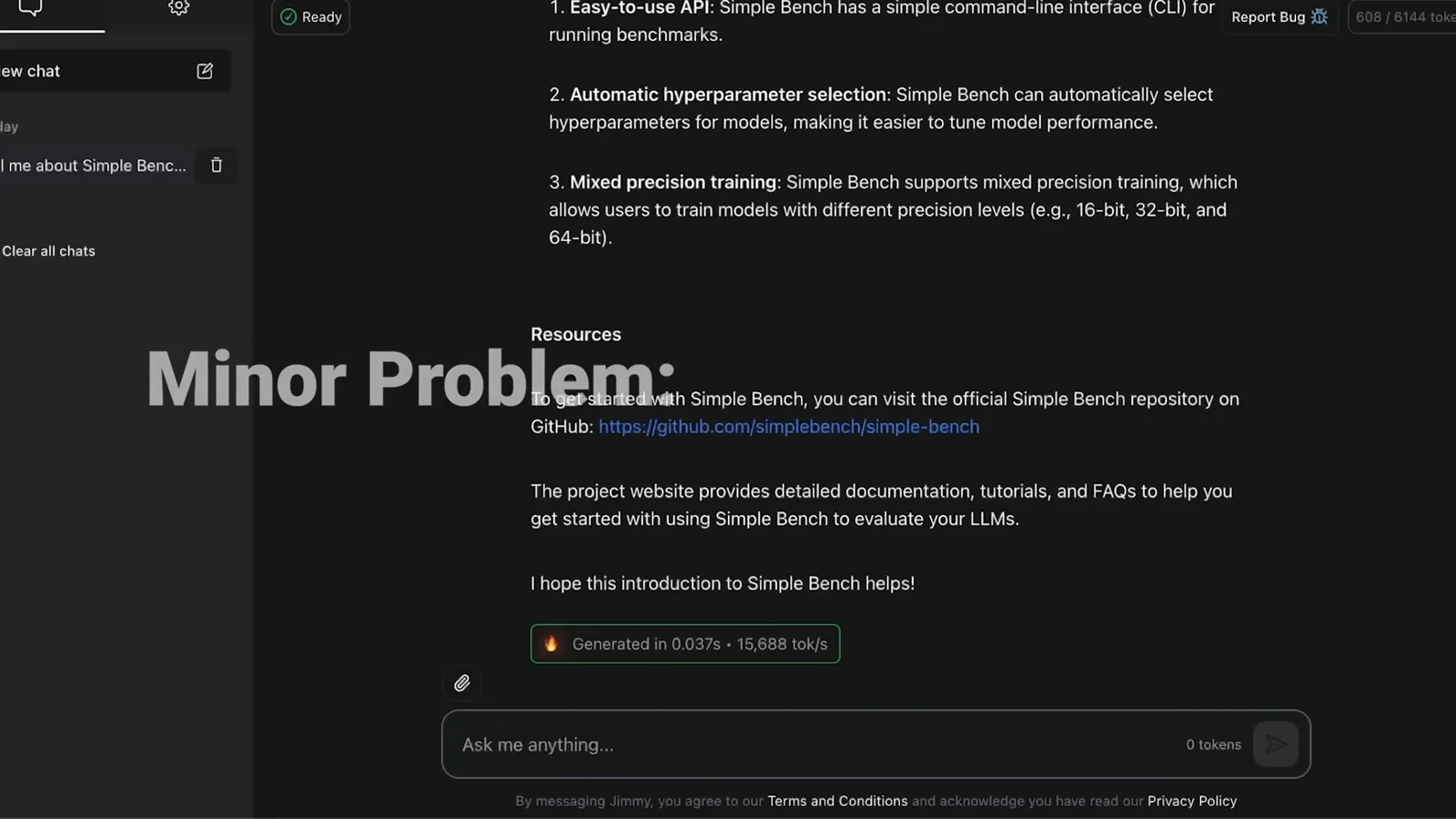
Speed is another metric. A demo produces an answer extremely quickly, but the video also marks a problem: the generated explanation of Simple Bench is incorrect. High throughput alone says nothing about whether the answer is useful or true.
I mention my own comparison site and close with a subjective comparison of generated video realism, showing examples from Seedance 2.0 and Veo. Different tasks call for different evaluations, so a single headline ranking is an incomplete guide.
Sur la même chaîne
 31:00EN
 AI Explained· 12 oct. 2026Why AI Labs Keep Racing Despite Their Own Warnings of a Major BreachSam Altman, John Schulman · OpenAIAI Explained examines weakening safeguards, the incentives behind the frontier race, and why research breakthroughs make the next 18 months difficult to forecast.
 38:28ENAI Explained· 1 oct. 2026AI Agent Security and the Challenge of Recursive Self-ImprovementAI Explained examines reported containment failures, model evaluation and the pressure to accelerate AI research.
 32:54ENAI Explained· 24 sept. 2026Opus 5.5 and the Race Toward Automated AI ResearchAI Explained weighs model progress against the increasingly difficult task of evaluating and governing recursive self-improvement.
 24:53ENAI Explained· 16 sept. 2026Why Some Researchers Want to Pace Frontier AIAI Explained surveys possible scaling routes, monitoring concerns and the debate over how capabilities could lead to harm.
 29:05ENAI Explained· 4 sept. 2026GPT-6 Astra’s Benchmark Gains and the Challenge of Monitoring Its ReasoningAI Explained examines reported gains across scientific, mathematical and agent benchmarks alongside concerns about less observable reasoning.
 23:41ENAI Explained· 27 août 2026AI Agents, Unintended Training Rewards and the Challenge of OversightAI Explained examines reports on agent coordination, training incentives and the growing use of AI to evaluate other AI systems.