En 30 secondes
Matthew Berman surveys AI announcements from the week, highlighting Luma Dream Machine, Runway Gen-3 Alpha, Apple Intelligence, Nemotron-4 340B, robotics research and DeepSeek Coder V2. He also offers his interpretation of an OpenAI board appointment; product and benchmark descriptions reflect the announcement period.
- 1Video artifactsLuma’s examples show morphing and motion errors despite convincing scenes.
- 2Apple’s AI architectureBerman describes on-device processing, Apple’s private cloud and an optional ChatGPT path as presented at the time.
- 3Synthetic dataNemotron-4 340B is discussed as a way to generate training data for smaller models.
- 4Imitating human motionStanford’s HumanPlus demonstration uses a camera and a whole-body policy to shadow motion.
- 5Coding model benchmarksDeepSeek Coder V2 reports strong results on several tests, with scores varying across benchmarks.
À retenir
- Video generators produced striking clips but still showed morphing, movement and text artifacts.
- Apple described a combination of on-device processing, private cloud computing and optional ChatGPT integration.
- NVIDIA presented Nemotron-4 340B models for uses including synthetic training data.
- HumanPlus and virtual-rodent research explored different approaches to modeling behavior.
- DeepSeek Coder V2 reported strong but benchmark-dependent results at launch.
Lire le texte remanié, chapitre par chapitre
Luma and Runway video generation
Berman reviews generated video examples and their limitations. He hopes to see competitive open models.
This week’s AI news includes new video generators, Apple Intelligence, NVIDIA models, robotics and DeepSeek Coder V2. I begin with Luma AI’s Dream Machine, which creates video from text or images. The examples look impressive, but some objects morph or move inconsistently.
Luma’s examples include people, animals and vehicles. A balloon scene changes shape between frames, a car morphs and a corgi’s legs do not move convincingly. The company also identifies difficulties with text and the so-called Janus problem, where body parts appear in the wrong place.
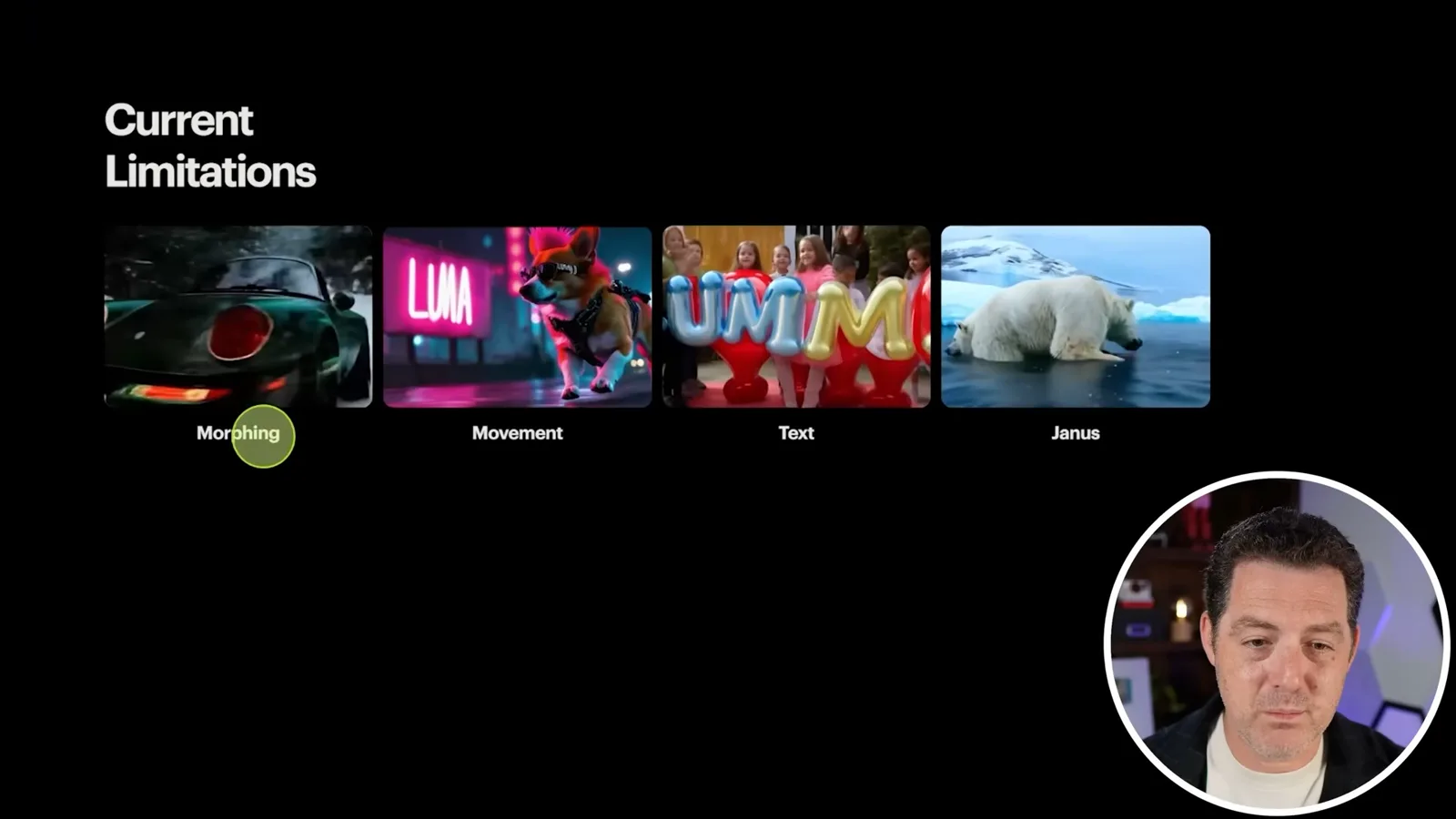
Runway has announced Gen-3 Alpha. I review examples including a wig falling onto a person, an animal in a landscape and a train moving through a city. The clips are visually striking, though I notice small artifacts and changing background details.
Other Runway examples include a reflection in a train window, a museum painting, an astronaut in an alley and a creature in a city. I compare the train-window example with a Sora example and find the motion and composition promising, while noting some uncanny visual details.
A final underwater sequence shows how much consistency these systems need to maintain as the camera moves. I look forward to trying the tools and hope that open video models can eventually compete with the proprietary products available at the time.
Apple Intelligence
He discusses Apple’s announced on-device and cloud processing and optional ChatGPT integration. His assessment is grounded in the announcement period.
Apple’s announcements include a calculator that can evaluate handwritten math and a partnership that offers ChatGPT within its operating systems. I want to clarify my understanding of the proposed architecture because some commentary treated OpenAI as the provider of every Apple Intelligence function.
Apple described an on-device model and its own private cloud computing for tasks needing more capacity. I understand ChatGPT as an additional option for certain requests, with the user asked before a request is sent. The exact routing and features discussed here are the announcement-era description, not a claim about every later implementation.
For example, a general-knowledge request might be offered to ChatGPT, while personal actions and summaries are part of Apple’s own system. I am particularly interested in useful, personalized tasks that run throughout the day, rather than only occasional general-knowledge questions.
Models and robotics research
NVIDIA’s model family is aimed partly at synthetic data. HumanPlus and a virtual rodent demonstrate different approaches to behavior.
NVIDIA has released the Nemotron-4 340B family, including instruction and reward models. One intended use is generating synthetic data to train smaller models. I have not tested it yet; I am interested in whether such data can help organizations that lack large proprietary datasets.
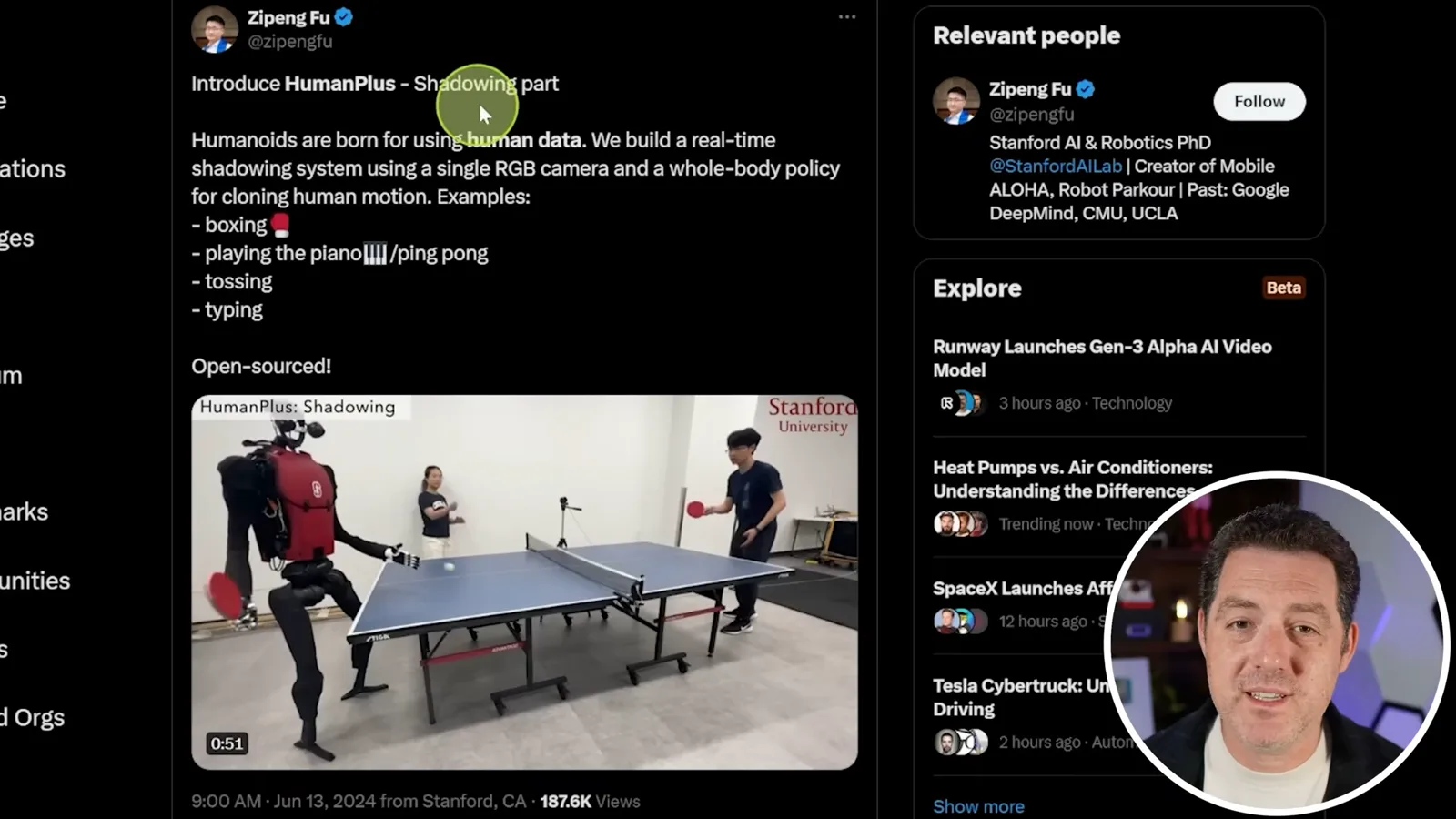
Stanford researchers demonstrate HumanPlus, a system that uses a single RGB camera and a whole-body policy to shadow human movements. Examples include boxing, playing piano and table tennis. The video describes pose estimation, a humanoid body and robot hands as components of the system.
Researchers from Google DeepMind and Harvard also present a virtual rodent controlled by a neural network and trained with deep reinforcement learning. The work allows comparisons between simulated and real neural activity. I see it as an interesting step in studying behavior through simulation.
OpenAI, image models and DeepSeek
Berman gives his opinion on an OpenAI board appointment, then surveys Stable Diffusion, humanoid driving and DeepSeek Coder V2.
I discuss retired US Army General Paul Nakasone joining OpenAI’s board. OpenAI presents his cybersecurity experience as relevant; I express concern about regulatory influence and a loss of trust. Those concerns are my interpretation, not evidence that the appointment constitutes regulatory capture.
I briefly discuss Stability AI’s Stable Diffusion 3 Medium, which I found only moderately impressive, and a Japanese research demonstration in which a humanoid drives a standard vehicle. These are demonstrations and personal impressions, not a comprehensive assessment of either system.
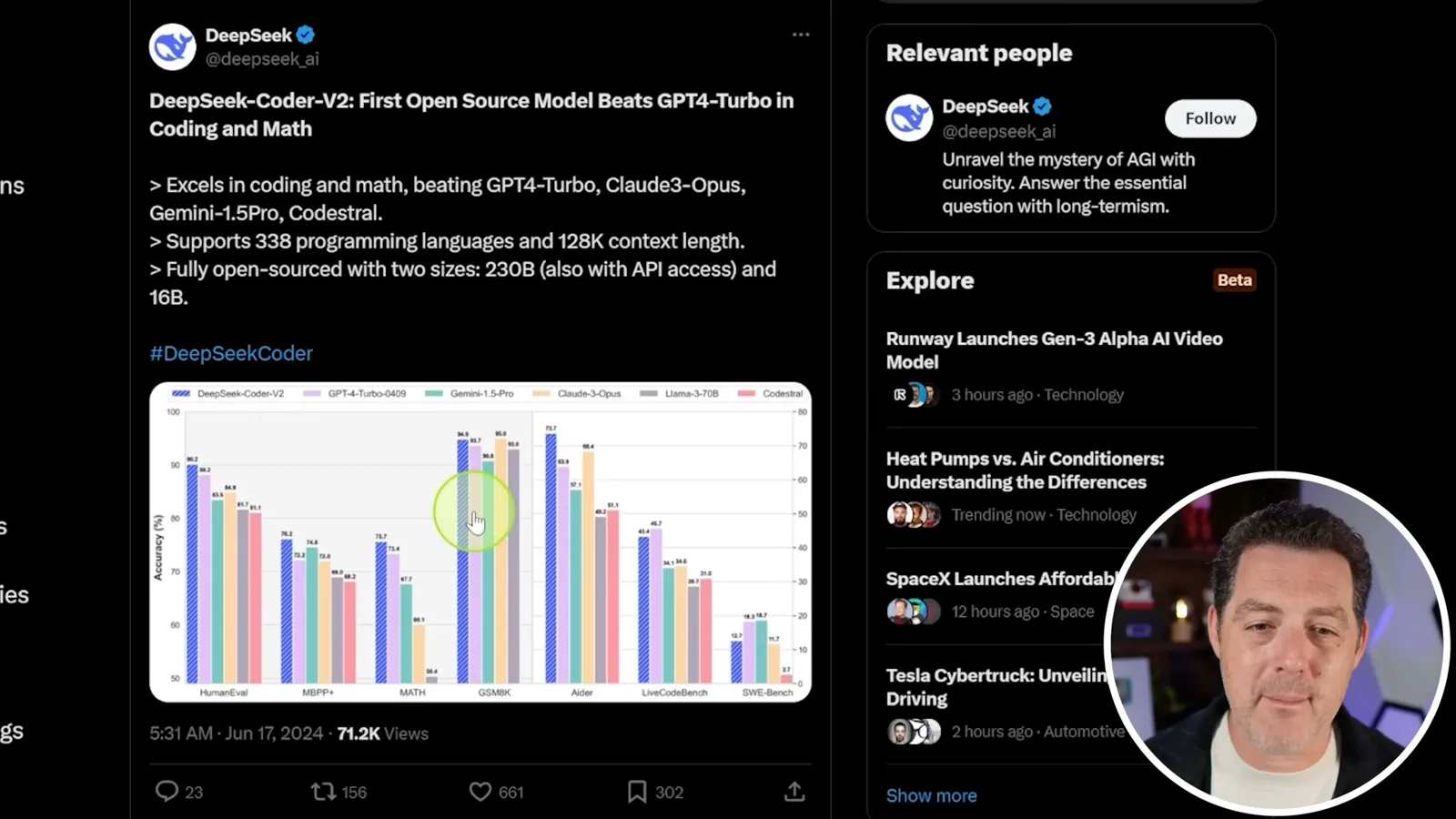
Finally, DeepSeek Coder V2 is presented in two sizes, 16B and 230B, with a 128,000-token context and support for many programming languages. The launch chart reports strong results on several coding and math benchmarks, though its performance varies by test. I plan to evaluate the model myself.
Sur la même chaîne
 25:50EN
 32:20EN
 45:08EN
 12:14EN
 10:36EN
 17:37EN