








Résultats
169 articlesTrier
 27:16EN
 Jane Street· 15 nov. 2024Tudor Brindus on Finding and Reducing System JitterTudor Brindus · Jane StreetA memory ping-pong benchmark reveals how virtualization, interrupts, CPU frequency changes and speculation can disrupt low-latency systems.
 40:33ENJane Street· 23 oct. 2024Charlie Marsh on uv: Python Dependency Resolution and PerformanceCharlie Marsh · AstralThe Astral founder explains universal lockfiles, Python packaging constraints, and the data structures and cache design behind uv.
 53:51ENJane Street· 7 oct. 2024Liora Friedberg on Solving Puzzles in ProductionYaron Minsky, Liora Friedberg · Jane StreetProduction engineering combines live incident response with software, process improvements and a culture that helps people learn from mistakes. Liora Friedberg and Ron Minsky explore the work at Jane Street.
 9:25ENJane Street· 1 oct. 2024Richard Eisenberg: Using OCaml’s Coercion OperatorRichard Eisenberg · Jane StreetA practical tour of subtyping, polymorphic variants and private type abbreviations, with no runtime conversion cost.
 8:06ENJane Street· 7 août 2024How OCaml's Proposed Include Functor Syntax Reduces RepetitionRichard Eisenberg · Jane StreetA reverse-array example shows how to derive common module functions from a minimal implementation without an extra wrapper module.
 1:07:34EN
 Sequoia Capital· 6 août 2024PodcastGitHub Didn’t Believe Copilot Was Writing 25% of the CodeThomas Dohmke tells Sequoia how an unplanned GPT-3 experiment became Copilot, why GitHub still will not train its own foundation model, and how he wants a billion people writing software by 2030.
 1:03:36ENJane Street· 12 juil. 2024Erin Murphy on Designing Tools for Expert UsersYaron Minsky, Erin Murphy · Jane StreetFrom NASA scientists to Jane Street engineers, a UX designer explains how observation, drawing and collaboration reveal what complex tools need to do.
 14:36ENJane Street· 24 juin 2024Programming with OCaml's Local ModeRichard Eisenberg · Jane StreetAn example shows how a local list can contain global values, why a non-escaping annotation alone does not ensure stack allocation, and where the experimental feature remains awkward.
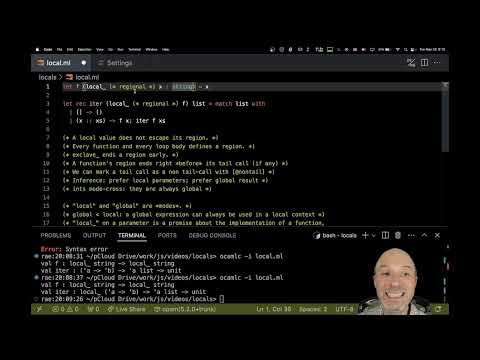 11:28ENJane Street· 13 juin 2024OCaml Local Types: Regional Parameters and Loop RegionsRichard Eisenberg · Jane StreetA demonstration explains why some local parameters can cross a function boundary and how loop regions reclaim allocations.
 9:14ENJane Street· 29 mai 2024OCaml Local Function Types: Why Partial Application Can EscapeRichard Eisenberg · Jane StreetRichard Eisenberg uses a list-append example to show how a local argument changes the mode of a partially applied function in Jane Street’s OCaml compiler branch.
 15:59ENJane Street· 7 mai 2024Tail Calls and Local Regions in OCamlRichard Eisenberg · Jane StreetA list-counting example reveals why a local closure can escape at a tail call, and how regional mode and [@nontail] affect the result.
 13:59EN
 Matthew Berman· 5 avr. 2024SWE-agent Tutorial: Navigating Repositories and Attempting GitHub FixesMatthew Berman, Carlos · Forward FutureMatthew Berman sets up a research coding agent, hits an installation problem and a cost limit, then shows an author’s successful SymPy benchmark example.
 14:23ENMatthew Berman· 31 mars 2024Testing DBRX: Coding Strengths and Reasoning GapsMatthew Berman · Forward FutureMatthew Berman examines Databricks’ open-weight model and puts it through coding, arithmetic and reasoning prompts.
 1:10:33EN
 20VC with Harry Stebbings· 20 mars 2024Podcast · 2 voixJean-Michel Lemieux on Shipping, Hiring and Product AlignmentInvité : Jean-Michel Lemieux · Anime : Harry StebbingsThe former Shopify CTO and Atlassian engineering leader explains how he balances speed and quality, aligns decisions and builds teams.
 3:30ENJane Street· 13 mars 2024Richard Eisenberg on Jane Street's OCaml ExperimentsRichard Eisenberg · Jane StreetJane Street's compiler team is exploring unboxed types, locality modes, and data-race-free parallelism to make OCaml's performance and memory management better suited to its needs.
 11:07ENJane Street· 29 févr. 2024How OCaml Locals Use a Separate StackRichard Eisenberg · Jane StreetA list example shows how region-scoped local values can avoid repeated garbage-collected allocations.
 55:29ENMatthew Berman· 24 févr. 2024Building a CrewAI Newsletter Team: Scraping, Summarizing and DebuggingMatthew Berman, Joe · Forward FutureMatthew Berman builds a two-agent newsletter prototype, works through input and scraping errors, and shows what still needs to be fixed.
 23:25ENJane Street· 20 févr. 2024Richard Eisenberg: How OCaml Locals Reduce Garbage-Collected AllocationRichard Eisenberg · Jane StreetAn annotated list-processing example shows why locality must be preserved both when values are created and when functions consume them.
 22:27ENJane Street· 7 févr. 2024How OCaml Infers LocalityRichard Eisenberg · Jane StreetA look at local and global mode inference, module signatures, mode crossing for integers, and conversions between function types.
 15:17ENJane Street· 31 janv. 2024OCaml Locals, Modes, and SubmodingRichard Eisenberg · Jane StreetA worked explanation of how local and global modes control escaping values, and how those modes interact with function types.
 9:25ENMatthew Berman· 31 janv. 2024Matthew Berman Tests Meta’s Code Llama 70B on a Snake GameMatthew Berman · Forward FutureA 2024 look at Meta’s coding-model release, a SQL-focused fine-tune and a hands-on test that did not work on the first attempt.
 12:52ENJane Street· 23 janv. 2024OCaml Local Variables, Return Values and RegionsRichard Eisenberg · Jane StreetA worked example shows how `local_` and `exclave_` let a function accept a local value and return a local structure in its caller's region.
 46:36EN
 No Priors: AI, Machine Learning, Tech, & Startups· 18 janv. 2024Podcast · 2 voixAfter a decade of code search, Sourcegraph’s CTO says the coding-AI fight is outside the modelAnime : Sarah Guo, Elad GilBeyang Liu on Cody, why keyword search still does most of RAG, and why CS fundamentals get more valuable as AI compresses the middleware.
 8:52ENJane Street· 5 janv. 2024Introducing Local Parameters in OCamlRichard Eisenberg · Jane StreetA demonstration of how Jane Street's experimental local mode restricts escaping values and makes function interfaces easier to reason about.
Charger plus24 sur 169 affichés