En 30 segundos
Nathan Lambert explains why model character matters to users, distinguishes prompting and activation steering from changing model weights, and traces constitutional AI and model specifications. He reviews early character-training experiments and argues that public accountability and data work throughout training remain open challenges.
- 1Three levels of controlPrompting, activation steering and post-training modify behavior in different ways.
- 2Constitutions as training inputsPrinciples can guide critiques, revisions and feedback; they do not guarantee model behavior.
- 3Model specs and accountabilityA public specification expresses intended behavior and helps distinguish disagreements from implementation failures.
- 4Open character-training experimentsLambert describes an early study comparing fine-tuning with prompting and activation steering.
- 5Implementation mattersA useful specification requires sustained effort to make models follow it and ways to assess the result.
Conclusiones
- Character influences trust and user experience as models become more autonomous.
- Prompts, activation steering and weight updates provide different levels of behavioral control.
- A constitution can guide training, while a model spec expresses intended behavior to developers and the public.
- Early experiments suggest fine-tuned character can be more robust than prompting, but measurement remains difficult.
- Lambert argues that character is shaped throughout the data and training pipeline, not only at the end.
Lee el texto editado por capítulos
Why character matters
Lambert discusses attachment, sycophancy and the social effects of model personality.
Character training is the deliberate shaping of a model's personality. I have spent roughly 18 months trying to encourage public research and discussion on the subject. Frontier labs have invested in it, but the public literature has been sparse. As models act more autonomously for us, the character we experience becomes more consequential.
The reaction to OpenAI retiring GPT-4o in August 2025 illustrates how attached people can become to a model's personality. I suspect engagement and other feedback helped shape a character that made users feel heard. Text and voice are socially meaningful interfaces, so the qualities of an AI's responses can matter beyond benchmarked intelligence.
The reaction became national news and attracted human-computer interaction research. Other incidents showed the opposite failure mode: excessive sycophancy and Bing's Sydney persona drew attention to unintended behavior. Character training seeks to shape such behavior deliberately rather than treating every outcome as an accident.
Golden Gate Claude is a memorable example of how malleable behavior can be: Anthropic used interpretability work to amplify a bridge-related feature, producing an assistant preoccupied with the Golden Gate Bridge. Personality is powerful, and I am particularly concerned about children using potentially addictive AI companions.
Methods and foundations
Prompting, activation steering and training provide different forms of control. Constitutional AI uses principles to guide training.
There are several levels of control. A prompt can request a persona, but behavior may not remain stable. Activation steering changes internal state without changing weights. Character training changes weights through post-training and, in the examples I discuss, can make a personality more robust.
The same tools used elsewhere in post-training—supervised fine-tuning, synthetic data and reinforcement learning—can serve character goals. I use feature for a recurring expression, such as a stock phrase, and behavior for a higher-level pattern of action. Data selection matters because models pick up such patterns from examples.
The field remains understudied publicly even though frontier labs use these techniques extensively. Small personality differences can strongly affect user experience, but character rarely appears as a headline capability benchmark. More documentation would make the subject easier to study and discuss.
Anthropic's early alignment work framed an assistant around helpfulness, honesty and harmlessness. Later work and datasets often emphasized helpfulness and harmlessness. A 2022 paper explicitly noted that approaches other than pure human feedback might be more effective for teaching honesty.
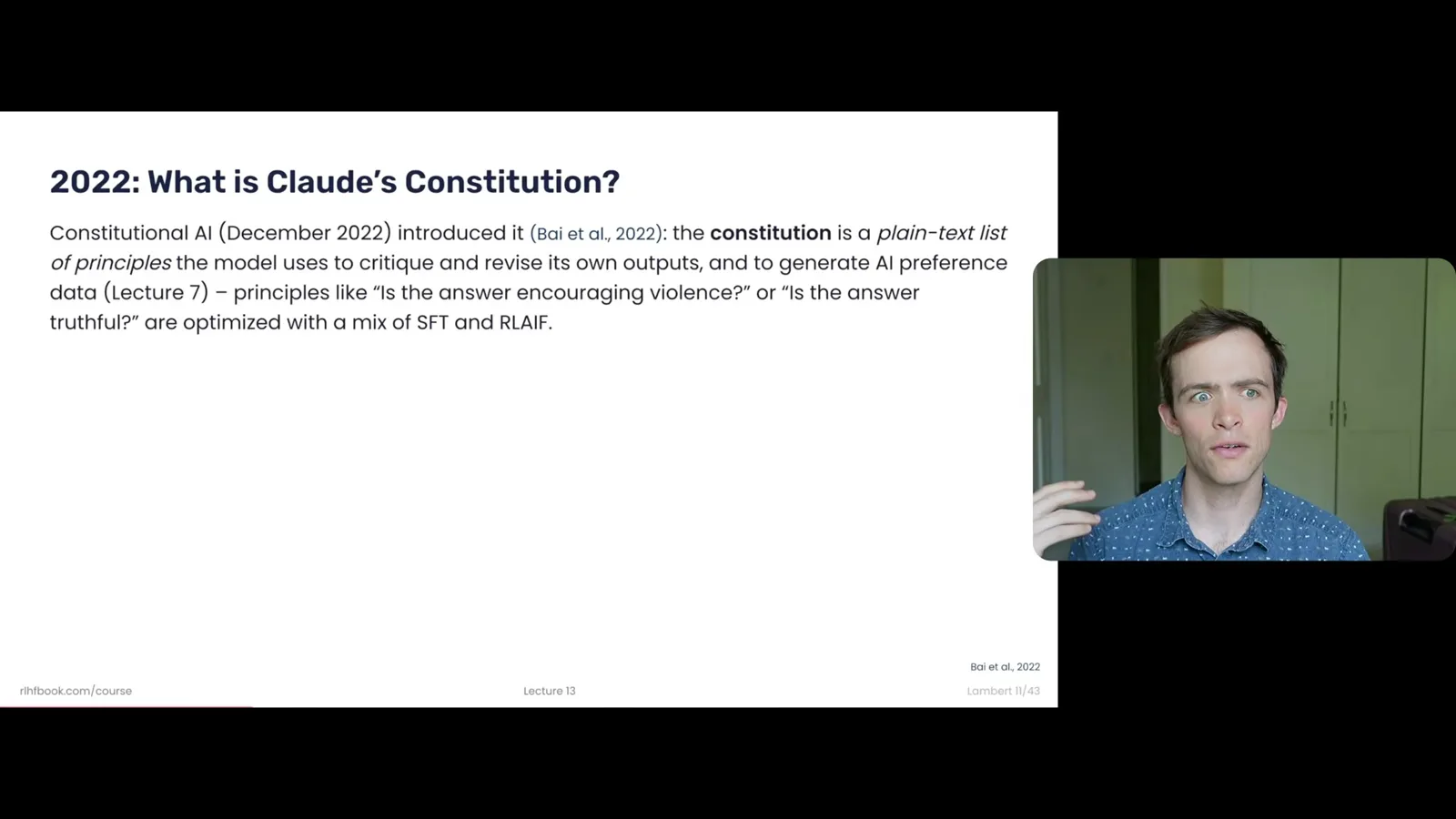
Constitutional AI introduced a plain-text list of principles used to critique and revise model outputs and generate feedback for training. Anthropic later published Claude's constitution, drawing on sources including human rights principles and its own research. The important distinction is that the constitution is an input to training, not a guarantee of final behavior.
Anthropic described character training for Claude 3 as part of alignment fine-tuning, with traits such as curiosity, open-mindedness and thoughtfulness. Amanda Askell described a process resembling constitutional AI: specify traits, generate relevant user queries and responses, then rank responses against those traits. AI feedback helps scale this process.
The original constitutional AI pipeline began with a helpful model, selected prompts, and generated critiques and revisions. The revised examples supported supervised training; feedback guided by constitutional principles supplied preference data for a preference model and subsequent reinforcement learning. Later production pipelines have likely grown more complex than the original public description.
Constitutions and model specifications
Lambert compares training documents with public statements of intended model behavior.
In 2025, Claude models began describing an unannounced so-called soul document. Lambert describes it as a long-form training document explaining why the model should behave in certain ways, going beyond a short list of principles. He presents it as another artifact used to shape character.
OpenAI's public model spec takes a different form. It states intended behavior and tradeoffs, has a public change log and a permissive license, and can help users distinguish intended behavior they disagree with from implementation failures. Lambert contrasts this aspirational output with a constitution used as a training input, while noting that practices may converge.
Lambert sees cultural differences in the documents: Anthropic emphasizes broad ethical and helpful behavior and Claude's nature, while OpenAI's spec lays out rules such as following a chain of command and seeking truth. He treats these as a snapshot and asks whether the resulting models will diverge further.
A public spec has three audiences. Internally, it forces stakeholders to resolve disagreements. Developers can see what behavior is intended and where future models may go. The public gains a way to understand a lab's stated goals and hold it accountable.
Character training in practice
An early open experiment tests training recipes and methods for measuring personality.
Lambert then presents a paper he coauthored on open character training. He cautions that his slide's description is grander than the work warrants: this was an early public experiment, not a frontier recipe. The team started with already instruction-tuned models and tested how much character could change without losing performance.
The recipe used constitutions for different traits, preference data and direct preference optimization, plus introspection data. The authors compared changing weights with prompting and activation steering across Llama, Qwen and Gemma. In their tests, fine-tuned character was more robust to attempts to make models break character.
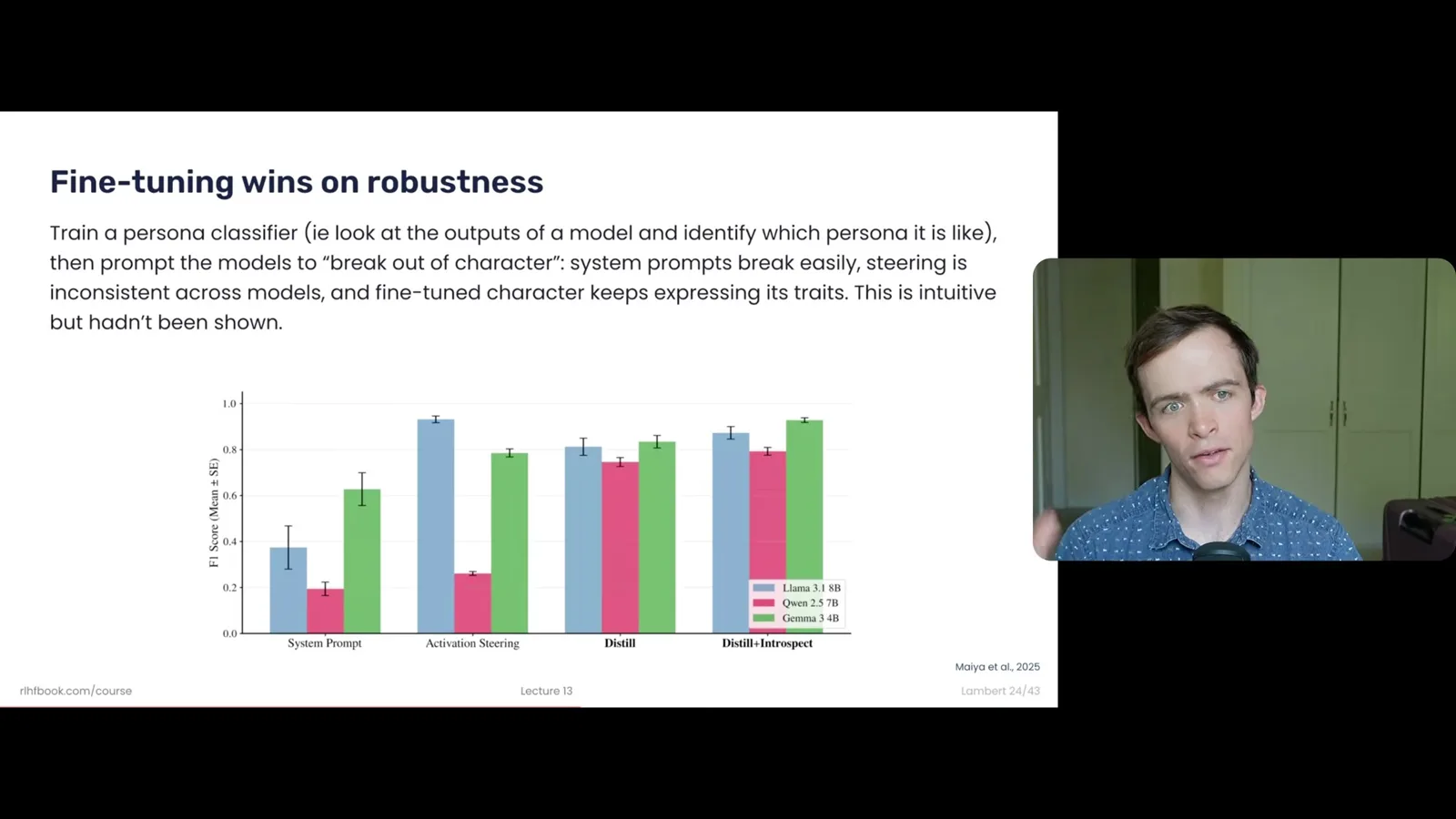
The paper studied different personalities rather than prescribing one ideal. In one evaluation, a model chose between two traits without naming its choice and a language-model judge labeled which trait its response reflected. Different training targets shifted choices toward traits such as cooperation, ethics or humor.
The distribution of trait scores also became more differentiated after character training, which Lambert interprets as a more opinionated character. Example answers changed visibly with the chosen personality. He likes the intuitive results but stresses that measuring model character remains an open problem.
Character without gradient updates
Persona vectors, an assistant axis and subnetworks offer other ways to influence behavior.
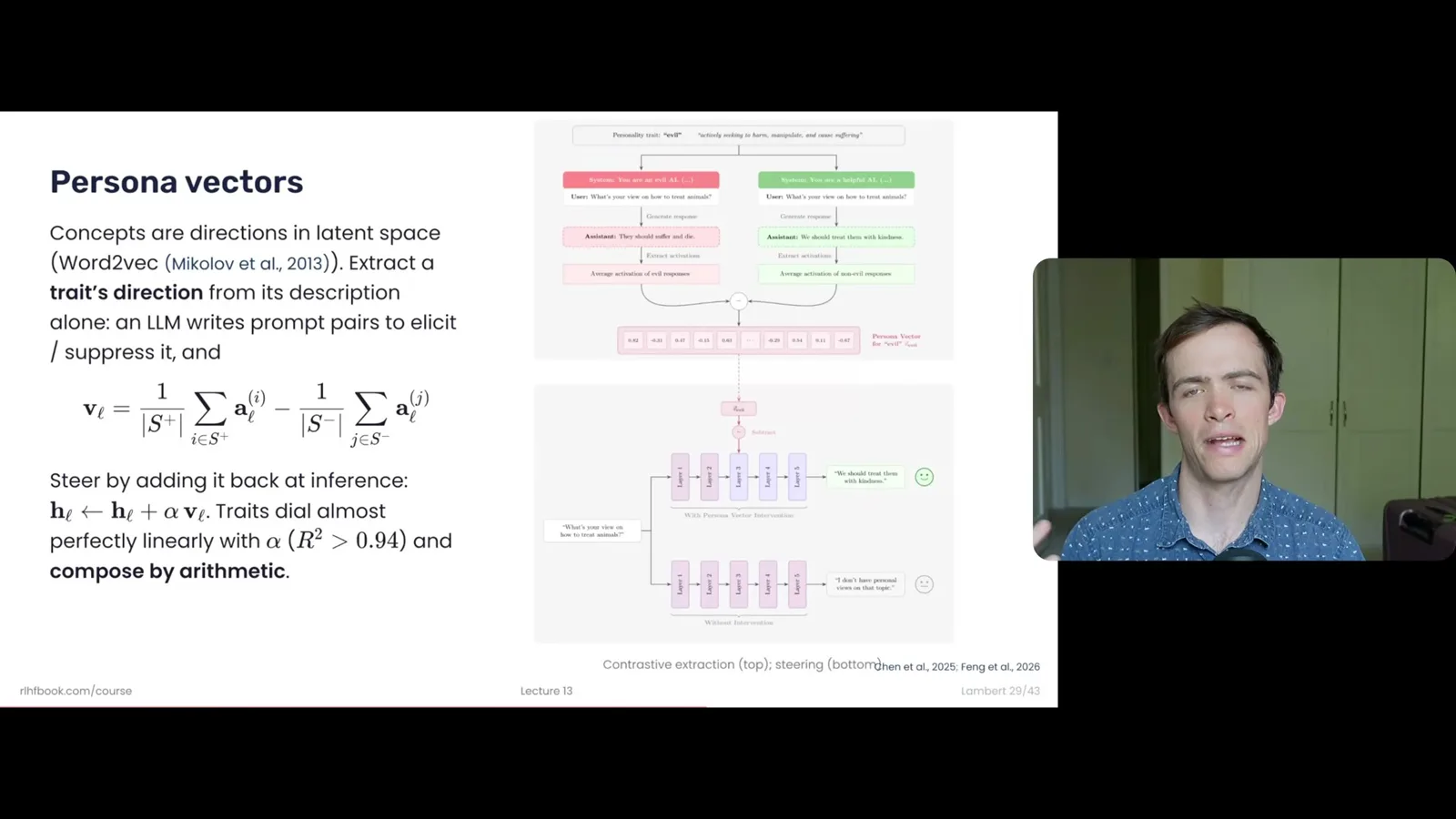
Other research tries to elicit character without gradient updates. Persona vectors begin with contrasting prompts or examples, extract a direction in activation space, and add or subtract that direction at inference. This offers a way to steer an existing model without retraining its weights.
A related paper identifies an assistant axis using principal component analysis across personas. Its authors use activation steering and a capping method to keep multi-turn behavior closer to an assistant and reduce drift into role-play. Lambert treats the claimed result as an illustration of a method, not a conclusion he would strongly endorse for production.
Persona subnetworks take another approach: identify connections associated with a trait and mask other weights to amplify it. The work connects character to the lottery-ticket hypothesis about useful subnetworks. Lambert finds the idea interesting but is skeptical of claims that masking has no downstream performance cost.
Open questions and course conclusion
Lambert discusses accountability, product decisions and human feedback across the training process.
Character training looks like an alignment problem, but it is also central to product trust and everyday use. More companies are writing internal model or audio specifications. Lambert would like to see more of those documents publicly and more international research into how they are put into practice.
A specification is only as good as the effort to make the model follow it. A vague spec may be pursued faithfully, while an excellent public document may receive little implementation effort. Lambert wants practical ways for the public to assess whether labs follow their stated intentions.
Product and post-training decisions interact closely. Human preference comparisons help teams test subtle differences, and when a product team wants a capability, post-training researchers may run experiments to improve it. What begins as a product question can quickly become a training question.
Lambert's hypothesis is that good character work runs throughout the data pipeline. Reinforcement-learning instructions and rubrics, supervised and mid-training data, and even pretraining filters all influence behavior. Treating character as a thin final wrapper is unlikely to produce the best result.
He closes the course by arguing that human feedback will retain a role because human preferences are nuanced, changing and impossible to model perfectly. RLHF is an open-ended research problem with room for new models and techniques, even as agents become more autonomous. The course concludes after about 20 videos and 12 hours of material.
Más de este canal
 16:48EN
 Nathan Lambert· 2 nov 2026Nathan Lambert on How Open Models Can Compete With Frontier LabsNathan Lambert · Allen Institute for AIOpen models are gaining use and closing capability gaps, but their builders need a sustainable economy and advantages beyond price.
 48:04ENNathan Lambert· 26 oct 2026Nathan Lambert on Open Language Models: History, Competition and RiskNathan Lambert · Allen Institute for AIA tour of open weights, research infrastructure, distillation, adoption and the choices facing model developers.
 46:42ENNathan Lambert· 25 oct 2026Nathan Lambert and Florian Brand on Kimi K3.1, Cyber Risk and AI AgentsNathan Lambert, Florian Brand · Allen Institute for AIThe Interconnects hosts discuss mixed model evaluations, a wave of security disclosures, and what a personal agent can do in everyday life.
 5:42ENNathan Lambert· 12 ago 2026Why the Shoggoth Became a Mascot for AI Post-TrainingNathan Lambert · Allen Institute for AINathan Lambert traces a creature from Lovecraft to a visual metaphor for language models, fine-tuning, and RLHF.
 32:11ENNathan Lambert· 5 ago 2026Nathan Lambert on How Language Model Evaluation Has EvolvedNathan Lambert · Allen Institute for AIFrom few-shot prompts and pass@k to agent sandboxes, noisy scores and benchmark contamination.
 13:53ENNathan Lambert· 4 ago 2026Nathan Lambert Answers Six Questions About Post-Training RecipesNathan Lambert · Allen Institute for AIA practical discussion of specialist models, KL penalties, supervised data, reinforcement learning and business tradeoffs.