En 30 segundos
Sawyer presents a geometry puzzle about matching a cone’s opening and volume to a sphere of flavored slush. He then solves the previous episode’s piggy bank problem using Bayes’ theorem and an equivalent two-bank counting argument, obtaining 4/7 regardless of the unknown number of one-dollar bills.
- 1A cone for a sphere of slushThe opening must fit the equator of a sphere of radius 5 cm, and the cone’s volume must equal the lower hemisphere’s volume. Sawyer leaves its exact shape as a challenge.
- 2The piggy bank questionGrandma adds either a $20 or a $1 bill with equal probability; after a $20 is drawn, the question is how likely she added a $20.
- 3Bayes’ theoremThe draw probabilities are 4/(n+4) and 3/(n+4), producing a conditional probability of 4/7 independent of n.
- 4Counting two possible banksIn equal-sized copies representing the two additions, four of the seven $20 bills belong to the bank that received a $20.
Conclusiones
- The new challenge asks for a cone whose rim matches a sphere’s equator and whose volume equals half the sphere’s volume.
- An unknown number of one-dollar bills cancels from the conditional probability in the previous puzzle.
- Bayes’ theorem combines the prior chance of each added bill with the likelihood of drawing a twenty.
- After observing a twenty, the probability that another twenty was added rises from 1/2 to 4/7.
- A two-copy counting argument gives the same result by comparing four favorable twenties with seven possible twenties.
Lee el texto editado por capítulos
The snow cone challenge
Sawyer sets a geometry problem involving a sphere and a cone. He asks viewers to determine the cone’s exact shape.
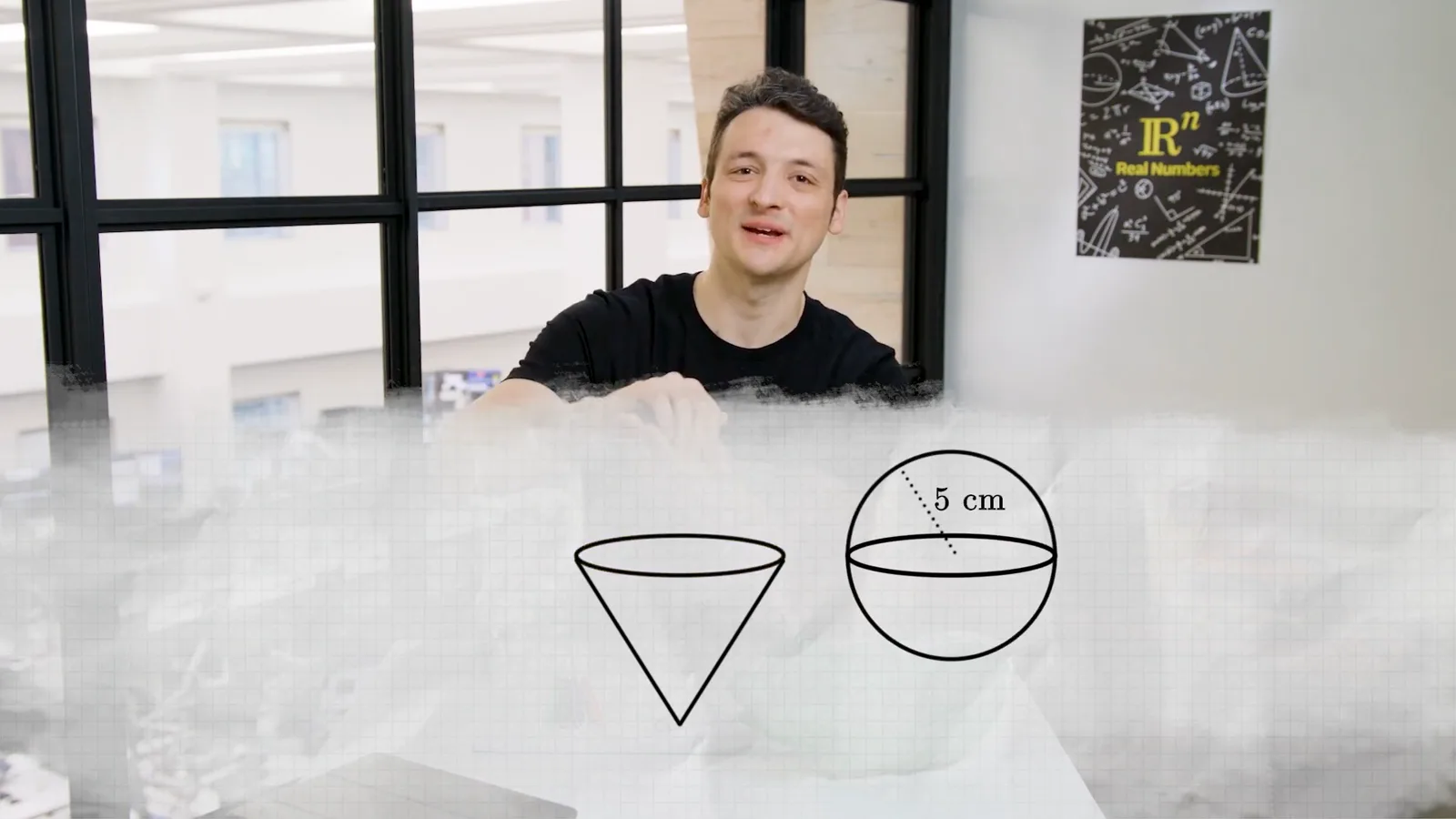
This week we shift from probability to a geometry puzzle. We are designing a snow cone holder shaped like a cone. Its rim must fit around the equator of a sphere of flavored slush with radius 5 centimeters, and its volume must equal the volume of the lower half of that sphere. What exact shape should the holder have? Submit a description and your work.
The piggy bank and Bayes’ theorem
Sawyer restates the previous probability problem and calculates the answer using conditional probabilities. The unknown number of one-dollar bills cancels.
First, let’s solve last week’s problem. On Saturday your grandmother had three $20 bills and an unknown number of $1 bills in a piggy bank. On Sunday she added one bill, equally likely to be a $20 or a $1. On Monday you randomly picked a bill and got a $20. What is the probability she added a $20?
At first there seems to be too little information: we don’t know the total number of bills. Surprisingly, that number will not matter. Let n be the number of $1 bills on Saturday. The events of interest are which bill Grandma added and whether you picked a $20; each possible addition has prior probability 1/2.
By Bayes’ theorem, P(added $20 | picked $20) equals P(picked $20 | added $20) × P(added $20) divided by P(picked $20). If Grandma added a $20, the bank has four twenties and n ones, so the chance of drawing a twenty is 4/(n+4).
To find the unconditional chance of drawing a twenty, split into the two possible additions. It is (1/2) × 4/(n+4) + (1/2) × 3/(n+4), or 7/(2n+8). Substituting into Bayes’ theorem gives 4/7: the n terms cancel.
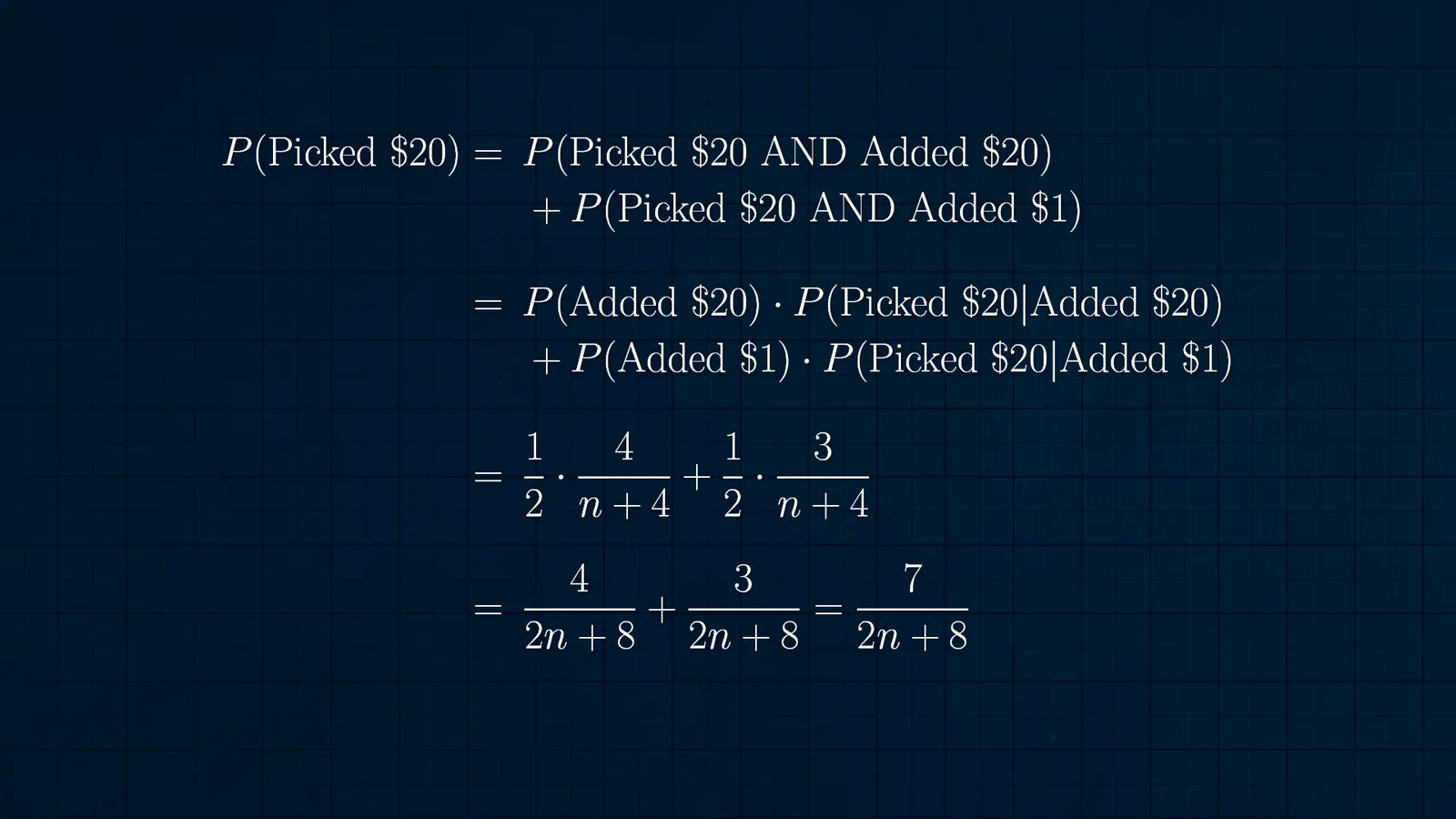
The posterior probability 4/7 is slightly greater than the prior probability 1/2. Drawing a $20 is evidence that the bank contains more twenties, so it increases the probability that Grandma added one.
A two-bank counting argument
Two equally likely copies of the bank provide a second way to see the 4/7 result. Sawyer returns to the geometry challenge.
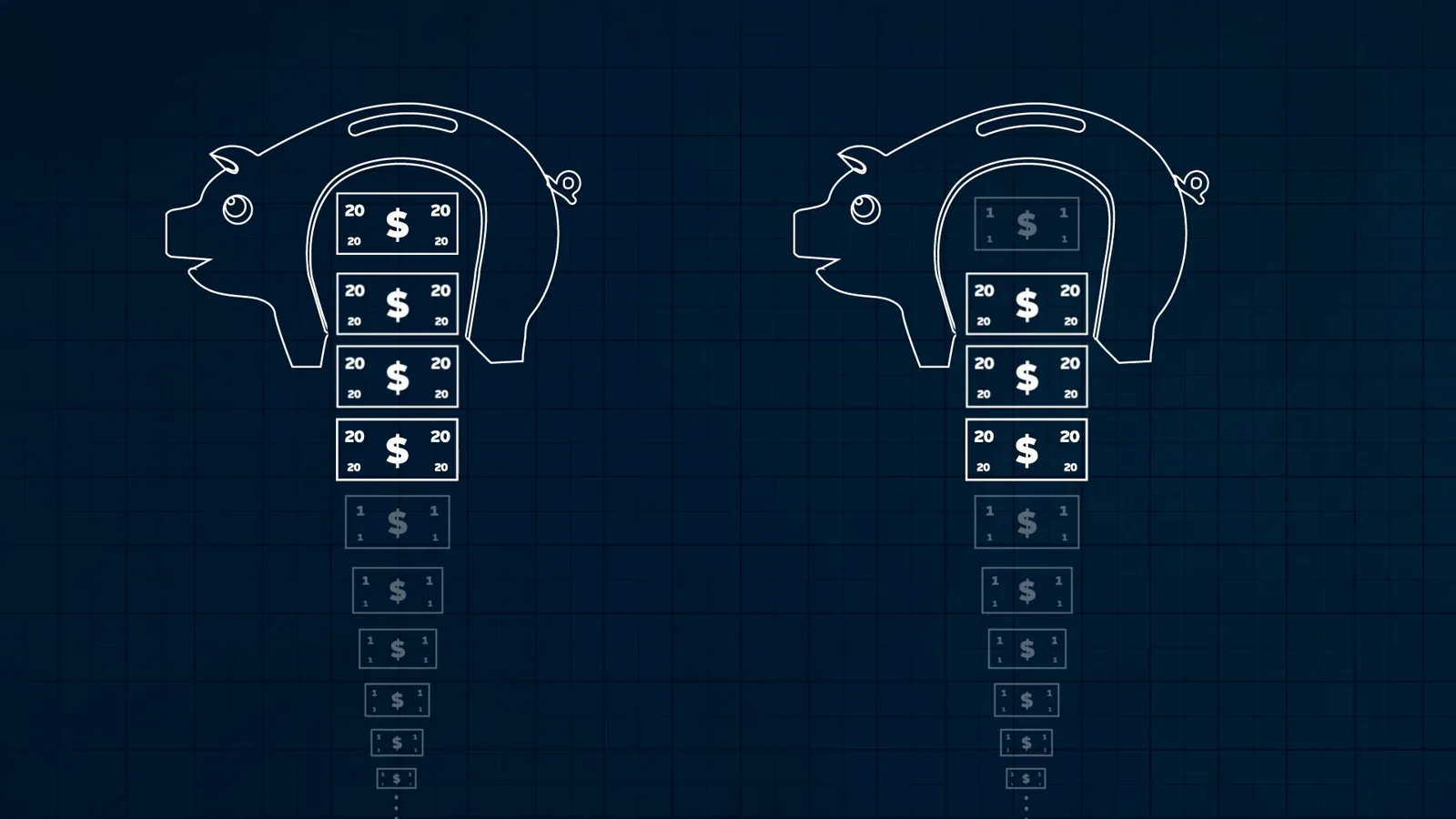
There is another way to see it. Imagine two copies of the original bank, each containing three twenties and n ones. Add a $20 to the left bank and a $1 to the right. Choosing a random bill from these equally likely, equally sized banks represents both the addition and the draw.
Conditioning on drawing a $20 leaves seven possible twenties across the two copies. Four are in the left bank, where Grandma added a $20, so the conditional probability is 4/7. Now return to the geometry puzzle: find a cone whose rim matches the sphere’s equator and whose volume equals half the sphere’s volume.
Más de este canal
 1:48:29EN
 1:36:37EN
 1:05:45EN
 1:25:00EN
 1:16:29EN
 27:39EN