En 30 segundos
Matthew Berman and producer Alex follow OpenAI's GPT-5 launch livestream from the initial API pricing page through the final research remarks. OpenAI presenters demonstrate a physics visualization, writing, a French-learning app, voice, safety, health and coding tools; Cursor CEO Michael Truell joins for an SDK bug example. Berman shares his early reactions and points to his own separate tests. This is a historical launch event, not a current pricing or availability guide. Benchmark scores are OpenAI's reported results under particular conditions, the health story is a personal testimonial, and selected demonstrations do not establish universal reliability. No paid sponsor is identified.
- 1Launch pricingThe API page shows GPT-5's 2025 input, cached-input and output prices and a 400,000-token context window.
- 2Automatic reasoningOpenAI describes combining fast answers with deeper reasoning, and Berman reacts to the routing approach.
- 3Benchmark contextThe presentations report strong scores, but comparisons must preserve the evaluation and whether tools were used.
- 4French-learning appA prompt asks for flashcards, quizzes and a mouse-and-cheese game; the team demonstrates a generated prototype.
- 5A patient testimonialKarolina and Felipe Millon describe using ChatGPT to understand a cancer diagnosis and prepare for discussions with physicians.
- 6Developer APIOpenAI introduces model sizes, reasoning effort, custom tools, grammar constraints and verbosity controls.
- 7Cursor partner demonstrationMichael Truell discusses codebase understanding and attempts an SDK bug fix with GPT-5 in Cursor.
Conclusiones
- The launch described a system that routes between faster responses and deeper reasoning, with tier-dependent access and limits.
- OpenAI's reported scores, including 74.9% on SWE-bench Verified and 88% on Aider Polyglot, apply to specified evaluations rather than all coding tasks.
- The AIME result depends on tool use: OpenAI reported 94.6% without tools and a higher tool-enabled result.
- The launch demos show generated interfaces and tool-driven coding, but working examples still require testing and review.
- Karolina's cancer-care story is a personal account of using AI alongside doctors, not clinical evidence that AI should replace medical care.
- Model-assisted data generation and code iteration are different from an autonomous runaway self-improvement loop.
- API prices, context limits, features and rollout plans described in the stream are historical.
Lee el texto editado por capítulos
Waiting for the launch
Berman and Alex discuss model naming, speed and routing. They inspect the launch-era API page before the OpenAI stream begins.
Matthew Berman and his producer Alex begin an August 7, 2025 watch party for OpenAI's GPT-5 launch. Before the official stream starts, they welcome viewers and discuss the possibility of a new model family. Alex's surname is not established in the video.
The hosts hope for clearer naming after GPT-4, GPT-4o, GPT-4.1 and the o-series. They speculate about mini and nano variants and talk about why a quick answer can be preferable to a slower reasoning model for ordinary tasks. These remarks precede the announcement.
Berman says he often uses fast models such as GPT-4o for everyday work, while Alex agrees that response speed matters. They contrast this with longer reasoning for harder tasks, framing the balance as a practical user choice rather than a benchmark.
Alex hopes the product will route requests to an appropriate model automatically. Berman says a unified interface could spare users from choosing among models, though at this point they do not yet know what OpenAI will announce.
Before the event, Berman checks the API page carefully to avoid exposing credentials. He reads launch-era prices for GPT-5: $1.25 per million input tokens, $0.125 per million cached input tokens and $10 per million output tokens. He notes a 400,000-token context window, up to 128,000 output tokens and a September 2024 knowledge cutoff; these are historical product details.
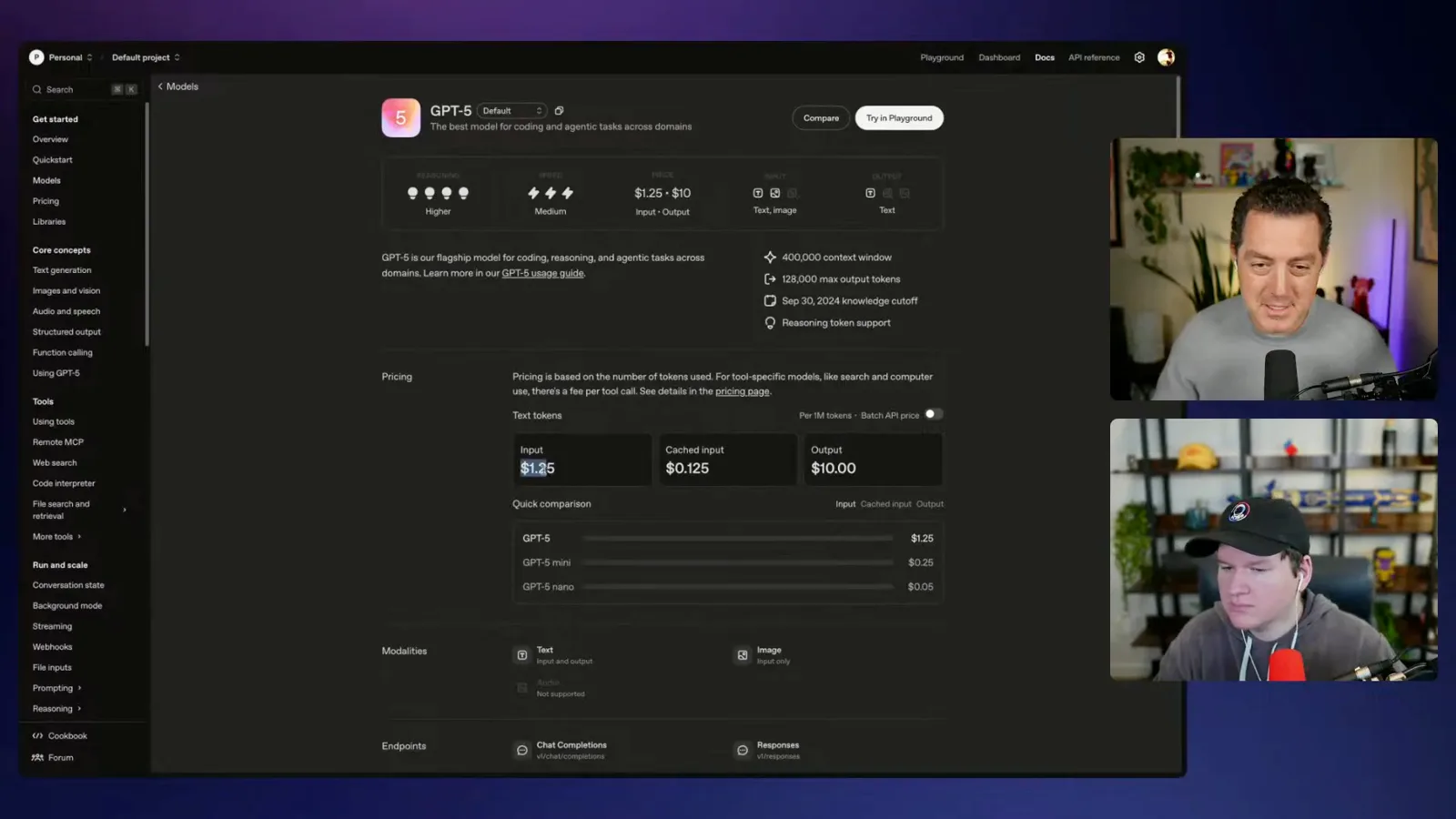
Berman notices a September 2024 knowledge cutoff and the hosts discuss using internet access to supplement stale training knowledge. A model only has current information when the relevant search capability is available and actually used.
He sees mini and nano options and considers them relatively inexpensive. The hosts debate the value of an AI subscription in terms of helping employees do more work. When Berman refreshes the playground after 10 a.m., GPT-5 appears and they switch to OpenAI's presentation.
OpenAI introduces GPT-5
Sam Altman and the team describe the model, reported evaluations and tier rollout. They demonstrate a generated physics visualization.
OpenAI CEO Sam Altman opens by saying ChatGPT has reached roughly 700 million weekly users and announces GPT-5. He calls it an important step on the company's path toward AGI and compares its breadth to having PhD-level experts available on demand. Those are OpenAI's usage and capability claims, not proof of expert reliability in every field.
Altman says GPT-5 can help with planning, learning and writing software. He calls it an expert in a pocket; this is a launch metaphor, not a professional credential or an assurance that it is accurate in medicine, law or other domains.
Altman describes uses including building software, planning, learning and understanding healthcare information. He anticipates software created on demand and says businesses and developers will have opportunities to build on the model. These examples are presented by the company at launch, not a demonstration that every action can be performed safely without supervision.
Chief research officer Mark Chen introduces Max Schwarzer and Rennie Song and describes GPT-5 as combining fast responses with deeper reasoning when needed. Berman pauses to identify this as hybrid routing. The company frames the choice of when to think as part of the system, while promising availability across tiers.
The presenters describe a system that can answer quickly or spend more time reasoning when a request calls for it. Berman reacts positively to not having to manually choose for every question, while the launch team describes both automatic and explicit thinking options.
OpenAI calls GPT-5 its strongest coding model and introduces evaluations spanning software, multimodal reasoning, mathematics, factuality and health. Schwarzer cautions that benchmarks do not describe everything a model can do. Berman notices a visual issue in the displayed bar chart and later notes that his own detailed test is separate.
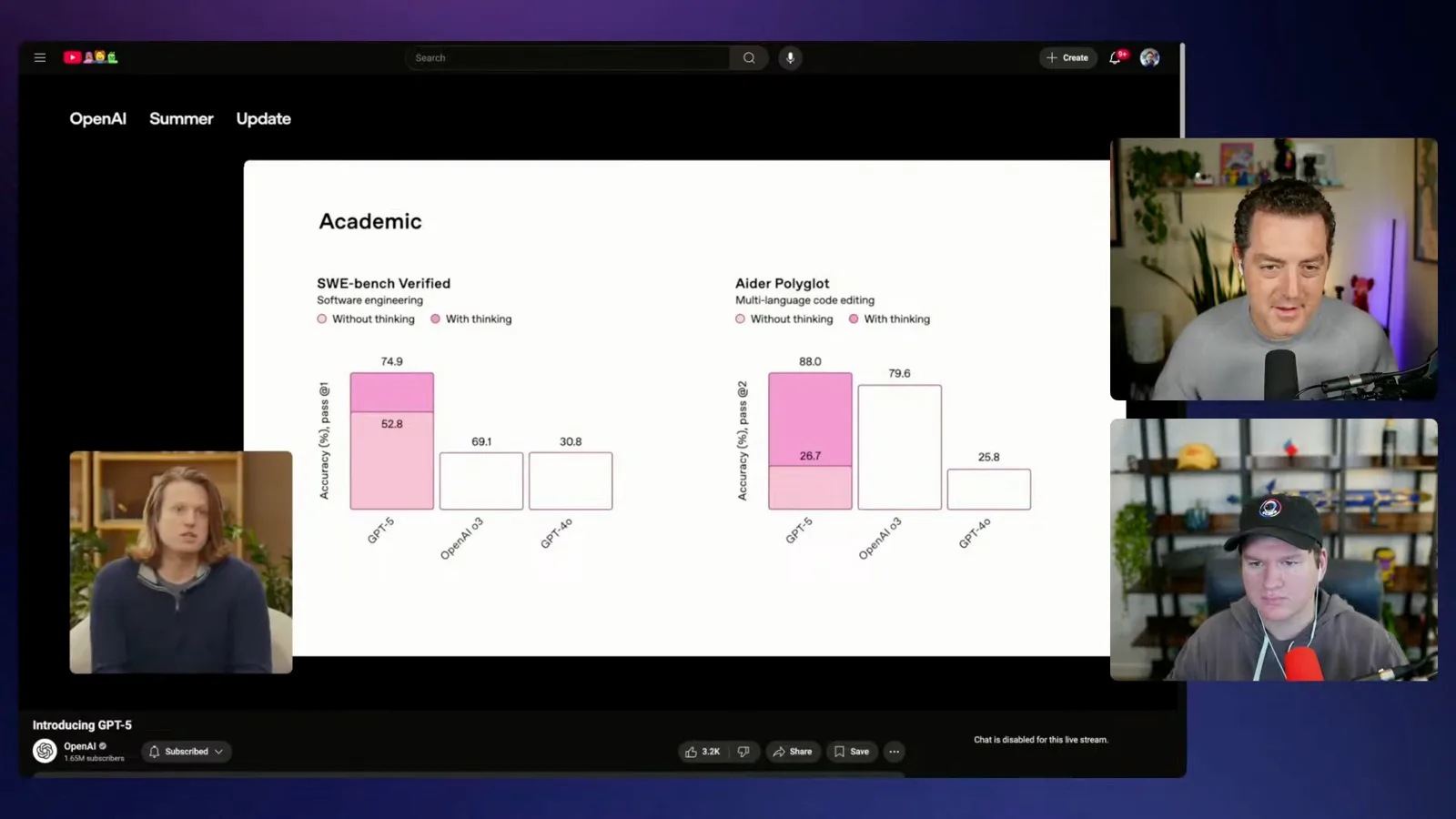
The presenters discuss SWE-bench and Aider Polyglot, followed by visual reasoning and AIME mathematics. Berman reacts to an apparent 100 on the chart. OpenAI's [launch data](https://openai.com/index/introducing-gpt-5/) reports 94.6% on AIME 2025 without tools; the near-100 result is a different tool-enabled setting. Scores and configurations should not be conflated or treated as universal competence.
Schwarzer notes that a visual understanding test asks the model to reason from images, and OpenAI also reports high mathematics performance. The team presents these as results on selected academic evaluations; no single score measures all reasoning or practical reliability.
OpenAI says it prioritized factuality and health-related responses and reports improvements on its own evaluations. Better benchmark scores do not make generated answers infallible, especially in medical or legal decisions. The presenters then explain how access and rate limits would work at launch.
Song says GPT-5 is rolling out to free, Plus, Pro and Team users, with Enterprise and Edu following. Free users would switch to GPT-5 mini after reaching a limit; Pro included extended-thinking access. These were the announced 2025 rollout conditions, not a statement of present-day availability or pricing.
Berman is surprised that the frontier model reaches the free tier at launch and wonders whether use will be limited. The presentation confirms limits for free users, a higher allowance for Plus and an extended-thinking option for Pro.
OpenAI says ChatGPT tools such as search, file and image uploads, data analysis, Canvas, image generation, memory and custom instructions would work with GPT-5. Berman is surprised by free-tier access and says he interviewed Mark Chen, with a separate interview and test video planned after the stream.
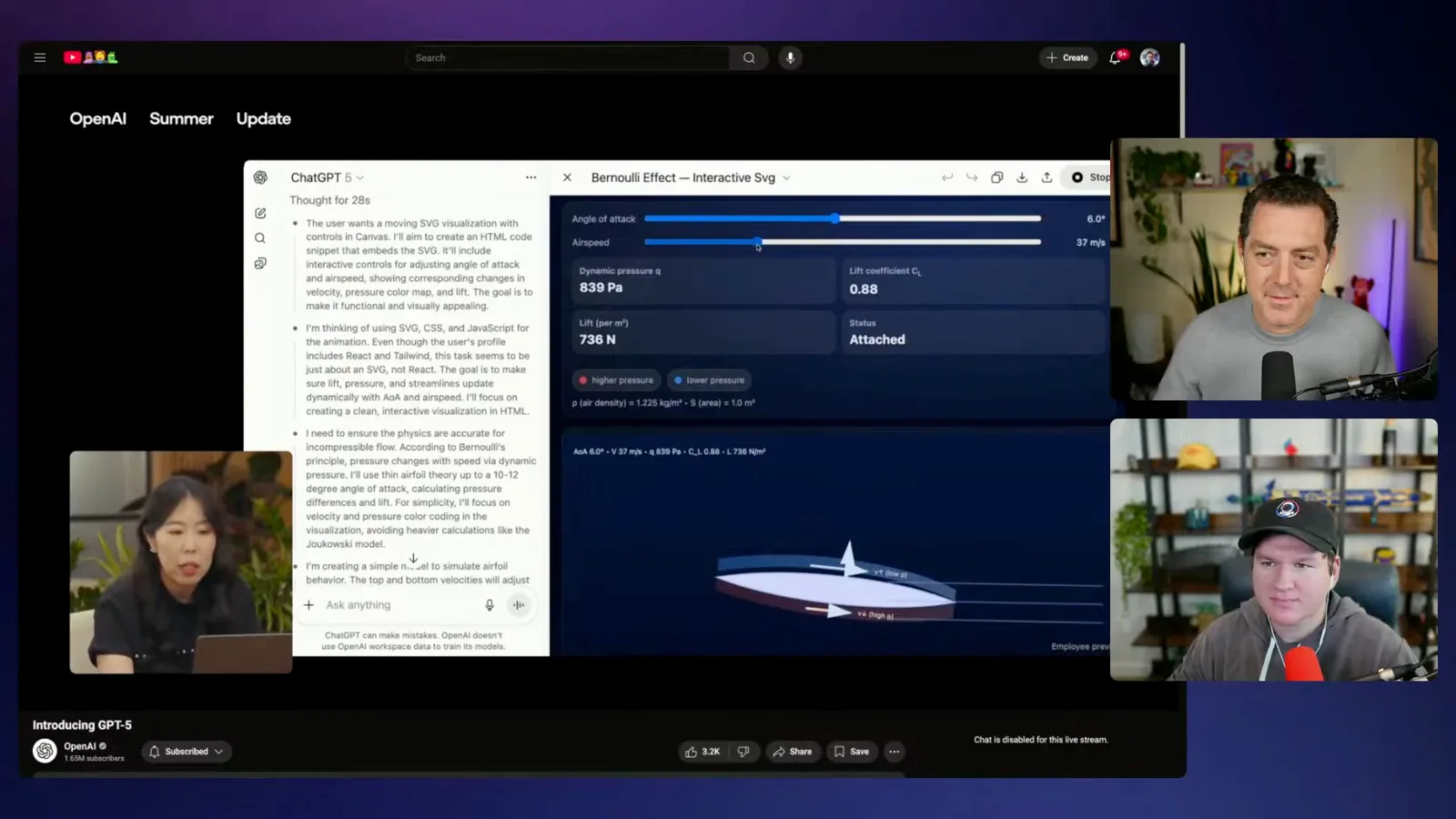
OpenAI begins a learning demonstration with a question about the Bernoulli effect and airplane wings. The presenter says an easy question receives a fast response, then asks for a moving visualization. Routing decisions and a single visual explanation do not guarantee that the resulting physics model is complete or accurate.
The learning prompt asks for a quick explanation of Bernoulli's principle and why airplane wings have their shape. The presenter then requests a moving SVG illustration, giving the model a more involved front-end task than the initial explanation.
The model writes front-end code for an interactive Canvas visualization. The presenter explains that GPT-5 can use additional reasoning automatically or be asked to think harder. Berman reminds viewers that the interface shows a summary of reasoning, not necessarily the raw internal chain of thought.
While the visualization is generated, Christina Kaplan recalls building an early ChatGPT front end and how the team learned about user needs over time. The presenters say the generated app has hundreds of lines of code and show controls for airspeed and angle of attack. It is a launch demo, not an independently validated aerodynamics simulator.
OpenAI's presenter says the visualization can be manipulated to change airspeed and angle of attack. Berman responds to viewer questions about speed and says his own experience suggests the model is fast, while pointing viewers to the later test for details.
Writing and French-learning app
OpenAI compares writing examples and builds a learning app with quizzes and a small game. Berman reacts to the selected demonstrations.
Berman tells viewers he had spent the prior week testing GPT-5 and intends to publish a separate video. OpenAI shifts to writing and asks GPT-4o and GPT-5 for a farewell to earlier models. Kaplan judges the GPT-5 passage more rhythmic and less generic; this is a subjective comparison of examples selected for a launch event.
The writing demonstration asks both models to compose a heartfelt and hopeful eulogy for older ChatGPT models. Kaplan compares their openings and selects phrases she feels are more specific and natural. Her preference is an illustration of style, not an objective literary score.
For the coding demo, an OpenAI presenter asks GPT-5 for a French-learning web app for a partner, with daily progress, flashcards, quizzes and a Snake-style mouse-and-cheese game. The prompt requests a spoken French word when the mouse eats cheese. Berman says he is still testing how the model performs in agentic coding environments.
The French-learning prompt is intentionally detailed: it asks for an engaging theme and multiple activities, plus a voice-over when a mouse eats cheese. The presenter opens multiple model responses to show variation rather than claiming every generation is identical.
The team runs a generated app and tries a flashcard, checks the French answer and watches the progress indicator update. They then play the mouse game and hear a word when the mouse collects cheese. Other generated tabs look different; the presenters acknowledge rough edges and suggest requesting changes.
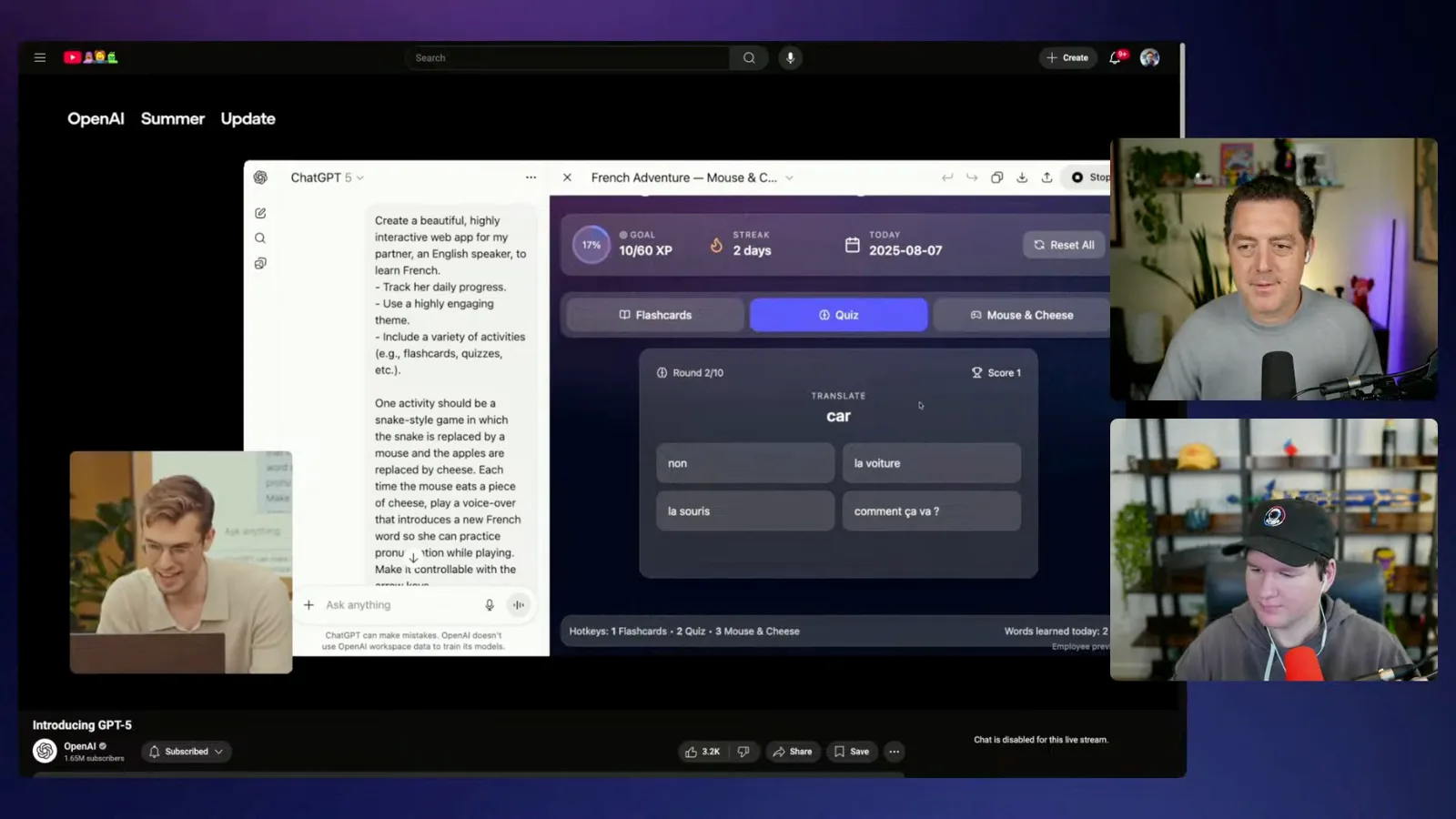
The presenters test alternative app versions and find some visual details less appealing. They say users can request revisions, and joke that GPT-5 often chooses purple. Berman likewise notes recurring front-end patterns in his own tests.
Mark Chen says these demos show progress from small code snippets toward on-demand applications. The company introduces updates to voice and personalization. A successful short demonstration does not establish that all generated code is secure, correct or ready for production.
Voice, personalization and safety
Presenters show voice practice and connected personal information, then discuss safe completions and synthetic training data. The features and risk claims have limits.
OpenAI's voice presenter describes more natural speech, video input and translation, and announces expanded voice access. A demo asks for one-word replies: the model summarizes Pride and Prejudice as ‘relationships’ and offers ‘patience’ as advice. Launch-day access and limits may have changed.
The voice demonstration begins with a constraint to answer in one word. The model follows that instruction for a literature question and a request for wisdom, showing the type of response-length control the presenters want to highlight.
The presenter then uses a Korean café role-play in study mode, asking how to order an Americano and requesting slower and faster speech. Berman says he uses voice often but had not yet tested this update. The example illustrates a practice interaction, not a formal assessment of language instruction.
The Korean exercise shifts from a normal speaking speed to a slower one for a beginner and then a much faster one. The host is interested in the potential for language practice and says he uses voice mode regularly.
OpenAI previews chat color options and selectable personalities, including supportive and sarcastic styles. The presenters frame personalization as making the assistant fit an individual's communication style, not as evidence that it has a human personality.
Kaplan describes memory and a planned Gmail and Google Calendar connection, beginning with Pro and later expanding to other paid and organization tiers. She asks for a schedule and shows the assistant finding time for a run, an unanswered email and a packing list. Such access requires a user to connect and authorize the services; the result remains subject to review.
Kaplan says she is training for a marathon and previously used ChatGPT to plan runs, but it lacked her actual schedule. After linking Gmail and Calendar, she asks for a plan for the next day, illustrating how connected data could personalize the answer.
Safety training lead Saachi Jain says GPT-5 is less likely than earlier models to misrepresent actions or claim a task succeeded when it did not. She describes this as an evaluation result, not a guarantee. The team introduces ‘safe completions,’ intended to provide useful high-level assistance within safety limits rather than always fully complying or refusing.
Jain illustrates a dual-use request involving fireworks materials. She says earlier behavior varied with framing, while GPT-5 gives safety guidance and directs the user to appropriate documentation instead of supplying hazardous operational detail. Berman reacts critically, but a refusal to provide dangerous detail is not itself a model safety failure.
The safety team says a sensitive request can have legitimate or harmful uses, and that prior systems sometimes behaved differently depending on how it was phrased. Its proposed approach is to give a safe, useful answer where possible and explain refusals where necessary.
Sebastien Bubeck describes using o3 to produce a synthetic curriculum for GPT-5 and presents this as one model generation helping train the next. He suggests this could foreshadow future self-improvement. The described training process involves a human-led research pipeline; it does not establish a fully autonomous runaway loop.
Health testimonial
Karolina and Felipe Millon describe using ChatGPT during cancer care alongside physicians. OpenAI presents HealthBench results as its own evaluation.
The presentation turns to health. Altman says GPT-5 improved on OpenAI's HealthBench, which the company developed with physician input, and introduces OpenAI employee Felipe Millon and his wife Karolina. Benchmark results and a launch-stage testimonial are not substitutes for clinical validation or individualized medical advice.
Karolina recounts receiving several cancer diagnoses and opening a biopsy report filled with unfamiliar medical terms. She says she uploaded a screenshot to ChatGPT, which translated the report into language she could understand before she spoke with her doctor several hours later. The account is her experience, not proof that a model can diagnose reliably.
Karolina describes seeing an unfamiliar biopsy term before she could speak with a doctor. She says a plain-language explanation helped her enter that later conversation with a better baseline understanding of the report.
She describes facing a treatment decision about radiation when specialists disagreed, and says ChatGPT helped her understand the arguments and weigh risks and benefits. Her doctors were part of the decision process. AI-generated health information can be incomplete or wrong, so a personal account should not be read as a recommendation to replace medical professionals.
She says the assistant provided a more detailed breakdown than could fit into a short appointment and helped her prepare for a difficult decision. The account reflects one patient's experience and does not verify that every output or treatment recommendation was correct.
Millon says he valued seeing Karolina regain a sense of agency and participate in care decisions. Both frame the potential of AI as helping patients ask better questions and understand their options. They stress the human context and the difficulty of navigating decisions after a diagnosis.
After trying GPT-5, the couple say its response to the original biopsy prompt appeared faster and more contextual, suggesting follow-up questions and pending results to discuss with clinicians. This is their reported comparison of particular responses, not a controlled medical study.
Developer models and benchmarks
OpenAI explains API model sizes, controls, tool use and context. Reported scores are tied to specific benchmark settings.
OpenAI president Greg Brockman takes the stage and recalls an early coding-model demo in 2021. He says GPT-5 is designed for agentic coding, including using tools over longer tasks, following instructions and building front-end applications. His description of it as the best is a vendor claim.
Brockman describes the appeal of expressing an idea in ordinary language and having software help turn it into an application. He frames GPT-5's coding work as an extension of that earlier promise and introduces the developer API team.
Michelle Pokrass introduces GPT-5, mini and nano in the API as different cost and latency choices. She describes a minimal reasoning-effort setting for latency-sensitive applications, as well as custom tools that can accept free-form text instead of requiring all arguments in JSON.
Pokrass says developers can constrain outputs using regular expressions or context-free grammars, useful for domain-specific formats. She also introduces tool-call preambles, which can describe intended actions, and a verbosity setting for shorter or longer answers. These are launch features; exact interfaces can change.
Pokrass explains that long code or other free-form arguments can be awkward to escape in JSON. Custom tools allow plain-text inputs, while optional grammar constraints are intended to help developers enforce a desired syntax.
OpenAI reports 74.9% on SWE-bench Verified versus 69.1% for o3, and 88% on Aider Polyglot. In its own preference test, evaluators favored GPT-5 over o3 on front-end examples 70% of the time. These are company-reported tests with specific setups, not a comparison with every competing model or a guarantee on a user's codebase.
Pokrass cites roughly 97% on the telecom portion of τ²-bench and describes an instruction-following evaluation, including an internal hard subset at 64% versus 47% for o3. The [developer launch page](https://openai.com/index/introducing-gpt-5-for-developers/) reports 96.7% for the telecom result. Berman notes that the presentation is not comparing every result against competitors.
The API presentation lists a 400,000-token total context window and discusses long-context retrieval and reasoning evaluations, including MRCR and a new BrowseComp long-context test. A large context limit does not mean the model will use every detail correctly; the reported scores are tied to particular tests.
The presenters distinguish a larger context limit from the ability to retrieve and reason accurately over that context. They say they are releasing a long-context evaluation to encourage further research, a claim about the test rather than a guarantee on all documents.
Brockman says that as some benchmarks approach saturation, it becomes harder to distinguish progress by small score differences, and the team emphasizes real workflows. Berman notes that the presentation has said little about image generation, while acknowledging that the product has image features.
Coding and front-end demonstrations
The team shows a Cursor bug task, a finance dashboard and a prepared castle game. Each is a selected example rather than a production guarantee.
Brian Fioca and Adi Ganesh show GPT-5 in Cursor on a bug Fioca says an earlier o3 attempt did not fix. The emphasis is on how the agent communicates a plan, searches the codebase and keeps the user informed. A demonstration of one bug is not a broad reliability estimate.
In the Cursor demonstration, the agent tells the user what it plans to search before it acts. The presenters say this makes it easier for a developer to redirect the work; a progress message is useful visibility but is not a substitute for checking the result.
The presenters describe training for autonomy, collaboration, communication, context management and testing, based on developer feedback. Fioca also recounts a separate example where the model refactored a test harness for parallel Docker execution and, he says, it ran on the first try after about 45 minutes.
In the live bug task, the presenters say the agent edits code, recognizes unrelated lint findings and proceeds toward a build and available tests. They value its progress updates and explain that system instructions, Cursor rules, verbosity and reasoning settings can steer its work. The demonstration does not itself certify the fix for production.
Fioca says the model's behavior can be tuned through instructions and rules, and describes using it to revise prompts. Berman remarks on the presenters' delivery while the team characterizes the coding example as a collaborative workflow.
Ganesh starts a second coding example: a finance dashboard for a startup CFO. The prompt asks for an interactive visual hierarchy and specifies a framework. The agent scaffolds a Next.js application with Tailwind, installs dependencies and begins creating components while the presenters discuss aesthetic defaults and steerability.
The team says it trained the model to balance following a precise layout with making sensible design choices from a short request. They describe long chains of tool use and a desire for ambition without going off task. These are the designers' goals and observations, rather than a guarantee that an agent will always remain on track.
As the dashboard develops, the presenters point out a README, modular chart components and sample data. They describe testing design choices with human designers and say the model is better at typography, spacing and color. The assessment of aesthetics is subjective and the demo uses sample data.
Ganesh and her colleague say their team assessed interface details with designer input and aimed to improve defaults for color, spacing and typography. The live example uses a short prompt, but the presentation is a curated demonstration rather than a representative sample of every output.
The agent runs a build, sees an error and revises its own code. The presenters call this an iterative development loop: a tool-enabled model can run a check and respond to the result. That should not be confused with a system autonomously retraining or improving its own model weights.
Ganesh follows the generated instructions to start the application locally and opens a dashboard with charts, customer segmentation and a date filter. Berman says he obtained a similar financial dashboard in his own tests. The launch demo shows a working interface, not a validated financial analysis or production audit.
The generated dashboard presents financial metrics and an interactive chart; a date picker and customer segmentation are shown. Berman remarks that his own earlier test produced a similar design, which is an observation rather than evidence of identical code or correctness.
For a playful second example, Ganesh asks for a 3D castle with moving figures, horses and a balloon-popping game with sound. To save time, she shows a previously generated version. The presenters explore the castle, interact with named characters and fire at balloons; they do not claim this particular displayed version was generated live at that moment.
The prepared castle includes animated elements, a merchant and a named character. The presenters try the balloon game and hear a sound when a target is hit. It is a visual and interaction demo, not a complete assessment of gameplay or underlying implementation.
Cursor, enterprise and closing
Michael Truell discusses an SDK issue and Cursor integration. OpenAI presents customer examples and closes the event; Berman wraps up the watch party.
The presenters celebrate the creative possibilities of building games from short prompts, then introduce Cursor co-founder and CEO Michael Truell. He appears as a launch partner, so his account is informed by product testing but is also promotional.
Truell says his team first asked GPT-5 to find something non-obvious about its codebase. He reports that it identified a remote-execution architecture decision and its security rationale, which he says had taken people weeks to reason through. This is a partner anecdote, not an independently measured comparison of equal tasks.
Truell values speed, breaking work into visible subproblems and the ability to respond to corrections across a long session. He and Brockman open an issue concerning PDF uploads in the OpenAI Python SDK and paste it into Cursor to see how GPT-5 investigates it.
The agent reads files, searches the codebase and begins proposing changes with Cursor's tools. Truell advises new users to start with scoped real tasks and work synchronously with the model. Berman wonders why OpenAI is highlighting Cursor alongside its own Codex product.
Truell says an agent can be useful across multiple turns, including revising an earlier approach when the user provides feedback. The SDK example uses custom tools to read web text and search files, so its result reflects the model working within a particular tool environment.
Asked what GPT-5 still cannot do, Truell wants better computer-use capabilities so an agent could run a dashboard, inspect its visual output and perform more quality assurance. Brockman anticipates longer-running work extending beyond the brief demos; that is a future aspiration, not a capability established by this session.
The SDK demo reaches code changes that the presenters say look roughly correct and propose reviewing a pull request after the show. Truell announces a launch-period Cursor trial and calls GPT-5 the smartest coding model his team had tried. The video does not show a merged fix or an independent test of its correctness.
OpenAI platform lead Olivier Godement shifts to enterprise, saying five million businesses had used the company's technology. He presents early customer accounts from Amgen in life sciences, BBVA in financial analysis and Oscar in medical policy reasoning. These are company and customer claims; the stream does not provide the full study designs needed to verify comparisons or establish clinical safety.
Godement attributes reported improvements in scientific literature analysis, financial research and clinical-policy mapping to early partners. The statements are launch testimonials, with limited detail about baselines, error rates and independent verification.
Godement says a US government agreement would make GPT-5 available to federal employees and reiterates the GPT-5, mini and nano API lineup. The quoted launch prices are $1.25 per million input tokens and $10 per million output tokens for GPT-5, with smaller models cheaper. The prices, rollout and usage terms are historical.
Chief scientist Jakub Pachocki closes the OpenAI presentation by thanking the research and engineering teams. He describes GPT-5 as the product of years spent understanding and steering deep learning, and says further research is needed. He expresses hope that future AI will help generate knowledge and improve lives.
Pachocki says the release contains early glimpses of ideas that researchers believe can go further, while recognizing that much remains to be understood about deep learning. The presentation ends with a statement of the team's hopes rather than a new benchmark.
Back in the watch party, Berman says his separate 30-plus-minute GPT-5 test is already published and that an interview with Mark Chen and an overview are planned. He thanks producer Alex and the audience before closing. No paid sponsor read is identified in this stream.
Más de este canal
 34:21EN
 Matthew Berman· 27 oct 2026Matthew Berman Examines Anthropic’s IPO Filing, AI Growth and GovernanceMatthew Berman, Sam Altman · Forward FutureThe presenter reviews the S-1’s financial metrics, compute strategy and voting structure while questioning the tension between rapid AI development and safety.
 0:26ENMatthew Berman· 25 oct 2026Sam Altman on Human Values and Problem-Solving in an AI WorldSam Altman · OpenAIIn a short interview excerpt, Altman considers the enjoyment of solving hard problems and the human role in interpreting results.
 0:36ENMatthew Berman· 25 oct 2026Kimi K3.1 and a Rubik’s Cube Solver DemonstrationMatthew Berman · Forward FutureMatthew Berman shows a scrambled virtual cube being solved and gives the Kimi K3.1 test a favorable assessment.
 0:21ENMatthew Berman· 24 oct 2026An AI-Generated Kimi Benchmark Chart Used Invented ScoresMatthew Berman · Forward FutureMatthew Berman asks for a graph of Kimi K3.1 Pro benchmarks, then discovers that the displayed figures are illustrative placeholders.
 25:50ENMatthew Berman· 24 oct 2026Kimi K3.1 Pro Tested: Strong 3D Demos, Uneven Results and Competitive PricingMatthew Berman · Forward FutureMatthew Berman tests the open-weight model on coding, 3D rendering and visual explanations, then compares benchmark results and prices.
 32:20ENMatthew Berman· 23 oct 2026Who Is Local AI For? The Costs, Trade-offs and a Hybrid FutureMatthew Berman · Forward FutureMatthew Berman weighs data control and independence against hardware cost, setup complexity and inference speed.