En 30 segundos
In this September 12, 2025 Forward Future Live episode, Matthew Berman reviews AI news and interviews Browserbase CEO Paul Klein about web agents, signed requests, evaluation and the future of browsing. Later, Untapped Capital’s Yohei Nakajima discusses AI-native investing, creative tools, children and technology, and the role of human taste. Dylan Patel was announced but did not join the interview and was rescheduled. News claims, rankings and guests’ predictions reflect the date and context of the broadcast; Zapier is described as a show partner.
- 1AI infrastructure newsBerman discusses a reported Oracle–OpenAI deal, an OpenAI–Microsoft memorandum and new open-weight models; these are 2025-era reports and claims.
- 2Agents browsing on a user’s behalfKlein explains Browserbase and Stagehand and sees current opportunities in repetitive enterprise browsing.
- 3Signed requests and privacyKlein describes opt-in signed agents while acknowledging concerns about tracking and the need for website owners to choose their own policies.
- 4A mixture of fixed steps and AIStagehand can break a shopping task into individual natural-language actions instead of giving an agent a single unrestricted objective.
- 5Evaluate the actual taskKlein says published browser benchmarks are a starting point and results depend on page complexity and infrastructure.
- 6Investing and AI-native workNakajima describes pre-seed investing, generative media experiments and reinforcement-learning environments.
- 7Human taste and AI ideasNakajima favors using AI to expand ideas while people decide which directions to pursue.
Conclusiones
- Signed agent requests can help identify automated traffic but do not themselves guarantee good behavior or eliminate privacy trade-offs.
- Klein advocates combining explicit workflow steps with model-driven browser actions and testing on the actual target task.
- Published web-agent benchmark scores depend on the tasks, model and browser infrastructure used.
- Nakajima sees opportunities in AI tools and early-stage startups but treats one-person unicorns and rapid growth as uncertain.
- For children, Nakajima emphasizes playful supervised exposure alongside time away from screens.
- Nakajima suggests using AI to expand ideas while keeping human judgment in choosing which ones to pursue.
Lee el texto editado por capítulos
AI news and model releases
Berman reviews 2025 infrastructure, model and product announcements. The figures and forecasts belong to the broadcast’s historical context.
Matthew Berman opens the September 12, 2025 livestream with AI news and announces interviews with Browserbase founder Paul Klein, investor Yohei Nakajima and analyst Dylan Patel. Patel does not ultimately appear; Berman says at the end that his interview will be rescheduled. The opening news and all future-oriented statements should be understood in the context of this date.
Berman discusses a press report that Oracle and OpenAI had agreed to a very large cloud-computing deal, with a reported value around $300 billion over time. He is surprised by Oracle's role in AI infrastructure and wonders how the expenditure will be financed. The amount and payment timeline are presented as reported or inferred, not as audited cash already spent.
He turns to ChatGPT developer mode and describes Model Context Protocol connectors that can perform actions as well as retrieve information. Examples include updating tickets and triggering workflows. He identifies Zapier as a partner of the show; connector capabilities and authorization depend on the particular integration and user's permissions.
Berman discusses reports that Microsoft AI CEO Mustafa Suleyman wants to invest further in training the company's own models. He sees in-house capabilities as a way to diversify reliance on external providers, while recognizing that Microsoft and OpenAI remain partners. His preference for more competition is an editorial judgment.
OpenAI and Microsoft announced a non-binding memorandum of understanding and said they were negotiating a definitive agreement. Berman speculates about what it could mean for OpenAI's corporate structure. A contemporaneous OpenAI statement described continued nonprofit control of a planned public-benefit corporation; the brief MOU itself did not establish the broader conclusions he guesses.
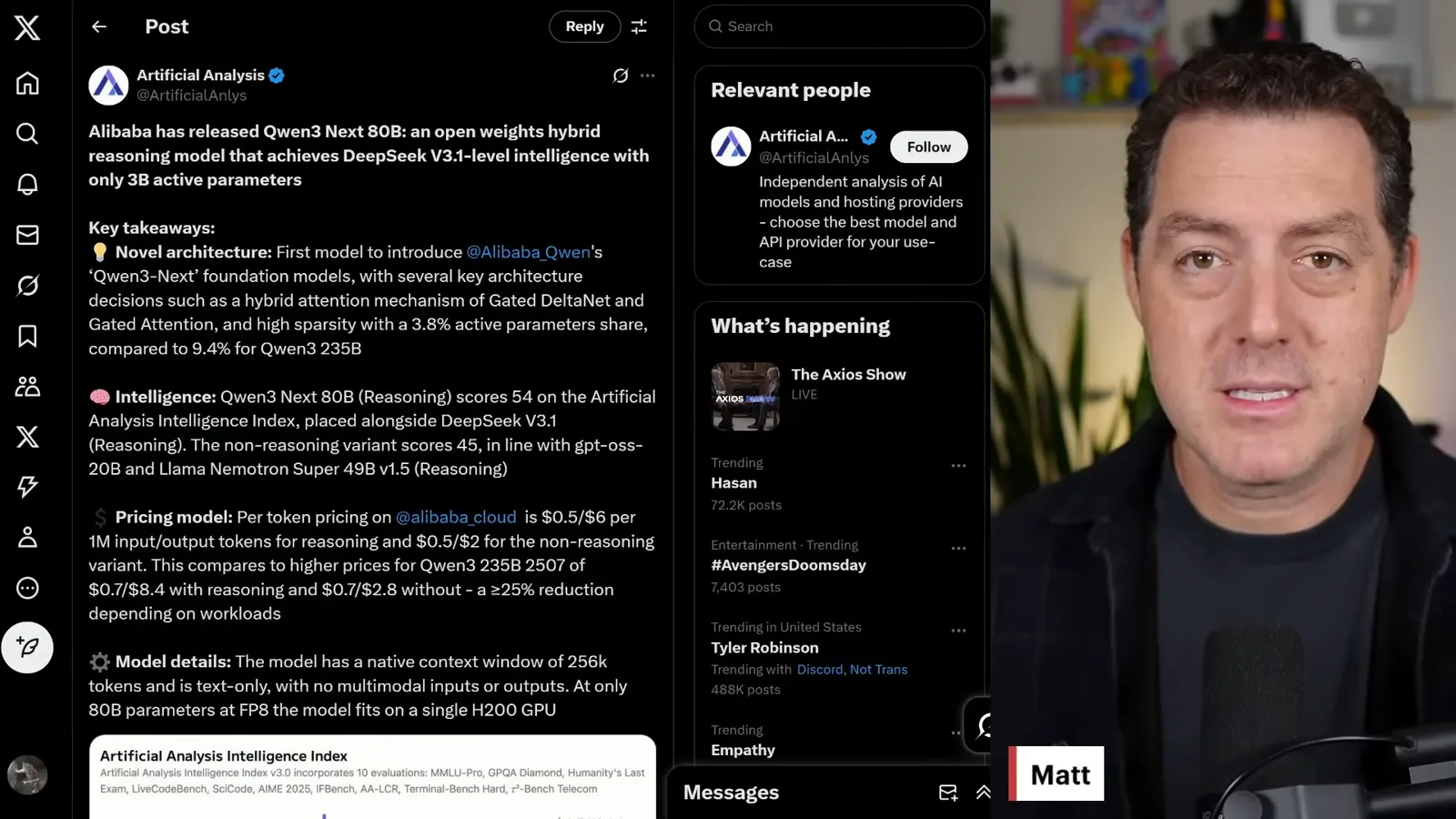
Berman reviews Qwen3-Next, an open-weight mixture-of-experts family. He stresses the difference between total parameters and active parameters: the 80B model activates roughly 3B per token. He cites a third-party intelligence index and price examples, but benchmark rankings and provider prices are time- and configuration-specific, and low active-parameter count alone does not determine memory requirements.
A second model story concerns K2 Think, described in a promotional post as a fast 32B reasoning model. Berman notes that the post's language is hyped and sees smaller models improving as part of an efficiency trend. Claims about being the fastest or matching a larger model need to be tied to particular tests and settings.
Browser agents and signed access
Klein introduces Browserbase and discusses agent access, publisher economics and privacy. Signatures identify traffic but do not by themselves prove intent or prevent misuse.
Klein introduces Browserbase as cloud browser infrastructure for agents: applications can retrieve information, click buttons, fill forms and upload or download files where a website has no convenient API. He also describes Stagehand, an open-source framework using natural-language browser actions, and Director, an agent-building product.
Asked when an agent will become the main interface to the web, Klein says the transition will take time. He sees early customer uses in compliance, finance, procurement and e-commerce, where browsing can augment repetitive work. Examples of future agents using tax or business tools are possibilities, not established product capabilities.
Berman worries that AI-generated noise could make an intermediary agent more valuable, while repeating social-media problems such as filter bubbles. Klein agrees that finding useful information is already difficult and turns to the question of distinguishing useful agents acting for users from abusive automated traffic.
Klein contrasts an assistant performing a single user's task with high-volume bots that hoard reservations or scrape content at scale. He argues that agents need authentication and access mechanisms so sites can understand who is acting and make appropriate decisions. A legitimate user identity is useful context, but it does not prove the intent or safety of every action.
Asked about work with Cloudflare, Klein describes early opt-in signed-agent mechanisms often called Web Bot Auth. A cryptographic signature can identify the origin of a request and help a site apply its own policy even when the visitor is not logged in. Berman asks the critical follow-up: knowing an origin does not automatically prevent that bot from scraping more than a site permits.
Klein uses book research versus mass collection for model training as an illustration of different purposes. He refers to an Anthropic authors' settlement, but his characterization should not be read as a blanket legal finding that all model training is unlawful or that every author would agree with an individual use. The copyright issues and case facts are distinct.
Klein says an infrastructure provider can help customers manage signatures, while a website can observe requests and decide whether to admit or restrict traffic. He compares opt-in signing to a pre-check process. Identity signals can support accountability and rate limits, but cannot by themselves enforce the user's stated intent or assure good conduct.
Berman asks whether publishers could be paid when agents consume content. Klein says Browserbase did not plan to monetize the signing mechanism and that content providers would need to choose their own business models. Berman, as a publisher himself, says direct payment or memberships could be alternatives if fewer people see advertising.
They discuss criticism of the Browserbase–Cloudflare collaboration. Klein says he comes from a security and privacy background and regards widespread tracking as a serious concern. His position is that signed agents should be optional and intended for automated browsing, not a requirement that ordinary people identify themselves on every website.
Klein explains that an optional signed request can provide an additional identity signal beyond changing IP addresses and user-agent strings. That may help a site assess traffic across requests, but also creates linkability and privacy questions. He explicitly opposes making signed identity compulsory for all human browsing.
Browser reliability and model choices
Klein explains Stagehand’s stepwise approach and evaluation. He discusses speed, cost, model independence and future browser interfaces.
On reliability, Klein says web tasks can require many steps and still fail. Stagehand tries to improve the information supplied to a model, for example using an accessibility tree rather than dumping an entire page's HTML. He says the framework incorporates research and model updates, a product claim rather than proof that every site will work reliably.
Klein says Browserbase publishes Stagehand evaluations comparing model accuracy, speed and cost on web interactions. He is optimistic that browser use will improve over the following six months, but that is a September 2025 forecast. A leaderboard can help engineers choose where to start; it is not a substitute for evaluating their own applications.
Berman asks how Stagehand balances deterministic and model-driven behavior. Klein uses a brownie-purchase example: a single broad instruction asks an agent to remember product, price and address through a long sequence. A developer can instead break the workflow into explicit steps—find a product, add it to a cart and proceed to shipping—and stop if a required item is unavailable.
The individual steps can still use natural language, making them flexible about page layout while retaining a fixed sequence. Klein names Stagehand's act, extract and observe operations and describes a reasoning agent delegating narrower browser actions. The exact tool interfaces and model choices can evolve, and the approach does not eliminate the need for authorization or validation.
Klein mentions Gemini 2.5 Pro as strong in the company's then-current evaluation, but refuses to name one universally best model. A simple classifieds page and a more complex travel site may need different trade-offs. He recommends measuring each model against the actual pages, actions and quality requirements a team cares about.

The shown leaderboard places a model near 90% on Browserbase's own evaluation. Klein explains that the tests focus on web elements such as date pickers and dropdowns and whether steps are performed correctly; they are not primarily tests of general reasoning. The same model can produce different results on different browser infrastructure or page conditions.
Berman asks whether the remaining gap implies benchmark saturation. Klein says he wants harder and more comprehensive evaluations and points to the variety of controls used across real websites. A high score on the displayed suite is therefore a measurement of that suite, not 90% reliability on all web tasks.
They compare accuracy, latency and cost. Klein says his customers' priorities differ: high-volume workflows may emphasize cost, while high-value tasks may pay more for speed, with accuracy as a starting requirement. Berman says he personally values responsiveness highly, even when others might make a different trade-off.
Asked about dependence on frontier labs, Klein positions Browserbase as model-agnostic infrastructure. He says customers can bring and switch models through Stagehand instead of committing every workflow to one provider. That is his company's strategy and does not eliminate all infrastructure, service or model-vendor risks.
Klein suggests a system may use a stronger reasoning model for the overall task and a different model for individual browser actions, potentially selecting by page complexity. His point is that one model need not perform every role. The right architecture still depends on cost, latency, security and measured task performance.
On new consumer browsers, Klein clarifies that Browserbase is an infrastructure company using Chromium, not The Browser Company and not the business acquired by Atlassian. He expects changing users' browser habits to take time and prefers an interface where an application dispatches an agent to perform background work.
Berman expects browser interfaces to change substantially. Klein thinks enjoyable browsing, such as shopping for shoes, can remain human-driven while tedious administrative tasks move to agents. He sees browsers continuing as a bridge to existing websites even if the agent is launched from a different app; these are their predictions.
More news and audience questions
Berman considers AI in government, team memory, robot predictions and funding. He responds to audience questions while a guest is delayed.
After Klein leaves, Berman returns to news. He discusses Albania's announcement of an AI-generated procurement minister and welcomes experimentation while warning that AI systems can be manipulated or attacked. A digital system's resistance to ordinary bribery does not by itself prove procurement is incorruptible or remove the need for human accountability.
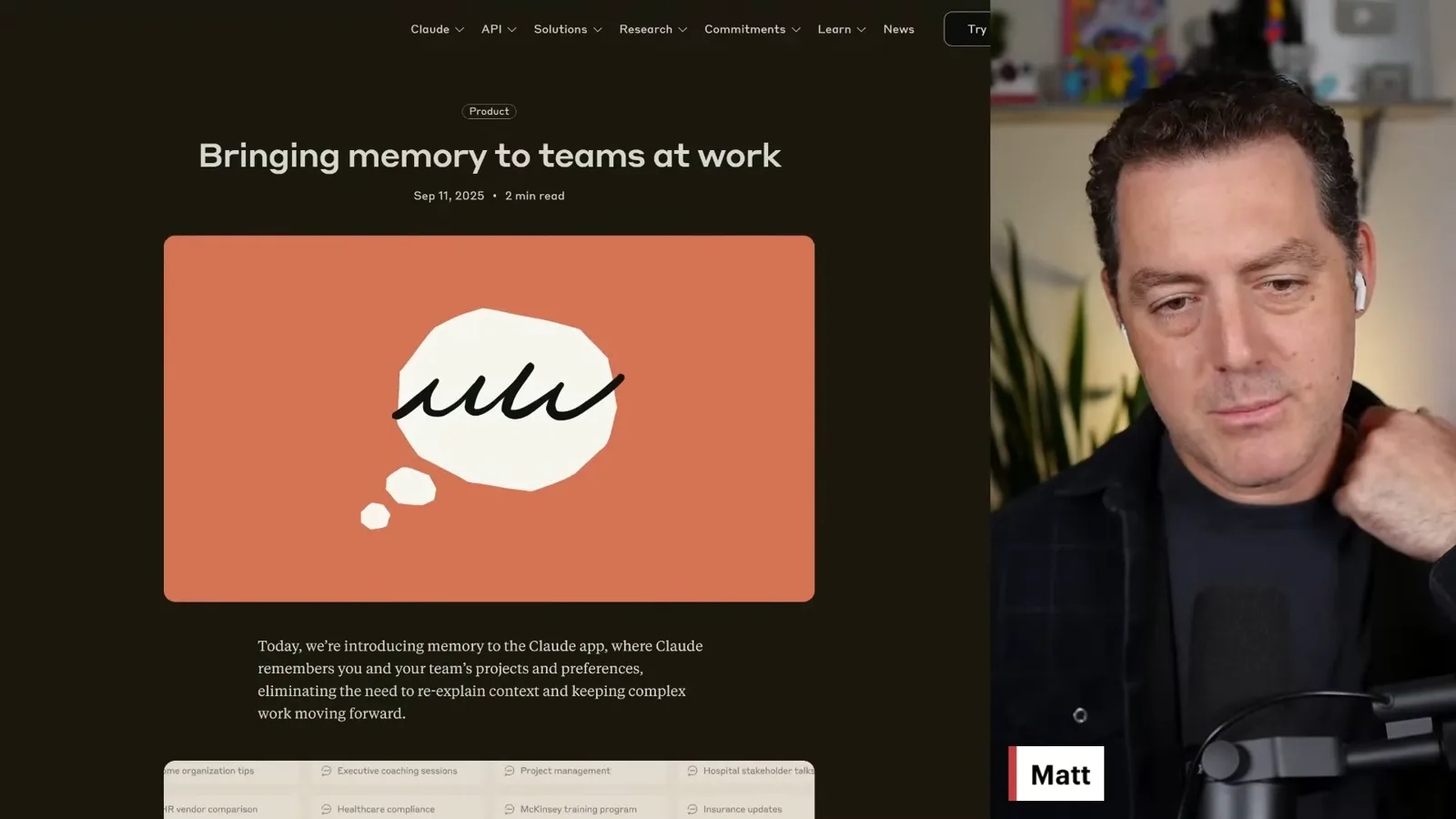
Anthropic announced optional memory for work teams. Berman considers the practical boundary between an individual's preferences, shared project context and an employer's information, including what happens when someone leaves a company. He describes controls and temporary chats from the announcement, while acknowledging that the details of what is shared require careful configuration.
The next story cites a robotics researcher's prediction that household robots could become highly capable within five years. Berman is more cautious about widespread adoption and guesses a longer horizon, though he would personally welcome help with dishes. Demonstrations of specific tasks and a researcher's timetable are not proof of autonomous operation in most households.
Berman mentions a reported $50 million raise by generative-media company Higgsfield and an associated venture initiative. He welcomes competition but offers no independent assessment of its financing or products. The planned interview with Dylan Patel is delayed and eventually rescheduled, so no views are attributed to Patel in this episode.
While waiting, Berman answers whether language-model progress has peaked. He does not think so and predicts continuing innovation, while noting that familiarization can make new advances feel less surprising. This is his outlook, not a measured forecast of the future rate of progress.
Returning to Qwen3-Next, he is interested in the open-weight model's sparse architecture and possible local inference with Apple's MLX. Active parameters alone do not establish that a particular machine can load or run the full weights efficiently. Asked about Seedream 4.0, he says his team has tested it but he has not personally done so, and he is uncertain about consistency.
Creative tools and early-stage investing
Nakajima discusses generative media, reinforcement-learning environments and the economics of AI startups. His comments are personal observations and forecasts.
Nakajima joins early after the schedule changes. He describes Untapped Capital as a pre-seed venture firm and himself as a generalist who goes deep on whichever subject currently interests him. In September 2025, AI is the area receiving much of that attention.
For his own experiments, Nakajima has been using generative video tools. He describes making a small advertisement with Runway and taking pictures of toys with his children, turning scenes into short clips and editing them into a narrative. He uses these examples to illustrate experimentation, not to measure comparative model quality.
They distinguish image generation from image-to-video workflows. Berman notes that some people create a frame with an image model and animate it with a separate tool; Nakajima says his family used photographs of toys as the starting images. Their model names and product availability reflect the time of the conversation.
Nakajima says he has also been exploring a new user-interface idea and may release it later. On investing, he hears significant interest in reinforcement-learning environments and tools that make agents more useful. He explicitly says model training is not his own technical specialty, so his explanation is an informal overview.
He describes an RL environment as a place where an agent can try actions and receive feedback or rewards, producing information useful for improving behavior. Agent trajectories can involve tool choice and multiple decisions rather than a single chat response. In practice, training algorithms and reward design vary; simply retaining good actions and discarding bad ones is an illustrative simplification.
Berman asks whether startups need less capital and whether a solo founder could build a billion-dollar company. Nakajima says a one-person unicorn is hypothetically possible but questions whether it should be the goal, adding that he would prefer AI to expand opportunities broadly. Neither participant presents a demonstrated timeline for such an outcome.
Nakajima observes that founders can often build prototypes and reach customers with fewer resources, changing what he expects even at pre-seed. He cites an approximate increase in Series A revenue expectations as an impression from industry data, not a verified universal threshold. The appropriate amount of capital still depends on the business and its stage.
Berman sees some companies raising large rounds at high valuations before substantial traction, while others have significant revenue. Nakajima says startup valuations have always varied and believes the range has widened as some companies grow quickly. He also distinguishes his pre-seed vantage point from the detailed financial data available to later-stage investors.
They joke about fast-growing AI revenue accompanied by a large model-provider bill. Nakajima says venture funding subsidizing growth is not new, but AI can make the cycle happen faster. He cautions that attention and first-mover distribution can help without guaranteeing that the earliest company wins.
Location, children and human taste
The discussion turns to San Francisco and Seattle, children’s supervised AI use and creative judgment. Nakajima closes with views on AI-native games and investment opportunities.
Berman asks whether AI founders must move to San Francisco. Nakajima says being there can provide access to developers and frequent in-person conversations, but it is not mandatory. The value depends on a company's buyers, the founder's network and ability to visit or connect online.
For a developer-tool company, the concentration of technical peers may be particularly useful; for a vertical application serving construction, customers may be elsewhere. Nakajima, who is based in Seattle, says an online presence can also create connections with people who assume he is in the Bay Area.
Asked about Seattle, Nakajima describes a renewed sense of AI activity and points to talent from AI2, Microsoft and Amazon. He contrasts the city's culture with San Francisco's dense startup network, while avoiding a claim that the two ecosystems are directly equivalent. These are his observations rather than a systematic regional comparison.
Berman turns to children and the tension between limiting screen time and introducing new tools. Nakajima says his three children see him using computers, but he also encourages outdoor play and crafts. His approach is to help them understand what AI can do through playful, supervised activities.
He describes family sessions in which each child suggests a theme and DALL·E combines them into an image, and similar experiments with music generation. Recently they have used toy photographs and video generation. For now, Nakajima acts as the intermediary rather than handing children unrestricted access to a general chatbot.
On schools, both men emphasize balance. Nakajima compares learning with AI to earlier experiences using calculators or computers: technology can build confidence when a child explores and sometimes surpasses the teacher. He also recognizes differences among schools and does not offer a single prescription for every classroom.
Asked what skills children will need, Nakajima focuses less on one fixed technique than on curiosity about what tools can and cannot do. He recalls that effective web search once required knowing both how to ask and what information a search engine might contain. He expects similar exploratory habits to matter as AI capabilities change.
Berman asks about taste: the ability to shape AI output into an experience other people value. Nakajima sees taste partly as self-discovery, influenced by art, music, movies, friends and personal identity. There is not one universally correct taste to teach.
Nakajima distinguishes divergent thinking—generating many possible ideas—from convergent thinking, selecting and refining a direction. He finds AI useful for expanding options but worries that delegating every choice to similar models could homogenize taste. His practical suggestion is to use AI for exploration while retaining personal judgment over what to pursue.
Returning to investment opportunities, Nakajima is interested in entertainment and intellectual property native to generative AI. He compares earlier shifts in social and mobile gaming, where new companies built for the platform alongside incumbents. His expectation of future AI-native winners is a thesis, not an identified investment result.
For a possible new game mechanic, he describes a project in which a human interacts with AI characters and tries to obtain a code without being detected. The idea resembles a social-deduction game with AI participants. Both guests treat it as an example of experimentation rather than a proven commercial category.
Nakajima also sees a seed of possibility in generative worlds such as Genie 3, though he says the gameplay has not yet clicked for him. Berman is cautious about the timeline. They agree that the interesting question is whether a future game can combine the technology with a compelling mechanic.
Nakajima says founders can reach him through X, email or introductions. Berman thanks Klein and Nakajima and explains that Patel's interview will be rescheduled. The livestream ends after the two completed interviews; no chip-race interview with Patel occurs in this recording.
Más de este canal
 34:21EN
 Matthew Berman· 27 oct 2026Matthew Berman Examines Anthropic’s IPO Filing, AI Growth and GovernanceMatthew Berman, Sam Altman · Forward FutureThe presenter reviews the S-1’s financial metrics, compute strategy and voting structure while questioning the tension between rapid AI development and safety.
 0:26ENMatthew Berman· 25 oct 2026Sam Altman on Human Values and Problem-Solving in an AI WorldSam Altman · OpenAIIn a short interview excerpt, Altman considers the enjoyment of solving hard problems and the human role in interpreting results.
 0:36ENMatthew Berman· 25 oct 2026Kimi K3.1 and a Rubik’s Cube Solver DemonstrationMatthew Berman · Forward FutureMatthew Berman shows a scrambled virtual cube being solved and gives the Kimi K3.1 test a favorable assessment.
 0:21ENMatthew Berman· 24 oct 2026An AI-Generated Kimi Benchmark Chart Used Invented ScoresMatthew Berman · Forward FutureMatthew Berman asks for a graph of Kimi K3.1 Pro benchmarks, then discovers that the displayed figures are illustrative placeholders.
 25:50ENMatthew Berman· 24 oct 2026Kimi K3.1 Pro Tested: Strong 3D Demos, Uneven Results and Competitive PricingMatthew Berman · Forward FutureMatthew Berman tests the open-weight model on coding, 3D rendering and visual explanations, then compares benchmark results and prices.
 32:20ENMatthew Berman· 23 oct 2026Who Is Local AI For? The Costs, Trade-offs and a Hybrid FutureMatthew Berman · Forward FutureMatthew Berman weighs data control and independence against hardware cost, setup complexity and inference speed.